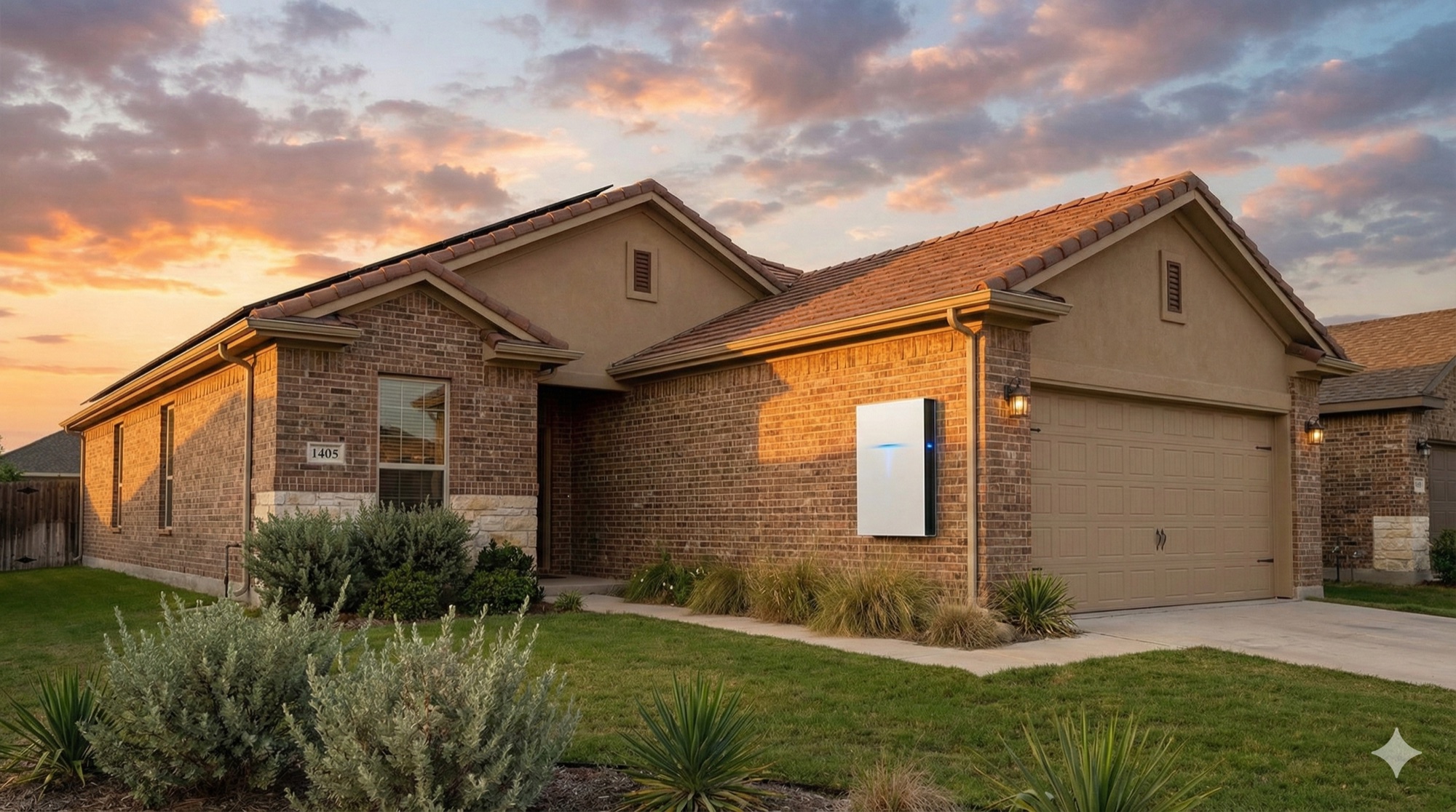
Updated November 2026 with EnergySage's 2026 Texas prices, Austin Energy's current battery program and the end of the federal homeowner credit. Every price below is shown without the federal credit.
A whole house battery backup system in Texas costs about $14,300 for 13.5 kWh of storage before incentives, based on EnergySage's average of $1,059 per kWh for Texas installs in the first half of 2026. Covering central air through a long outage often takes two or three batteries, which puts many homes between about $28,600 and $42,900.
The biggest change from last year is the tax picture. The 30% federal Residential Clean Energy Credit isn't available for a battery installed after December 31, 2025, so unless a local utility program applies, the price you're quoted today is close to the price you'll pay. This guide covers current Texas costs, what drives a quote up or down, how to size a system, and which incentives still apply in 2026.
EnergySage tracks real installer quotes on its marketplace. In its July 13, 2026 update, covering quotes from the first half of 2026, EnergySage reports that:
Here's what that Texas average works out to at common system sizes:
| System Size | Typical Setup | Estimated Installed Cost (Before Incentives) |
|---|---|---|
| 10 kWh | One smaller battery, essentials only | About $10,600 |
| 13.5 kWh | One Tesla Powerwall 3 or similar | About $14,300 |
| 20 kWh | Essentials plus a few large loads | About $21,200 |
| 27 kWh | Two batteries, partial whole home | About $28,600 |
| 40.5 kWh | Three batteries, whole home with AC | About $42,900 |
For a deeper look at per-kWh pricing and what a battery costs over its whole life, see the full breakdown of battery storage cost per kWh.
EnergySage names the equipment itself as the most significant cost factor in a battery installation. Equipment typically makes up 50 to 60 percent of the price, and labor and project planning make up most of the rest. After that, a handful of site details decide whether your quote lands near the average or well above it.
The number of kilowatt-hours you buy sets most of the bill. Every added battery raises the total, so deciding how much of your home you really need to back up is the most useful cost decision you'll make.
Whole home backup often means new backup equipment between the battery and your main panel, and an older or full panel may need an upgrade before an installer can tie the system in. Ask every installer to list panel work as its own line so you can compare quotes fairly.
Garage walls are usually the simplest install. An outdoor location far from the panel, trenching, or a tight utility room can add labor. In Texas, shade matters too. Tesla's Powerwall 3 datasheet notes that performance may be de-rated at operating temperatures above 104°F, so a battery baking on a west-facing wall can deliver less power on the hottest afternoons.
A battery added to an existing solar system has to work with the inverter you already own. Some batteries include their own inverter, and others need a compatible one. A new solar and battery install designed together is often simpler to price.
Your city sets permit requirements and fees. If your battery or solar can send power to the grid, the local utility that owns the poles and wires also has to approve the interconnection. In most of the competitive Texas market, that's Oncor, CenterPoint Energy, AEP Texas or TNMP.
These are EnergySage's averages for the most quoted batteries on its marketplace in the first half of 2026, before any incentives.
| Brand | Average Cost per kWh | Typical Size | Typical Cost |
|---|---|---|---|
| Tesla | $967 | 13.5 kWh | $13,055 |
| Sigenergy | $1,028 | 15.4 kWh | $15,831 |
| EG4 | $1,149 | 12.9 kWh | $14,822 |
| FranklinWH | $1,232 | 15 kWh | $18,480 |
| EcoFlow | $1,365 | 9.5 kWh | $12,968 |
| Enphase | $1,429 | 10 kWh | $14,290 |
Price per kWh is only half the comparison. Warranty terms tell you how long the manufacturer stands behind the capacity you're paying for:
For side-by-side picks, see the best solar battery guide and this roundup of solar battery storage companies.
According to the IRS, the 30% Residential Clean Energy Credit covered qualified property installed from 2022 through December 31, 2025, and it isn't available for any property placed in service after that date. A battery you buy and install in 2026 doesn't qualify for a federal homeowner credit.
The date that counts is when installation is finished, not when you paid. The IRS explains in its August 2025 FAQ that an expenditure is treated as made when the original installation is completed. If you paid a deposit in 2025 but installation was completed in 2026, the credit doesn't apply.
You can still claim the credit on your 2025 federal return with Form 5695, for the tax year the battery was installed. A few rules from the IRS and the 2025 Form 5695 instructions are worth checking before you file:
A tax professional can confirm how these apply to your return.
A lease or similar agreement works differently, because the company that owns the battery is the one claiming any credit. The clean electricity investment credit in Section 48E of the tax code still covers energy storage, and its rule against credits on leased home equipment only names solar water heating and small wind property. It also carries new restrictions on material from prohibited foreign suppliers for projects that begin construction after 2025. You can't claim it yourself, so if you're weighing a lease against buying, ask the installer how the owner's credit shows up in your monthly payment.
Texas Tax Code Section 11.27 exempts the added value of a solar energy device from property taxes. The Texas Comptroller's Form 50-123 defines those devices as equipment that converts solar energy, stores the converted energy, or distributes it, so a battery that stores power from your own solar panels can count. The exemption isn't automatic. You file Form 50-123 with your county appraisal district between January 1 and April 30 of the year you want it to apply.
Two of the state's city-owned utilities pay customers who let them use stored energy during peak demand or grid emergencies. These programs only apply inside each utility's service area.
Outside those cities, homes in areas with retail electricity choice can sometimes earn money through a virtual power plant program, which pools many home batteries so they can help the grid at once. ERCOT's Aggregate Distributed Energy Resource (ADER) pilot is the framework behind these programs, and ERCOT raised the pilot's registered capacity limit from 200 MW to 500 MW on March 2, 2026 as participation grew, according to its market notice. If you're offered a program like this, read how often the battery can be drawn down and how much charge it keeps in reserve for your own outages.
Almost every home battery is lithium-ion. The difference that matters is the cathode chemistry inside the cells.
LFP (lithium iron phosphate) cells are more thermally stable than nickel-based cells and generally handle more charge cycles, which is why they've become common in home batteries. Enphase and FranklinWH both list LFP chemistry for their current batteries. NMC (nickel manganese cobalt) cells pack more energy into a smaller space, which is why they're common in many electric cars.
For a Texas garage that sees triple-digit summer days, heat tolerance and the warranty are worth more than a smaller cabinet. Check each spec sheet for the operating temperature range and the capacity the warranty guarantees at the end of its term.
Sizing a battery comes down to two numbers, and both matter.
Find the kWh used on your last few electricity bills and divide each month by 30. That's your average daily use. Look at a July or August bill too, because Texas air conditioning can push summer use far above the spring months. The Texas home battery storage guide and this walkthrough on how to size a battery for solar go into more detail.
Essentials backup keeps a short list of circuits running, like the refrigerator, lights, Wi-Fi, a few outlets and fans. Because those loads are small, one battery can stretch a long way.
Whole home backup covers everything, including central air. That's what drives most Texas homes to two or three batteries.
Divide the energy you want to cover by the usable capacity of one battery. If you'd like to cover 25 kWh of essential use, that's about two 13.5 kWh batteries. Then check power. A Powerwall 3 delivers up to 11.5 kW continuously, while one Enphase IQ Battery 5P delivers 3.84 kW, so smaller modular batteries often need several units before they can start a large AC compressor. An installer should confirm your AC's startup current against the battery's rating.
A standby generator can cost less upfront and run as long as it has fuel. A battery is silent, needs no fuel, and can store solar power, but it runs out once it's drained unless solar recharges it.
| Factor | Battery Backup | Standby Generator |
|---|---|---|
| Fuel | None (grid or solar charging) | Natural gas, propane or diesel |
| Runtime | Limited by stored kWh, longer with solar | As long as fuel lasts |
| Noise | Nearly silent | Engine noise while running |
| Maintenance | Minimal, mostly software updates | Regular oil, filter and exercise runs |
| Everyday value | Can store solar and join paid grid programs | Only useful during outages |
| Emissions on site | None | Exhaust while running |
Choose a battery if you have solar or plan to add it, want quiet automatic backup, or can join a paid battery program. A generator makes more sense if you need to ride out multiday outages without solar or your budget is tight.
Most of Texas runs on the ERCOT grid, which has limited connections to neighboring grids. In February 2021, Winter Storm Uri caused a loss of power for more than 4.5 million homes, according to the University of Texas at Austin Energy Institute. The Texas Department of State Health Services later counted 246 storm-related deaths.
Most outages are shorter and local, caused by storms or equipment on your street. For those, a battery that switches on automatically keeps the refrigerator cold, the Wi-Fi up and medical devices charged without anyone stepping outside.
If you have solar, the way your electricity plan credits the power you send back shapes what a battery is worth. Ambit Energy's Total Solar Buyback Plan credits excess solar energy at the same rate you pay for the energy you use, and extra credits roll over to future bills. When your exports are credited that way, a battery's value comes mostly from outage protection and grid programs, not from avoiding low export credits. Plan details and rates subject to change.
Timelines vary most with permitting and utility approval, so ask each installer for a realistic schedule in writing. The process usually follows these steps:
For the permit, building code and utility steps in more detail, including the faster third-party permit review Texas law has allowed since September 1, 2025, see the battery storage installation guide for Texas homeowners.
About $14,300 for a 13.5 kWh system before incentives, based on EnergySage's Texas average of $1,059 per kWh in the first half of 2026. Whole home backup with central air often takes two or three batteries, roughly $28,600 to $42,900 at that average.
Not for a battery you own. The IRS says the 30% Residential Clean Energy Credit isn't available for property placed in service after December 31, 2025. A company that owns a leased battery may still claim a business credit under Section 48E, but you can't claim it yourself.
No. The IRS treats the expenditure as made when the original installation is completed, so an installation completed after December 31, 2025 doesn't qualify.
The credit is nonrefundable. If it's more than your 2025 tax, the 2025 Form 5695 instructions let you carry the unused portion to 2026.
Yes. Austin Energy's Power Partner Battery program pays a $500 rebate for each battery system that gets Permission to Operate on or after February 18, 2025, plus $75 per kW each year for enrolled batteries. Solar isn't required, and third-party-owned systems don't qualify. The pilot is limited to 1,500 approved systems.
Warranties are the best guide. Tesla's Powerwall 3 carries a 10-year warranty, Enphase's IQ Battery 5P a 15-year limited warranty of up to 6,000 cycles, and FranklinWH's aPower 2 a 15-year limited warranty.
Yes. A standalone battery charges from the grid and still covers outages. It can also join utility or ERCOT grid programs where they're offered. The Texas property tax exemption, though, applies to devices that store solar energy.
Only if they're installed with backup equipment that separates your home from the grid when the power goes out. Tesla lists its Gateway 3 and Backup Switch for this, and Enphase uses its IQ System Controller. Ask your installer to confirm your quote includes it.
They can be, with the right chemistry and location. LFP batteries are more thermally stable, and Tesla notes the Powerwall 3 may be de-rated above 104°F, so a shaded garage wall or indoor spot helps any battery hold its output on hot days.
Key takeaways for 2026:
Whether or not you add a battery, the electricity plan behind it still sets your monthly bill. If you have solar or plan to add it, the Ambit Energy solar buyback plan is a good place to start, and you can compare Texas electricity plans for your address.
Get Started Today
Request your free energy quote or call (817) 402-2664 to compare Ambit Energy electricity plans for your home, including solar buyback.
Last updated: November 16, 2026














Copyright © 2026 VIPEnergyService.com. All rights reserved | PUCT# 10117
Important message regarding earnings: Ambit Energy makes no guarantee or promise of income or business. Anyone considering building a full-time or part-time Ambit business should have realistic expectations of their potential income. Learn more at goambit.com/disclaimer.