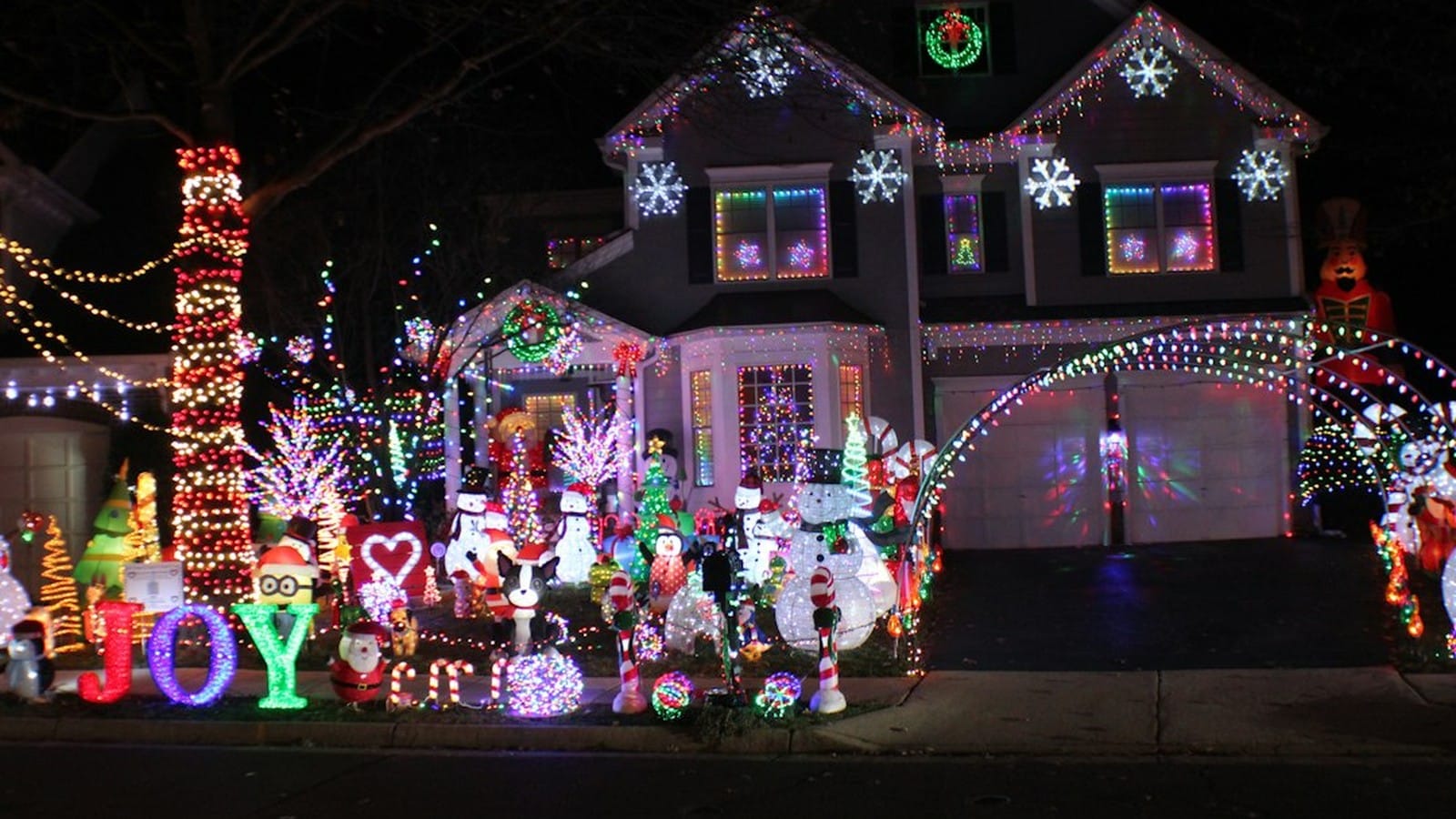
Do Christmas lights use a lot of electricity? LED strings barely register on a bill, and large incandescent bulbs can. In the Oncor area, 100 LED mini lights run six hours a night for 40 nights use about 1.15 kWh, or roughly 8 cents of delivery. One 25-bulb C9 incandescent string uses 42 kWh: $2.88 of delivery plus 42 cents for every cent of your plan's energy charge.
Updated November 17, 2026. Delivery figures use Oncor's residential charges as of November 2026, from Ambit Energy's Residential TDU Delivery Charges sheet. Every light table here is illustrative arithmetic, not a measurement of your home.
That last figure is the one to remember. Most articles about holiday lights price them at a national average rate, and a Texas bill doesn't work that way. In the deregulated part of the state, every extra kWh carries two charges: your retail plan's energy charge and your local utility's per kWh delivery charge. This guide prices the lights at both, shows how to plug in the Energy Charge from your own Electricity Facts Label (EFL), and explains what changes on a free nights plan.
Christmas lights use a lot of electricity only when the bulbs are incandescent, the display is large, or the lights stay on most of the day. A single LED string adds pennies to a season. A roofline of large incandescent bulbs plus a tree and an inflatable can add about 200 kWh a month, close to a fifth of a typical Texas home's usage, as the worked example below shows.
The unit that matters is the kilowatt-hour (kWh). A kWh is 1,000 watts used for one hour, and it's the unit your bill charges for. Any light's season usage comes from one line of arithmetic: watts times hours a night times nights, divided by 1,000.
Bulb type decides most of the answer. The U.S. Department of Energy says LED holiday strands "consume 70 percent less energy than conventional incandescent light strands." For mini lights the gap is wider: Avista's figures for a 100-count string, 40 watts incandescent and about 4.8 watts LED, work out to about 88% less.
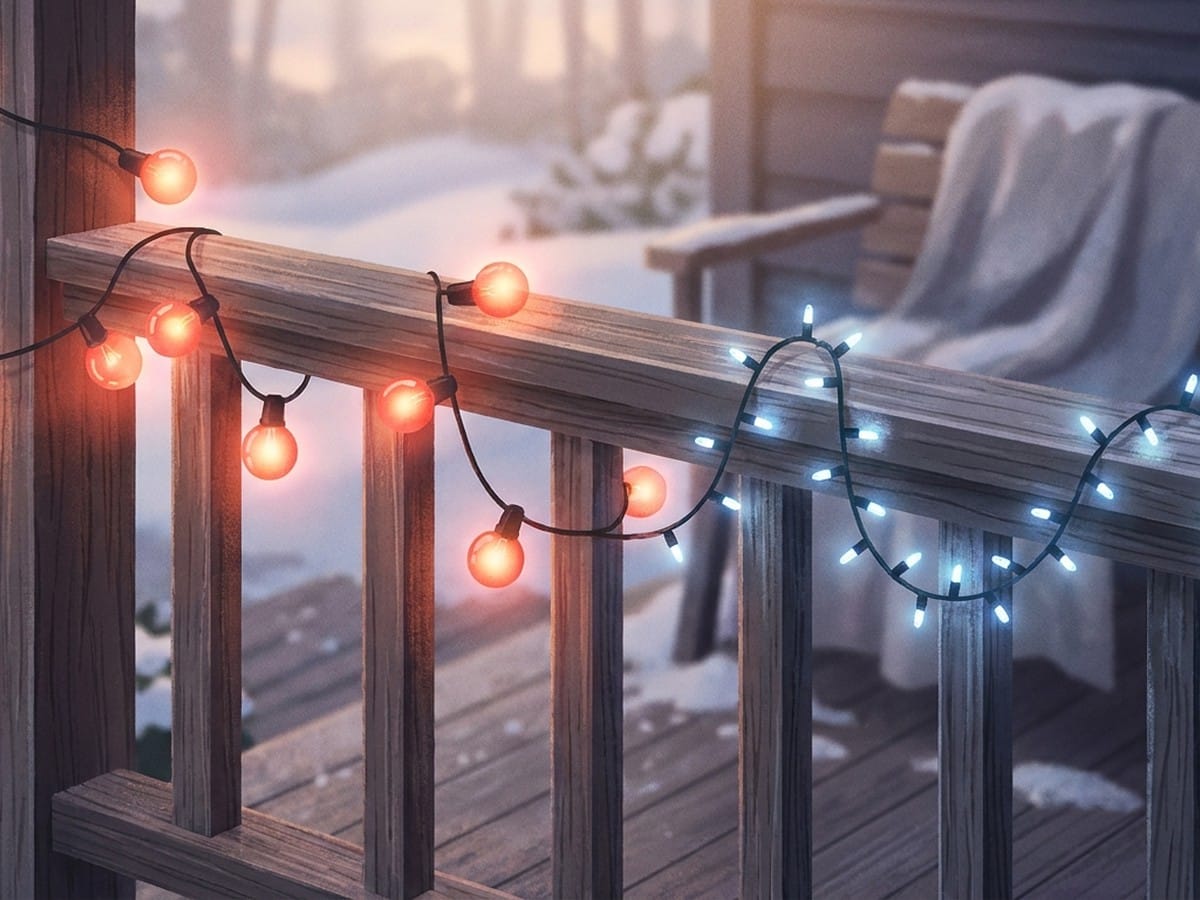
Christmas light wattage runs from a few hundredths of a watt per LED bulb to several watts per large incandescent bulb. The wattage printed on the box, the tag near the plug or an inflatable's label beats any published average, so use that number when you have it. These are the sourced figures this guide uses.
| Light type | Wattage | Source |
|---|---|---|
| LED mini string, 100 bulbs | About 4.8 watts total | Avista (December 2021) |
| Incandescent mini string, 100 bulbs | 40 watts total | Avista (December 2021) |
| Single LED holiday bulb | 0.04 watts | New Jersey Division of Rate Counsel |
| Single C7 or C9 incandescent bulb | 5 to 7 watts | New Jersey Division of Rate Counsel |
| Four-foot inflatable | About 50 watts | Entergy Mississippi (December 3, 2021) |
| Large inflatable | About 150 watts | Entergy Mississippi (December 3, 2021) |
The New Jersey Division of Rate Counsel puts it plainly: "most of the C7 or C9 lights use 5 to 7 watts per bulb," while "Each LED light uses only 0.04 watts." That makes a 100-bulb LED string about four watts, close to Avista's 4.8. Avista notes C7 bulbs typically come in a string of 25, so a large-bulb string at seven watts a bulb draws 175 watts, more than four incandescent mini strings put together.
Tree size changes the count fast. Avista estimates it "takes 700 mini lights to decorate a 7-foot tree, 1,000 for a 10-foot tree, and as many as 2,000 for a 12-foot tree."
Multiply the season's kWh by the price of one extra kWh on your bill, which is your plan's Energy Charge plus your utility's per kWh delivery charge. Leave out the monthly base charge and the utility's monthly delivery charge, because those stay the same whether the lights are on or off. That method is the Four-Number Light Check.
Watts times hours times nights, divided by 1,000, gives the season's kWh. Multiply that by the fourth number for the season's cost.
In the Oncor area, the per kWh delivery charge is 6.8673 cents and the monthly delivery charge is $4.06 as of November 2026, per Ambit's Residential TDU Delivery Charges sheet. Only the 6.8673 cents moves with your lights. Ambit's TDU page notes these charges "are approved by the Public Utility Commission of Texas and are passed through to you without any markup." They can also change during the season, so check the current figure on Ambit's Texas TDU charges page. For how the Oncor charge reached its current level, see this explainer on the October 4, 2026 Oncor delivery increase.
The average price per kWh on an EFL is the wrong number for this, for two reasons. First, it already includes delivery. Ambit's TDU page describes delivery charges "that were included in the average prices per kWh shown on your Electricity Facts Label," so adding delivery on top counts it twice. Second, the average spreads the monthly charges across 500, 1,000 or 2,000 kWh, and those charges don't grow when you plug in a string of lights.
Two more EFL details are worth a look. Ambit's TDU page says "Certain product plans may have partial TDU Delivery Fees included in part of the energy rate," so if your EFL says that, don't add the full delivery charge again. And if your plan has a usage-based bill credit, extra kWh could move you across its threshold, which changes the math. For a fuller walk through EFL pricing, see how to price a plan at your real usage with Smart Meter Texas.
At six hours a night for 40 nights, a 100-count LED mini string adds about 8 cents of Oncor delivery, and a 25-bulb C9 incandescent string at seven watts a bulb adds $2.88. The last column shows what each 1 cent of your plan's energy charge adds on top, so multiply it by the Energy Charge on your EFL, in cents.
Illustrative arithmetic: 240 hours (six hours a night for 40 nights) at Oncor per kWh delivery of 6.8673 cents, as of November 2026.
| Light type | Watts | Season kWh | Oncor delivery | Each 1 cent of energy charge adds |
|---|---|---|---|---|
| LED mini string, 100 bulbs | 4.8 | 1.15 | $0.08 | About $0.01 |
| Incandescent mini string, 100 bulbs | 40 | 9.6 | $0.66 | $0.10 |
| C7 or C9 string, 25 bulbs at 5 watts | 125 | 30 | $2.06 | $0.30 |
| C7 or C9 string, 25 bulbs at 7 watts | 175 | 42 | $2.88 | $0.42 |
| Seven-foot tree, 700 LED minis | 33.6 | 8.06 | $0.55 | $0.08 |
| Seven-foot tree, 700 incandescent minis | 280 | 67.2 | $4.61 | $0.67 |
| Four-foot inflatable | 50 | 12 | $0.82 | $0.12 |
| Large inflatable | 150 | 36 | $2.47 | $0.36 |
Here's how to read a row. Say the Energy Charge on your EFL read a round 10 cents, a number picked for the arithmetic and not any plan's price. The 175-watt C9 string would cost 42 times 10 cents, or $4.20, plus $2.88 of delivery, for $7.08 over the season.
A display adds up line by line. Take a roofline of four 25-bulb C9 strings at seven watts a bulb (700 watts), a seven-foot tree with 700 incandescent minis (280 watts) and one large inflatable (150 watts). That's 1,130 watts. Over 240 hours it uses 271.2 kWh, which carries $18.62 of Oncor delivery, and each 1 cent of energy charge adds $2.71. At the same round 10 cents, the season comes to $27.12 of energy plus $18.62 of delivery, or $45.74.
For most Texas homes, one string of lights is a rounding error on a monthly bill, and a big incandescent display is not. Choose Texas Power puts typical Texas household use at 1,096 kWh a month. Over 30 nights at six hours a night, the 175-watt C9 string uses 31.5 kWh, about 3% of that. A seven-foot LED tree uses about 6 kWh, about half of 1%. The whole display above uses 203.4 kWh, close to a fifth of a typical month.
To see your own number, compare your Smart Meter Texas interval data on evenings with the lights on against a night before they went up. If it's the December swing that bothers you, Average Monthly Billing spreads bills out across the year, though it doesn't lower what you pay.

On a free nights plan, the hours inside the free window cost less, and the hours before it don't. Ambit Energy's Free & Clear Nights 12 takes the energy charge to zero from 9 p.m. through 5:59 a.m. every day, and its EFL for the Oncor area, dated November 16, 2026, adds: "TDU Per kWh Delivery Charges will be credited for usage during the nighttime hours." The EFL defines nighttime as 9 p.m. through 5:59 a.m. each day.
So a light string running after 9 p.m. adds no energy charge and no per kWh delivery charge. The plan's monthly base charge and the utility's monthly delivery charge still apply, but they don't change with the lights. Lights on from dusk until 9 p.m. are billed at the plan's daytime energy charge plus 6.8673 cents of Oncor delivery.
Here's the 175-watt C9 string again, on from 6 p.m. to midnight for 40 nights.
| Billing window | Hours a night | Season kWh | Oncor per kWh delivery | Energy charge |
|---|---|---|---|---|
| 6 p.m. to 9 p.m. (daytime) | 3 | 21 | $1.44 | Each 1 cent of daytime energy charge adds $0.21 |
| 9 p.m. to midnight (nighttime) | 3 | 21 | Credited | $0 |
Move the timer an hour later, to 7 p.m. through 1 a.m., and only two hours a night fall in the daytime window. That's 14 kWh, with $0.96 of delivery and $0.14 for each cent of daytime energy charge.
One caution. A free nights plan's daytime energy charge is higher than a typical fixed plan's, because that's how the free hours get paid for. Holiday lights run for a few weeks of the year, so whether the plan fits depends on how much of your home's usage lands after 9 p.m. all year. This free nights guide walks through that break-even math, and this line-by-line read of free nights EFLs shows where to find each charge. You can also see the plan on Ambit's Free & Clear Nights page.
Plan details and rates subject to change. Energy facts label available for every plan, and the EFL for your address is the one that applies to you.
Holiday inflatables use more than LED strings and less than most large-bulb displays, and the fan inside runs the whole time they're up. Entergy Mississippi estimates a large inflatable draws about 150 watts and a four-foot one about 50 watts, so three small ones use about what one large one does. At six hours a night for 40 nights, the large one uses 36 kWh, with $2.47 of Oncor delivery and $0.36 for each cent of energy charge.
Inflatables vary more than light strings, so the label on the blower is the number to use. One left on around the clock uses four times the six-hour figure.
Yes. A light string draws the same watts every hour it's on, so its cost rises in a straight line with the hours. The 175-watt C9 string uses 42 kWh at six hours a night, 84 kWh at 12 hours, and 168 kWh left on around the clock for 40 nights. That's $2.88, $5.77 or $11.54 of Oncor delivery, before the energy charge.
Avista's advice is simple: "Wait until dark to turn on Christmas lights and turn them off before you go to bed." On Free & Clear Nights, the hours after 9 p.m. carry no energy charge or per kWh delivery charge, so the hours before 9 p.m. are the ones that count.
Want a second set of eyes on your own EFL? Get your free quote and a Texas advisor can walk through your plan's charges with you.
It depends on the bulbs and your plan's energy charge. Over 30 nights at six hours a night in the Oncor area, a 100-count LED mini string uses about 0.86 kWh, or about 6 cents of delivery. A 25-bulb C9 incandescent string at seven watts a bulb uses 31.5 kWh, with $2.16 of delivery plus $0.32 for each cent of your energy charge.
No. A 100-count LED mini string draws about 4.8 watts, per Avista. Run six hours a night for 40 nights, it uses about 1.15 kWh, which carries about 8 cents of Oncor delivery as of November 2026.
No. The average price per kWh already includes delivery charges and spreads the monthly charges over a set usage. Use the Energy Charge on your EFL plus your utility's per kWh delivery charge instead.
Usage from 9 p.m. through 5:59 a.m. carries no energy charge, and the per kWh delivery charge is credited too, per the plan's Oncor EFL dated November 16, 2026. The monthly base charge and the utility's monthly delivery charge still apply, and lights on before 9 p.m. are billed at the daytime energy charge plus delivery.
On your EFL, where it's listed as the Energy Charge in cents per kWh. Your utility's per kWh delivery charge is listed on the same EFL and on Ambit's Texas TDU charges page.




Copyright © 2026 VIPEnergyService.com. All rights reserved | PUCT# 10117
Important message regarding earnings: Ambit Energy makes no guarantee or promise of income or business. Anyone considering building a full-time or part-time Ambit business should have realistic expectations of their potential income. Learn more at goambit.com/disclaimer.