Update, October 2026: According to the IRS, the 30% federal Residential Clean Energy Credit is not available for systems placed in service after December 31, 2025. Mentions of the credit below apply only to systems installed by then. Texas utility rebates and the Texas property tax exemption may still lower your cost.
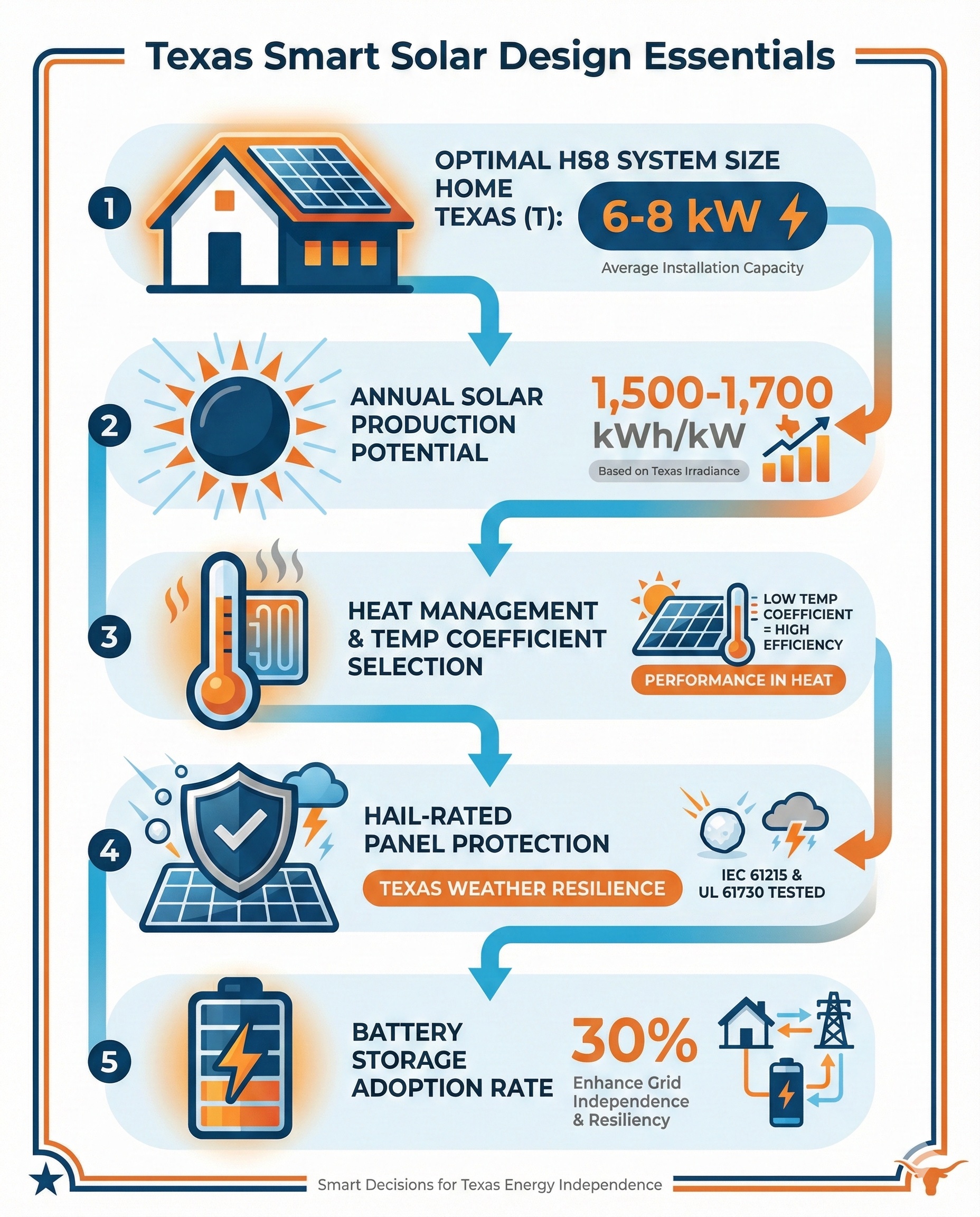
Smart solar design for your home solar system means correctly sizing your panels, optimizing placement for maximum energy production, and integrating battery storage for complete energy independence. The average Texas home needs a 6-8 kW home solar system producing 1,500-1,700 kWh per kilowatt annually. With proper house energy storage, Texas homeowners can reduce electricity bills by 50-90% while gaining backup power reliability during grid outages.
This guide covers everything you need to know about home solar system smart solar design for your Texas home in 2026.
What Is Smart Solar Design for Home Systems?
Smart solar design transforms how Texas homeowners approach their home solar system installation. Unlike traditional installations that simply mount panels on available roof space, smart solar design uses AI-optimized tools to determine the ideal system size, panel placement, and battery storage integration for your specific energy needs.
According to the National Renewable Energy Laboratory, Texas enjoys exceptional solar production potential. A home solar system in Dallas produces approximately 1,550 kWh per kilowatt annually, while San Antonio reaches 1,650 kWh/kW and El Paso achieves 1,700 kWh/kW. This superior solar irradiance makes Texas one of the best states for residential solar systems.
The three pillars of smart solar design include:
- Correct system sizing based on your actual energy consumption
- Optimal panel placement accounting for roof orientation, shading, and Texas heat
- Battery storage integration for energy independence and backup power
Smart solar technology also incorporates real-time monitoring through apps that track your solar production and energy usage. This data helps homeowners understand their energy patterns and maximize savings from their home solar system.
How to Size Your Home Solar System Correctly
Proper system size calculation is the foundation of any successful home solar system installation. Getting this right ensures you generate enough electricity to meet your energy goals without overspending on unnecessary capacity.
According to the Lawrence Berkeley National Laboratory's Tracking the Sun report, the median U.S. residential system size reached 7.2 kW in 2023. Texas homeowners typically need systems in the 6-8 kW range for homes between 1,500 and 2,500 square feet.
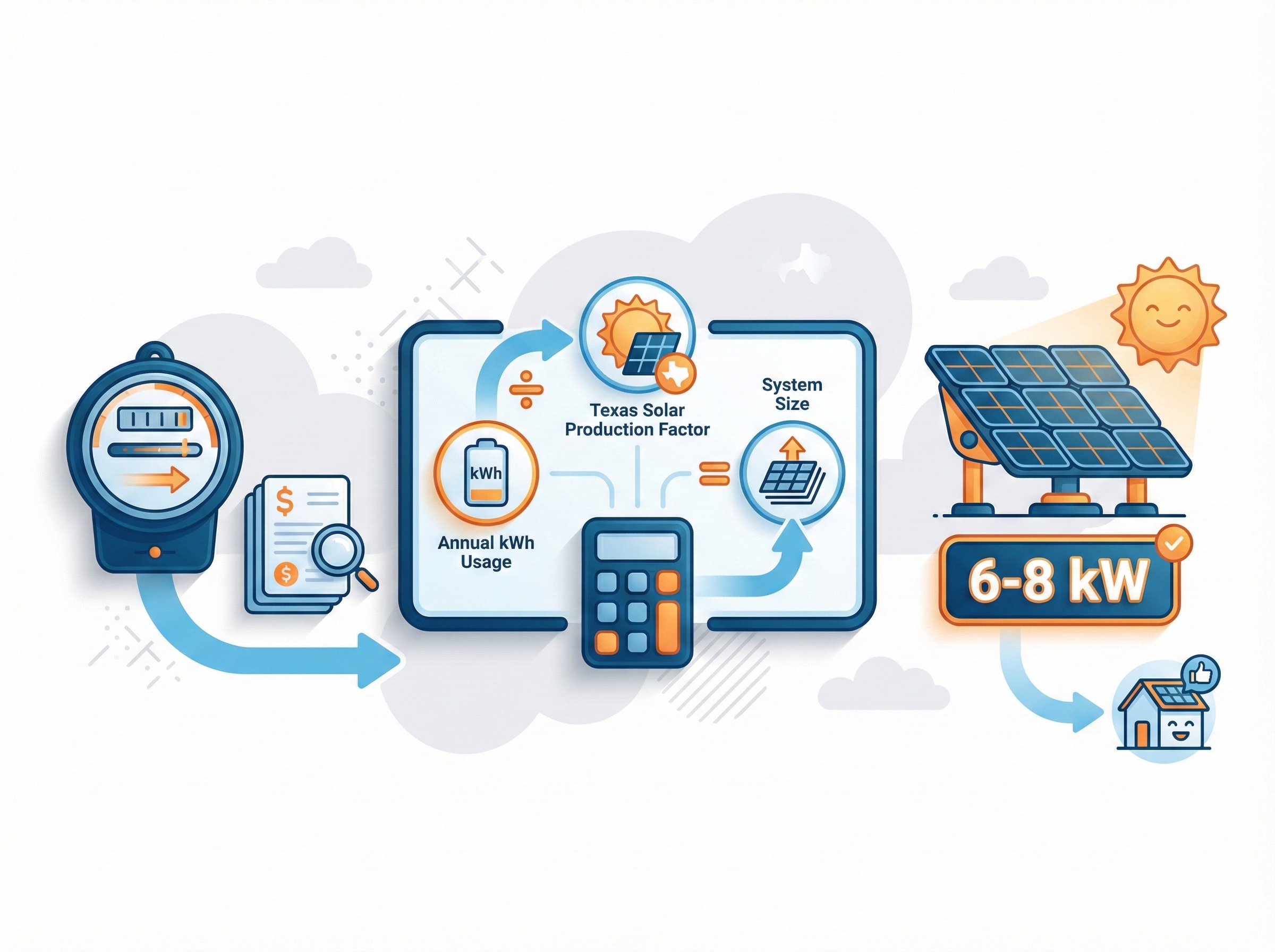
Here's how to calculate your ideal home solar system size:
Step 1: Determine annual energy consumption
Review 12 months of electricity bills to find your total kWh usage. The average Texas home consumes approximately 12,000 kWh annually.
Step 2: Calculate required system size
Divide your annual consumption by your area's solar production factor. For example: 12,000 kWh / 1,600 (Austin average) = 7.5 kW system.
Step 3: Account for future energy needs
Consider adding 10-20% capacity if you plan to purchase an electric vehicle or add battery storage.
The good news for Texas homeowners is that solar costs here remain below the national average. The LBNL reports Texas residential solar costs averaged $2.64 per watt DC in 2023, compared to the national median of $3.28 per watt. Combined with the 30% federal Investment Tax Credit, a typical home solar system costs approximately $13,000-$15,000 after incentives.
Understanding your system size requirements helps you compare quotes from solar installers and ensures you receive a solar cost analysis that accurately reflects your energy needs.
Smart Solar Features That Maximize Energy Production
Modern home solar system installations include smart features that dramatically improve energy efficiency and production monitoring. These technologies help Texas homeowners extract maximum value from their solar investment.
Panel-level monitoring and optimization
Companies like Enphase and SolarEdge provide microinverters and power optimizers that enable panel-level monitoring. This smart solar technology allows homeowners to identify underperforming panels and track production in real time through smartphone apps.
AI-optimized panel placement
Smart design software analyzes satellite imagery, roof angles, and local weather patterns to determine optimal panel placement. This technology accounts for Texas-specific factors like extreme heat, which can reduce panel efficiency by 10-15% on the hottest summer days.
Battery storage integration
According to the Solar Energy Industries Association, approximately 30% of new U.S. residential solar installations now include battery storage. Texas homeowners increasingly recognize that solar and battery systems work together to provide energy independence and backup power during grid outages.
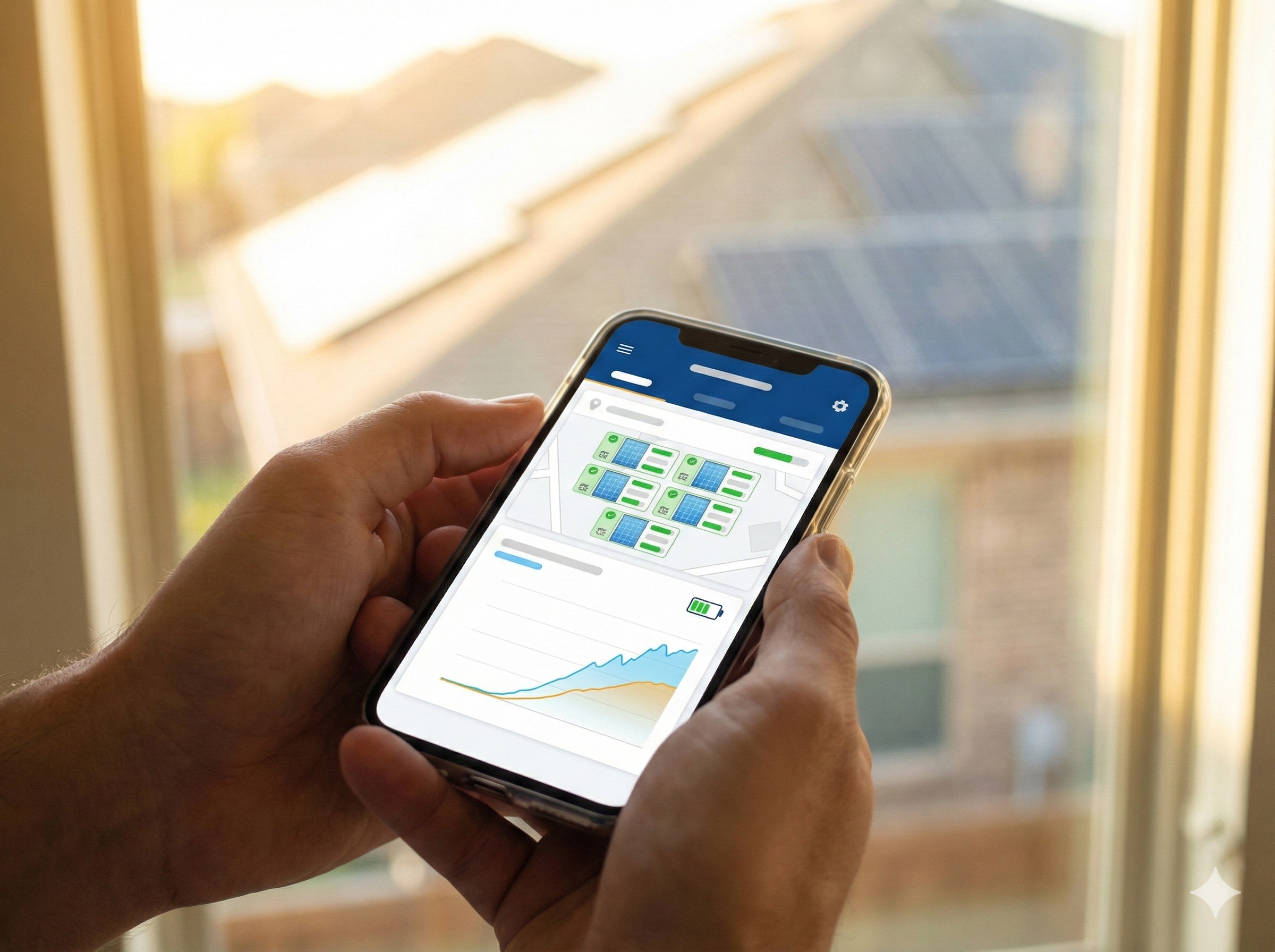
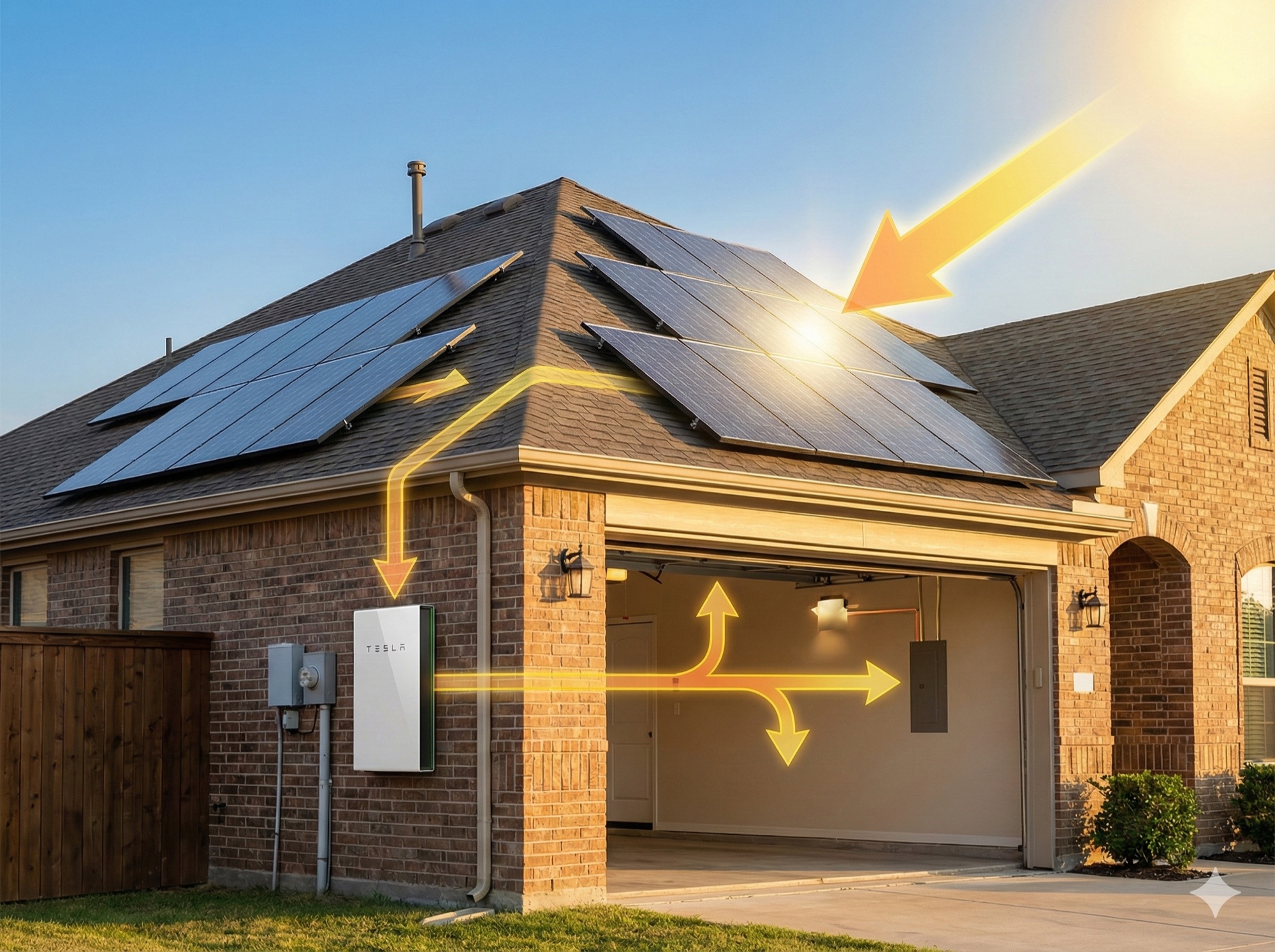
The stored solar energy from battery systems keeps essential appliances running when the grid fails. Smart inverters automatically detect outages and switch to battery power within milliseconds, ensuring continuous electricity for your home solar system.
ERCOT data shows Texas is adding 11.8 GW of battery storage capacity to the grid in 2025, reflecting the growing importance of energy storage across the state.
Texas Solar Design Considerations for 2026
Designing a home solar system for Texas requires addressing unique regional factors that affect solar production and system longevity.
Heat management
Texas summers push temperatures above 100 degrees for extended periods. Smart solar design selects panels with low temperature coefficients that maintain efficiency in extreme heat. Proper installation spacing allows airflow behind panels for natural cooling.
Storm and hail protection
Texas experiences severe weather including hail storms. Choose hail-rated, tempered-glass solar panels and robust mounting systems designed for high winds. Quality home solar system installations use materials tested to withstand the state's demanding conditions.
Grid integration and buyback programs
According to the Institute for Energy Economics and Financial Analysis, wind and solar produced 40.2% of ERCOT electricity through June 2025. Texas homeowners with Texas solar buyback programs can sell excess solar energy back to the grid and receive credits on their electricity bills.
The Texas market for residential solar systems continues expanding rapidly. Chariot Energy reports that over 100,000 new residential solar systems were installed in Texas during 2023, with installations growing approximately 30% annually between 2020 and 2023.
Looking ahead to 2026, expect continued price decreases for both solar panels and battery storage, making smart solar design more accessible for Texas homeowners seeking energy independence.
Getting Started with Smart Solar Design
Ready to explore home solar system smart solar design for your Texas home? Follow these steps to begin your journey toward energy efficiency and independence.
Step 1: Gather your energy data
Collect 12 months of electricity bills to understand your consumption patterns. Note your highest usage months, typically summer when air conditioning drives energy costs.
Step 2: Assess your roof
Evaluate your roof's orientation, age, and available space. South-facing roofs maximize solar production, but east and west orientations also work well for Texas home solar system installations.
Step 3: Compare solar buyback plans
Research retail electric provider plans that offer favorable rates for selling excess solar energy back to the grid. Look for plans with competitive buyback rates that credit your full retail rate for exported energy.
Step 4: Consult qualified installers
Work with experienced Texas solar installers who understand local conditions, permitting requirements, and utility interconnection processes.
At Ambit Energy VIP Energy Service, we help Texas homeowners navigate the path to smart solar design with personalized energy solutions. Our team matches you with the right combination of solar panels, battery storage, and electricity plans to maximize your energy goals.
Ready to start saving with solar? Get your free energy quote today and discover how our competitive solar buyback rate can help you achieve true energy independence with your home solar system.
Sources
- NREL PVWatts Calculator - Texas Solar Production Data
- LBNL Tracking the Sun 2024 - Residential Solar Costs and Sizing
- SEIA Solar Industry Research Data - Battery Attachment Rates
- IEEFA - Solar Growth and Reliability in Texas
- Chariot Energy - Texas Solar Growth Statistics
Update, October 2026: According to the IRS, the 30% federal Residential Clean Energy Credit is not available for systems placed in service after December 31, 2025. Mentions of the credit below apply only to systems installed by then. Texas utility rebates and the Texas property tax exemption may still lower your cost.
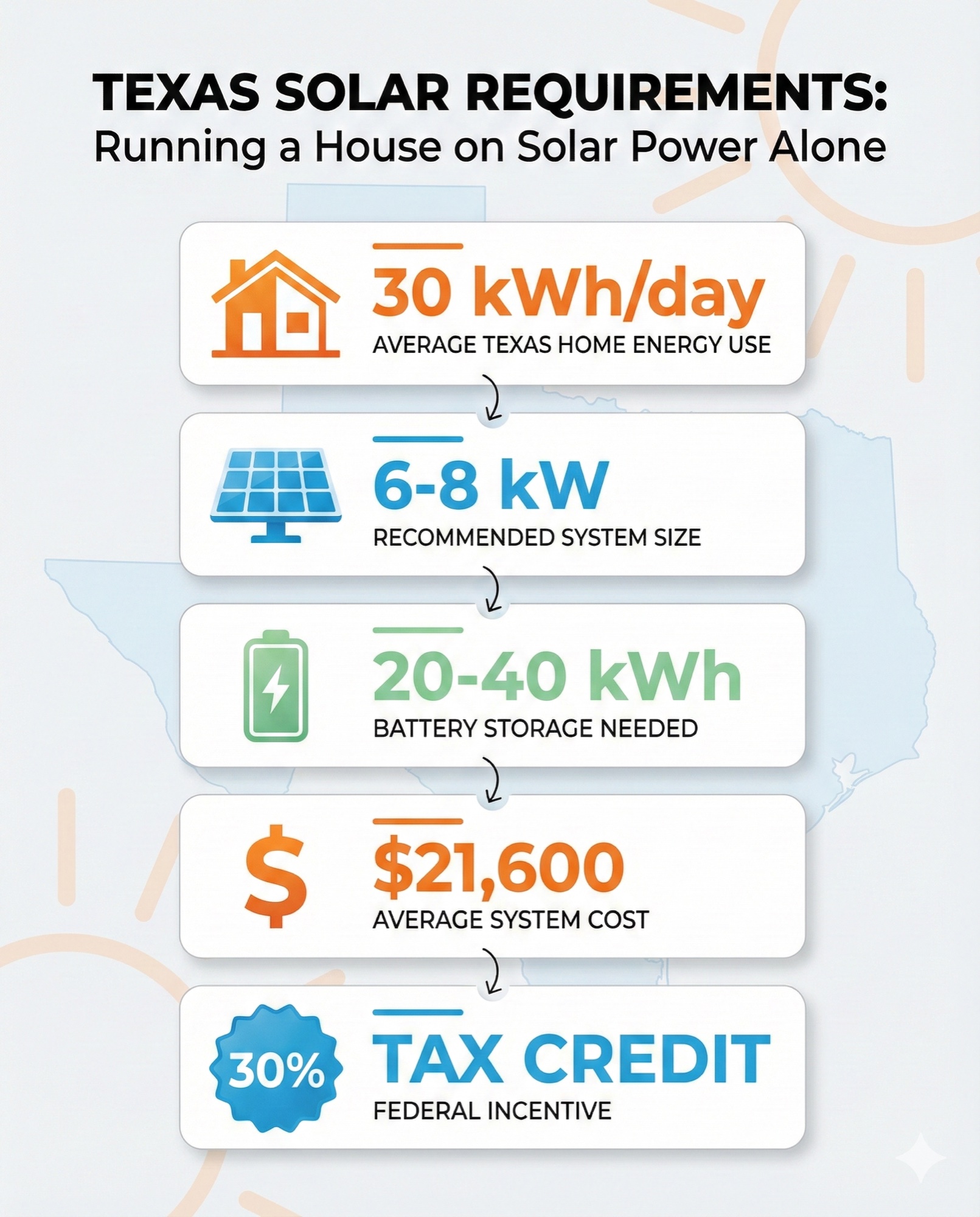
Yes, a house can run on solar power alone with the right combination of solar panels and battery storage. The average Texas home needs a 6-8 kW solar panel system and 20-40 kWh of battery capacity for full energy independence. While going completely off-grid requires significant investment, many Texas homeowners achieve near-100% solar coverage with grid-tied systems that include house energy storage for backup reliability during outages.
What Does It Take to Run a House on Solar Power Alone?
Running your house on solar power alone requires three essential components working together: adequately sized solar panels, sufficient battery storage, and a smart backup strategy. According to the U.S. Energy Information Administration, the average American home uses approximately 10,791 kWh of electricity per year—roughly 30 kWh per day.
Texas homeowners have a significant advantage when it comes to running a house on solar power. The state's excellent solar irradiance means solar panel systems generate more electricity per panel than in most other regions. In fact, solar now provides 13.3% of all ERCOT electricity generation, demonstrating that solar power systems work exceptionally well in the Texas climate.
The question isn't whether you can run your house on solar power alone—it's understanding what system size and solar battery storage capacity you need to power your home reliably.
How to Size Your Solar System for Complete Energy Independence
Sizing your solar panel system correctly is the foundation of running your house on solar power alone. Start by reviewing your utility bills to calculate your daily energy consumption. Most Texas homes need between 6-8 kW of solar capacity to meet their electricity needs.
Here's a simple sizing formula: divide your daily kWh usage by your area's sun-hours multiplied by 0.78 (accounting for system efficiency losses). For example, if you use 30 kWh daily with 5 peak sun hours, you'd need approximately 7.7 kW of solar panels.
Battery storage requirements depend on how many days of autonomy you want. According to SEIA, battery costs have dropped to around $115 per kWh, making energy storage more accessible than ever. For grid-tied backup, 10-30 kWh covers evening loads plus one night. To run your house on solar power alone off-grid, you'll need 40-100+ kWh of stored solar energy.
The 30% federal Investment Tax Credit remains available through 2025, effectively reducing your solar panel system costs by nearly one-third.
Grid-Tied vs. Off-Grid: Which Is Right for Your Texas Home?
Most Texas homeowners find that a grid-tied system with battery storage offers the best balance of energy independence and practicality. This approach lets you run your house on solar power for most needs while maintaining grid connection as backup.
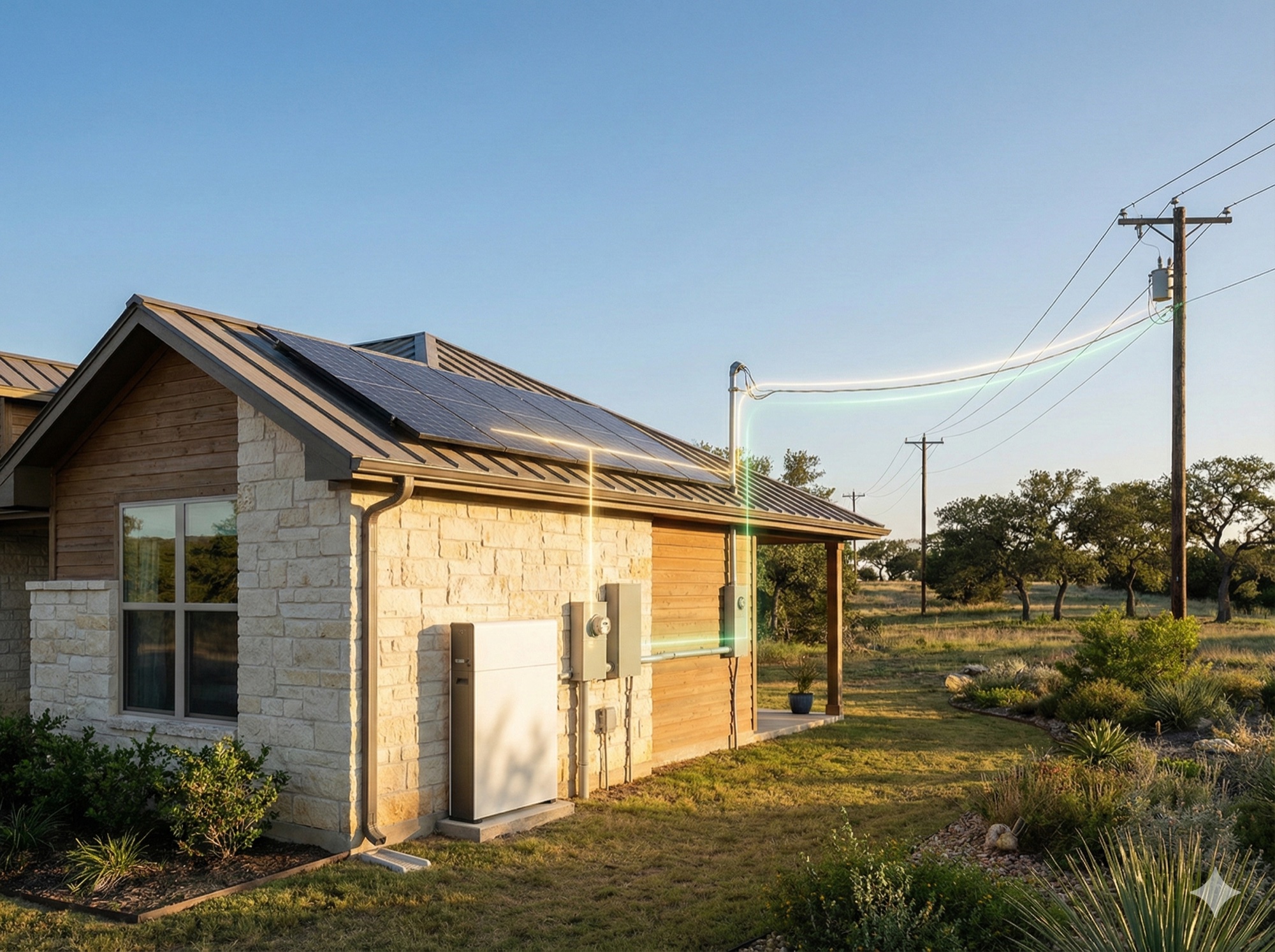
Texas solar buyback programs make grid-tied systems especially attractive. With competitive solar buyback rates, excess electricity your solar panels generate earns full credit toward your electric bills. Net metering essentially uses the grid as free battery storage—you export excess energy during sunny hours and draw it back when needed.
Winter Storm Uri taught many Texans a hard lesson about grid reliability. That's why backup power options with battery storage have become essential. According to the Institute for Energy Economics, Texas wind and solar generated 40.2% of ERCOT electricity through June 2025, but having your own battery storage ensures your house can run on solar power even when the grid fails.
"There will never be a better time to go solar than right now. Systems installed by the end of 2025 will still be eligible for the tax credit."
What Texas Homeowners Should Expect in 2026
Solar panel system costs in 2026 continue trending downward. Current installed prices range from $2.50-$3.50 per watt, meaning a typical 7.2 kW system costs around $21,600 before incentives—or approximately $15,120 after the 30% federal tax credit.
Battery prices are dropping even faster at roughly 20% annually. This means running your house on solar power alone becomes more affordable each year. According to industry data, solar panel prices have dropped 60% since 2010.
Growing concerns about grid reliability are making solar plus storage the new standard for Texas homes. Energy independence isn't just about saving on electric bills—it's about ensuring your family has power your home can rely on.
Your Next Steps Toward Solar Energy Independence
Ready to explore whether you can run your house on solar power alone? Start by assessing your energy consumption and roof space. Then consult with Texas energy experts who understand local conditions and solar buyback programs.
Get your free energy quote to compare Texas electricity plans that support your solar goals. Our team at Ambit Energy VIP can help you find the right combination of solar installs, battery storage, and energy plans to achieve true energy independence.
Whether you want to run your house on solar power completely off-grid or maintain a grid connection with maximum solar coverage, there's a solution for your Texas home.
Ready to explore solar energy independence? Get your free energy quote today and discover how Ambit Energy VIP can help you run your house on solar power with Texas's best competitive solar buyback rates.
Sources
- EIA - Texas Energy Statistics and Average Home Energy Consumption
- SEIA - Solar Industry Research Data and Battery Cost Trends
- IEEFA - Solar Growth and Reliability in Texas Grid Operations
- Aurora Solar - 2025 Homeowner Guide to Solar Installation
- ERCOT - 2024 State of the Grid Report
Update, October 2026: According to the IRS, the 30% federal Residential Clean Energy Credit is not available for systems placed in service after December 31, 2025. Mentions of the credit below apply only to systems installed by then. Texas utility rebates and the Texas property tax exemption may still lower your cost.
To power a house with solar energy, you need to install solar panels on your roof, connect them to an inverter that converts DC to AC power, and integrate with your electrical panel. The typical Texas home requires 15-25 panels to cover energy needs. Most homeowners pay $16,000-$26,000 before incentives, with the 30% federal tax credit reducing costs significantly.
For the best results, consider pairing solar with house energy storage to maximize savings and provide backup power during outages. Here's a complete step-by-step guide to powering your home with solar energy.
Understanding Your Solar Energy Needs
Before you can power a house with solar energy, you need to understand how much electricity your home actually uses. Start by reviewing 12 months of electricity bills to calculate your average monthly consumption.
According to the U.S. Energy Information Administration, the average American home uses approximately 10,500 kWh per year. However, Texas homes often use more due to air conditioning demands during hot summers. Your bills will show your specific usage patterns.
To calculate the system size you need, divide your annual kWh usage by 1,400 to 1,600. This gives you the kilowatts (kW) of solar capacity required. For example, a home using 12,000 kWh annually needs roughly an 8-9 kW system.
Consider future energy needs as well. Planning to add an electric vehicle, pool, or home addition? Factor these into your calculations now. The ERCOT grid in Texas experiences peak demand during summer afternoons, making solar particularly valuable for reducing strain during these high-use periods.
Evaluating Your Property for Solar
Not every property is equally suited for solar panels. Your roof's orientation significantly impacts energy production. South-facing roofs capture the most sunlight in Texas, though southwest and southeast orientations also work well.
According to the National Renewable Energy Laboratory, roof condition matters as much as orientation. Your roof should have at least 15 years of life remaining before installing solar panels. Plan approximately 100 square feet of roof space per kW of capacity you need.
Shading from trees, neighboring buildings, and chimneys can dramatically reduce production. Walk around your property at different times of day to identify shading patterns. Even partial shading on one panel can affect the entire system with certain inverter types.
If your roof isn't suitable, ground-mount systems offer an alternative. Texas homeowners with adequate land often choose ground mounts for easier maintenance and optimal positioning. Many areas in Texas feature flat terrain with minimal tree cover, making ground-mount installations straightforward.
Use free tools like the NREL PVWatts Calculator to estimate your property's solar potential based on location and roof characteristics.
How to Choose Solar Panels and Equipment
Selecting the right equipment determines your system's performance for the next 25-30 years. Solar panels come in two main types: monocrystalline and polycrystalline.
According to the Solar Energy Industries Association, monocrystalline panels now account for over 80% of residential installations. These panels offer 20-24% efficiency compared to 15-17% for polycrystalline alternatives. The higher efficiency means you need fewer panels to achieve the same output.
For inverters, you'll choose between string inverters and microinverters. String inverters connect all panels in a series, making them cost-effective but sensitive to shading. Microinverters from manufacturers like Enphase attach to each panel individually, optimizing production even when some panels are shaded.
Battery storage is increasingly popular for Texas homes. Options like Tesla Powerwall, Enphase IQ batteries, and FranklinWH systems store excess energy for evening use or backup power. Pairing solar with house energy storage protects against grid outages and maximizes self-consumption.
Your installer will recommend mounting hardware and monitoring systems. Most systems include app-based monitoring that tracks production in real-time.
Step-by-Step Solar Installation Process

Installing solar panels to power a house follows a predictable process. Here's what to expect at each stage:
Step 1: Get Multiple Quotes
Request quotes from 3-5 certified solar installers. Compare equipment brands, warranties, and total costs. Verify NABCEP certification for your installer. Check online reviews and ask for references from recent local installations.
Step 2: Review and Sign Contract
Understand your financing options: cash purchase, solar loan, lease, or power purchase agreement (PPA). According to EnergySage, the average residential solar installation takes 6-12 weeks from contract to activation. Confirm equipment specifications and warranty details before signing.
Step 3: Permit Acquisition (1-4 Weeks)
Your installer handles permit applications. Most Texas cities require electrical permits for solar installations. If you have an HOA, obtain approval before proceeding. Permit timelines vary by jurisdiction.
Step 4: Equipment Delivery and Installation (1-3 Days)
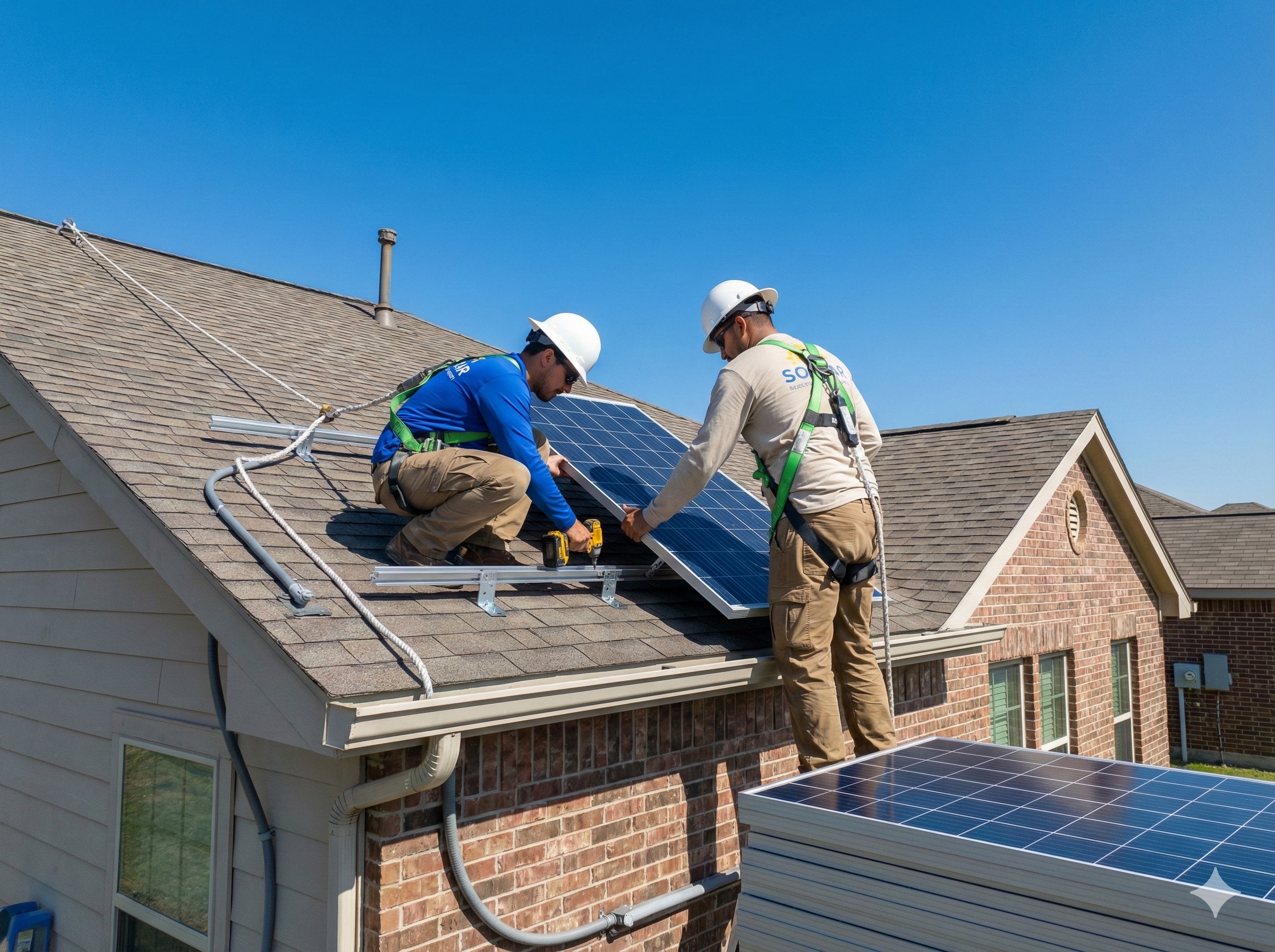
The installation crew prepares your roof, mounts the racking system, and secures panels. They run wiring to a new or existing electrical subpanel and install your inverter. Most residential installations complete in 1-3 days.
Step 5: Inspection (1-2 Weeks)
Your city's electrical inspector verifies the installation meets code requirements. The utility company also verifies the system before authorizing connection.
Step 6: Utility Interconnection (2-4 Weeks)
Your utility installs a net meter to track power flow in both directions. Enroll in a solar buyback program in Texas to receive credits for excess power you generate. You'll receive Permission to Operate (PTO) when interconnection is complete.
Step 7: System Activation
Flip the switch and start generating clean energy. Set up your monitoring app to track daily production. Compare your first full month's electricity bill to previous months.
Understanding Solar Costs and Incentives
Knowing the true cost to power a house with solar energy helps you make an informed decision. According to EnergySage, residential solar costs average $2.80 to $3.25 per watt in 2024.
For a typical 6-8 kW system, expect to pay $16,800 to $26,000 before incentives. The federal Investment Tax Credit (ITC) reduces this cost by 30% through 2032. According to the IRS, this credit applies to your federal tax liability, not as a refund.

Texas offers additional benefits. Property tax exemptions mean your home's value increases without raising your property taxes. According to the U.S. Department of Energy, homeowners can save $20,000 to $96,000 over a solar system's lifetime.
The payback period typically ranges from 6-12 years, depending on your electricity rates and sun exposure. Solar panels last 25-30 years with minimal degradation, meaning you'll enjoy free electricity for 15+ years after payback.
Check the DSIRE database for current incentives in your area. Some Texas utilities offer additional rebates for solar installations.
Texas Solar Outlook for 2026
Texas has become one of the nation's leading solar markets. According to the Solar Energy Industries Association, Texas added more solar capacity than any other state in 2024 and ranks second nationally for total installed capacity.
The ERCOT grid operates independently from the national grid, creating unique opportunities and challenges. Solar buyback rates vary significantly by utility, ranging from 5 to 15 cents per kWh. Compare rates through a solar buyback analysis to find the best program for your situation.
After Winter Storm Uri in 2021, more Texas homeowners recognize the value of energy independence. Battery storage adoption is accelerating as costs decline and reliability concerns persist. New utility programs launching in 2026 will offer additional options for solar customers.
VIP Energy Service helps Texas homeowners navigate the Texas solar payback program options. Our energy consultants provide personalized guidance based on your usage patterns and goals.
Troubleshooting and When to Call a Professional
Most solar systems operate reliably with minimal maintenance. However, knowing how to troubleshoot common issues helps you power your house with solar energy effectively.
Common Issues and Quick Fixes:
If production seems low, check for obvious shading from new tree growth or debris on panels. Dirt and pollen accumulation can reduce output by 5-10%. Rain usually cleans panels naturally, but you may need to rinse them during dry spells.
Monitor your app for inverter error codes. Many issues resolve by cycling the inverter off and on. Check your breaker panel to ensure the solar breaker hasn't tripped.
If your electricity bill is higher than expected, review your usage patterns. Time-of-use rates mean you may pay more for evening consumption even with solar credits.
When to Call a Professional:
Contact your installer for physical damage from hail, fallen branches, or severe weather. Texas hailstorms can crack panels or damage mounting hardware. Persistent inverter errors require professional diagnosis.
Call a professional if you notice roof leaks near mounting points or observe a production drop greater than 20% not explained by weather or seasonal changes. Electrical issues are never DIY projects.
Ready to power your home with solar? Contact VIP Energy Service at (817) 402-2664 for personalized guidance on solar options and buyback programs for your Texas home.
Sources
- U.S. Department of Energy - Homeowner's Guide to Going Solar
- NREL PVWatts Calculator - Solar Potential Estimator
- DSIRE - Database of State Incentives for Renewables & Efficiency
- EnergySage - Solar Marketplace and Cost Data
- Solar Energy Industries Association - Industry Statistics
House energy storage refers to battery systems that store electricity in your home for use during power outages, peak rate periods, or when solar panels aren't generating power. Modern lithium-ion home batteries like the Tesla Powerwall, Enphase IQ Battery, and FranklinWH can provide backup power for hours or even days, helping Texas homeowners protect against grid outages while potentially saving money on electricity bills through time-of-use optimization.
Table of Contents
What Is House Energy Storage?
House energy storage systems are residential battery solutions that capture and store electricity for later use. These energy storage systems typically consist of three main components: the battery pack that stores energy, an inverter that converts power between DC and AC, and an energy management system that coordinates charging and discharging.
According to Straits Research, the global residential energy storage systems market was valued at $8.78 billion in 2023 and is projected to reach $37.65 billion by 2032, growing at a compound annual growth rate of 17.56%. This explosive growth reflects increasing homeowner interest in backup power and energy independence.
Modern home battery systems primarily use lithium-ion batteries due to their high energy density, long cycle life, and declining costs. These batteries can be charged from multiple sources, including solar panels, the electrical grid, or both. When your home needs power during an outage or during peak electricity rate periods, the stored energy discharges to power your home. Curious about the investment? Our guide to home battery storage cost breaks down everything you need to know about pricing.
House energy storage installations can be configured as whole-home backup systems or critical-loads systems. Whole-home setups provide power to your entire house, while critical-loads systems prioritize essential circuits like refrigerators, medical equipment, and HVAC systems. According to Fact.MR, approximately 70% of residential energy storage deployments are on-grid systems, meaning they remain connected to the utility grid while providing backup capability.
Why House Energy Storage Matters in 2026
The case for house energy storage has never been stronger. Following Winter Storm Uri in 2021, Texas homeowners experienced firsthand the devastating consequences of prolonged power outages. Frozen pipes, spoiled food, and dangerous indoor temperatures highlighted the need for reliable backup power solutions. As we move into 2026, home battery systems offer protection against these increasingly common grid disruptions.
According to the U.S. Energy Information Administration, large-scale U.S. battery storage capacity grew from 1.5 GW in 2020 to over 16 GW by 2024. This tenfold increase demonstrates the accelerating adoption of energy storage technology across all sectors, including residential applications. Not sure what capacity you need? Check out our guide on how to size a home battery for your specific needs.
Rising electricity costs and complex rate structures make house energy storage financially attractive. Many Texas retail electric providers offer time-of-use rates where electricity costs significantly more during peak demand hours. A home battery system allows you to charge during low-cost periods and discharge during expensive peak times, potentially saving hundreds of dollars annually on your electricity bill.
The connection between solar energy and house energy storage continues to strengthen. Cognitive Market Research reports that the North American residential energy storage market reached $460 million in 2024, with a projected 17.7% compound annual growth rate through 2031. As their research notes, "The North American residential energy storage market is witnessing robust growth driven by increasing demand for reliable power backup and renewable energy integration."
For homeowners already generating solar energy, batteries solve a critical problem: what happens when the sun isn't shining. Energy storage systems capture excess solar energy during the day for use during evening hours when most families consume the most electricity. According to Fact.MR, single-family homes account for approximately 60% of the residential energy storage market.
How Home Battery Systems Work
Understanding how PV and battery systems work together helps you make informed decisions about house energy storage. The process involves three main stages: charging, storage, and discharging.
Charging: Home battery systems can charge from solar panels, the electrical grid, or both. When your solar panels produce more electricity than your home needs, the excess energy flows to your battery instead of being exported to the grid. Grid charging typically occurs during off-peak hours when electricity rates are lowest.
Storage: The battery stores electricity as direct current (DC) in lithium-ion cells. According to the NREL Annual Technology Baseline, a representative residential battery system provides 5 kW of power with 12.5 kWh of storage capacity. This means the battery can deliver 5 kilowatts continuously while storing enough energy to power a home for several hours.
Discharging: When your home needs stored energy, the inverter converts DC power from the battery to AC power that your appliances can use. Modern smart inverters manage this process automatically, prioritizing which loads receive power and switching seamlessly between grid and battery power during outages.
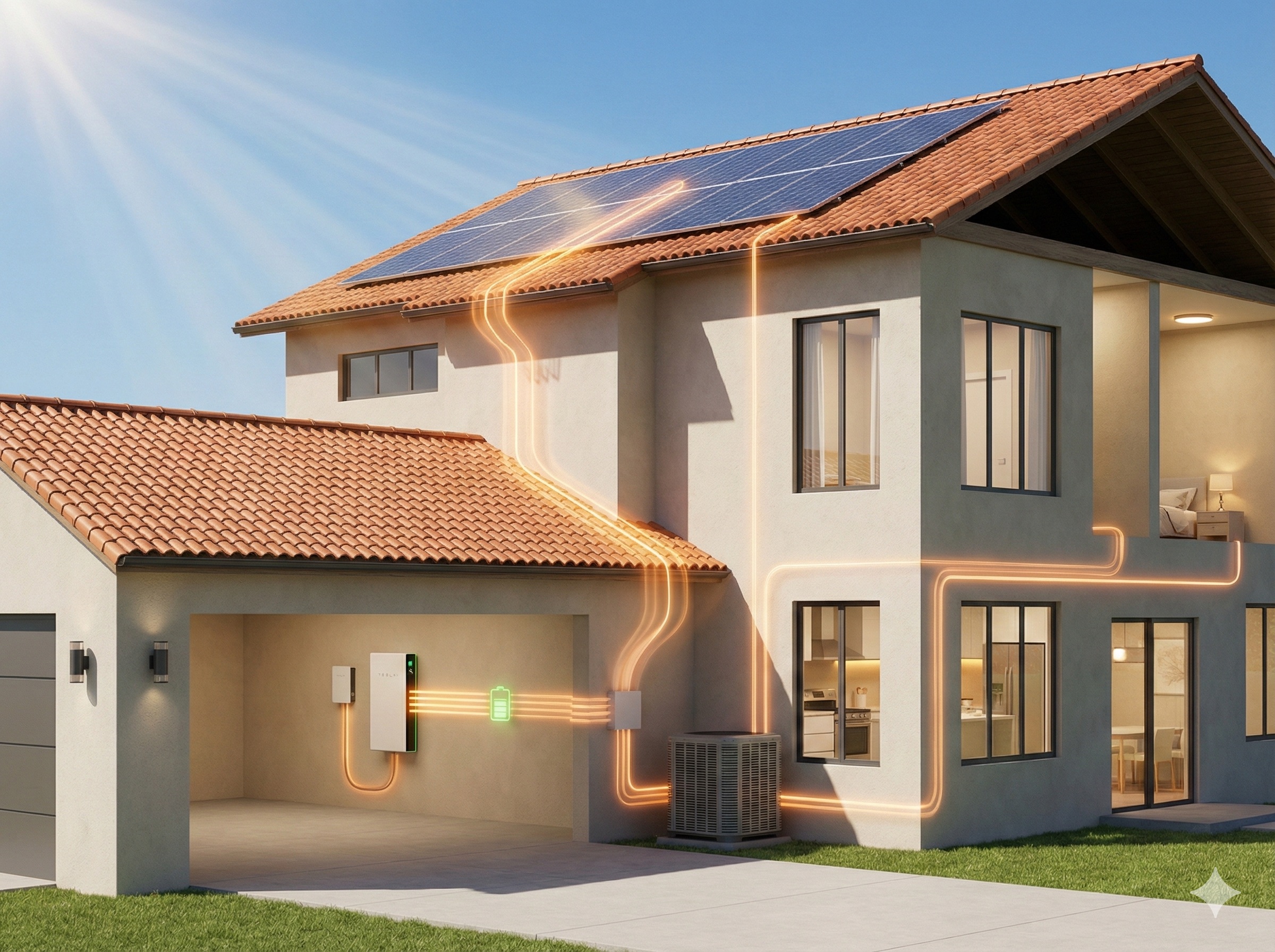
The coupling type affects how your home battery integrates with existing solar installations. AC-coupled systems include their own inverter and connect to your home's AC electrical panel, making them ideal for adding storage to existing solar arrays. DC-coupled systems connect directly to solar panels on the DC side before the inverter, offering higher efficiency for new solar-plus-storage installations.
Energy management systems continuously monitor your home's energy consumption, solar production, and battery state of charge. These intelligent controllers optimize when to charge, when to discharge, and how much power to reserve for backup purposes. The NREL ATB notes that battery costs have fallen rapidly over the past decade, with continued declines projected through 2030 across all scenarios.
Types of Residential Energy Storage
Several battery technologies compete in the house energy storage market, each with distinct advantages for different applications. Understanding these options helps you select the right solar battery storage solution for Texas.
Lithium Iron Phosphate (LFP): This lithium-ion chemistry has become the preferred choice for home battery applications. LFP batteries offer exceptional thermal stability, making them safer and more reliable in hot Texas climates. They typically provide 6,000+ charge cycles compared to 2,000-3,000 cycles for other lithium chemistries, translating to 15-20 years of useful life.
Nickel Manganese Cobalt (NMC): These lithium-ion batteries offer higher energy density than LFP, meaning more storage capacity in a smaller package. However, they require more sophisticated thermal management and have shorter cycle life. NMC batteries suit applications where space constraints outweigh longevity concerns.
Lead-Acid: According to KBV Research, the lead-acid segment is growing at 21% CAGR within residential energy storage, though lithium-ion dominates overall market share. Lead-acid batteries cost less upfront but have shorter lifespans, heavier weight, and lower efficiency. They remain an option for budget-conscious homeowners with minimal backup needs.
| Battery Type | Cycle Life | Best Climate | Cost | Recommended For |
|---|---|---|---|---|
| Lithium-ion (LFP) | 6,000+ cycles | Hot climates | Higher upfront | Most Texas homes |
| Lithium-ion (NMC) | 2,000-3,000 cycles | Controlled temps | Moderate | Space-limited installations |
| Lead-acid (AGM) | 500-1,200 cycles | Any | Lower upfront | Budget backup only |
The KBV Research analysis indicates that solar and storage systems are expected to capture more than 55% market share by 2030, while standalone storage currently holds the largest revenue share. This shift reflects growing integration between solar panels and house energy storage systems. For homeowners who are not ready to commit to solar panels, learn about home battery backup without solar options that work independently.
Coupling type represents another key decision point. AC-coupled systems work independently of your solar inverter, making them easier to retrofit. DC-coupled systems integrate with hybrid solar inverters for higher overall system efficiency but require more careful design. The 6-10 kW power rating segment is expected to achieve $1.4 billion by 2030 according to KBV Research, indicating strong demand for mid-sized residential systems.
Choosing the Right Battery for Your Home
Selecting the right house energy storage system requires evaluating your specific needs, existing equipment, and budget. Start by sizing a battery for your solar system based on your daily energy consumption and backup requirements.
Calculate Your Needs: Review your electricity bills to determine average daily consumption in kilowatt-hours. A typical Texas home uses 30-40 kWh daily, though this varies significantly based on home size and HVAC usage. For backup purposes, identify which loads you need to keep running during outages and for how long.
As Straits Research notes, "The rapid decline in the cost of lithium-ion batteries has significantly increased market adoption of residential energy storage systems." This cost trend makes larger battery capacities increasingly accessible for Texas homeowners.
Compare Leading Brands: The top solar battery storage companies offer various solutions for different needs:
| Brand | Capacity | Power Output | Best For | Texas Considerations |
|---|---|---|---|---|
| Tesla Powerwall 3 | 13.5 kWh | 11.5 kW | Whole-home backup | Widely available, strong brand recognition |
| Enphase IQ Battery | 5-15 kWh modular | 3.84 kW+ | Microinverter homes | Popular with Texas installers, flexible sizing |
| FranklinWH aPower | 13.6 kWh | 10 kW | Large AC loads | Excellent for Texas heat, smart load management |
| AlphaESS Smile | 5.7-22.9 kWh | Variable | Off-grid/ranch | Price-competitive, suitable for rural properties |
| Sonnen eco | 10-20 kWh | 8-16 kW | VPP participation | Premium quality, grid services ready |
| LG RESU | 9.8-16 kWh | 5-7 kW | Custom installations | Integrates with multiple inverter brands |
Key Specifications to Compare: Pay attention to usable capacity (actual available storage), continuous power output (how many watts the system can deliver), peak power (short-term surge capability for starting motors), round-trip efficiency (typically 85-95% for lithium-ion), and warranty terms (usually 10-12 years).
According to KBV Research, customer-owned systems hold the largest revenue share among ownership models, indicating that most homeowners prefer purchasing their house energy storage systems outright rather than leasing. This ownership model typically provides the best long-term value, especially for homes that already have or plan to add solar panels.
House Energy Storage in Texas
Texas presents unique opportunities and challenges for house energy storage. Understanding whether solar batteries are worth it in your specific situation requires considering the state's distinctive energy market and climate conditions.
ERCOT Grid Considerations: The Electric Reliability Council of Texas operates an isolated grid serving most of the state. Unlike other regions that can import power from neighboring grids during emergencies, Texas must meet its own electricity demands. This independence increases the value of residential backup power, particularly following high-profile reliability events.
Deregulated Market Advantages: Texas's competitive retail electricity market allows homeowners to choose from numerous providers offering different rate structures. Many retail electric providers offer solar buyback programs that credit homeowners for excess energy exported to the grid. However, as these buyback rates become less generous, home battery storage becomes more valuable for maximizing the value of your solar investment.
Storm Resilience: Texas faces extreme weather from multiple directions. Gulf Coast hurricanes, winter ice storms, summer heat waves, and severe thunderstorms all threaten grid reliability. A properly sized house energy storage system keeps critical loads running through extended outages, protecting your family and property.

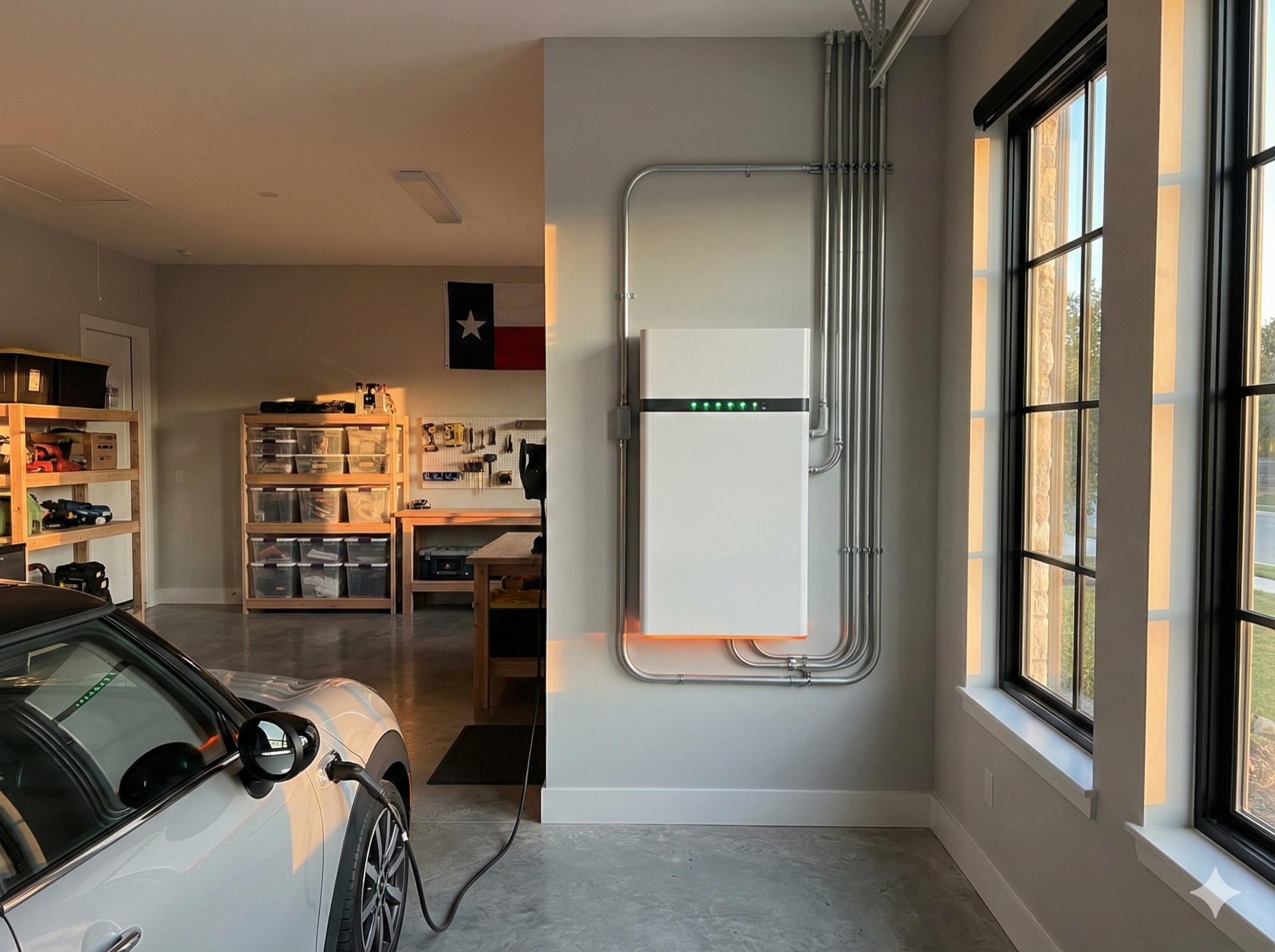
Installation Considerations for Texas Climate: Heat significantly impacts battery performance and longevity. The most common installation location is an attached garage, which provides shade and some temperature moderation. LFP chemistry batteries handle high temperatures better than NMC alternatives, making them preferred for Texas installations.
Critical Load Priorities for Texas Homes:
- Air conditioning (at least one zone) for extreme heat protection
- Refrigerator and freezer for food preservation
- Medical equipment if required
- Well pump for rural properties
- Communications and internet equipment
- Essential lighting
Texas homes typically have larger cooling loads than the national average, requiring careful system sizing. A FranklinWH or similar system with smart load management can help stretch battery capacity during extended outages by cycling HVAC systems efficiently while maintaining safe indoor temperatures.
Home Battery Trends for 2026
The house energy storage landscape continues to evolve rapidly. According to Fact.MR, "Expansion of grid-interactive residential applications, including advanced bidirectional power systems and next-generation battery solutions, will shape the next phase of residential energy storage market development."
Virtual Power Plants (VPPs): Utilities and aggregators are enrolling residential batteries in virtual power plant programs. These programs pay homeowners to allow controlled discharge of their batteries during grid emergencies. ERCOT is exploring distributed energy resource programs that could eventually include residential house energy storage systems.
Bidirectional EV Charging: Vehicle-to-home (V2H) technology transforms electric vehicles into mobile power sources. As this technology matures in 2026, homeowners may be able to use their EV batteries as backup power, potentially reducing the size of dedicated home battery systems needed.
AI-Powered Energy Management: Smart controllers increasingly use artificial intelligence to predict energy consumption patterns, weather conditions, and utility rate changes. These systems automatically optimize when to charge, when to discharge, and how much capacity to reserve for emergencies.
Continued Cost Declines: The NREL Annual Technology Baseline projects continued cost declines for residential battery storage through 2030 across all scenarios. These declining costs, combined with rising grid electricity prices, improve the financial case for house energy storage each year.
According to Straits Research, the residential energy storage market will grow from $10.32 billion in 2024 to $37.65 billion by 2032. This growth trajectory suggests house energy storage will become standard equipment for new construction and an increasingly common retrofit for existing homes.
Next Steps: Getting Started with House Energy Storage
Ready to explore house energy storage for your Texas home? Follow these steps to move forward with confidence:
- Assess Your Energy Needs: Review your electricity bills from the past 12 months. Calculate average daily consumption and identify peak usage patterns. Consider which loads are most critical during outages.
- Evaluate Your Current Setup: If you already have solar panels, determine their capacity and age. Understand your current solar buyback arrangement and whether storage would improve your energy economics.
- Research Local Incentives: While Texas lacks a state-level solar battery incentive, some municipal utilities offer rebates. Federal tax credits may apply to battery installations paired with solar.
- Get Multiple Quotes: Request proposals from at least three qualified installers. Compare not just prices but also equipment options, warranty terms, and company reputation.
- Connect with an Energy Consultant: A knowledgeable advisor can help you navigate electricity plan options, evaluate whether house energy storage makes financial sense for your situation, and identify the best combination of solar and battery equipment.
Contact VIP Energy Service Today
Our team specializes in helping Texas homeowners optimize their energy setup. Whether you're considering house energy storage, solar panels, or both, we can guide you through the options and connect you with the right resources.
Call (817) 402-2664 or get your free energy quote to start the conversation.
Compare rates and plans to see how your current electricity setup stacks up.
Sources
- Straits Research - Residential Energy Storage Systems Market Report (2023)
- Fact.MR - Residential Energy Storage Market Analysis (2024)
- KBV Research - Residential Energy Storage Market Forecast (2024)
- Cognitive Market Research - North America Residential Energy Storage (2024)
- NREL Annual Technology Baseline - Residential Battery Storage (2023)
- U.S. Energy Information Administration - Battery Storage Analysis (2024)
- Fortune Business Insights - Residential Energy Storage System Market (2024)
Updated October 2026. When choosing a solar battery for a Texas home, there are four things to look at closely: maximum power output, how well it handles Texas heat, the warranty, and compatibility with your existing or planned solar equipment. This guide reviews the solar batteries Texas installers quote the most, using EnergySage marketplace data and each manufacturer's most recent spec sheet. Changes to the federal tax credit this year affect a lot of families, so those are covered too. If cost is your first question, start with this breakdown of home battery storage cost in 2026.
The best solar battery for most Texas homes in 2026 is a lithium iron phosphate (LFP) battery, and Tesla Powerwall 3 is the best all-around pick, with 13.5 kWh of usable storage, 11.5 kW of continuous power and a built-in inverter. FranklinWH aPower 2 is the pick for large homes that want whole-home backup (15 kWh, 10 kW, 15-year warranty). If your solar system already runs on Enphase microinverters, go with the Enphase IQ Battery 10C. Plan on about $1,000 per kWh installed in Texas, roughly $13,000 for a typical 13 kWh system, and keep in mind that the 30% federal tax credit no longer applies to batteries homeowners buy and install in 2026.
Table of Contents
- Best Solar Batteries of 2026 at a Glance
- How These Batteries Were Compared
- The Best Solar Batteries for Texas Homes, Reviewed
- LFP vs NMC vs Lead-Acid: Why Chemistry Matters in Texas Heat
- What a Solar Battery Costs in Texas in 2026
- The Federal Tax Credit Changed in 2026
- Texas Programs That Pay Battery Owners
- How to Choose the Right Solar Battery
- Solar Battery FAQs
- Next Steps: Getting Started
Best Solar Batteries of 2026 at a Glance
| Battery | Usable capacity | Continuous power | Chemistry | Warranty | Best for |
|---|---|---|---|---|---|
| Tesla Powerwall 3 | 13.5 kWh | 11.5 kW | LFP | 10 years | Best overall, new solar installs |
| FranklinWH aPower 2 | 15 kWh | 10 kW | LFP | 15 years or 60 MWh | Whole-home backup, large homes |
| Enphase IQ Battery 10C | 10 kWh | About 7.1 kW | LFP | 15 years | Homes with Enphase microinverters |
| Enphase IQ Battery 5P | 5 kWh | 3.84 kW | LFP | 15 years | Small, modular add-ons |
| SolarEdge Home Battery | 9.7 kWh | 5 kW | Varies by model | 10 years | Homes with SolarEdge inverters |
| Sol-Ark L3 Series | Modular | Set by the Sol-Ark inverter | LFP | 10 years (product) | Texas-based brand, large or off-grid systems |
Specs come from each manufacturer's current data sheet. Capacity is per unit, and most of these batteries can be stacked for more storage.
How These Batteries Were Compared
A battery spec sheet has lots of numbers. Six are critical for performance in a Texas home.
- Usable capacity (kWh): how much energy you can draw, which sets how long the battery lasts on a charge.
- Continuous power (kW): how many appliances it can run at once. This is the number that decides whether your central AC stays on during an outage.
- Chemistry: LFP holds up better in heat and is the safer chemistry, which is why nearly every 2026 model here uses it.
- Roundtrip efficiency: how much of the energy you put in comes back out.
- Warranty and end-of-warranty capacity: most warranties promise about 70% of original capacity at the end of the term.
- Compatibility: AC-coupled batteries can be added to almost any solar system, while DC-coupled batteries work best with their own brand's inverter.
Average quoted prices and roundtrip efficiency figures come from EnergySage's 2026 battery ranking, which is built from real installer quotes on its marketplace.
The Best Solar Batteries for Texas Homes, Reviewed
Tesla Powerwall 3: Best Overall
Powerwall 3 is the most-quoted battery on the EnergySage marketplace, and EnergySage ranks it number one for 2026. Each unit stores 13.5 kWh and delivers 11.5 kW of continuous power, comfortably above what a typical central air conditioner draws while it runs. It also has a hybrid solar inverter built in, so a new solar-plus-battery install needs less equipment on the wall. Powerwall 3 uses LFP cells, a change from the NMC chemistry in the older Powerwall 2.
Key specs: 13.5 kWh usable, 11.5 kW continuous, 97.5% roundtrip efficiency, 10-year warranty, about $998 per kWh average quoted price (EnergySage).
The tradeoff: you get the most out of Powerwall 3 when it's paired with its own inverter. If your roof is shady or complex and you want panel-level microinverters, an Enphase system may fit better.
Best for: new solar installs, EV owners, whole-home backup
FranklinWH aPower 2: Best for Whole-Home Backup
The aPower 2 packs 15 kWh into a single unit, one of the largest capacities available from an established brand. It delivers 10 kW of continuous power and 15 kW of peak power, which helps with the startup surge from AC compressors and well pumps. The warranty runs 15 years or 60 MWh of throughput, one of the longest on the market, and the aGate controller manages solar, grid, battery and a backup generator from one place.
Key specs: 15 kWh usable, 10 kW continuous (15 kW peak), 90% roundtrip efficiency, 15-year or 60 MWh warranty, about $1,177 per kWh average quoted price (EnergySage).
The tradeoff: at 90% roundtrip efficiency, it loses a bit more stored energy than Powerwall 3.
Best for: large homes, whole-home backup, homes that also run a standby generator
Enphase IQ Battery 10C and 5P: Best for Enphase Systems
Enphase batteries are AC-coupled and designed to work with Enphase microinverters, so they're the natural choice if your solar system already uses them. The IQ Battery 10C stores 10 kWh with about 7.1 kW of continuous power. The smaller IQ Battery 5P stores 5 kWh with 3.84 kW. Both use LFP chemistry and carry a 15-year limited warranty. Because the units are modular, you can start small and add capacity later.
Key specs (IQ Battery 10C): 10 kWh usable, about 7.1 kW continuous, 90% roundtrip efficiency, 15-year limited warranty, about $1,404 per kWh average quoted price (EnergySage).
The tradeoff: Enphase is one of the more expensive options per kWh, and EnergySage rates its energy optimization features as more limited than Tesla's or FranklinWH's.
Best for: Enphase microinverter systems, homeowners who want to expand over time
SolarEdge Home Battery: Best for SolarEdge Systems
If your panels feed a SolarEdge inverter, the SolarEdge Home Battery connects on the DC side and charges straight from your panels. It stores 9.7 kWh per unit, with 5 kW of continuous power and a 10-year warranty.
Key specs: 9.7 kWh usable, 5 kW continuous, 94.5% roundtrip efficiency, 10-year warranty, about $1,532 per kWh average quoted price for the BAT-10K (EnergySage).
The tradeoff: because it's DC-coupled, it only makes sense with a SolarEdge inverter, and its power output is lower than similarly priced batteries.
Best for: homes with SolarEdge inverters
Sol-Ark L3 Series: The Texas-Based Option
Sol-Ark is headquartered in Allen, Texas, just north of Dallas. Its L3 Series batteries use LFP chemistry, come in indoor and outdoor versions and carry a 10-year product warranty, with a throughput-based performance warranty that varies by configuration. They're built to pair with Sol-Ark hybrid inverters and scale to large systems, which suits bigger homes, rural properties and off-grid setups.
The tradeoff: the battery and inverter are a package decision, so you're buying into the Sol-Ark ecosystem.
Best for: Texas homeowners who want a Texas-based brand, larger or off-grid systems
Newer Names You May See on a Quote
EnergySage's 2026 ranking also includes two newer brands: the MidNite Solar Powerflo 16, with 16 kWh in one unit and a 15-year warranty, and the Sigenergy SigenStor, which posted the highest roundtrip efficiency on its list at 98%. Both post strong specs at lower prices per kWh. The catch is a shorter track record, so ask your installer how many they've installed and who handles warranty service in Texas.
For a look at the companies behind these products, see the guide to top solar battery storage companies for Texas homes.
LFP vs NMC vs Lead-Acid: Why Chemistry Matters in Texas Heat
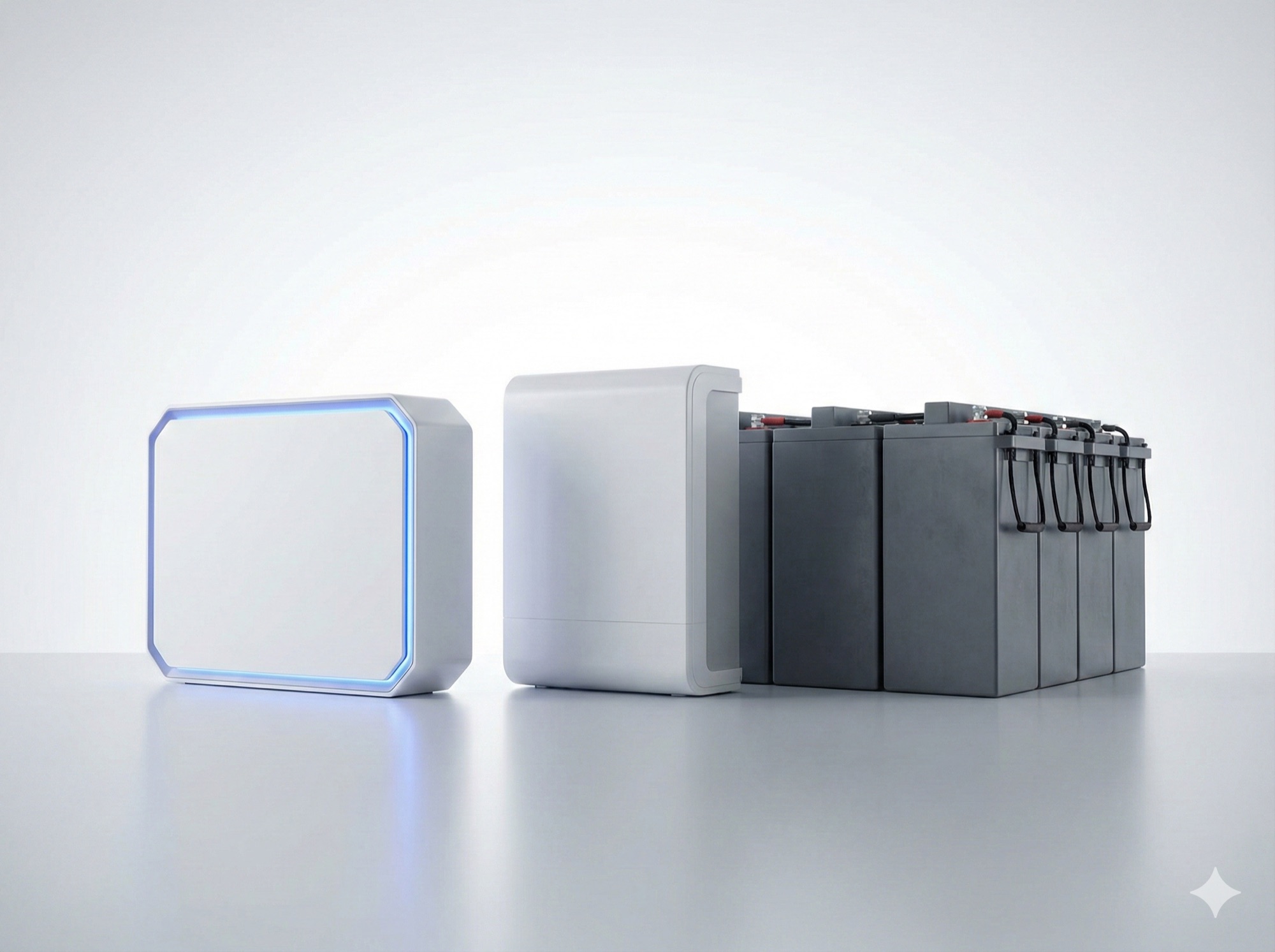
Most home batteries sold in 2026 use lithium iron phosphate (LFP). It's more thermally stable than nickel manganese cobalt (NMC), the chemistry in many older lithium-ion batteries like Powerwall 2, and it handles deep daily cycling well. That matters in a Texas garage that can sit in the 90s or higher through August. No matter what battery you choose, look for the operating temperature range on the spec sheet. Talk to your installer about where the battery will be placed to avoid direct afternoon sun.
Lead-acid batteries still cost less up front, but you can only use about half their capacity and they wear out much sooner. Today they make sense only for small off-grid or legacy setups.
| Battery type | Usable capacity | Typical cycle life | Best for |
|---|---|---|---|
| LFP | 90% or more | 6,000+ cycles | Most Texas homes in 2026 |
| Lithium-ion (NMC) | About 90% | 4,000-5,000 cycles | Older models such as Powerwall 2 |
| Lead-acid | About 50% | 1,500-2,000 cycles | Small off-grid or legacy setups |
Curious how the pieces fit together? See how PV and battery systems work together.
What a Solar Battery Costs in Texas in 2026
EnergySage's Texas data puts installed battery storage at about $1,000 per kWh before incentives, or roughly $13,000 for a typical 13 kWh system (updated September 2026). The national average is higher, at about $1,159 per kWh and $15,647 for an average system.
Your price depends on the battery, how many units you stack, whether you need a main panel upgrade, and whether the battery goes in with new solar or gets added to an existing system. Brand matters too. On EnergySage's marketplace, average quoted prices run from about $998 per kWh for Powerwall 3 to about $1,532 per kWh for the SolarEdge BAT-10K.
For a deeper look at pricing, see the cost of battery storage per kWh guide. And if you're still deciding whether a battery pays off at all, read whether solar batteries are worth it in Texas.
The Federal Tax Credit Changed in 2026
Earlier versions of this guide pointed to the 30% federal Residential Clean Energy Credit. That's no longer available for new installs. The One Big Beautiful Bill Act ended the credit (Section 25D) for expenditures made after December 31, 2025, and the IRS treats an expenditure as made when installation is completed. So a battery a homeowner buys and has installed in 2026 doesn't qualify, even if it was paid for in 2025.
Two things still matter. If your battery was installed in 2025 or earlier and you couldn't use the whole credit that year, the unused amount can carry forward to future returns. And if an installer offers a lease or power purchase agreement, the federal rules for third-party-owned residential systems changed too, so ask in writing how any incentive is handled and how it affects your price. Tax situations vary, so talk with a tax professional before you count on any credit.
Texas Programs That Pay Battery Owners
With the federal credit gone, programs closer to home carry more weight. In the deregulated parts of Texas served by Oncor, CenterPoint, AEP Texas and TNMP, ERCOT's Aggregated Distributed Energy Resource (ADER) pilot lets home batteries join virtual power plants, with compensation passed through participating retail electricity providers. Tesla Electric, for example, credits enrolled Powerwall owners for virtual power plant participation. Homes served by a municipal utility or an electric co-op should check with that utility directly, since several run their own battery programs.
In the deregulated market, your electricity plan also affects what a battery saves you. A battery can charge during cheaper or free hours and power your home during the hours with higher rates. See how that works in Solar + Battery + Free Nights: The Texas Triple Play. If you export extra solar to the grid, compare the best solar buyback plans in Texas and learn how Texas solar buyback programs work. You can also compare Texas electricity rates and plans.
How to Choose the Right Solar Battery
Start with your bill. Divide your monthly kWh by 30 to get daily use (here's how many kWh a Texas home uses per day in summer), then decide what you want the battery to do.
- Backup for essentials (fridge, lights, internet and a few outlets): one 10 to 13.5 kWh battery usually covers essentials overnight.
- Whole-home backup with central AC: look at continuous power first. You'll likely want 10 kW or more of continuous output, which means a Powerwall 3, an aPower 2, or two smaller units working together.
- Bill savings: pick a battery with full time-of-use controls and pair it with a plan built around cheaper hours.
Batteries need to be matched to your solar equipment. An Enphase microinverter system points to an Enphase battery. SolarEdge equipment points to SolarEdge batteries. A new install gives you the most flexibility, and that's where the Powerwall 3 and the FranklinWH aPower 2 are worth a close look.
Read your warranty for the number of years covered and the share of original capacity guaranteed at the end of the term. Most promise about 70%.
For the full sizing math, see how to size a home battery. For Texas-specific setups, the Texas solar battery storage guide and the home battery storage guide for Texas go further.
Solar Battery FAQs
What is the best solar battery for a Texas home?
For most homes, Tesla Powerwall 3. It combines 13.5 kWh of storage, 11.5 kW of continuous power, LFP chemistry and a built-in inverter, and it tops EnergySage's 2026 ranking. FranklinWH aPower 2 is the better fit for very large homes that want whole-home backup.
Can a solar battery run my air conditioner?
Yes, if it has enough continuous and peak power. For whole-home backup with central AC, look for 10 kW or more of continuous output, or plan on stacking two units.
Is there still a federal tax credit for solar batteries in 2026?
Not for batteries homeowners buy and install in 2026. The 30% Section 25D credit ended for expenditures made after December 31, 2025. Virtual power plant programs and local utility programs are the places to look for battery incentives now.
How long do solar batteries last?
Most come with 10 to 15 year warranties that guarantee about 70% of original capacity at the end of the term. LFP batteries typically last longer than older NMC or lead-acid designs.
Do I need solar panels to get a home battery?
No. A battery can charge from the grid and still give you backup power and shift your usage to cheaper hours. Learn more about home battery backup without solar.
What happens to solar panels in a power outage without a battery?
Most grid-tied solar systems shut off during an outage for safety, so panels alone won't keep your lights on. A battery is what lets solar keep powering your home. See why solar panels stop during a power outage.
Next Steps: Getting Started
- Pull 12 months of bills and note your daily kWh use and your summer peak.
- Decide on backup priorities: essentials only or whole-home coverage.
- Get two or three quotes from installers certified for the battery you want.
- Compare quotes on the same terms: ask each installer for continuous power, end-of-warranty capacity and total installed price per kWh.
- Check for programs with your retail electricity provider or utility before you sign.
- Review your electricity plan so the battery charges during your cheapest hours.
For Texas homeowners who want reliable home battery backup, the right battery can pay off twice: lower bills on normal days and peace of mind when the grid goes down. To find a qualified installer, start with the guide to the best solar providers in Texas.
Battery prices, specs and program terms in this guide come from the sources listed below as of October 2026 and change often. Plan details and rates subject to change.
Sources
- EnergySage: Best solar batteries for your home in 2026
- EnergySage: Texas battery storage cost data (updated September 2026)
- EnergySage: How much do batteries cost
- Tesla: Powerwall 3 technical specifications
- Enphase: IQ Battery 10C data sheet
- Enphase: IQ Battery 5P data sheet
- FranklinWH: aPower 2
- SolarEdge: Home Battery data sheet
- Sol-Ark: Products
- IRS: FAQs on the One Big Beautiful Bill changes to Section 25D
- IRS: Instructions for Form 5695
- Tesla: Tesla Electric virtual power plant
- U.S. DOE: Solar-Plus-Storage
Update, October 2026: According to the IRS, the 30% federal Residential Clean Energy Credit is not available for systems placed in service after December 31, 2025. Mentions of the credit below apply only to systems installed by then. Texas utility rebates and the Texas property tax exemption may still lower your cost.

A home battery wall is a wall-mounted lithium-ion storage system that stores electricity from solar panels or the grid, providing backup power during outages and reducing electricity bills through time-of-use optimization. For Texas homeowners, these systems offer critical protection against ERCOT grid instability, with the 30% federal tax credit and Texas property tax exemptions making 2026 an ideal time to invest in home energy independence.
Table of Contents
- What Is a Home Battery Wall?
- Why Texas Homeowners Need Battery Backup
- How Home Battery Wall Systems Work
- Top Home Battery Brands Compared
- Costs, Incentives & ROI for Texas
- Choosing the Right Battery for Your Home
- Next Steps: Getting Started
What Is a Home Battery Wall?
A home battery wall is a compact, wall-mounted energy storage system that captures and stores electricity for later use. These lithium-ion battery systems connect to your home's electrical panel and can store power from solar electricity plans in Texas or the grid during off-peak hours.
Common names include Tesla Powerwall, home battery backup, and wall-mounted battery storage. Understanding how solar storage works helps homeowners maximize the benefits of these energy storage systems.
Why Texas Homeowners Need Battery Backup
The Texas power grid has faced increasing challenges in recent years. According to NATiVE Solar, "ERCOT continues hitting record energy demand" as population growth, EV adoption, and air conditioning loads increase.
A 2025 homeowner survey by Charge Home Solutions found that 57% of homebuyers now consider battery backup a desirable feature when purchasing a home.
"Texas homeowners have seen the power grid struggle in recent years. Heatwaves, winter storms, and grid overloads cause frequent outages. Many families now search for a reliable backup. Home battery backup offers a clear solution."
— EcoFlow Texas Home Battery Backup Guide 2025
Home battery wall systems provide essential backup power during Texas heat waves, winter storms, and other grid stress events. Cities like Houston, Dallas, Austin, and San Antonio have experienced more frequent outages as Texas population grows faster than grid capacity. Not sure what capacity you need? Check out our guide on how to size a home battery for your specific needs.
How Home Battery Wall Systems Work
A home battery wall system operates through a simple charge-and-discharge cycle. During the day, solar panels or off-peak grid electricity charges the battery. When power demand peaks or the grid fails, the battery automatically powers your home.
"In Texas, electricity prices change throughout the day. Batteries store energy when prices are low. They power the home when prices rise. This saves money every month." Curious about the investment? Our guide to home battery storage cost breaks down everything you need to know about pricing.
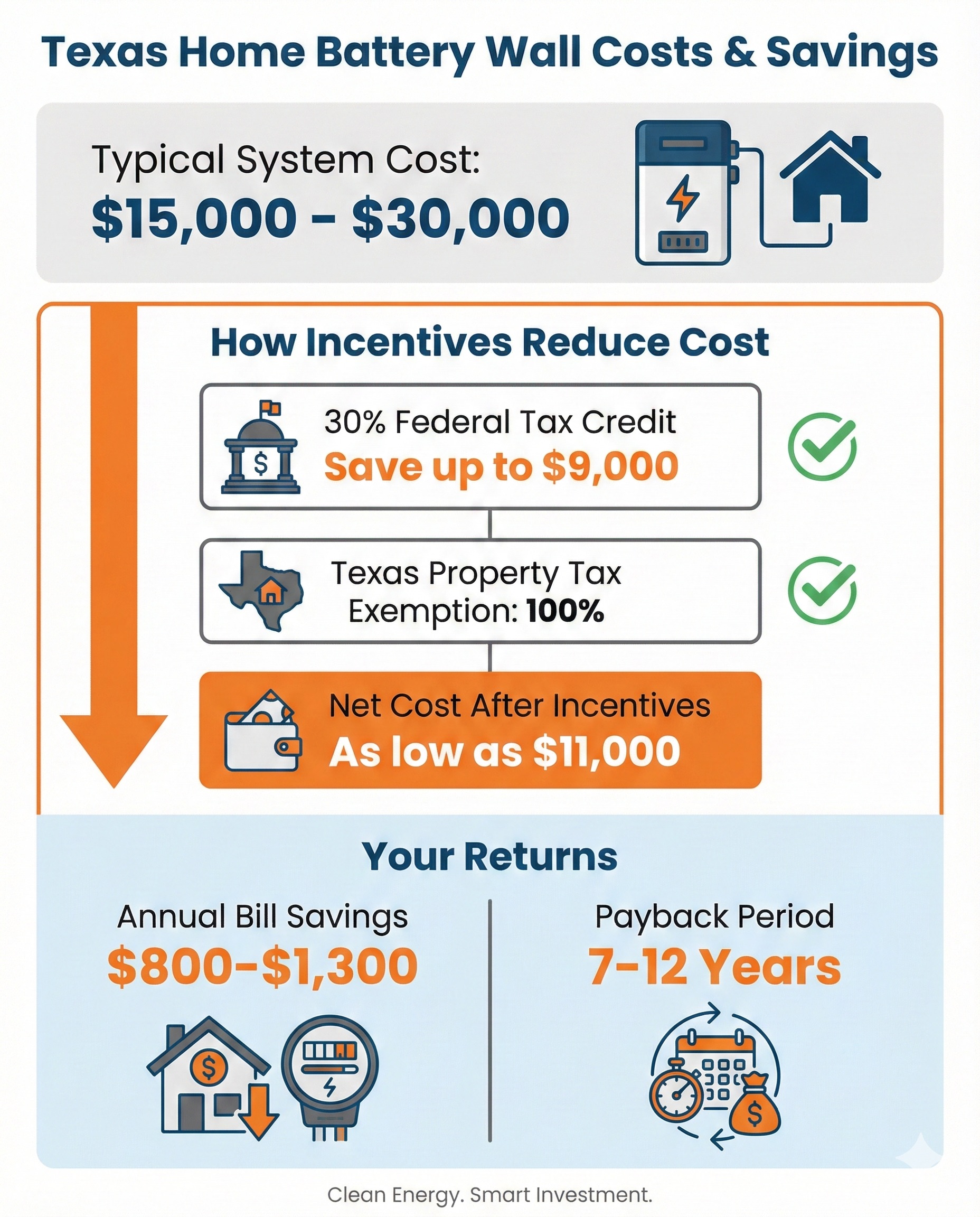
According to Charge Home Solutions, homeowners with solar and time-of-use optimization see typical annual bill savings of $800–$1,300.
Home battery systems come in two main configurations:
- Whole-house backup: Powers your entire home during outages
- Critical loads backup: Powers essential circuits like refrigerators, medical equipment, and lights
Most wall-mounted batteries use lithium iron phosphate (LFP) chemistry for long cycle life and safety. These energy storage systems integrate with renewable energy companies in Texas for complete solar + storage solutions.
Top Home Battery Brands Compared
Several home battery wall brands compete in the Texas market. Here's how the leading options compare:
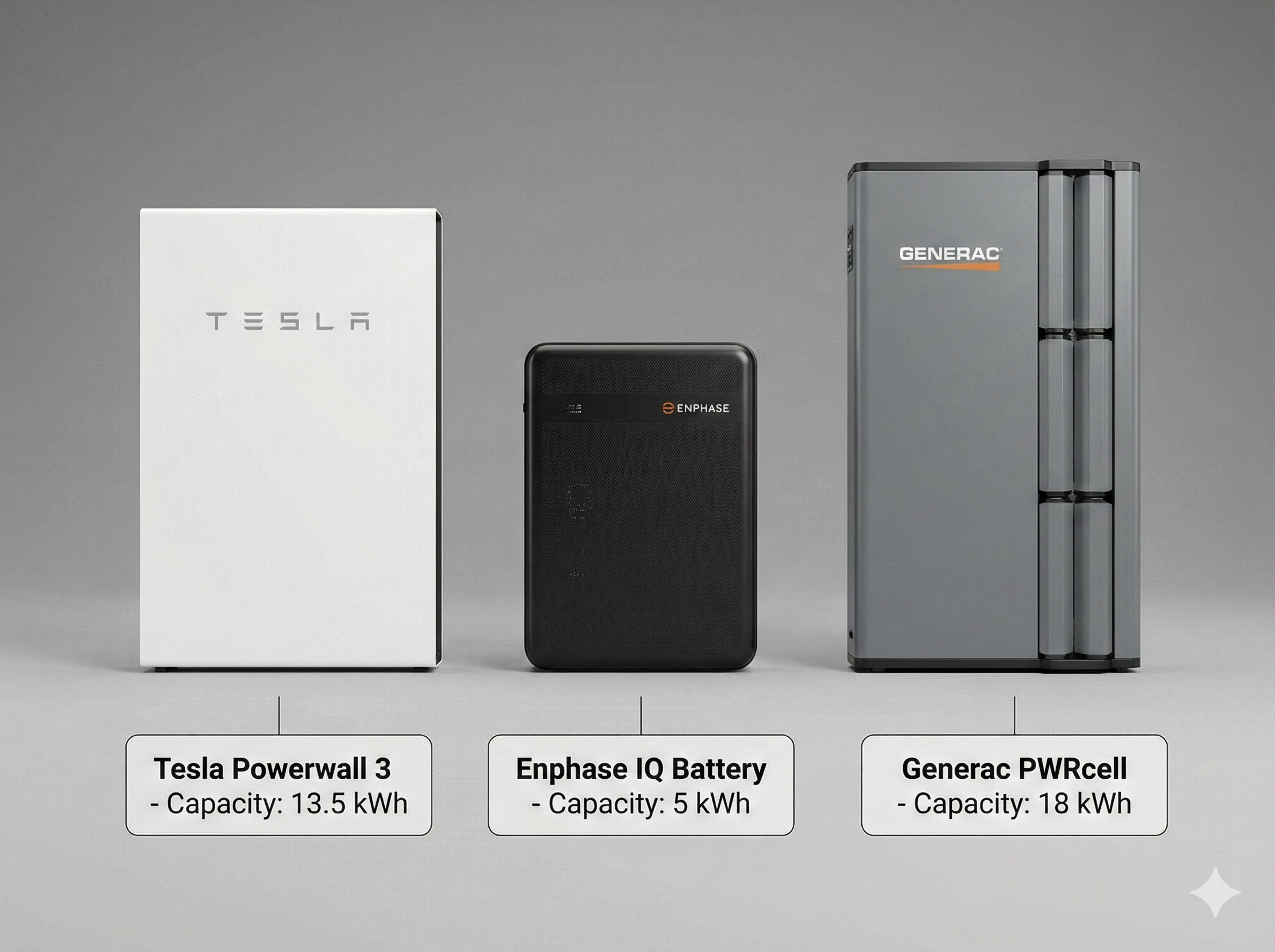
| Brand | Capacity | Key Feature | Best For |
|---|---|---|---|
| Tesla Powerwall 3 | 13.5 kWh | Tesla ecosystem integration | Tech-forward homes |
| Enphase IQ Battery | 5 kWh (modular) | Enphase microinverter pairing | Existing Enphase systems |
| LG Home 8 | 16 kWh | Compact design | Space-constrained installs |
| Generac PWRcell | 9-18 kWh | Generator combination | Rural Texas homes |
| SolarEdge Home Battery | 9.7 kWh | DC efficiency | SolarEdge solar systems |
Tesla Powerwall leads the market with strong brand recognition and seamless app integration. Generac PWRcell appeals to rural Texas homeowners who want generator and battery backup combined. The modular Enphase IQ Battery works best for homes already using Enphase microinverters.
Costs, Incentives & ROI for Texas
A home battery wall system typically costs $15,000–$30,000 before incentives. However, Texas homeowners benefit from significant cost reductions.
The 30% federal Investment Tax Credit (ITC) applies to home battery systems through 2025. According to EcoFlow's Texas guide, a 20 kWh system at $30,000 could receive approximately $9,000 in federal credits plus up to $10,000 in local rebates, reducing net cost to about $11,000.
"Texas Property Tax Code Section 11.27 provides a 100% property tax exemption for the added home value from solar and battery installations."
This exemption saves approximately $300–$400 per year based on Dallas County's 2.18% property tax rate. Combined with Ambit Energy's competitive solar buyback rate, homeowners can maximize their solar buyback returns.
Most Texas homeowners see payback periods of 7–12 years when combining the federal tax credit, avoided outage costs, and time-of-use rate savings.

Choosing the Right Battery for Your Home
Selecting the right home battery wall system depends on your specific needs. Review your electricity bills to determine daily kilowatt-hour usage. A typical Texas home uses 40-50 kWh per day, but central air conditioning can significantly increase demand during summer months.
Texas SB 1252, effective September 2025, streamlines permitting for residential energy backup systems under 50 kW / 100 kWh.
"Cities can no longer create extra inspections, local ordinances, or permitting restrictions for these larger systems… If your system meets standard electrical code… the city can't slow-walk approvals."
— Adam Glick, NATiVE Solar
Consider these factors when sizing your home battery wall:
- Daily energy consumption: Match battery capacity to outage duration needs
- Climate: Texas heat affects battery performance; indoor or shaded mounting extends life
- Solar integration: Pair with Texas solar buyback programs for maximum savings
- Critical load requirements: Identify essential circuits for backup power
Next Steps: Getting Started
Ready to invest in a home battery wall system? Here's how to begin:
- Assess your energy needs: Review recent electricity bills and identify critical loads
- Get multiple quotes: Contact certified installers for competitive pricing
- Understand incentives: Confirm 30% ITC eligibility and local utility rebates
- Pair with solar buyback: Ambit Energy offers a true competitive solar buyback rate—one of only two providers in Texas with this benefit
Take the first step toward energy independence. Get your free energy quote today and discover how a home battery wall can protect your Texas home while reducing electricity costs.
Ambit Energy also offers no deposit electricity plans for customers who want to start saving immediately without upfront costs.
Related reading: Home Battery Backup Without Solar


