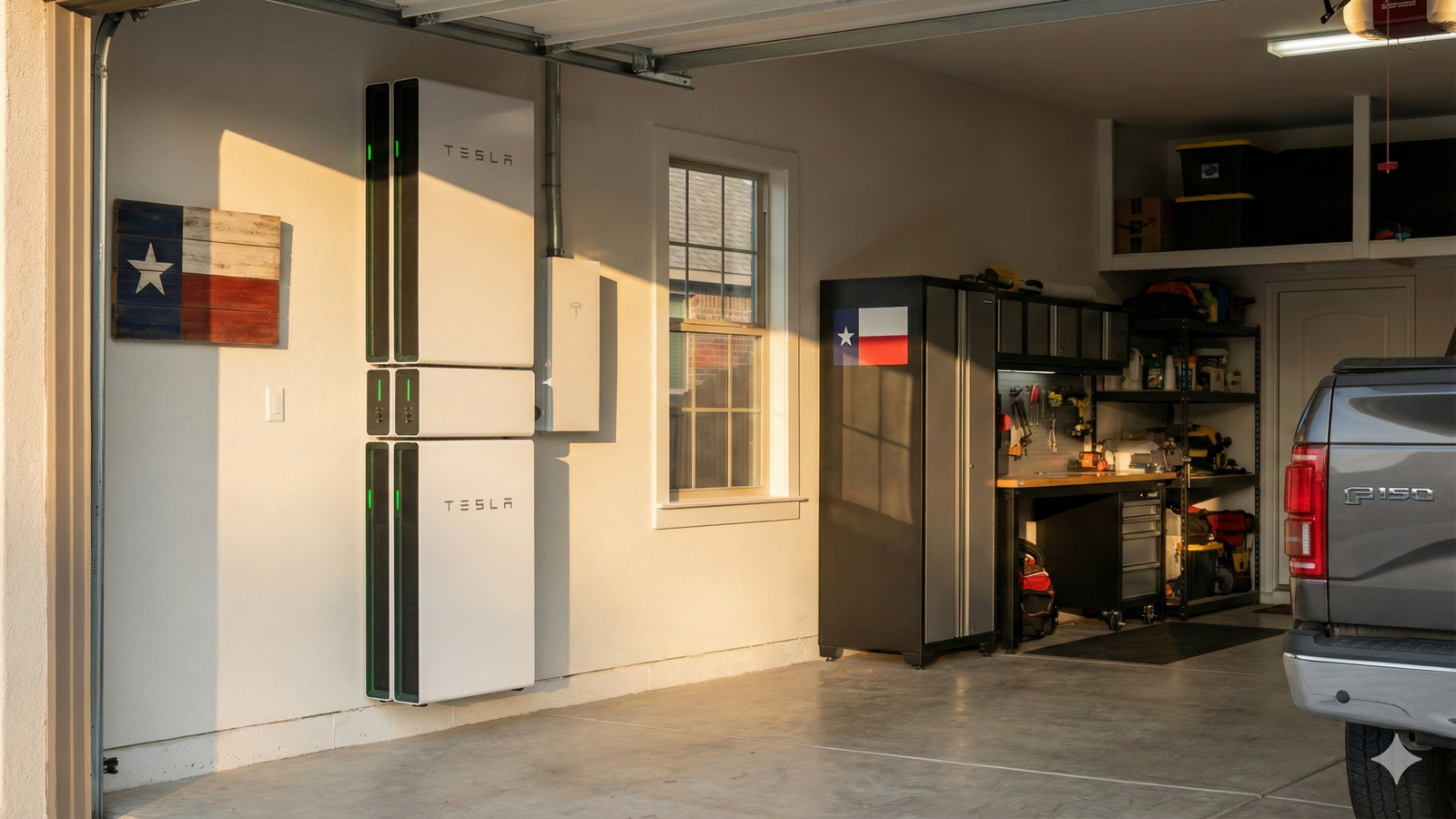
Updated November 2026: This guide now includes a working Ah calculator, 2026 battery costs from EnergySage, and current specs for Tesla Powerwall 3 and the Enphase IQ Battery 10C. According to the IRS, the 30% federal Residential Clean Energy Credit isn't available for systems placed in service after December 31, 2025.
Texas summers push air conditioners to their limits, and winter storms and hurricanes can knock the power out for days. When you buy a home battery, size is the decision that matters most. Too small and it runs dry halfway through an outage. Too big and you've paid for capacity you'll never touch.
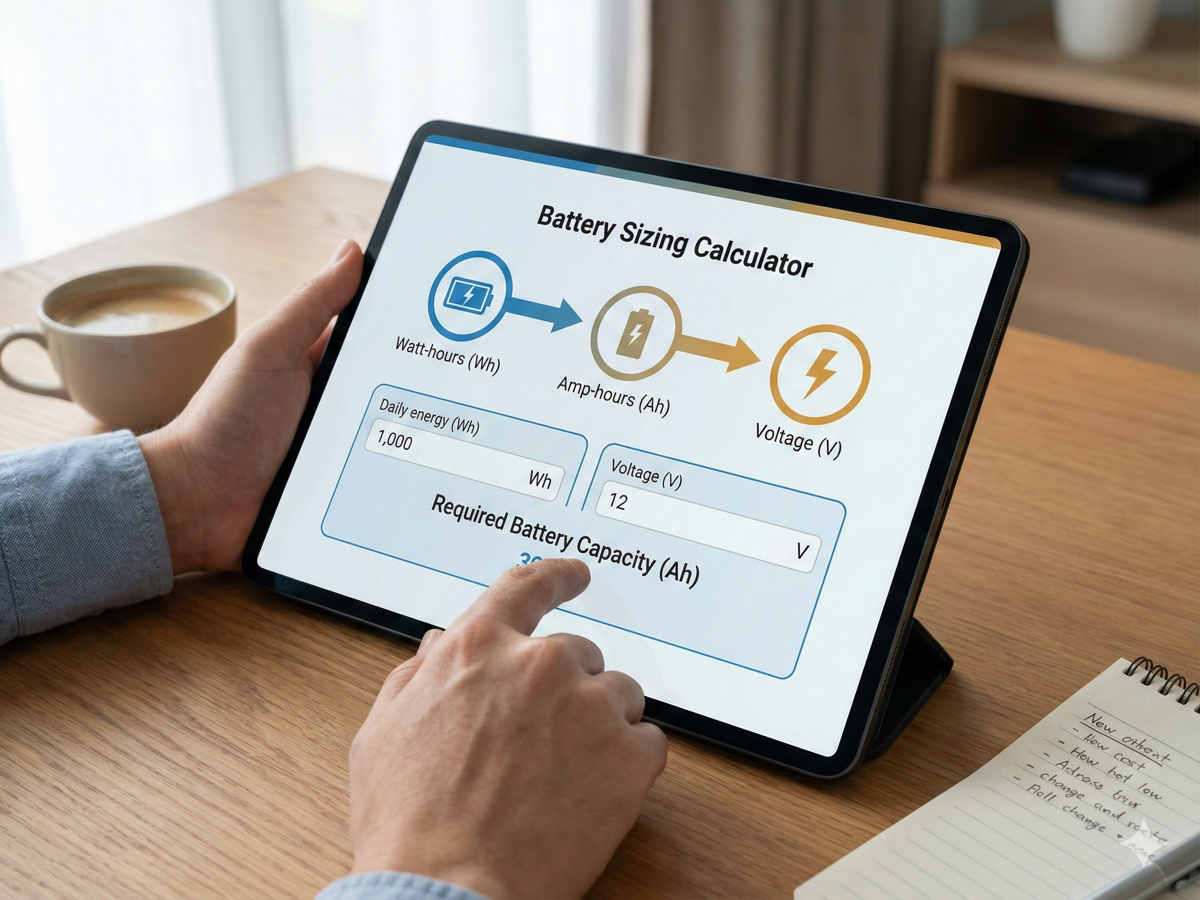
The solar battery Ah calculator below does the math for you. Enter how much energy you want to cover, how long it has to last and your battery voltage, and it returns the amp-hours (Ah), the bank size in kWh and how many batteries that takes. The rest of this guide explains each input so you can trust the number. If you're still setting a budget, start with the whole house battery backup cost guide.
Results are planning estimates. An installer should confirm the final design, including inverter size and wiring.
The defaults match the Texas critical-loads example further down: 5 kWh a day, one day of backup and a 48V lithium bank. Change any field and the results update. Shopping for a packaged battery like a Tesla Powerwall 3 or an Enphase IQ Battery 10C? Those are rated in usable kWh, not amp-hours, so compare the usable kWh line with the spec sheet.
An amp-hour measures how much current a battery can deliver over time. In theory, a 100 Ah battery can supply 100 amps for 1 hour, 10 amps for 10 hours or 1 amp for 100 hours. Think of it as the size of the fuel tank.
Amp-hours alone don't tell you how much energy is stored, though. Voltage matters too, and the conversion is simple:
So the same 100 Ah rating can mean very different amounts of energy:
| Battery | Energy Stored |
|---|---|
| 100 Ah at 12V | 1.2 kWh |
| 100 Ah at 24V | 2.4 kWh |
| 100 Ah at 48V | 4.8 kWh |
| 100 Ah at 51.2V (a typical "48V" lithium module) | 5.12 kWh |
Most "48V" lithium iron phosphate (LiFePO4) modules are actually 51.2V nominal, because they stack 16 cells at 3.2V each. That's why two batteries with the same Ah rating can hold different amounts of energy. When you compare brands, compare kWh.
Your system voltage also changes how many amp-hours you need for the same energy. Here's what 10 kWh takes:
| System Voltage | Ah Required for 10 kWh |
|---|---|
| 12V | 833 Ah |
| 24V | 417 Ah |
| 48V | 208 Ah |
Most home battery banks run at 48V. Higher voltage means less current for the same power, which means thinner cable and lower losses.
The calculator uses the standard sizing formula:
Required Ah = (Daily Wh × Days of Autonomy) ÷ (DoD × System Voltage × Efficiency)
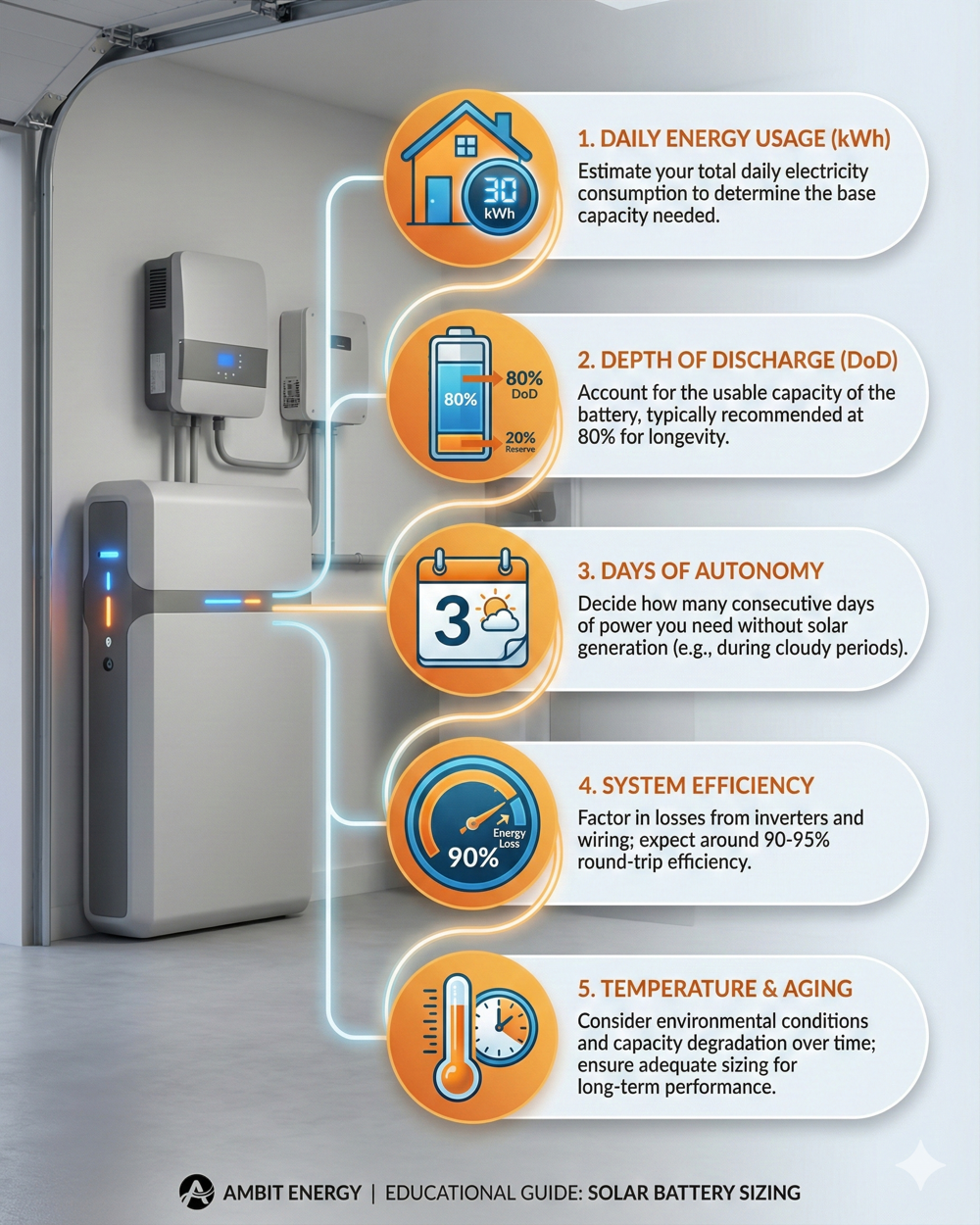
Then it adds your safety margin on top. Here's what each input means:
| Factor | Description | Typical Values |
|---|---|---|
| Daily Wh | The energy you want to cover each day | Varies by home |
| Days of Autonomy | Days of backup with no grid or solar help | 1-2 (grid-tied) |
| DoD (Depth of Discharge) | The share of the battery you can actually use | 80-100% (lithium), 50% (lead-acid) |
| System Voltage | Battery bank voltage | 48V (most efficient) |
| Efficiency | Round-trip efficiency | 85-95% |
| Safety Margin | Extra capacity for heat, aging and surprise loads | 10-25% |
The average Texas home used 1,096 kWh a month in 2024, according to EIA data. That works out to about 36 kWh a day for the whole house, central AC included. For backup you usually only need your critical loads, which is a much smaller number.
Your own numbers beat any average. If your home is on Oncor, CenterPoint, AEP Texas or TNMP lines, Smart Meter Texas shows your usage down to 15-minute intervals. You'll need your ESI ID and meter number, and both are printed on your bill. Look at your hottest week in August and your coldest week in January, because those are the days a battery has to carry you.
Days of autonomy is how many days the battery covers with no help from the grid or your panels. For a grid-tied Texas home, 1 to 2 days is typical. Off-grid systems usually plan for 2 to 5.
Texas outages can run longer than a day. When Hurricane Beryl came ashore on July 8, 2024, more than 2.26 million CenterPoint customers lost power at the peak, according to CenterPoint. If you have solar, your panels can refill the battery each sunny day, so one day of storage plus a working array goes a lot further than storage alone. For outage planning in more depth, see solar battery backup for power outages in Texas.
Three more inputs shape the result:
Depth of discharge (DoD). This is how much of the battery you can safely use. Lead-acid batteries should only be discharged to about 50% to protect their lifespan. Lithium batteries can use 80-100% of their capacity without significant wear.
Round-trip efficiency. Some energy is lost every time a battery charges and discharges. Lithium batteries run about 90-95% efficient, while lead-acid manages 80-85%. Tesla lists 89% solar-to-battery-to-home efficiency for Powerwall 3 on its datasheet.
Heat and aging. Capacity drops in extreme temperatures and as a battery ages, so add a 10-25% margin. Heat matters here more than in most states. Powerwall 3 is rated to operate from -4°F to 122°F, so plan a shaded wall or a conditioned space rather than a sun-facing garage wall.
Capacity is how long a battery runs. Power is how much it can run at once. A battery can have plenty of kWh and still trip when a central AC compressor kicks on, because motors draw a surge of several times their running load when they start.
Check two numbers on the spec sheet: continuous power and load start (surge) rating. Powerwall 3 lists up to 11.5 kW of continuous power and 185 LRA load start capability. Enphase lists 7.08 kW of continuous power for the IQ Battery 10C. For a DIY 48V bank, your inverter sets this limit, so size it for your largest motor starting while everything else is running. A qualified installer will confirm this during the design, and the battery storage installation guide walks through what that visit covers.
Here's the calculation the defaults above are built on:
Scenario: A 2,000 sq ft home backing up critical loads (refrigerator, lights, WiFi and electronics, one mini-split)
Step 1: Identify Critical Loads
Step 2: Apply the Formula
Calculation:
Required Ah = (5,000 × 1) ÷ (0.8 × 48 × 0.9)
Required Ah = 5,000 ÷ 34.56
Required Ah = 145 Ah
With a 20% margin: 145 × 1.2 = 174 Ah
Recommendation: Two 48V, 100 Ah lithium modules give you 200 Ah. That's 9.6 kWh at 48V, or about 10.2 kWh with 51.2V modules, which covers this home with room for aging and the odd extra load.
Now run the whole house. At the Texas average of about 36 kWh a day, the same settings call for roughly 1,042 Ah at 48V before any margin. That's about 50 kWh of battery, and it's why backing up critical loads is the usual starting point.
For a DIY bank, wire batteries in series to reach your system voltage, then add parallel strings to reach the amp-hours. Four 12V, 100 Ah batteries in series make one 48V, 100 Ah string. The example above needs 174 Ah, so that's two strings, or eight batteries in total. With 48V, 100 Ah rack modules, it's two batteries.
For packaged home batteries, divide the usable kWh you need by the usable kWh per unit and round up. The example needs about 6 kWh usable with its margin, so one Enphase IQ Battery 10C (10 kWh) or one Powerwall 3 (13.5 kWh) covers it. A 20 kWh target takes two Powerwall 3 units, and Tesla's datasheet allows up to four in one system.
Packaged batteries list kWh, so here's how the common options translate at 48V:
| Battery System | Usable Capacity | Continuous Power | Approximate Ah @ 48V |
|---|---|---|---|
| Tesla Powerwall 3 | 13.5 kWh | Up to 11.5 kW | ~281 Ah |
| Enphase IQ Battery 10C | 10 kWh | 7.08 kW | ~208 Ah |
| 48V LiFePO4 rack module (100 Ah) | About 5.1 kWh (51.2V) | Set by your inverter | 100 Ah |
Specs are from each manufacturer's product page or datasheet as of November 2026. For a closer look at brands, see the best solar battery guide.
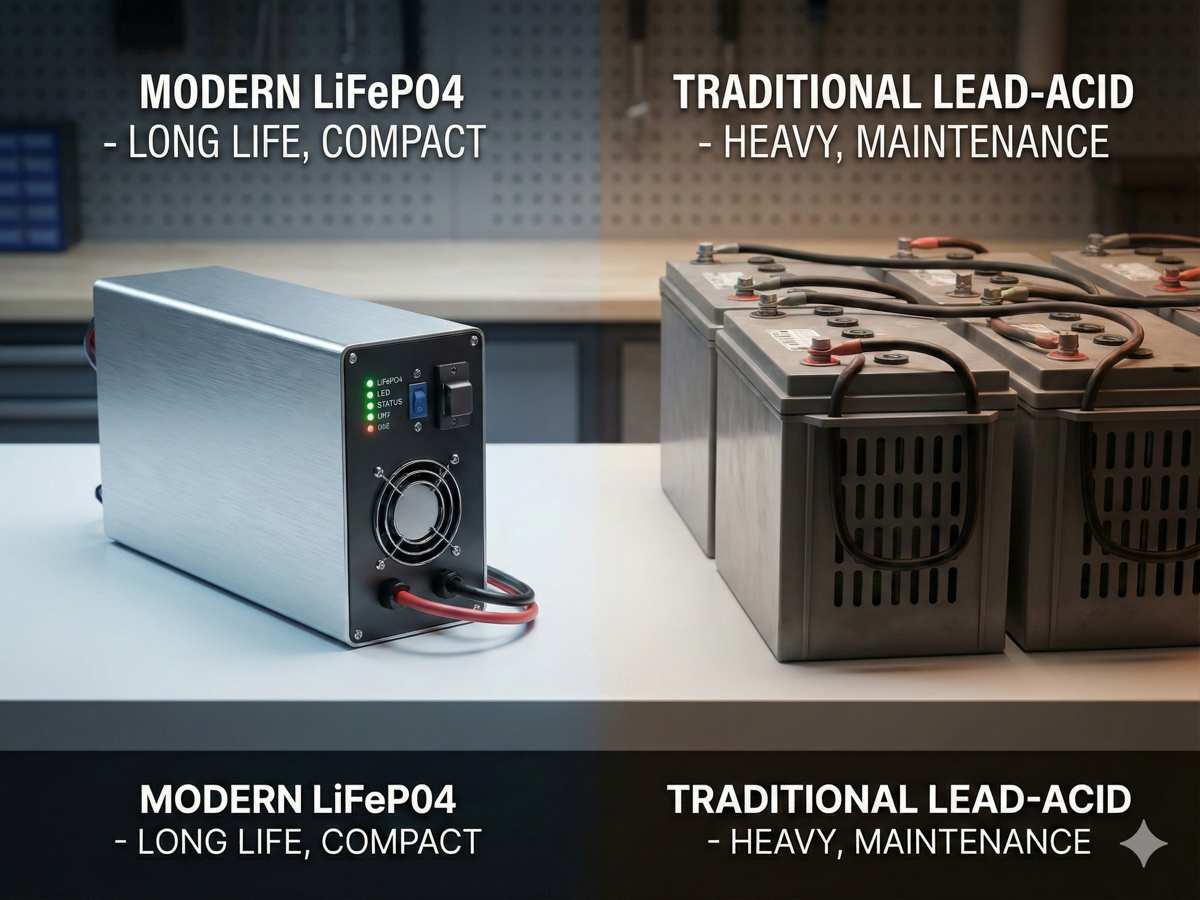
Battery chemistry changes both your Ah requirement and what you'll pay:
| Specification | Lead-Acid | Lithium (LiFePO4) |
|---|---|---|
| Usable Capacity | 50% | 80-100% |
| Cycle Life | 1,000-2,000 | 6,000-10,000 |
| Lifespan | 3-5 years | 10-15 years |
| Efficiency | 80-85% | 90-95% |
| Upfront Cost | Lower | Higher |
Lithium costs more upfront, but it gives you up to twice the usable energy per rated amp-hour and lasts years longer. For most Texas homes, lithium iron phosphate (LiFePO4) is the practical choice because it's stable in heat and handles daily cycling well.
EnergySage puts the average installed home battery at $1,159 per kWh of storage, or $15,647 for a 13.5 kWh system, based on quotes through its marketplace (updated August 26, 2026). Here's what that average looks like at common sizes:
| Usable Capacity | Estimated Installed Cost at $1,159 per kWh |
|---|---|
| 6 kWh | $6,954 |
| 10 kWh | $11,590 |
| 13.5 kWh | $15,647 |
| 27 kWh | $31,293 |
Real quotes vary by brand, installer and how much electrical work your home needs. For a deeper breakdown, see the cost of battery storage per kWh guide.
The 30% federal tax credit for battery storage isn't available for systems placed in service after December 31, 2025, so plan on the full system price for a new installation. A battery that stores energy from your own solar panels may qualify for the Texas property tax exemption for solar energy devices under Tax Code Section 11.27. You apply with the Comptroller's Form 50-123 through your county appraisal district.
A battery stores your midday solar for the evening and keeps the essentials running during an outage. It doesn't choose your electricity plan, though. If you'll still send extra solar to the grid, a solar buyback program credits you for those exports, and the right plan makes every kWh you store or send go further. The home battery storage in Texas guide covers how batteries and plans work together.
For the whole house, a lot. At the Texas average of about 36 kWh a day, one day of backup on a 48V lithium bank (80% DoD, 90% efficiency) takes about 1,042 Ah, or roughly 50 kWh. A critical-loads setup at 5 kWh a day needs about 145 Ah at 48V before margin.
Multiply by the voltage. At 12V it's 1.2 kWh, at 24V it's 2.4 kWh and at 48V it's 4.8 kWh. A 51.2V lithium module rated at 100 Ah holds about 5.1 kWh.
At 48V, 200 Ah is 9.6 kWh. With 80% usable and 90% efficiency, you get about 6.9 kWh, which runs a 500W critical load for close to 14 hours.
Tesla rates it in energy, not amp-hours: 13.5 kWh. At 48V, that's the equivalent of about 281 Ah.
For home backup, 48V. It needs a quarter of the amp-hours a 12V bank does for the same energy, so cables are smaller and losses are lower. 12V suits RVs, sheds and small off-grid setups.
Size for the loads you can't live without, not the whole house. Check power as well as capacity, add a margin for heat and aging, and then run your own numbers through the calculator above. If you want a second method to check against, the how to size a battery for solar guide works through it from the solar side.
The key takeaways for Texas homeowners:
Adding a battery to your solar setup? Pair it with an electricity plan built for solar homes. Get your free energy quote today and see how Ambit's solar buyback options fit your home.
Plan details and rates subject to change. Visit ambitenergy.com for full plan terms.













Copyright © 2026 VIPEnergyService.com. All rights reserved | PUCT# 10117
Important message regarding earnings: Ambit Energy makes no guarantee or promise of income or business. Anyone considering building a full-time or part-time Ambit business should have realistic expectations of their potential income. Learn more at goambit.com/disclaimer.