
The average Texas commercial account used 8,790 kWh a month and paid $751.73 a month in 2024, according to the U.S. Energy Information Administration (EIA). That average covers every commercial account in Texas, big-box stores, hospitals and office towers included, so a typical small business electric bill in Texas runs well below it. Your own number depends mostly on your square footage, your type of business and your hours.
This guide shows what drives a small business's electricity use, how usage changes by business type, and how to estimate your own before you choose or renew a plan. It's written for Texas owners of shops, offices, restaurants, salons and franchise locations with a peak demand under 50 kW.
A Texas commercial electricity account used an average of 8,790 kWh a month in 2024, for an average monthly bill of $751.73, according to EIA Table 5.b. That's 2024 data from the most recent edition of the table available, released Oct. 7, 2025.
Read that average carefully. It spreads all commercial sales in Texas across 1,557,087 accounts, and the list includes grocery chains, hospitals, hotels and downtown office towers. A few very large accounts pull the average up, so a 1,500-square-foot office or a single retail storefront will usually use far less.
That's why the average is a starting point, not a forecast. Two things get you closer to your own number:
Food sales and food service businesses use the most electricity for their size, followed by inpatient health care, strip malls, outpatient health care and lodging. The EIA's Commercial Buildings Energy Consumption Survey (CBECS) measures this as electricity intensity, the kWh a building uses per square foot each year.
CBECS is national survey data, not Texas-only, and the 2018 survey is the most recent consumption release. EIA's own summary puts food sales buildings at 53.3 kWh per square foot, "over four times higher" than the 12.6 average for all commercial buildings.
Here's the full picture from CBECS Table C22, "Electricity consumption totals and conditional intensities by building activity subcategories, 2018":
| Business type (EIA category) | Examples | kWh per sq ft per year (national, 2018) |
|---|---|---|
| Food sales | Grocery store, convenience store (with or without a gas station) | 53.3 |
| Food service | Restaurant, cafe, fast food | 43.8 |
| Inpatient health care | Hospital | 28.8 |
| Enclosed and strip malls | Strip shopping center | 19.6 |
| Outpatient health care | Clinic, medical office with diagnostic equipment | 17.4 |
| Lodging | Hotel, motel | 14.4 |
| Retail other than mall | Standalone retail store, dealership showroom | 13.7 |
| Office | Professional office, administrative office | 13.6 |
| All commercial buildings | All types combined | 12.6 |
| Education | School, training center | 9.4 |
| Service | Repair shop, dry cleaner, beauty parlor or barber shop | 7.2 |
| Warehouse and storage | Self-storage, distribution | 5.8 |
| Religious worship | Church, temple | 4.9 |
Here are the rules from EIA's building type definitions:
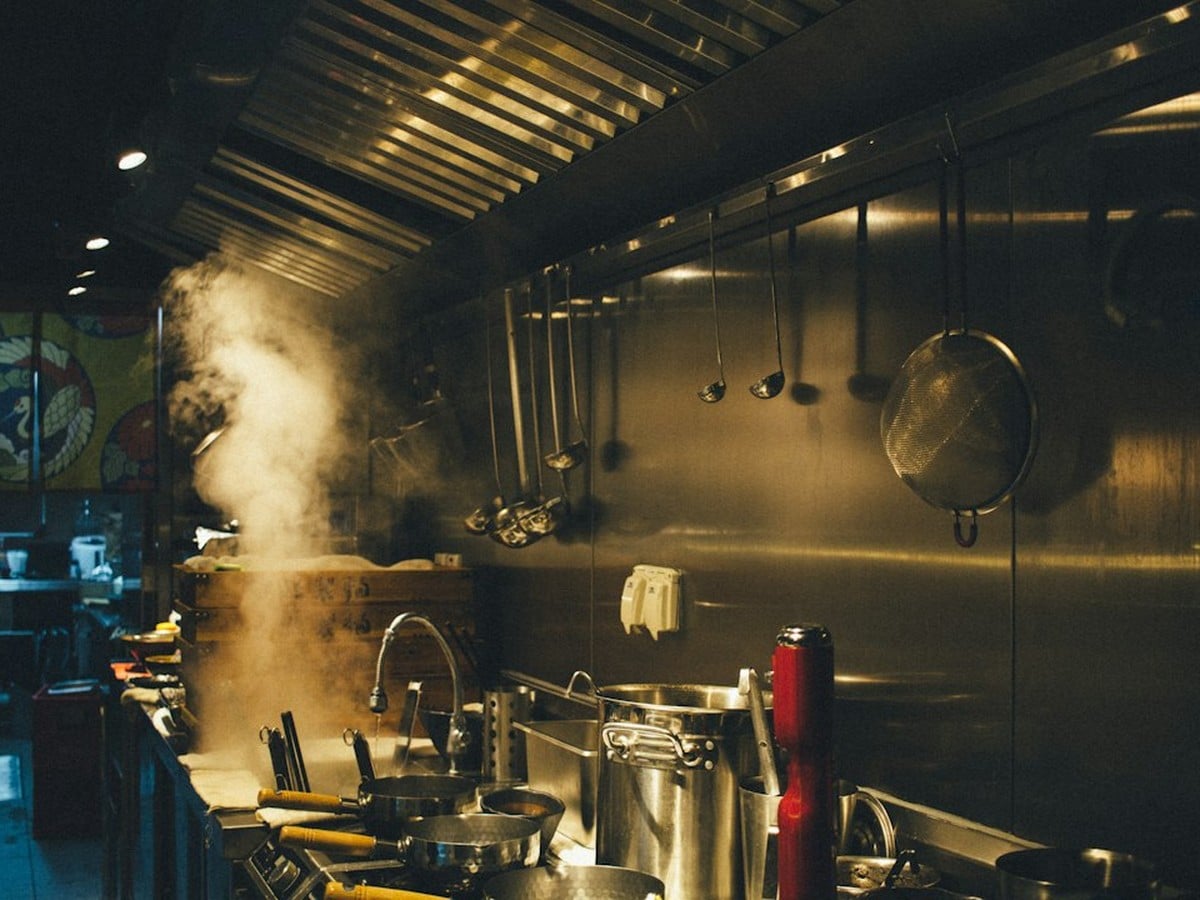
Restaurants rank high because refrigeration, cooking and ventilation run for long hours, some of it overnight. In CBECS, food service buildings use about 3.5 times the electricity per square foot of the average commercial building (43.8 versus 12.6). For a closer look at kitchen loads, see what uses the most electricity in a restaurant.
A note on the numbers: Table C22 reports averages (total kWh divided by total floor space), while our restaurant guide uses CBECS medians (39.3 kWh per square foot for food service, 8.6 for all buildings). Both are correct. They measure different things.
Multiply your square footage by your business type's kWh per square foot, and divide by 12 to get a monthly estimate. Compare the estimate to your last 12 months of usage on Smart Meter Texas to find the best plan for you.
Annual kWh = square feet x kWh per square foot. Monthly kWh = annual kWh / 12.
Here's how that math works for a few common small-business spaces, using the national 2018 CBECS averages above. These are estimates built on national averages, not quotes and not forecasts.
| Example space | Square feet | kWh per sq ft (CBECS 2018) | Estimated kWh a year | Estimated kWh a month |
|---|---|---|---|---|
| Professional office | 1,500 | 13.6 | 20,400 | about 1,700 |
| Retail store | 2,000 | 13.7 | 27,400 | about 2,280 |
| Retail store | 2,500 | 13.7 | 34,250 | about 2,850 |
| Medical clinic | 2,000 | 17.4 | 34,800 | about 2,900 |
| Church | 5,000 | 4.9 | 24,500 | about 2,040 |
| Restaurant | 2,500 | 43.8 | 109,500 | about 9,125 |
| Convenience store | 3,000 | 53.3 | 159,900 | about 13,325 |
Notice the spread. A 2,500-square-foot restaurant lands near 9,125 kWh a month, while a retail shop the same size lands near 2,850. Square footage alone can't tell you much until you know what happens inside it.
Smart Meter Texas is the statewide portal where the delivery utilities in Texas make smart meter data available. It offers monthly billing reads, daily reads and usage at 15-minute intervals. The Smart Meter Texas Small Business User Guide says it keeps up to two years of history. You can download reports as a CSV file or in Green Button format.
To create an account, you will need:
Once you're logged in, work through your history:
If you're adding equipment or extending hours, adjust your 12-month history upward for the new load. A new location has no history, so the square-footage estimate is your best starting point. The guide to setting up electricity for a new business location in Texas outlines the steps before move-in day.
Two businesses with the same square footage can get very different bills because of equipment, operating hours and peak demand. A 24-hour convenience store with coolers and a 9-to-5 office in the same strip center don't use electricity the same way, and once demand passes a delivery utility's threshold, part of the bill is charged on kW, not just kWh.
Your bill can have two parts:
Running several large loads at once can push your kW demand up even if your monthly kWh is low.
| Delivery utility | Smaller nonresidential class | Larger, demand-billed class |
|---|---|---|
| Oncor | Secondary service less than or equal to 10 kW | Secondary service greater than 10 kW |
| CenterPoint Energy Houston Electric | Less than or equal to 10 kVA | Greater than 10 kVA |
| AEP Texas (Central and North) | Secondary voltage service less than or equal to 10 kW | Greater than 10 kW |
| TNMP | Secondary service less than or equal to 5 kW | Greater than 5 kW |
CenterPoint measures in kVA, not kW. Oncor moves an account to the larger class after demand passes 10 kW three times in a rolling 12 months, or after any single reading above 12 kW. CenterPoint keeps an account on the larger schedule for at least 12 months once it passes 10 kVA.
Some utilities can bill a minimum based on an earlier peak, called a ratchet, on demand-billed accounts. The PUCT's rule 25.244 bars a demand ratchet for a nonresidential secondary customer with an annual load factor of 25% or less.
The 50 kW figure is a customer-protection line, not a billing line. The Public Utility Commission of Texas (PUCT) defines a small commercial customer as "a non-residential customer that has a peak demand of less than 50 kilowatts during any 12-month period" (16 TAC 25.471). Your Smart Meter Texas history shows your peak, so you can see which side of that line you're on.
Look at four things: the length of the contract term, whether the price is fixed or variable, your contract end date, and the Electricity Facts Label price at your usage level. Your peak and usage for the last 12 months will help you see which plans work.
Our guide to small business electricity renewal in Texas covers when renewal happens and what to compare.
When you have your numbers, see what business electricity plans Ambit Energy has available in your area. Plan details and rates subject to change, and an Electricity Facts Label is available for every plan.
Before you shop, run your business through four quick questions:
In cases where answers don't line up, use two rules of thumb:
EIA doesn't publish a small-business-only figure. Its broadest Texas number is the commercial average of $751.73 a month in 2024, across 1,557,087 accounts that include very large buildings, so most small businesses pay less. Your own bill depends on your usage, your plan and your delivery utility.
It depends on business type. Using national CBECS 2018 averages, a 1,500-square-foot office works out to about 1,700 kWh a month, a 2,500-square-foot retail store to about 2,850 kWh, and a 2,500-square-foot restaurant to about 9,125 kWh. Check your own Smart Meter Texas history before you rely on an estimate.
Food sales businesses, such as grocery and convenience stores, use the most per square foot at 53.3 kWh a year in EIA's 2018 national survey. Food service, such as restaurants and cafes, comes next at 43.8 kWh per square foot.
Many do. Oncor and AEP Texas bill demand above 10 kW, CenterPoint above 10 kVA and TNMP above 5 kW, according to each utility's tariff. A business under those lines is generally billed on kWh.
Register on Smart Meter Texas with your ESIID, meter number and current provider's name. It shows up to two years of monthly, daily and 15-minute usage, and you can download the data as a CSV file.






Copyright © 2026 VIPEnergyService.com. All rights reserved | PUCT# 10117
Important message regarding earnings: Ambit Energy makes no guarantee or promise of income or business. Anyone considering building a full-time or part-time Ambit business should have realistic expectations of their potential income. Learn more at goambit.com/disclaimer.