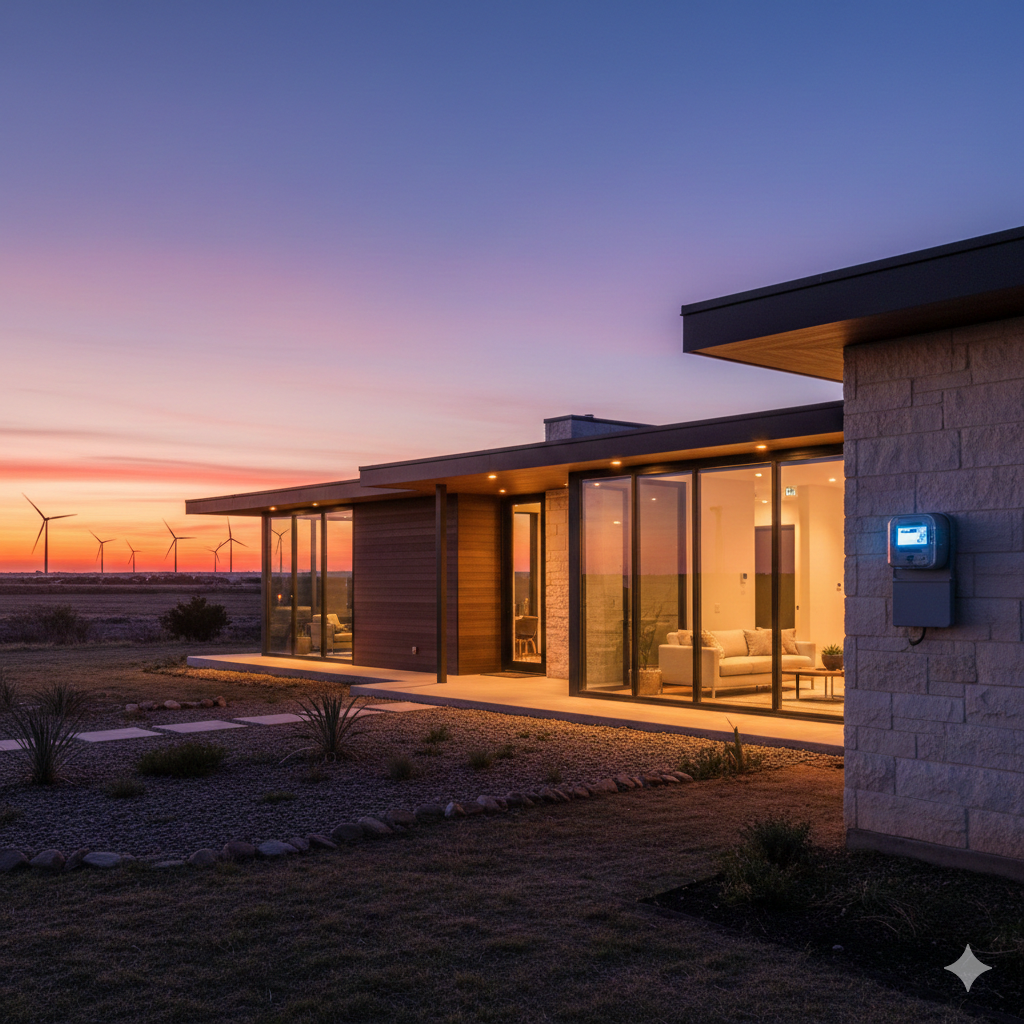
Free nights electricity plans in Texas charge $0 for energy during off-peak hours (typically 9 PM – 6 AM) and higher rates during the day. To save money, you need to shift 50–65% of your usage to free hours. Without deliberate shifting, the average household pays about 30% more than a fixed-rate plan. The biggest savings opportunity: pairing a home battery with a free nights plan — charging at $0 overnight and discharging during expensive daytime hours — which can save $1,000+ per year for the average Texas home.
Free nights electricity plans let Texas homeowners get $0 energy charges during off-peak hours — typically 9 PM to 6 AM. But "free" doesn't mean zero cost, and the math only works in your favor if you know how to use these plans correctly. This guide breaks down how free nights electricity plans work in the Texas deregulated market, which providers offer the best deals, and how pairing battery storage with a free nights plan can unlock savings most homeowners miss.
In Texas's deregulated electricity market, about 85% of households can choose their electricity provider through ERCOT (Electric Reliability Council of Texas). Free nights electricity plans are a type of time-of-use pricing where your retail electric provider charges $0.00 per kWh for energy during designated nighttime hours.
Here's the key: wind energy generates heavily at night in Texas — accounting for 24% of the state's total electricity generation — creating surplus capacity on the grid. Providers buy this cheap wholesale electricity and offer it as "free" to customers, while charging higher-than-average rates during daytime hours.
Your smart meter tracks electricity usage at 15-minute intervals — 96 data points per day — so your provider knows exactly when you used power, according to Smart Meter Texas.
Important: TDU delivery charges from your local utility (Oncor, CenterPoint, AEP) still apply 24/7, even during "free" hours. These charges typically represent 30–40% of your total electricity bill, according to ElectricityPlans.com.
Not all free nights electricity plans are created equal. Here's how the leading providers compare:
| Provider | Plan Name | Free Hours | Peak Rate | Base Charge |
|---|---|---|---|---|
| Ambit Energy | Free & Clear Nights | 9 PM – 5:59 AM | 21.9¢/kWh | $9.95/mo |
| TXU Energy | Free Nights & Solar Days | 8 PM – 4:59 AM | ~19.9¢/kWh | $9.95/mo |
| Reliant Energy | Truly Free Nights | 8 PM – 6 AM | ~18.2¢/kWh | Included |
| Direct Energy | Twelve Hour Power | 9 PM – 9 AM | ~23.6¢/kWh | Varies |
| Chariot Energy | Free Nights 24 | 11 PM – 5:59 AM | ~15.5¢/kWh | N/A |
Ambit Energy's Free & Clear Nights stands out with 100% wind-powered electricity and the TLC Pledge — a 60-day window to switch to any other Ambit plan at no cost if the free nights plan doesn't fit your lifestyle.
For more on Ambit's full plan lineup, see our guide to Ambit Energy plans.
The honest answer: it depends entirely on how much electricity you use during free hours.
For the average Texas household using 1,096 kWh per month, according to Choose Texas Power:
The break-even threshold falls around 50–65% of usage during free hours, according to industry analyses from EnergyBot. Without deliberate usage shifting, the average household pays about 30% more on a free nights and weekends electricity plan compared to a traditional fixed-rate plan.
Who saves the most with free nights electricity plans:
Who should consider a fixed-rate plan instead:
The biggest misconception about free nights electricity in Texas: customers think ALL costs disappear during free hours. Here's the reality:
TDU delivery charges apply 24/7. In the Oncor service area (Dallas/Fort Worth), delivery charges run about 5.58 cents per kWh. If you use 400 kWh during "free" nighttime hours, you still pay $22.32 in delivery charges. CenterPoint Energy (Houston) recently raised its delivery rate to about 6.00 cents per kWh.
Other costs to watch for:
Here's where free nights electricity plans get genuinely exciting. Pairing a home battery storage system with a free nights plan creates an energy arbitrage opportunity that transforms how the math works.
How it works:
Savings example for the average Texas home (1,096 kWh/month):
A typical system like the Tesla Powerwall 3 (13.5 kWh) covers partial daytime usage. For full arbitrage, you'll need 20–25 kWh of capacity — about two batteries. For detailed pricing, see our cost of battery storage per kWh guide.
At Ambit Energy VIP Energy Service, we help homeowners combine the best free nights electricity plan with the right battery storage solution to maximize savings.
Whether or not you add battery storage, here are practical steps to get the most from your free nights electricity plan:
Ready to Start Saving with Free Nights Electricity?
Find the right Ambit Energy plan and battery storage combination for your home.
If a free nights plan fits how your household actually uses electricity, you can see Ambit's Free & Clear Nights plan and check availability at your address.
Free nights electricity plans charge $0 for the energy portion of your bill during off-peak hours (typically 9 PM to 6 AM). However, TDU delivery charges from your local utility (Oncor, CenterPoint, AEP) still apply 24/7. These delivery charges run 5–6 cents per kWh, so "free" electricity still costs something.
Savings depend on how much electricity you shift to free hours. If you move 60% of usage to free hours, you could save about $300/year. With battery storage enabling 75%+ shifting, savings can reach $740–$1,287/year compared to a standard fixed-rate plan. Without deliberate shifting, you'll likely pay more.
Yes — and it's the most powerful savings strategy available. A home battery charges for $0 at night and discharges during expensive daytime hours, effectively reducing your energy costs to TDU delivery charges only (~5–6¢/kWh). This energy arbitrage approach can save over $100/month for the average Texas household.




Copyright © 2026 VIPEnergyService.com. All rights reserved | PUCT# 10117