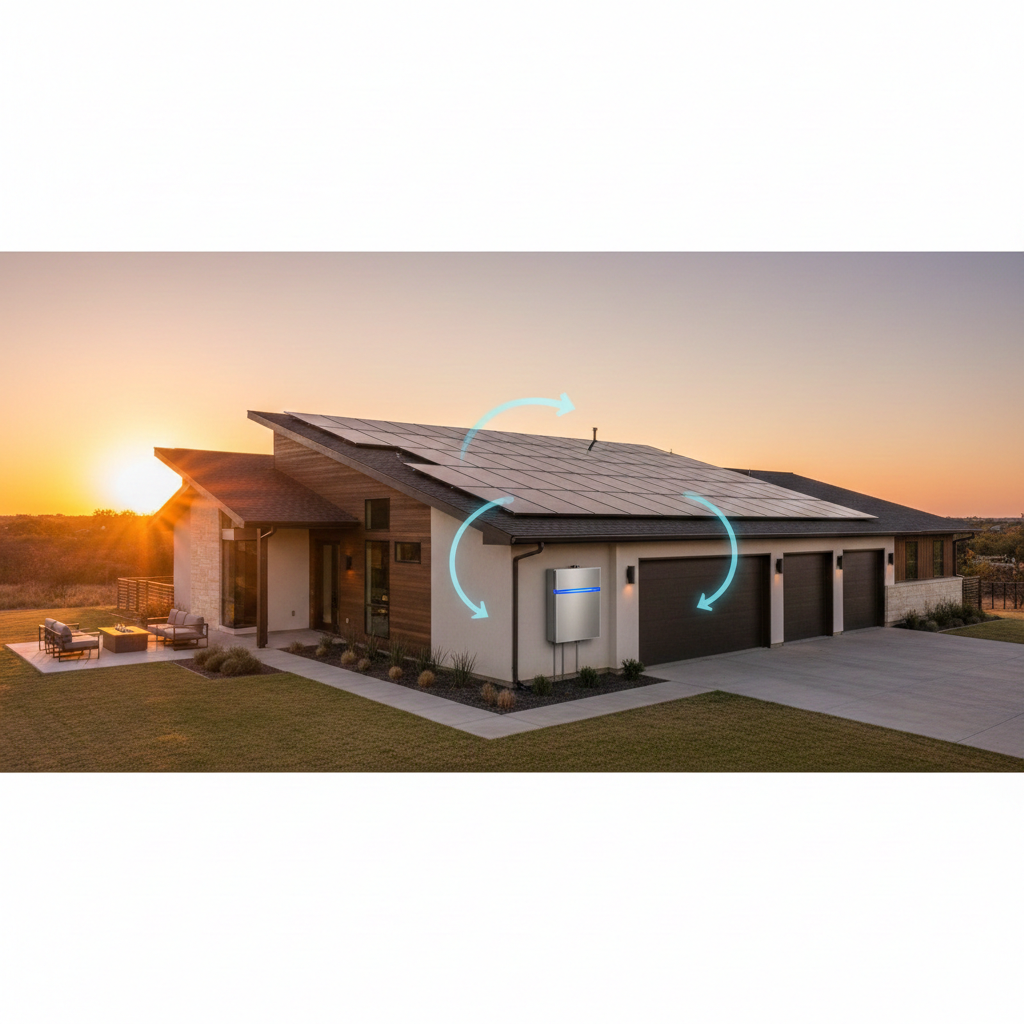
Battery backup for solar panels captures 2–6x more value per kilowatt-hour than exporting surplus energy for buyback credits. With buyback rates compressed to 3–7¢/kWh while retail electricity costs 12–18¢/kWh during peak hours, storing solar energy in a battery and using it yourself is the smarter economic play for Texas homeowners in 2026.
Most Texas solar homeowners start with a solar buyback plan in Texas — and that’s a smart first step. But the numbers in 2026 tell a clear story: relying on buyback credits alone leaves money on the table. Battery backup for solar panels changes the math entirely. Instead of exporting surplus energy at 3 to 7 cents per kWh and buying it back at 12 to 18 cents during peak hours, a battery lets you store that power and use it when it’s worth the most. The result? Two to six times more value from every kilowatt-hour your panels produce.
Here’s the uncomfortable truth about solar buyback plans in 2026: most Texas providers pay just 3 to 5 cents per kWh for your exported solar. Meanwhile, you’re buying electricity back from the grid at 12 to 18 cents during evening peak hours when your panels aren’t producing. Without backup batteries for a solar system, a typical home only uses 25 to 40 percent of its own solar generation directly, according to SolarTech. The rest goes to the grid at a fraction of retail value.
This gap is getting worse, not better. Buyback rates are compressing as more solar floods the ERCOT market during midday hours, driving wholesale prices lower. And the shift is showing in installation data: 40 percent of new residential solar installations in 2025 were paired with battery storage, according to Wood Mackenzie. Texas solar owners are voting with their wallets.
For a deeper look at maximizing your solar energy credits in Texas, see our dedicated guide.
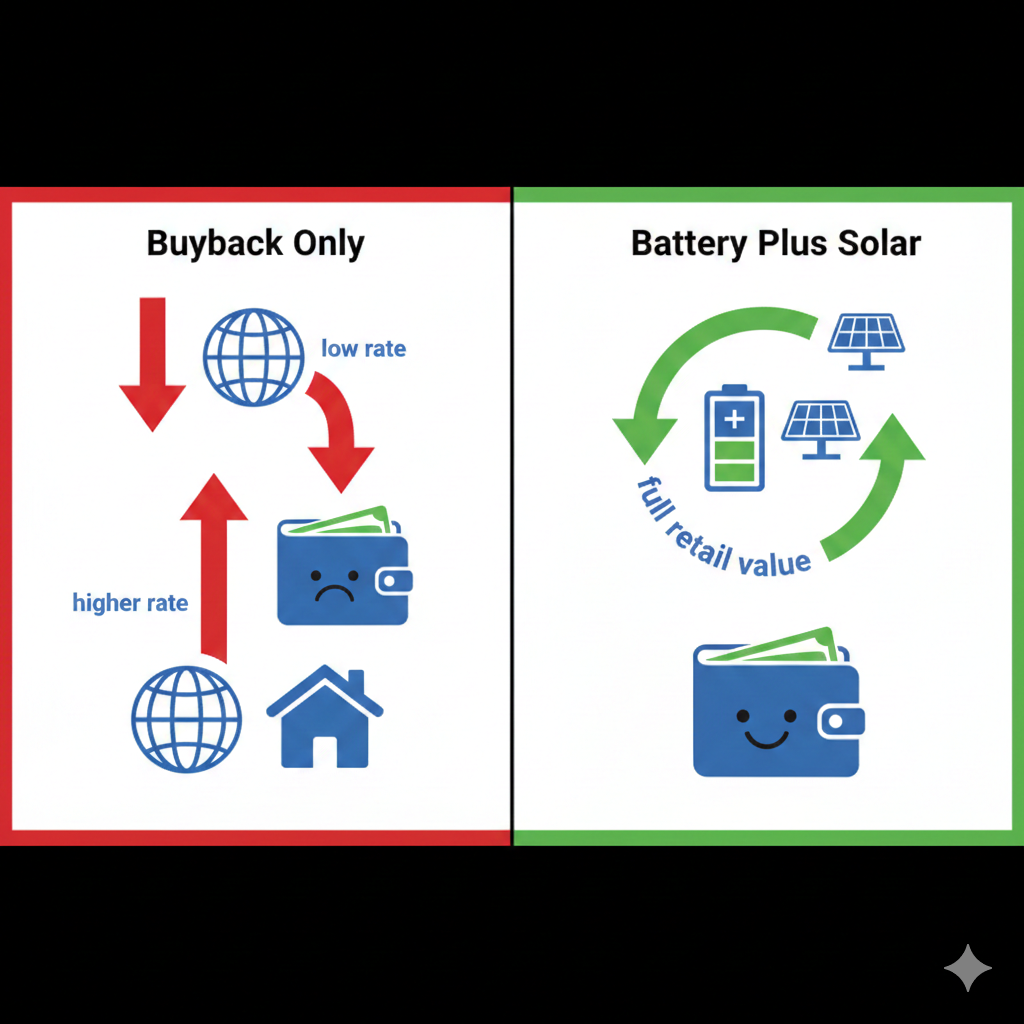
Solar panels with battery backup flip the economics. Instead of 25 to 40 percent self-consumption, battery owners achieve 60 to 90 percent — keeping power for evening peak hours rather than selling it at a discount, according to SolarTech. In real dollars, that translates to roughly $445 per year in additional savings compared to buyback alone.
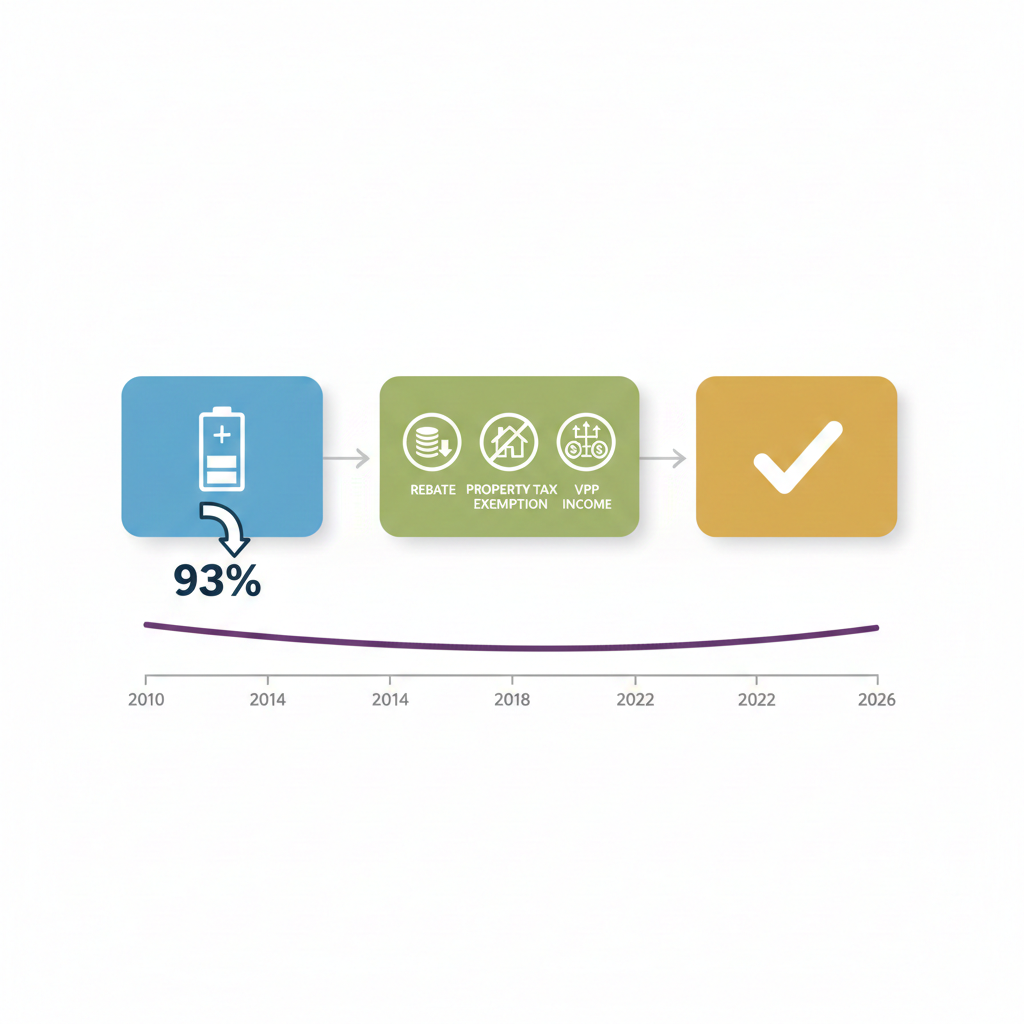
The timing has never been better. Battery storage costs have fallen 93 percent since 2010, with lithium-ion pack prices reaching a record low of $108 per kWh in 2025, according to BloombergNEF. Ember analyst Kostantsa Rangelova called the economics of battery storage “unrecognizable” compared to recent years.
Financial incentives sweeten the deal further. Oncor offers up to $9,000 in rebates for new solar-plus-battery installations in the Dallas-Fort Worth area, with the program closing November 2026, according to Quick Electricity. And emerging virtual power plant programs in Texas pay battery owners $400 to $600 annually for sharing stored energy during peak demand — turning your battery backup for solar panels into an income-producing asset.
For detailed pricing, see our cost of battery storage per kWh breakdown, or explore available battery backup rebates in Texas.
If economics alone aren’t convincing, consider reliability. Winter Storm Uri in 2021 left 4.5 million Texas homes without power. When Winter Storm Fern hit in January 2026, the grid held — and battery storage played a key role. Batteries delivered over 7,000 MW during peak demand, accounting for 9.5 percent of total grid power, according to Inside Climate News.
But the underlying vulnerability hasn’t disappeared. ERCOT’s winter reserve margin has dropped from 17.5 percent in 2021 to a projected 10.1 percent in 2026, well below the 15 percent target, according to the Texas Policy Foundation. A solar with backup battery texas homeowners can rely on isn’t just a financial play — it’s an insurance policy that pays dividends.
Pair your battery system with the right electricity plan. Compare Ambit Energy Texas rates and plans to find the best fit for solar-plus-storage.
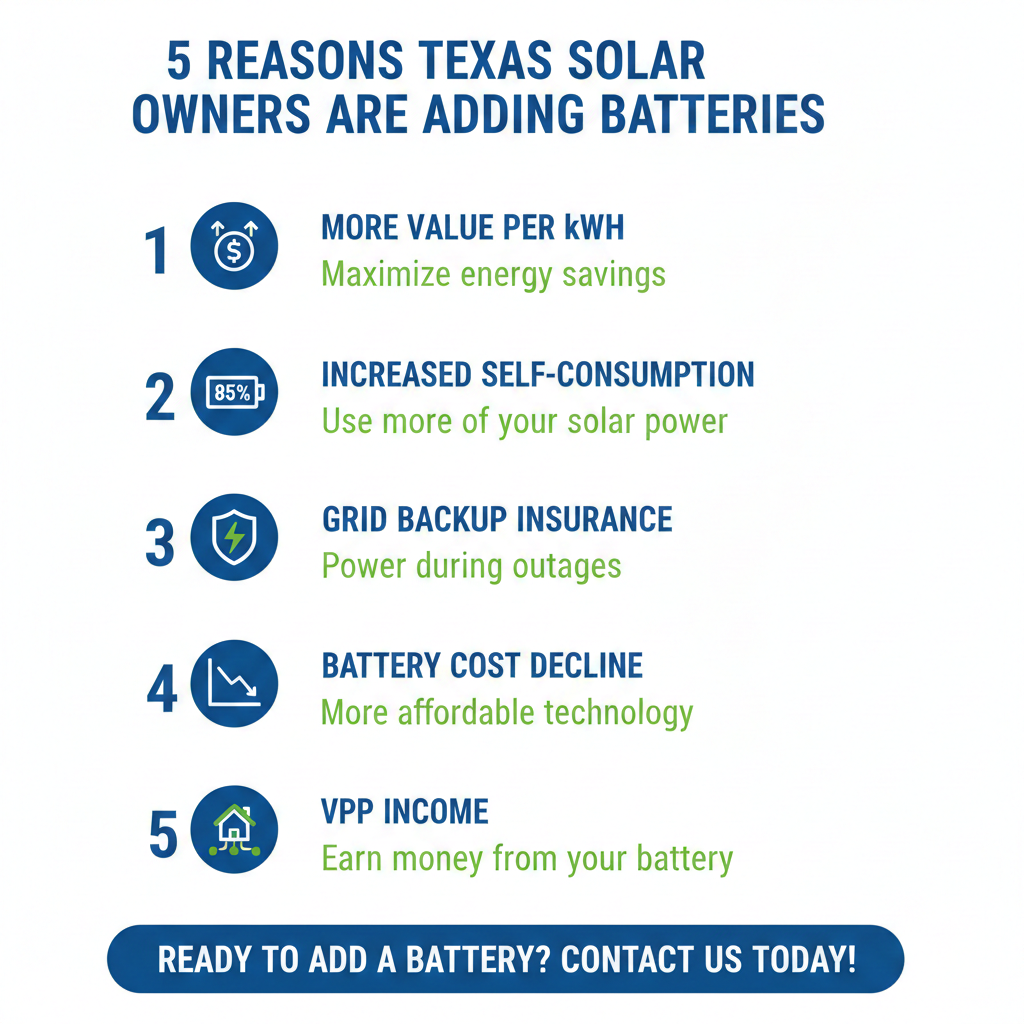
If you already have solar panels, adding backup batteries for your solar system is straightforward. AC-coupled batteries like the Tesla Powerwall 3 or Enphase IQ Battery 5P connect directly to your electrical panel without replacing your existing inverter — making them the easiest retrofit option, according to EnergySage.
Expect to pay $12,000 to $20,000 for a retrofit before incentives. One important note: the Oncor rebate program applies only to new installations, not retrofits. But the Texas property tax exemption on solar and battery systems still applies regardless.
The bottom line? Whether you’re installing a new system or retrofitting, the window for action is narrowing. Buyback rates will keep compressing, Oncor’s rebate budget is finite, and the federal 30 percent tax credit expired in December 2025. A solar with backup battery texas homeowners invest in today will pay for itself faster than waiting.
Browse solar electricity plans to find the right energy plan to pair with your battery.
Ready to Go Beyond Buyback?
Pair Ambit Energy’s solar buyback plans with battery storage and maximize every kilowatt-hour.
Yes. AC-coupled batteries like the Tesla Powerwall 3 and Enphase IQ Battery 5P connect independently to your electrical panel and don’t require replacing your existing solar inverter. Expect to pay $12,000 to $20,000 for the retrofit. DC-coupled batteries may require a hybrid inverter upgrade at an additional $1,000 to $3,000.
A home battery system costs $14,000 to $20,000 installed in 2026, depending on capacity and brand. Popular options include the Tesla Powerwall 3 at roughly $15,400, Enphase IQ 5P at $15,000 to $17,000, and FranklinWH aPower 2 at $16,000 to $20,000. Oncor rebates of up to $9,000 are available for new installations.
Yes. The 30 percent Residential Clean Energy Credit expired December 31, 2025, but battery economics remain strong. Battery costs have fallen 93 percent since 2010, state incentives like the Oncor rebate and Texas property tax exemption still apply, and emerging VPP programs add $400 to $600 annually in revenue. Most systems pay for themselves in 5 to 7 years when paired with solar.
Sources: SolarTech, Wood Mackenzie / pv magazine, BloombergNEF, Quick Electricity, Inside Climate News, Texas Policy Foundation, EnergySage. Data reflects 2026 market conditions. Rates and incentives are subject to change. VIP Energy Service is an independent Ambit Energy consultant. This article is for educational purposes and does not constitute financial advice.














Copyright © 2026 VIPEnergyService.com. All rights reserved | PUCT# 10117