
Solar Storage Explained: How PV and Battery Systems Work Together

Solar energy storage system for Texas homes

Solar Storage Explained: How PV and Battery Systems Work Together

December 8, 2025
by
Shawn Cornett

Update, October 2026: According to the IRS, the 30% federal Residential Clean Energy Credit is not available for systems placed in service after December 31, 2025. Mentions of the credit below apply only to systems installed by then. Texas utility rebates and the Texas property tax exemption may still lower your cost.

Solar storage combines photovoltaic (PV) panels with battery systems to capture and store excess solar energy for later use. This pairing allows Texas homeowners to use solar power during peak evening hours, provide backup during outages, and maximize energy independence. Modern lithium iron phosphate (LFP) batteries offer 10-15 kWh capacity, 90%+ round-trip efficiency, and 10+ year lifespans. With Texas adding 6.4 GW of new battery capacity in 2024—the most of any state—now is an ideal time to explore solar storage solutions for your home.

For a comprehensive overview of battery options and technologies, see our complete solar battery storage guide.

What Is Solar Storage and How Does It Work?

Solar storage systems pair rooftop PV panels with battery units to capture, store, and deploy solar energy on demand. During daylight hours, your solar panels generate direct current (DC) electricity. Any excess power that your home doesn't immediately consume charges your battery system instead of flowing back to the grid.

The heart of a solar storage system is the inverter. In AC-coupled systems, separate inverters handle the solar panels and battery independently. DC-coupled systems use a single hybrid inverter to manage both components more efficiently. According to the Department of Energy, hybrid inverters simplify installation and typically achieve round-trip efficiency above 90%, meaning you retain most of the energy you store.

When evening arrives or an outage occurs, your battery releases stored solar energy to power your home. This on-demand access transforms intermittent solar generation into reliable, 24-hour renewable energy.
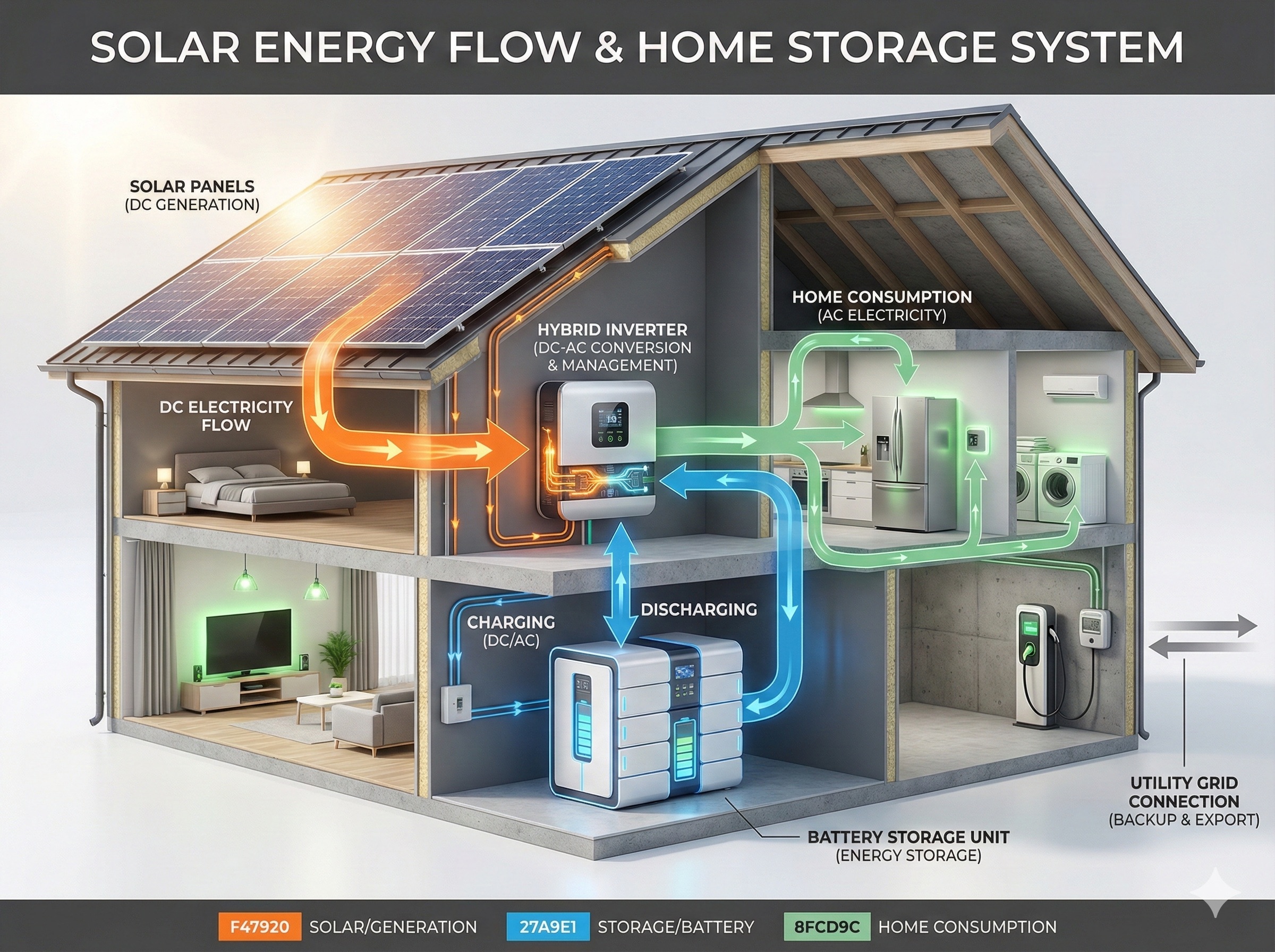
Solar energy flow diagram showing panels, inverter, battery, and home

Key Components of a Solar Storage System

A complete solar storage installation includes several essential components working in harmony:

Solar Panels: Generate DC electricity from sunlight. Most residential systems in Texas use 6-12 kW arrays depending on home size and energy consumption.

Battery System: Stores excess solar energy for later use. Popular options include the Tesla Powerwall, Enphase IQ Battery, and Generac PWRcell. Most residential batteries provide 10-15 kWh of usable capacity—enough to power essential loads for several hours during an outage.

Inverter: Converts DC electricity to AC power for home use. Hybrid inverters manage both solar production and battery storage in a single unit.

Critical Load Panel: Prioritizes which circuits receive power during outages. This ensures your refrigerator, medical equipment, and communications stay operational when you need them most.

Modern lithium iron phosphate (LFP) batteries dominate the Texas market due to their safety, longevity, and performance in high temperatures. LFP chemistry offers 90-100% depth of discharge and thousands of charge cycles over a 10+ year lifespan. Learn more about sizing your solar battery for your specific needs.

Benefits of Solar Storage for Texas Homeowners

Texas homeowners face unique energy challenges that make solar storage particularly valuable. ERCOT, the state's grid operator, projects electricity demand will nearly double by 2030, increasing strain on infrastructure during extreme weather events.

Outage Protection: During a September 2023 heat wave, battery storage systems helped avoid grid failure by powering approximately 434,000 homes when traditional generation couldn't keep up. With solar storage, you're prepared for both summer heat waves and winter storms. See how solar panels perform during power outages.

Energy Independence: Reduce your reliance on the ERCOT grid by storing your own solar energy. Use battery power during expensive peak hours or when rates spike due to demand.

Bill Savings: Maximize your solar investment through peak shaving and time-of-use optimization. Pair your system with a competitive solar buyback program to earn full credits for excess generation.

Tax Incentives: The federal Investment Tax Credit provided a 30% credit on solar storage systems placed in service by December 31, 2025. It is not available for newer systems. Texas still offers property tax exemptions for solar and battery improvements.

Texas neighborhood during power outage with one home powered by solar storage

Costs and ROI of Solar Storage in Texas

Understanding the investment helps you plan effectively. According to Lone Star Solar Services, home battery systems in Texas typically cost $10,000-$17,000 installed before incentives.

For example, a Tesla Powerwall installation runs approximately $15,400-$16,779 before incentives. For systems installed by the end of 2025, the 30% federal tax credit brought the net cost to approximately $10,780-$11,745.

Several factors affect your solar storage ROI:

  • Electricity Usage: The typical Texas home consumes 25-30 kWh daily. Higher consumption means greater potential savings.
  • Buyback Programs: Solar buyback rates vary significantly between retail electric providers. Programs offering competitive credits maximize your return.
  • Outage Frequency: If you experience frequent power interruptions, the value of backup power increases substantially.

Most Texas homeowners see payback periods of 10-15 years for battery storage alone, with shorter timelines when paired with solar panels in high-use households. Request your free energy quote to get a personalized cost analysis.
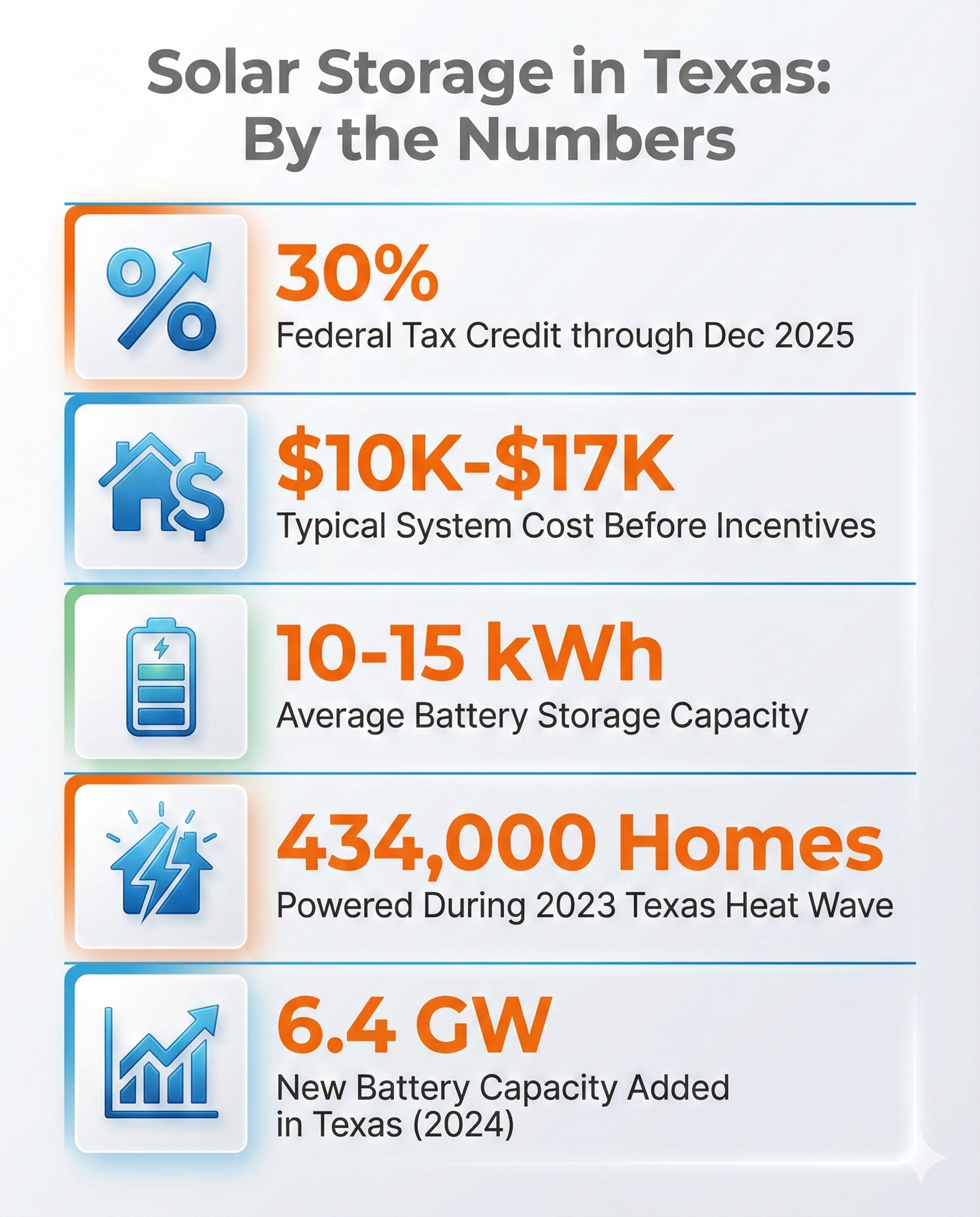
Solar Storage in Texas statistics infographic showing key data points

Is Solar Storage Right for Your Home?

Solar storage makes the most sense for homeowners who meet several criteria:

  • You already have solar panels or plan to install them
  • Your area experiences frequent power outages
  • You want protection from volatile electricity prices
  • Energy independence is a priority for your household

Consider your home's size, energy consumption patterns, and budget when evaluating options. Even modest battery systems can power essential circuits during emergencies, while larger installations provide whole-home backup capability.

For detailed guidance on home battery backup options, explore our resources or speak with an energy consultant.

Take the Next Step

Solar storage transforms your PV system from a daytime power source into a complete energy solution. With battery costs declining and Texas grid challenges intensifying, homeowners have good reasons to look at storage now.

Ready to explore solar storage for your home? Get your free energy quote or call our Texas energy consultants at (817) 402-2664 to discuss your options. You can also compare solar buyback plans to maximize your solar investment returns.


Sources

$85.27 per 1,000 kWh: TNMP's New Delivery Rates Top the PUCT Table, and December Bills Add a One-Month Surcharge

TNMP TDU delivery charges are $7.56 a month plus 7.7710 cents per kWh as of October 1, 2026, or $85.27 at 1,000 kWh, the highest on the PUCT's table. Two September steps added $12.75, and December 2026 bills add a one-month Rider IS surcharge.
Read More >>

Texas Picked Its 2027-28 Backup Electricity Providers. How POLR Service Works If Your Provider Shuts Down

Texas approved its 2027-28 provider of last resort list on Oct. 9, 2026. Your power stays on if your provider fails, and you can leave POLR service any time.
Read More >>

ERCOT's December 2026 Outlook Puts Grid Emergency Odds at 2.95% in Its Riskiest Hour. What a Texas Winter Storm Can and Can't Do to Your Electric Bill

ERCOT's December 2026 outlook puts the riskiest hour, 8 a.m. on December's peak-load day, at a 2.95% chance of an Energy Emergency Alert, well under its 10% low-risk line. Here is what a Texas winter storm can and can't do to your electric bill.
Read More >>

Houston Delivery Charges Fell on August 15. They Jumped September 1 and Rose Again for Meters Read September 30. What That Does to Your October Bill.

CenterPoint delivery charges dipped on August 15, jumped back up September 1, and rose again for Houston meters read on or after September 30. Here's what it means for your October bill.
Read More >>

Lubbock Electricity Rates Change November 1: LP&L's New $2.50 Base Charge Means Smaller Homes Pay More and Bigger Homes Pay Less

LP&L adds a $2.50 monthly base charge and cuts delivery to 6.008 cents per kWh on Nov 1, 2026. Homes under 822 kWh a month pay more, bigger homes pay less.
Read More >>

How to Dispute an Electric Bill in Texas: What the PUCT's New Complaint Process Changes, and What It Doesn't

To dispute an electric bill in Texas, write to your provider first (21 days to answer), then file with the PUCT. On October 21, 2026 the PUCT ends formal complaints. Here is what changes and what stays the same.
Read More >>

Direct Energy Free Nights Review: What the EFL Actually Charges After the Free Window

Direct Energy free nights (Twelve Hour Power) is free 9 p.m. to 9 a.m. As of September 29, 2026, the 12-month EFLs charge 34.5 to 35.4 cents per kWh after the free window. Here is the break-even math.
Read More >>

27 Texas Electricity Plans Got Withdrawn on September 12 Alone. Here Is the Best Time to Renew Your Contract This Fall.

Best time to renew a Texas electricity contract: the fall shoulder window and the 14 days before your end date. 27 plans got pulled Sept 12. Here is the clock.
Read More >>

SmartEnergy Just Launched a $200 Bill Credit Plan on September 3. Here Is How Bill Credit Plans Actually Work in Texas (And When You Lose the Credit)

SmartEnergy launched a $200 bill credit plan on September 3, 2026. Here is how Texas bill credit plans actually work, and the four conditions that forfeit the credit.
Read More >>

No Deposit Light Companies in Texas: What You Actually Qualify For Without a Credit Check

Four legal ways to skip a Texas electricity deposit as of September 2026: soft-check plans, PUCT Rule 25.478 waivers, letters of credit, or prepaid Rule 25.498 plans. What each costs and who qualifies.
Read More >>

Every Ambit Energy Plan Compared for 2026: Rates, Terms, Fees and Who Each One Actually Suits

Compare every Ambit Energy plan in Texas for 2026 side by side: Lone Star Classic 12 and 24, Flex, Free and Clear Nights, Solar Buyback, small business TSC. Rates, fees, terms and who each one actually suits.
Read More >>

Your Oncor Delivery Charge Went Down on August 1. Your Bill Still Went Up $2.73. Here Is Where the Money Went.

Oncor's per-kWh delivery rate dropped on August 1, 2026, but a new PUCT-approved Rider IS surcharge started the same day. Here is the exact math on the $2.73 bill increase.
Read More >>

TXU Free Nights and Weekends vs Ambit Free and Clear Nights: The Break-Even Math on Both Plans

Comparing TXU Free Nights and Weekends vs Ambit Free and Clear Nights: hours, rates, ETFs, and the smart-meter break-even math your bill actually needs.
Read More >>

Should Texans Lock In a Fixed-Rate Electricity Plan This August? Here Is What the Forward Price Curve Says

August 2026 fixed vs variable Texas electricity rates. What the ERCOT forward curve says about winter 2026-2027 and a five-filter lock-in decision framework.
Read More >>

Commercial Electricity Rates in Texas Are Repricing Right Now. A Small Business Renewal Guide for August 2026

Texas commercial electricity rates average 5.98 to 8.35 cents per kWh in August 2026 as TDU charges reset. Here is when to lock and what to compare on renewal.
Read More >>

Texas Electric Bill Too High After the July Heat Wave? The 4 Assistance Programs That Actually Help in 2026

Four Texas assistance programs will actually pay part of your summer electric bill: CEAP, Texas Utility Help, 2-1-1, and Salvation Army. 2026 eligibility, benefit amounts, and how to apply.
Read More >>
1 2 … 16