Update, October 2026: According to the IRS, the 30% federal Residential Clean Energy Credit is not available for systems placed in service after December 31, 2025. Mentions of the credit below apply only to systems installed by then. Texas utility rebates and the Texas property tax exemption may still lower your cost.
To size a battery for solar, calculate your daily energy consumption in kilowatt-hours (kWh), multiply by your desired days of backup autonomy, then divide by the battery's depth of discharge and efficiency. For most Texas homes using 25-30 kWh daily, a 10-15 kWh battery covers essential loads during outages. Larger whole-home backup typically requires 20-30 kWh or more of storage capacity.
Getting your solar battery size right matters more than most homeowners realize. An undersized battery leaves you without power when you need it most. An oversized battery wastes money on capacity you'll never use. Understanding how to size battery for solar systems correctly protects both your investment and your family during outages.
Battery capacity measures how much energy a battery can store, expressed in kilowatt-hours (kWh). However, the number on the label doesn't tell the whole story. Every battery has a depth of discharge (DoD) limit—the percentage of total capacity you can actually use without damaging the battery. This is why battery backup for home systems require careful planning.
For grid-tied solar systems, battery sizing focuses on backup duration during outages. Off-grid systems require larger batteries to cover multiple days without sunshine. According to the U.S. Energy Information Administration, understanding your actual energy needs is the foundation of proper battery sizing.
The key difference between total capacity and usable capacity determines how many solar batteries you need for your specific situation.
Before calculating your battery size, you need to know your actual energy consumption. This number drives every sizing decision you'll make.
The simplest method uses your utility bill. Find your monthly kWh usage and divide by 30 to get your daily average. According to the U.S. Energy Information Administration, the average American home uses approximately 10,500-11,000 kWh annually, or roughly 880-920 kWh per month. That translates to about 29-31 kWh per day.
Texas homes typically use 25-35 kWh daily, though this varies significantly based on home size, efficiency, and whether you have electric heating or cooling. During summer months, air conditioning can push daily usage above 40 kWh. ERCOT data shows Texas residential consumption peaks during July and August.
However, most homeowners don't need to power their entire home during an outage. A critical loads panel isolates essential circuits—refrigerator, lights, phone charging, WiFi router, and medical equipment. These essential loads typically consume only 8-12 kWh per day, dramatically reducing the battery capacity you need.
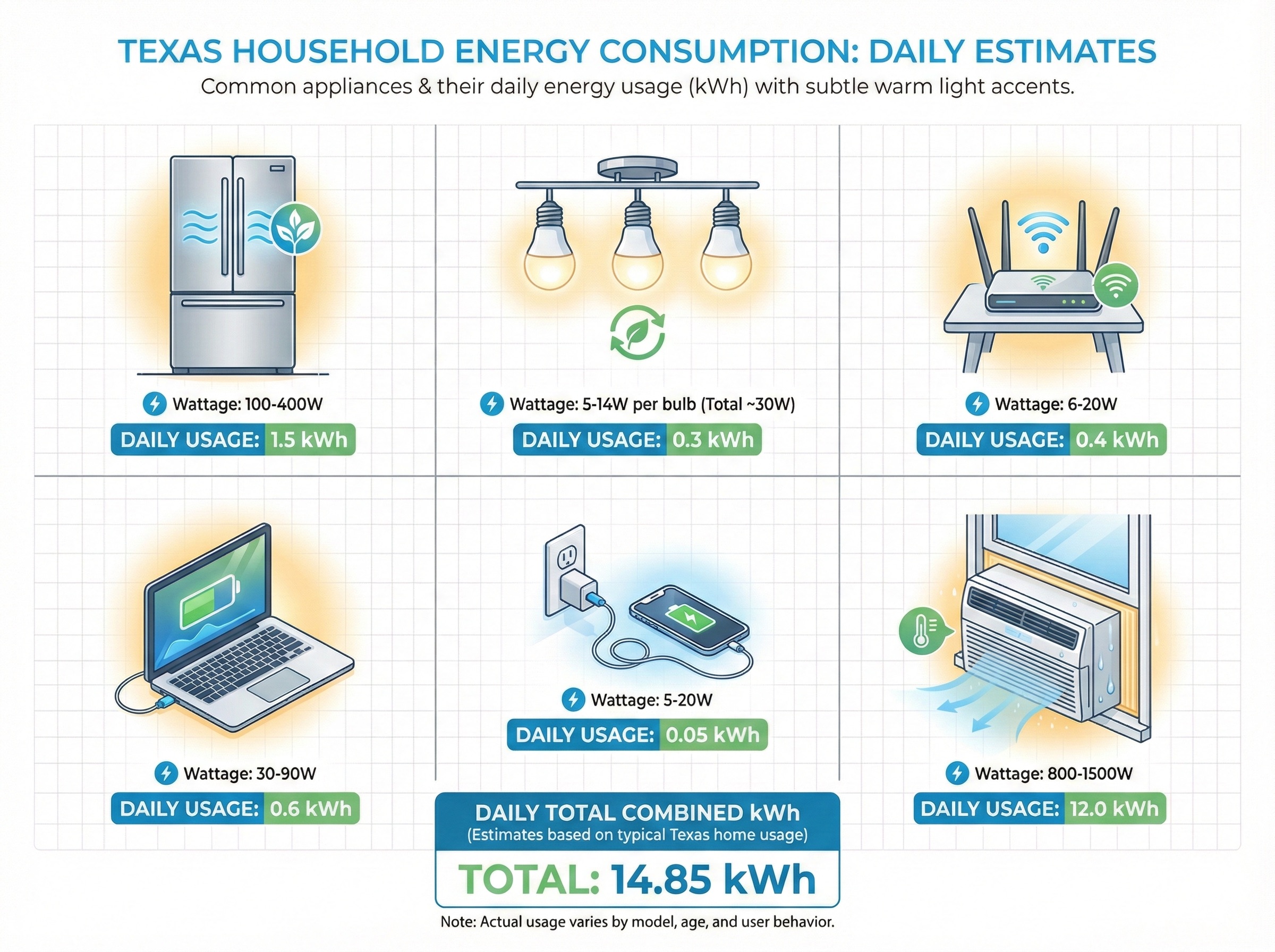
Common Appliance Energy Usage:
| Appliance | Watts | Hours/Day | Daily kWh |
|---|---|---|---|
| Refrigerator | 150-400 | 24 | 1.2-2.4 |
| LED Lights (10 bulbs) | 100 | 6 | 0.6 |
| WiFi Router | 10 | 24 | 0.24 |
| Phone Charger | 5 | 3 | 0.015 |
| Laptop | 50 | 4 | 0.2 |
| Window AC Unit | 1,200 | 8 | 9.6 |
| Central AC (3 ton) | 3,500 | 8 | 28 |
Understanding how much battery storage do i need starts with knowing these numbers.
The core formula for calculating battery size is straightforward once you understand each component. This calculation tells you exactly how many solar batteries you need for your situation.
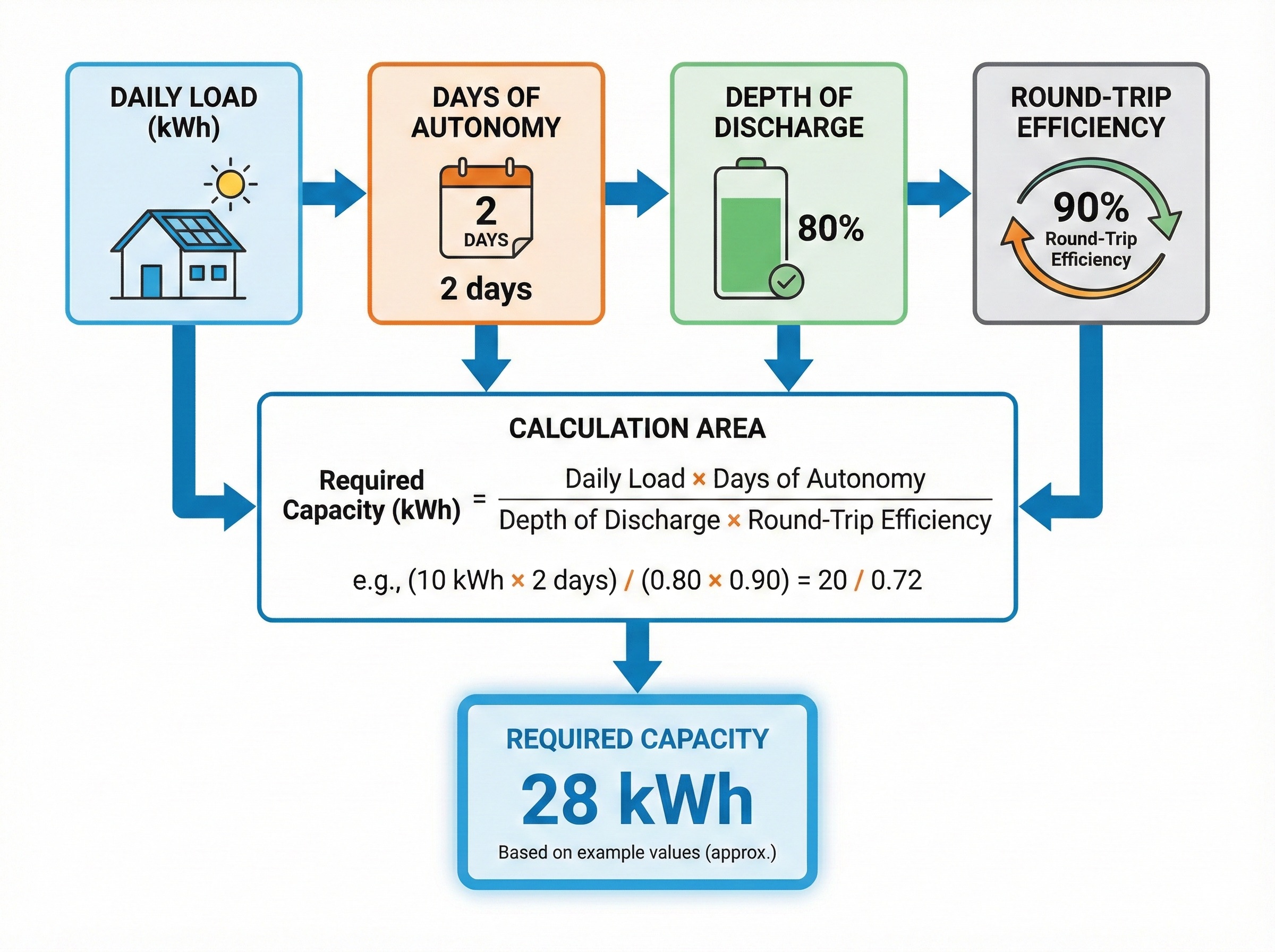
The Master Formula:
Let's break down each element:
Daily Load: Your daily energy consumption in kWh. Use your critical loads total for backup systems, or full-home usage for off-grid applications.
Days of Autonomy: How many days you want the battery to last without solar recharging. Grid-tied backup systems typically use 1-2 days. Off-grid systems often require 3-5 days to account for cloudy weather.
Depth of Discharge (DoD): The percentage of battery capacity you can safely use. Lithium iron phosphate (LFP) batteries allow 80-90% DoD. Traditional lead-acid batteries only permit 50% DoD to maintain longevity. This is why lithium batteries effectively provide more usable storage per labeled kWh.
Round-Trip Efficiency: Energy is lost during charging and discharging. Lithium batteries achieve 90-95% round-trip efficiency. Lead-acid batteries manage only 80-85%. According to BloombergNEF, these efficiency differences significantly impact long-term performance and sizing requirements.
This formula accounts for real-world losses that many battery calculators ignore. Skipping these factors leads to undersized systems that disappoint during actual outages.
Let's work through a complete example for a typical Texas home. This practical calculation shows how to size battery for solar in real-world conditions.
Scenario: A Houston-area home wants backup power for essential loads during grid outages.
Step 1: Calculate Daily Load
Step 2: Choose Days of Autonomy
Step 3: Select Battery Chemistry
Step 4: Apply the Formula
Result: This home needs approximately 28 kWh of nominal battery capacity. A system using two Tesla Powerwall 3 units (13.5 kWh each = 27 kWh total) would meet this requirement.
Common Sizing Scenarios:
| Backup Goal | Daily Load | Days | Battery Size Needed |
|---|---|---|---|
| Essential loads only | 8-10 kWh | 1 | 10-14 kWh |
| Essential loads | 8-10 kWh | 2 | 20-28 kWh |
| Most home circuits | 15-20 kWh | 1 | 21-28 kWh |
| Whole-home backup | 25-30 kWh | 1 | 35-42 kWh |
According to the American Clean Power Association, residential storage installations reached 608 MW of new capacity in Q2 2025, representing a 132% increase compared to Q2 2024. This growth reflects increasing homeowner interest in properly sized backup systems.
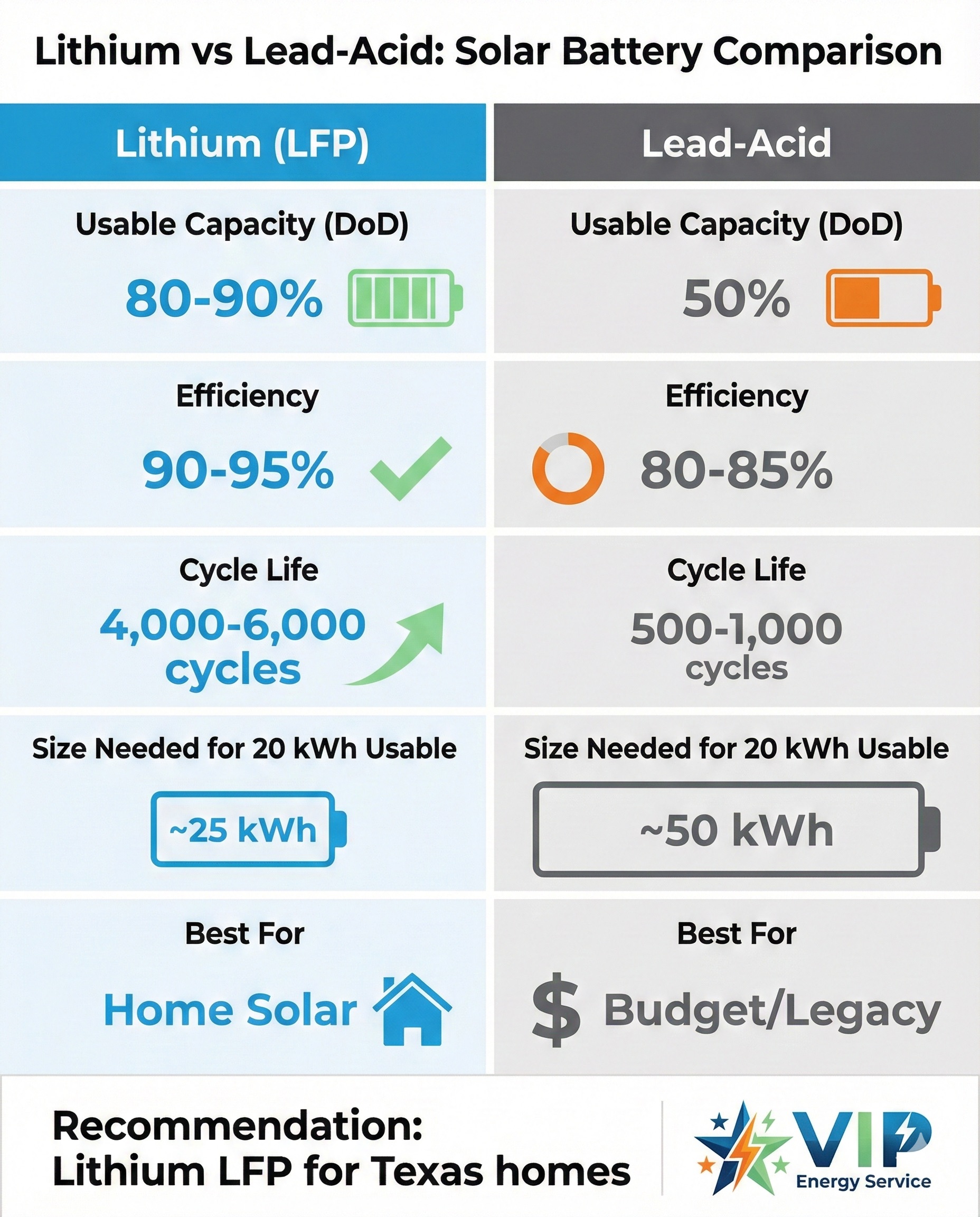
Battery chemistry dramatically impacts how many solar batteries you need. The same energy requirement produces very different battery bank sizes depending on your chosen technology.
Lithium Iron Phosphate (LFP) has become the preferred choice for residential solar storage. These batteries offer 80-90% depth of discharge, meaning you can use most of the labeled capacity. Their 90-95% round-trip efficiency loses minimal energy during charge cycles. According to ACE Battery market research, lithium-ion technology continues to dominate residential storage because of high energy density, faster charging, and longer cycle life.
Lithium NMC (Nickel Manganese Cobalt) batteries offer slightly higher energy density but require more sophisticated thermal management. Products like the Enphase IQ Battery and LG Energy Solution systems use this chemistry.
Lead-acid batteries remain available but require significantly larger installations. Their 50% depth of discharge means you need twice the nominal capacity to achieve the same usable energy. Lower 80-85% efficiency creates additional losses. While upfront costs are lower, the total cost per usable kWh typically exceeds lithium options over the system lifetime.
Chemistry Comparison:
| Factor | Lithium LFP | Lithium NMC | Lead-Acid |
|---|---|---|---|
| Usable DoD | 80-90% | 80-85% | 50% |
| Round-Trip Efficiency | 90-95% | 85-90% | 80-85% |
| Cycle Life | 4,000-6,000 | 2,000-3,000 | 500-1,000 |
| Thermal Stability | Excellent | Good | Good |
| Upfront Cost/kWh | Higher | Higher | Lower |
| Cost per Usable kWh | Lower | Moderate | Higher |
Major manufacturers like BYD and Sonnen have standardized on LFP chemistry for residential applications. This trend aligns with the MarketsandMarkets projection that the global residential energy storage market will grow from $26.9 billion in 2024 to $45.8 billion by 2030.
Texas homeowners face unique considerations when sizing solar batteries. The ERCOT grid operates independently from the rest of the country, and reliability concerns have driven record demand for home battery storage.
After Winter Storm Uri in 2021, Texans increasingly view battery backup as essential rather than optional. Wood Mackenzie research analyst Allison Feeney noted that "residential storage is expected to outperform rooftop solar in growth thanks to resilient policy support and high attachment rates." Texas leads the nation in new solar-plus-storage installations.
Summer Considerations: Texas summers push air conditioning systems hard. If you want to run AC during outages, plan for an additional 25-35 kWh daily beyond essential loads. Most homeowners choose smaller backup systems and rely on fans and strategic cooling rather than sizing for full AC operation.
Winter Considerations: While Texas winters are generally mild, cold snaps can stress electric heating systems. Heat pumps consume 3-5 kWh per hour when running. Gas heating with electric blower motors requires much less battery capacity.
Texas Incentive Programs: The 30% federal tax credit on battery storage is not available for systems placed in service after December 31, 2025. VP of Energy Storage Noah Roberts at the American Clean Power Association emphasized that "large-scale deployment of batteries is rapidly strengthening the U.S. grid and lowering energy costs for homes and businesses."
Consider your solar electricity plans when sizing batteries. Time-of-use rate structures can make battery storage economically attractive even without outages.
Your solar array must generate enough power to recharge your battery within a reasonable timeframe. Mismatched systems create problems—either the battery never fully charges or the solar panels waste potential generation.
Solar-to-Battery Sizing Rule:
Texas averages 4.5-5.5 peak sun hours daily depending on location. For a 28 kWh battery:
This calculation ensures your panels can fully recharge the battery on a typical sunny day while still powering daytime loads.
Inverter Considerations: Your hybrid solar inverter must handle both solar input and battery charging/discharging. Check that the inverter's continuous power rating exceeds your peak load expectations. The inverter often limits how much power you can draw simultaneously from the battery.
System Voltage: Most residential systems operate at 48V for efficiency. Higher voltages reduce wiring losses and improve charge controller performance. Systems using lower voltages (12V or 24V) work for small applications but require more complex wiring for whole-home backup.
If your existing solar system produces more than you use, you might be able to sell solar energy back to the grid. Battery storage gives you flexibility to choose when to export excess power versus storing it for later use.
Even experienced solar installers sometimes make sizing errors. Avoiding these common mistakes ensures your battery system performs as expected.
Mistake 1: Ignoring Depth of Discharge
Many homeowners compare batteries by total capacity alone. A 10 kWh lead-acid battery with 50% DoD delivers only 5 kWh of usable energy—the same as a 5.5 kWh lithium battery with 90% DoD. Always calculate usable capacity.
Mistake 2: Forgetting Round-Trip Efficiency
Every charge-discharge cycle loses some energy. A system sized without accounting for efficiency losses will underperform by 5-15%. The formula in this guide includes this factor.
Mistake 3: Sizing for Average Instead of Peak Usage
Your energy usage varies throughout the year. Sizing for your annual average leaves you short during peak summer months. Use your highest-consumption season for backup sizing.
Mistake 4: Ignoring Battery Degradation
Batteries lose capacity over time. A new 10 kWh battery might only hold 8 kWh after 5-7 years. Building in 10-15% extra capacity accounts for this degradation.
Mistake 5: Overlooking Texas Heat
High temperatures reduce battery efficiency and accelerate degradation. Batteries installed in unconditioned spaces (garages, outdoor enclosures) may need additional capacity to compensate. LFP batteries handle heat better than other lithium chemistries—one reason they're preferred for Texas installations.
How many solar batteries do I need for my house?
The number depends on your daily energy consumption and backup goals. Most Texas homes need 10-15 kWh for essential backup (1 battery) or 20-30 kWh for extended backup (2 batteries). Calculate your specific needs using the formula above.
What size battery for a 5kW solar system?
A 5kW solar system pairs well with 10-15 kWh of battery storage. This ratio allows full battery charging on sunny days while leaving generation capacity for daytime loads. Larger batteries may not fully charge during shorter winter days.
How long will a 10 kWh battery last during an outage?
Duration depends entirely on your load. Running essential loads (refrigerator, lights, WiFi) at 400-500 watts gives you 20-25 hours. Adding a window AC unit at 1,200 watts reduces runtime to approximately 6-8 hours. Whole-home loads drain a 10 kWh battery in just 2-3 hours.
Can I add more batteries later?
Most modern systems are modular and expandable. The Tesla Powerwall, Enphase IQ Battery, and Sonnen systems all support adding additional units. Verify expandability before purchasing if you anticipate future needs. Starting smaller and adding capacity later often makes financial sense.
Proper battery sizing protects your investment and ensures reliable backup when you need it most. The formula is straightforward: calculate your daily load, multiply by days of autonomy, and divide by usable capacity factors.
For most Texas homeowners, a 10-15 kWh battery system handles essential loads through typical outages. Whole-home backup or multi-day autonomy requires 25-40 kWh or more. Either way, accurate sizing prevents both underpowered disappointment and overspending on excess capacity.
When calculations get complex or you're unsure about load estimates, professional guidance pays for itself in system performance. VIP Energy Service helps Texas homeowners determine exactly how much battery storage they need based on their specific home, usage patterns, and backup priorities.
Ready to size your solar battery system correctly? Contact VIP Energy Service for a personalized assessment of your home's energy needs and battery storage options.













Copyright © 2026 VIPEnergyService.com. All rights reserved | PUCT# 10117