Solar + Battery + Free Nights: The Texas Triple Play for Lower Electric Bills

Hero Triple Play Texas

Solar + Battery + Free Nights: The Texas Triple Play for Lower Electric Bills

April 13, 2026
by
Shawn Cornett

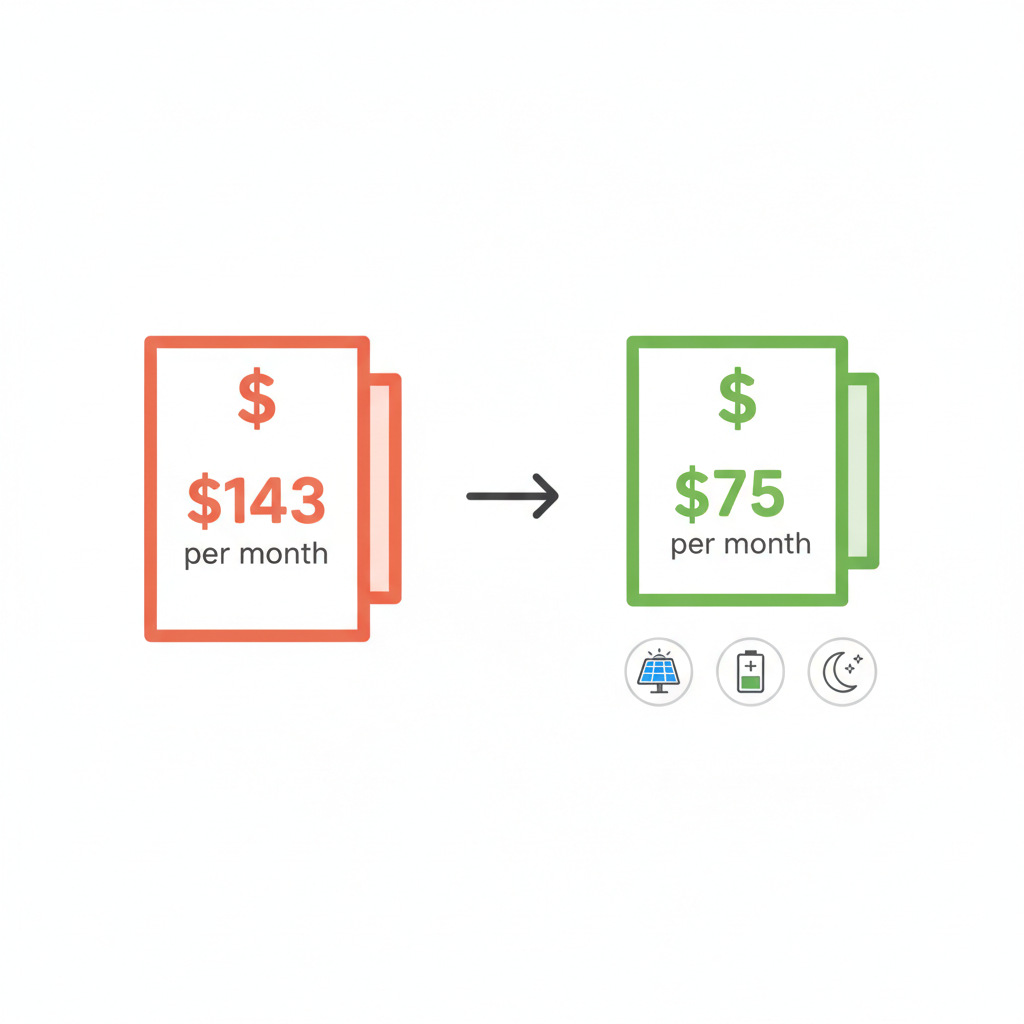
Combining solar panels, battery storage, and a free nights electricity plan creates a 24-hour energy strategy that can cut Texas electricity costs from ~$143/month to as low as $71–$82/month, saving approximately $732–$864 per year. Solar covers daytime usage, the battery bridges peak evening hours, and the free nights plan eliminates overnight energy charges. Total system cost: $32,000–$40,500 before incentives (Oncor rebate up to $9,000 available).

What if your solar panels, home battery, and electricity plan all worked together around the clock? That's the idea behind the Texas triple play — combining solar electricity plans with home battery storage in Texas alongside a free nights plan to slash your electricity costs from every angle. For the average Texas home, this strategy can cut monthly bills from ~$143 to as low as $71–$82, saving $732–$864 per year. Here's how each layer works together, what it costs in 2026, and whether it makes sense for your home. For background on free nights plans, see our guide to free nights electricity plans in Texas.

How the Triple Play Works

The triple play creates a 24-hour energy cycle where you rarely pay full price for electricity:

Time Window Power Source Cost
9 PM – 6 AM Free grid electricity $0 energy (TDU only ~5.58¢)
6 AM – 9 AM Battery discharge $0 (charged overnight for free)
9 AM – 5 PM Solar panels $0 (self-generated)
5 PM – 9 PM Battery discharge $0 (charged by solar during the day)

Each layer covers the others' weaknesses. Solar alone can't help at night — but the free nights plan and battery handle that. A free nights plan alone has expensive daytime rates (21.9¢/kWh) — but solar and battery eliminate most daytime grid purchases. A battery alone is expensive to charge from the grid — but solar and free nights provide zero-cost energy to charge it.

The result: your home draws from the grid primarily during free hours, and your battery bridges the gaps. According to Good Faith Energy, Texas solar-battery owners can configure time-based controls on systems like Tesla Powerwall and FranklinWH to automate this daily cycle.
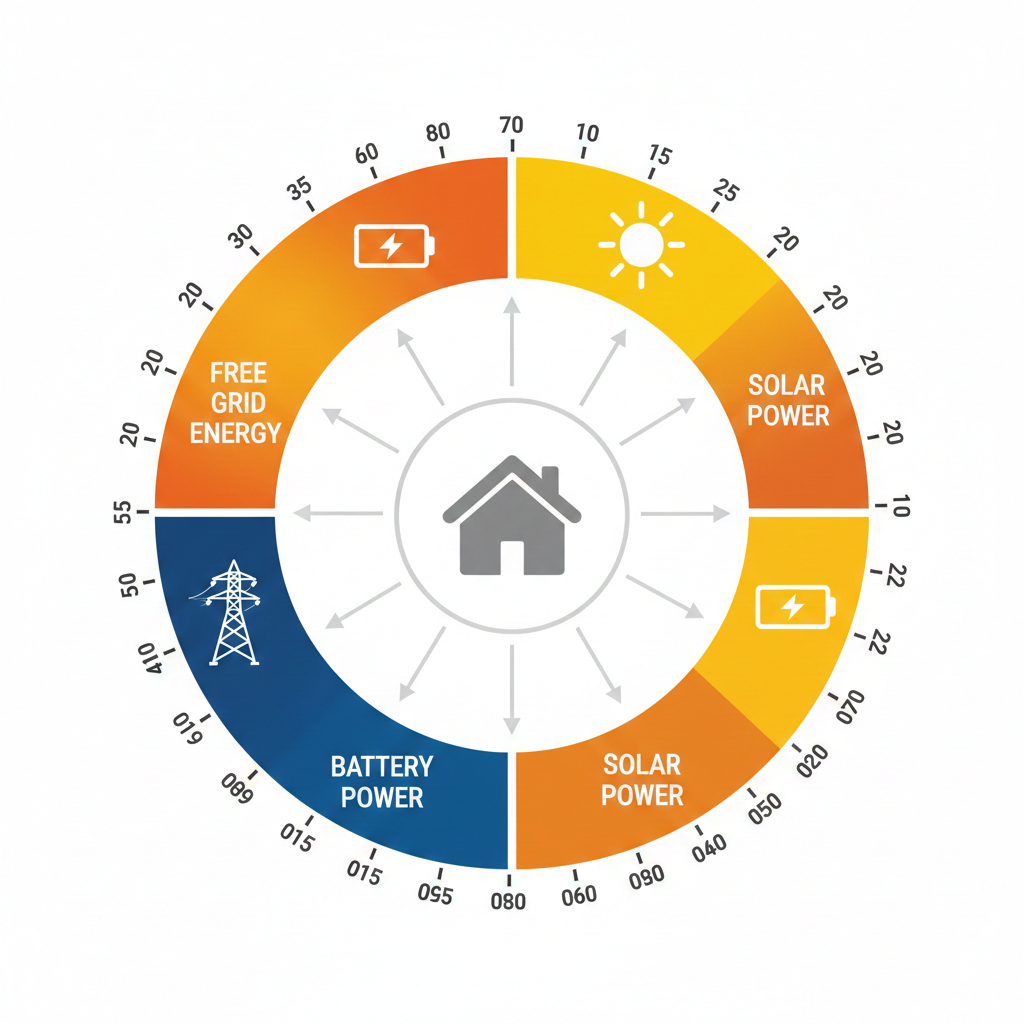
Diagram showing the 24-hour energy cycle of a solar battery system with free nights plan
Diagram showing the 24-hour energy cycle of a solar battery system with free nights plan.

The 3-Layer Savings Stack

Here's how each layer contributes to home battery storage electricity bills savings for the average Texas home (1,100 kWh/month):

Layer 1 — Solar generation: An 8 kW system in Texas generates approximately 1,200 kWh/month, according to EnergySage. That's enough to cover most or all daytime consumption — eliminating the 21.9¢/kWh daytime energy charge.

Layer 2 — Battery arbitrage: Your battery charges for free during nighttime hours and discharges during the expensive 6 AM–9 AM and 5 PM–9 PM windows. This captures value from the price gap between $0 nighttime energy and 21.9¢/kWh daytime rates.

Layer 3 — Free nights plan: Overnight usage (battery charging, appliances, HVAC) costs $0 in energy charges. You only pay TDU delivery at ~5.58¢/kWh, according to QuickElectricity.

Combined monthly estimate:

Component Fixed-Rate (13¢/kWh) Triple Play
Daytime energy $93 $0–$11
Nighttime energy $50 $0 (free plan)
TDU delivery Included $61
Base charge $0 $9.95
Monthly total ~$143 ~$71–$82
Annual savings ~$732–$864

Real-world results back this up: Texas homeowners on DIY Solar Forum report achieving near-zero electricity bills with solar + battery + free nights configurations, with one user paying just $77 total over six months.

What the System Costs in 2026

Transparency matters here. An 8 kW solar array in Texas costs $20,000–$24,000 before incentives, and a 13.5 kWh Tesla Powerwall 3 runs $12,000–$16,500 installed, according to SolarReviews. Total system cost: approximately $32,000–$40,500.

Important for 2026 buyers: The federal 30% Residential Clean Energy Credit expired December 31, 2025. This increases out-of-pocket costs compared to previous years. However, key incentives remain:

  • Oncor rebate: Up to $9,000 for solar + battery installations in the DFW service area, according to QuickElectricity
  • Third-party ownership (TPO): Solar leases and PPAs still qualify for the federal tax credit through 2027 — you get the benefits without the upfront cost
  • Battery cost trends: Lithium battery costs are declining 8–12% per year, with prices projected to reach $550–$850/kWh by late 2026, according to Native Solar

For current battery pricing, see our cost of battery storage per kWh guide. To understand how solar and battery systems work together, we have a dedicated explainer.

Why Ambit's Free & Clear Nights Fits This Strategy

Ambit Energy's Free & Clear Nights plan is built for solar electricity plans with home battery storage in Texas:

  • 9 PM – 5:59 AM free window — 9 hours of $0 energy for battery charging and overnight usage
  • 100% wind-powered — your nighttime grid electricity comes from renewable sources, complementing your solar investment
  • TLC Pledge — Ambit gives you 60 days to test the plan. If it doesn't fit, switch to any other Ambit plan at no cost. No early termination fee during the trial period
  • TDU delivery charges still apply (~5.58¢/kWh in Oncor territory), but the energy charge — typically the largest line item — is eliminated during free hours

For solar buyback plans with free nights, Ambit also offers 1:1 solar buyback on other plans if you decide to sell excess generation back to the grid instead.
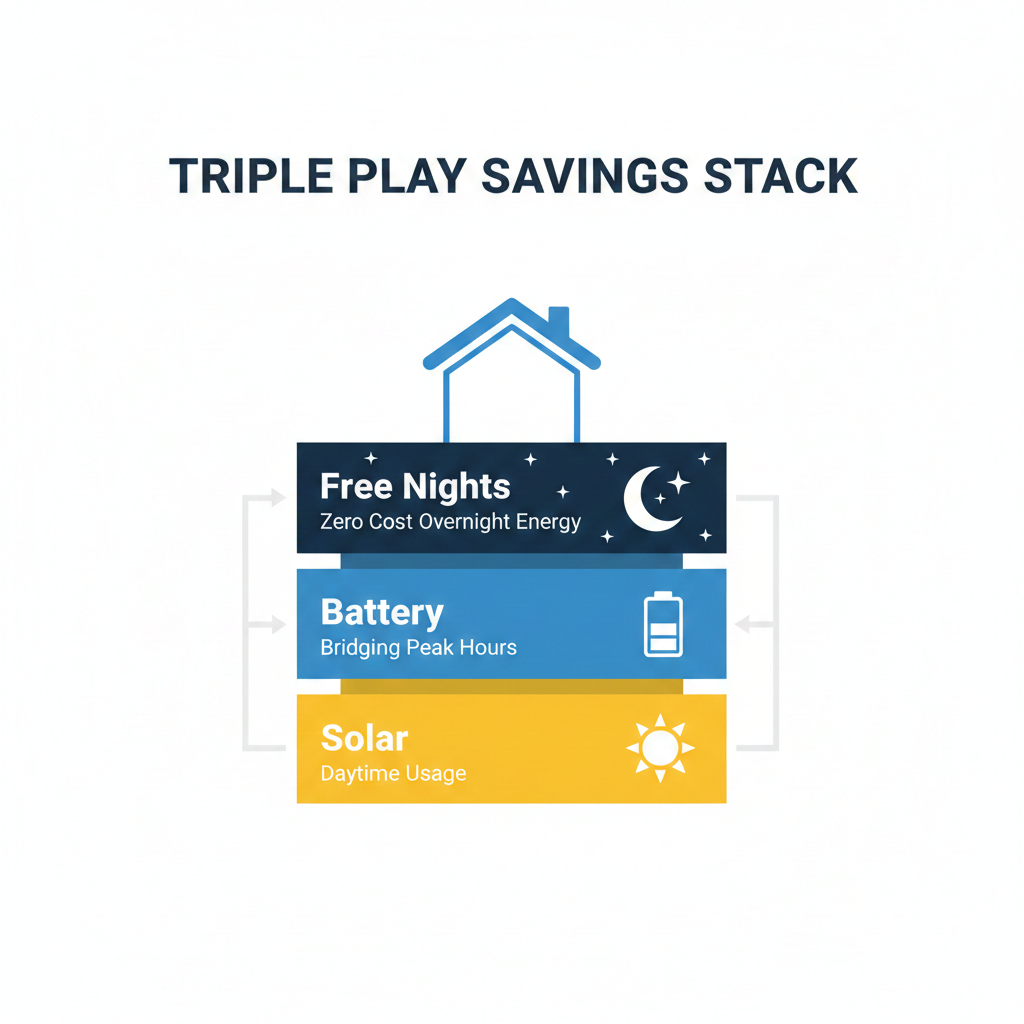
Layered view of the Texas Triple Play: solar, battery storage, and free nights plan
Layered view of the Texas Triple Play: solar, battery storage, and free nights plan.
Side-by-side savings comparison of solar-only versus solar plus battery plus free nights
Side-by-side savings comparison of solar-only versus solar plus battery plus free nights.

Is the Triple Play Right for Your Home?

The triple play makes the most sense if you:

  • Own your home (roof access for solar, ability to install battery)
  • Use 1,000+ kWh/month (higher usage = more savings to capture)
  • Live in Oncor or CenterPoint territory (TDU rebates and competitive delivery rates)
  • Plan to stay 7+ years (allows the system to pay for itself)

Not sure where you stand? Check your nighttime usage percentage at Smart Meter Texas, then compare Ambit Energy rates and plans to see which free nights option fits your home.

Ready to Build Your Triple Play System?

Get a personalized solar + battery + free nights recommendation from Ambit Energy VIP Energy Service.

Get Your Free Quote
Enroll Online

Frequently Asked Questions

How much can I save with solar + battery + free nights in Texas?

The average Texas home (1,100 kWh/month) can save approximately $732–$864 per year with the triple play strategy compared to a standard fixed-rate plan. Your actual savings depend on solar system size, battery capacity, daytime consumption patterns, and your TDU service area.

Did the federal solar tax credit expire?

The 30% Residential Clean Energy Credit (Section 25D) for customer-owned systems expired December 31, 2025. However, third-party-owned systems (solar leases and PPAs) remain eligible through 2027. The Oncor residential solar program also offers up to $9,000 in rebates for qualifying solar + battery installations.

Can I add battery storage to my existing solar system?

Yes — battery storage can be retrofitted to most existing solar installations. A 13.5 kWh battery like the Tesla Powerwall 3 costs $12,000–$16,500 installed and can be configured to work with free nights plans using time-based charging controls. Battery costs are declining 8–12% per year, making 2026 pricing more accessible than previous years for the battery component.

Sources:
EnergySage |
SolarReviews |
QuickElectricity |
Native Solar |
Good Faith Energy

Rates and plans subject to change. Always review the Electricity Facts Label (EFL) before signing up. System costs and savings estimates are approximate and vary by location, installer, and usage patterns.
Free Nights Plans for EV Owners in Texas: The Smartest Way to Charge

Texas EV owner? A free nights electricity plan can zero out your home charging bill. Here is the break-even math, top providers, and the setup that works.
Read More >>

Texas Summer Electricity Bills: How to Stay Cool and Save Money

TXU's Beat the Heat program signals summer bill season in Texas. Here are practical homeowner tips to compare plans, lock a fixed rate, and lower cooling costs.
Read More >>

How to Shift Your Energy Usage to Nights and Maximize a Free Nights Plan

A step-by-step playbook to shift energy usage to nights and maximize a Texas free nights plan: which appliances to run when, the break-even math, and how to verify savings.
Read More >>

Free Nights vs. Free Weekends: Which Texas Energy Plan Saves More?

Free nights vs free weekends in Texas: a side-by-side comparison, the break-even math, and who saves more on each plan.
Read More >>

Free Nights Energy Plans in Texas: How They Work and Who They're For

Free nights electricity plans in Texas: how they work, who actually saves money, the hidden costs, and the break-even math before you switch.
Read More >>

Solar Buyback vs. Battery Storage: Which Saves Texas Homeowners More Money?

Home › Solar Buyback Plans in Texas › Solar Buyback vs. Battery Storage Which saves more? For Texas homeowners with a competitive solar buyback rate like Ambit Energy's 1:1 at 12.5¢/kWh, buyback-only delivers $934/year with zero capital investment. Battery storage delivers $1,038–$1,376/year but requires $6,400–$7,779 after Oncor rebates. The hybrid approach — both together — […]
Read More >>

Texas Utility Shutoffs Are Rising: What Homeowners Should Know

A new federal report shows Texas leads the nation in electricity shutoffs. Here is what Houston and DFW homeowners can do to protect their service before summer.
Read More >>

Best Solar Buyback Plans in Texas: How to Compare and Choose

Home › Solar Buyback Plans in Texas › Best Solar Buyback Plans in Texas The best solar buyback plan in Texas depends on five factors: rate type (fixed vs. variable vs. 1:1), credit structure, contract length, TDU delivery charges, and your production-to-consumption ratio. As of 2026, Ambit Energy offers the highest fixed buyback rate at […]
Read More >>

Texas $0-Down Home Battery Plan: What Homeowners Should Know

The new Octopus Energy PowerStore plan offers Texas homeowners a 30 kWh battery with no down payment. We break down the real all-in cost for a Houston home and the four questions to ask before signing a 36-month contract.
Read More >>

Beyond Buyback: Why Texas Solar Owners Are Adding Battery Storage Instead

Home › Solar Buyback › Beyond Buyback: Battery Storage Battery backup for solar panels captures 2–6x more value per kilowatt-hour than exporting surplus energy for buyback credits. With buyback rates compressed to 3–7¢/kWh while retail electricity costs 12–18¢/kWh during peak hours, storing solar energy in a battery and using it yourself is the smarter economic […]
Read More >>

Solar Buyback Plans in Texas: A Complete Guide for Solar Homeowners

Home › Solar Buyback › Solar Buyback Plans in Texas Solar buyback plans let Texas homeowners sell surplus solar energy back to their REP for bill
Read More >>

Oncor Rate Increase 2026: What Texas Homeowners Need to Know Before Summer

Oncor filed for a rate increase adding approximately $7 per month to DFW electricity bills. Learn what is driving the increase, how it affects your bill, and the steps Texas homeowners can take to lock in competitive rates before summer 2026.
Read More >>

Solar + Battery + Free Nights: The Texas Triple Play for Lower Electric Bills

Home › Energy Plans › Solar + Battery + Free Nights Triple Play Combining solar panels, battery storage, and a free nights electricity plan create
Read More >>

Are Free Nights Electricity Plans Worth It? A Texas Homeowner's Analysis

Home › Energy Plans › Are Free Nights Plans Worth It? Are free nights electricity plans worth it? For most Texas homes, no. A study of 501 consume
Read More >>

Free Nights Electricity Plans in Texas: The Ultimate Guide to Saving More

Home › Energy Plans › Free Nights Electricity Plans in Texas Free nights electricity plans in Texas charge $0 for energy during off-peak hours (ty
Read More >>

How to Size a Home Battery: How Much Storage Do You Actually Need?

Home › Energy Storage › How to Size a Home Battery: How Much Storage Do You Actually Need? Most Texas homes need a battery energy storage system f
Read More >>
1 2 14