Solar Battery Backup for Power Outages: Keeping Your Texas Home Running

Hero Solar Battery Backup Power Outage

Solar Battery Backup for Power Outages: Keeping Your Texas Home Running

March 2, 2026
by
Shawn Cornett

A solar battery backup system gives Texas homeowners uninterrupted power when storms, heat waves, or equipment failures take the ERCOT grid offline. The system detects grid failure and switches to battery power in less than one second, while rooftop solar panels recharge the battery during the day for potentially indefinite backup.

A solar battery backup system gives Texas homeowners something the ERCOT grid cannot guarantee: uninterrupted power when storms, heat waves, or equipment failures take the grid offline. If you're exploring home battery storage options, understanding how solar battery backup works during outages is the key to protecting your family and your home.

Texas has experienced more power outages than any other U.S. state in the past five years: 263 major outages, each averaging over 160 minutes and affecting roughly 172,000 residents per event, according to Governing.com. A solar battery backup for power outages is no longer a luxury. It's a necessity.

How Solar Battery Backup Works During an Outage

When the grid goes down, your solar battery backup system detects the failure and switches to battery power in less than one second. An automatic transfer switch (ATS) disconnects your home from the grid and activates stored energy to power essential circuits: your refrigerator, Wi-Fi router, lights, phone chargers, and medical equipment.

During daylight hours, your rooftop solar panels continue generating electricity and recharging the battery. This means a solar battery backup for home use can provide potentially indefinite power as long as the sun is shining. At night, the battery discharges stored energy until morning.

Without a battery, solar-only homes go dark during outages. Anti-islanding protection, a safety feature required by electrical code, prevents solar panels from sending power to the grid when it's down, which protects utility repair crews. A solar battery backup system bypasses this limitation by powering your home directly.

Diagram showing how solar battery backup automatically switches from grid power to battery during an outage
Solar battery backup switches from grid to battery power in less than one second during an outage.

Why Texas Homeowners Need Solar Battery Backup

Texas runs on the ERCOT grid, an isolated electrical network that cannot import power from neighboring states during emergencies. That isolation makes Texas uniquely vulnerable.

ERCOT's winter reserve margin has dropped from 17.5% in 2021 to a projected 10.1% in 2026, well below the 15% industry standard, according to the Texas Policy Foundation. Meanwhile, 225 new large-load requests (mostly from data centers) arrived in 2025, and ERCOT projects energy demand will nearly double by 2030.

"We knew that the state of power system vulnerability nationwide is exacerbating... But the magnitude of that was shocking, and greater than we hypothesized."

Dr. Ali Mostafavi, Director, Urban Resilience AI Lab, Texas A&M University (EnergySage)

The consequences are real. During Winter Storm Uri in 2021, 4.5 million Texas homes lost power for an average of 42 hours. The economic damage reached up to $295 billion.

Map of Texas showing the isolated ERCOT grid with storm clouds and power outage indicators
Texas operates an isolated electrical grid, making it uniquely vulnerable to widespread power outages.

How Long Will a Solar Battery Power Your Home?

A Tesla Powerwall 3 (13.5 kWh) can power essential loads for approximately 2.5 days on a single charge. With rooftop solar panels recharging the battery each day, backup power can extend indefinitely during sunny weather.

Most Texas homes need between 10 and 30 kWh of storage for effective grid-tied backup. A single battery covers essentials, while two or more units can power your entire home. Use our solar battery sizing calculator to find the right capacity for your household.

System sizing depends on your home's electricity usage, the number of circuits you want to back up, and whether you have solar panels. For a deeper look at pricing, see our guide to the cost of battery storage per kWh.
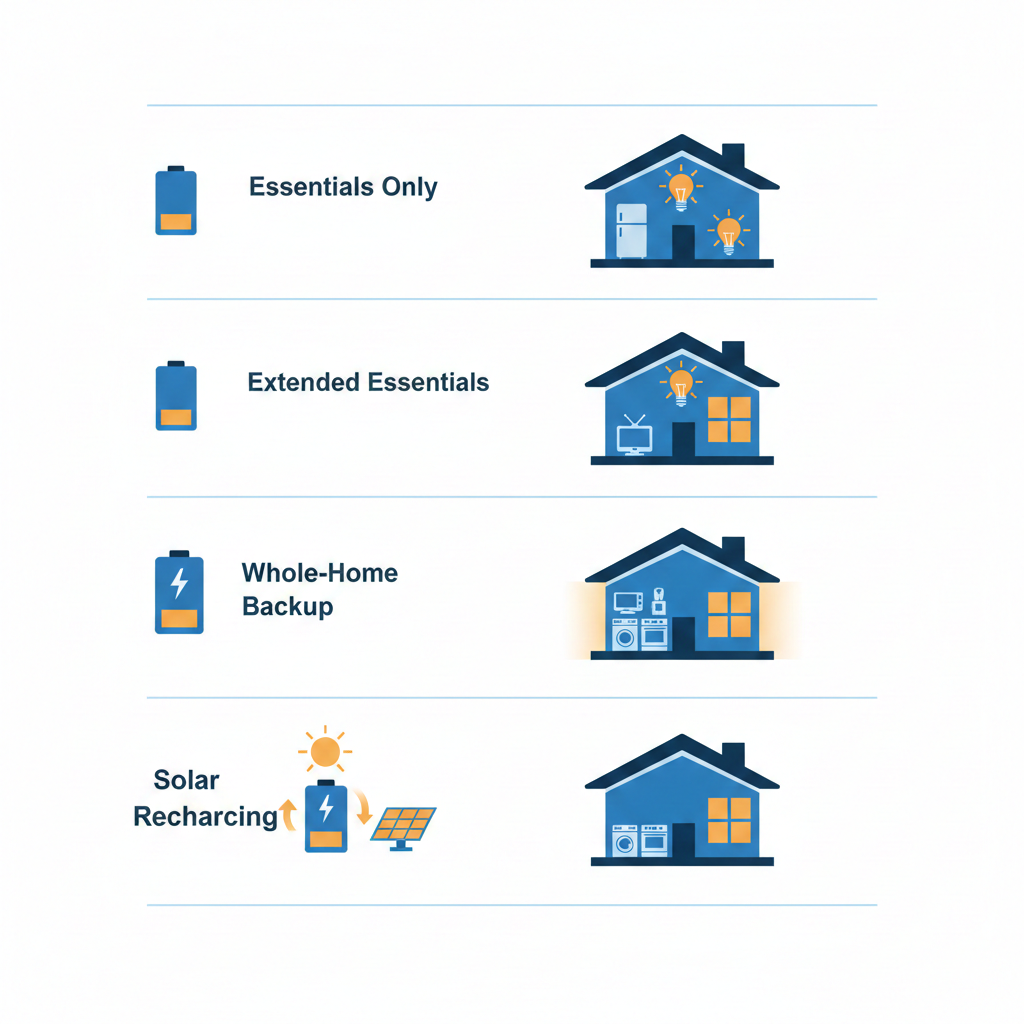
Infographic showing how long different solar battery backup systems power a Texas home
Solar battery backup duration depends on system size and whether solar panels are recharging the battery.

Benefits Beyond Backup Power

A solar battery backup system does more than keep your lights on during outages:

  • Lower electricity bills: Charge your battery during off-peak hours or with free solar energy, then use stored power during expensive peak periods.
  • Solar buyback credits: With Ambit Energy's 1:1 solar buyback rate, you receive full retail credit for excess solar energy sent to the grid. Learn about our solar buyback plans in Texas.
  • Energy independence: Reduce your dependence on an increasingly strained ERCOT grid.
  • Higher home value: According to HousingWire, 70% of new Texas home buyers now opt for backup battery features.

Take the Next Step

The Texas grid is getting more strained every year, not less. Between surging data center demand, declining reserve margins, and the increasing frequency of severe weather events, a solar battery backup system is one of the smartest investments a Texas homeowner can make in 2026.

At Ambit Energy VIP Energy Service, we help you pair the right solar battery backup with the right electricity plan, whether that's our Free Nights plans, 1:1 solar buyback, or no-deposit options.

Ready to protect your home from the next outage? Get Your Free Energy Quote or Enroll Online to start saving today.

Frequently Asked Questions

Does solar battery backup work at night?
Yes. The battery stores energy generated during the day and discharges it at night. Your home runs on stored power until your solar panels begin recharging the battery the next morning.

How fast does a solar battery switch on during an outage?
Modern solar battery backup systems detect grid failures and switch to battery power in less than one second, fast enough to keep sensitive electronics running without interruption.

Can I add battery backup to my existing solar system?
Yes. Most solar battery backup systems can be retrofitted to existing rooftop solar installations. Your installer will add a battery unit, an inverter (if needed), and an automatic transfer switch.


Sources

Your Texas Fixed Rate Can Still Change for 3 Reasons. The PUCT Is Now Weighing a Fourth

Fixed rate electricity plans in Texas can change only for TDU charges, ERCOT admin fees or new laws. The PUCT is now weighing a fourth: grid reserve costs.
Read More >>

Budget Billing Won't Lower What You Pay. Here's What Average Monthly Billing Does in Texas

Budget billing won't lower what you pay in Texas. See how Ambit's Average Monthly Billing works, when the carried balance peaks, and who should skip it.
Read More >>

Opening a New Business Location in Texas? How to Set Up Electricity Before Move-In Day

To set up electricity for a new Texas business location, find the ESI ID, confirm the TDU, estimate peak demand, choose a plan and schedule the move-in.
Read More >>

How to Use Smart Meter Texas to Price Your Next Electricity Plan

Smart Meter Texas holds up to two years of your usage. Here's how to register, download it and price any Texas plan's EFL at your real kWh, winter included.
Read More >>

$85.27 per 1,000 kWh: TNMP's New Delivery Rates Top the PUCT Table, and December Bills Add a One-Month Surcharge

TNMP TDU delivery charges are $7.56 a month plus 7.7710 cents per kWh as of October 1, 2026, or $85.27 at 1,000 kWh, the highest on the PUCT's table. Two September steps added $12.75, and December 2026 bills add a one-month Rider IS surcharge.
Read More >>

Texas Picked Its 2027-28 Backup Electricity Providers. How POLR Service Works If Your Provider Shuts Down

Texas approved its 2027-28 provider of last resort list on Oct. 9, 2026. Your power stays on if your provider fails, and you can leave POLR service any time.
Read More >>

ERCOT's December 2026 Outlook Puts Grid Emergency Odds at 2.95% in Its Riskiest Hour. What a Texas Winter Storm Can and Can't Do to Your Electric Bill

ERCOT's December 2026 outlook puts the riskiest hour, 8 a.m. on December's peak-load day, at a 2.95% chance of an Energy Emergency Alert, well under its 10% low-risk line. Here is what a Texas winter storm can and can't do to your electric bill.
Read More >>

Houston Delivery Charges Fell on August 15. They Jumped September 1 and Rose Again for Meters Read September 30. What That Does to Your October Bill.

CenterPoint delivery charges dipped on August 15, jumped back up September 1, and rose again for Houston meters read on or after September 30. Here's what it means for your October bill.
Read More >>

Lubbock Electricity Rates Change November 1: LP&L's New $2.50 Base Charge Means Smaller Homes Pay More and Bigger Homes Pay Less

LP&L adds a $2.50 monthly base charge and cuts delivery to 6.008 cents per kWh on Nov 1, 2026. Homes under 822 kWh a month pay more, bigger homes pay less.
Read More >>

How to Dispute an Electric Bill in Texas: What the PUCT's New Complaint Process Changes, and What It Doesn't

To dispute an electric bill in Texas, write to your provider first (21 days to answer), then file with the PUCT. On October 21, 2026 the PUCT ends formal complaints. Here is what changes and what stays the same.
Read More >>

Direct Energy Free Nights Review: What the EFL Actually Charges After the Free Window

Direct Energy free nights (Twelve Hour Power) is free 9 p.m. to 9 a.m. As of September 29, 2026, the 12-month EFLs charge 34.5 to 35.4 cents per kWh after the free window. Here is the break-even math.
Read More >>

27 Texas Electricity Plans Got Withdrawn on September 12 Alone. Here Is the Best Time to Renew Your Contract This Fall.

Best time to renew a Texas electricity contract: the fall shoulder window and the 14 days before your end date. 27 plans got pulled Sept 12. Here is the clock.
Read More >>

SmartEnergy Just Launched a $200 Bill Credit Plan on September 3. Here Is How Bill Credit Plans Actually Work in Texas (And When You Lose the Credit)

SmartEnergy launched a $200 bill credit plan on September 3, 2026. Here is how Texas bill credit plans actually work, and the four conditions that forfeit the credit.
Read More >>

No Deposit Light Companies in Texas: What You Actually Qualify For Without a Credit Check

Four legal ways to skip a Texas electricity deposit as of September 2026: soft-check plans, PUCT Rule 25.478 waivers, letters of credit, or prepaid Rule 25.498 plans. What each costs and who qualifies.
Read More >>

Every Ambit Energy Plan Compared for 2026: Rates, Terms, Fees and Who Each One Actually Suits

Compare every Ambit Energy plan in Texas for 2026 side by side: Lone Star Classic 12 and 24, Flex, Free and Clear Nights, Solar Buyback, small business TSC. Rates, fees, terms and who each one actually suits.
Read More >>

Oncor Delivery Charges Rose $8.38 on October 4, 2026. Here's What Changed on Your Bill.

As of October 4, 2026, Oncor's residential delivery charge is 6.8673 cents per kWh, about $8.38 more a month at 1,000 kWh. Here's the rider math, what August really did, and what you can control.
Read More >>
1 2 … 16

Important message regarding earnings: Ambit Energy makes no guarantee or promise of income or business. Anyone considering building a full-time or part-time Ambit business should have realistic expectations of their potential income. Learn more at goambit.com/disclaimer.