
Update, October 2026: According to the IRS, the 30% federal Residential Clean Energy Credit is not available for systems placed in service after December 31, 2025. Mentions of the credit below apply only to systems installed by then. Texas utility rebates and the Texas property tax exemption may still lower your cost.
Texas homeowners face unique energy challenges. Summer heat waves push air conditioners to their limits. Winter storms can knock out power for days. When you're investing in a home battery system, getting the size right matters. Too small, and you'll run out of power when you need it most. Too large, and you've wasted money on capacity you'll never use.
A solar battery Ah calculator helps you find that sweet spot. Understanding amp-hours (Ah) is the key to properly sizing your battery storage system. Before diving into the calculations, you'll want to understand how battery capacity relates to whole house battery backup cost to make an informed investment decision.
An amp-hour measures how much electrical current a battery can deliver over time. Think of it as the fuel tank of your battery storage system. The larger the amp-hour rating, the more energy your battery can store.
Here's a simple way to understand it: A 100 Ah battery can theoretically provide 100 amps for 1 hour, 10 amps for 10 hours, or 1 amp for 100 hours. In practical terms, this translates to how long your solar battery can power your essential appliances during an outage.
The relationship between amp-hours and the energy units on your electric bill works like this:
Most homeowners think in kilowatt-hours since that's what appears on electricity bills. However, battery capacity calculations require understanding amp-hours to properly size your system.
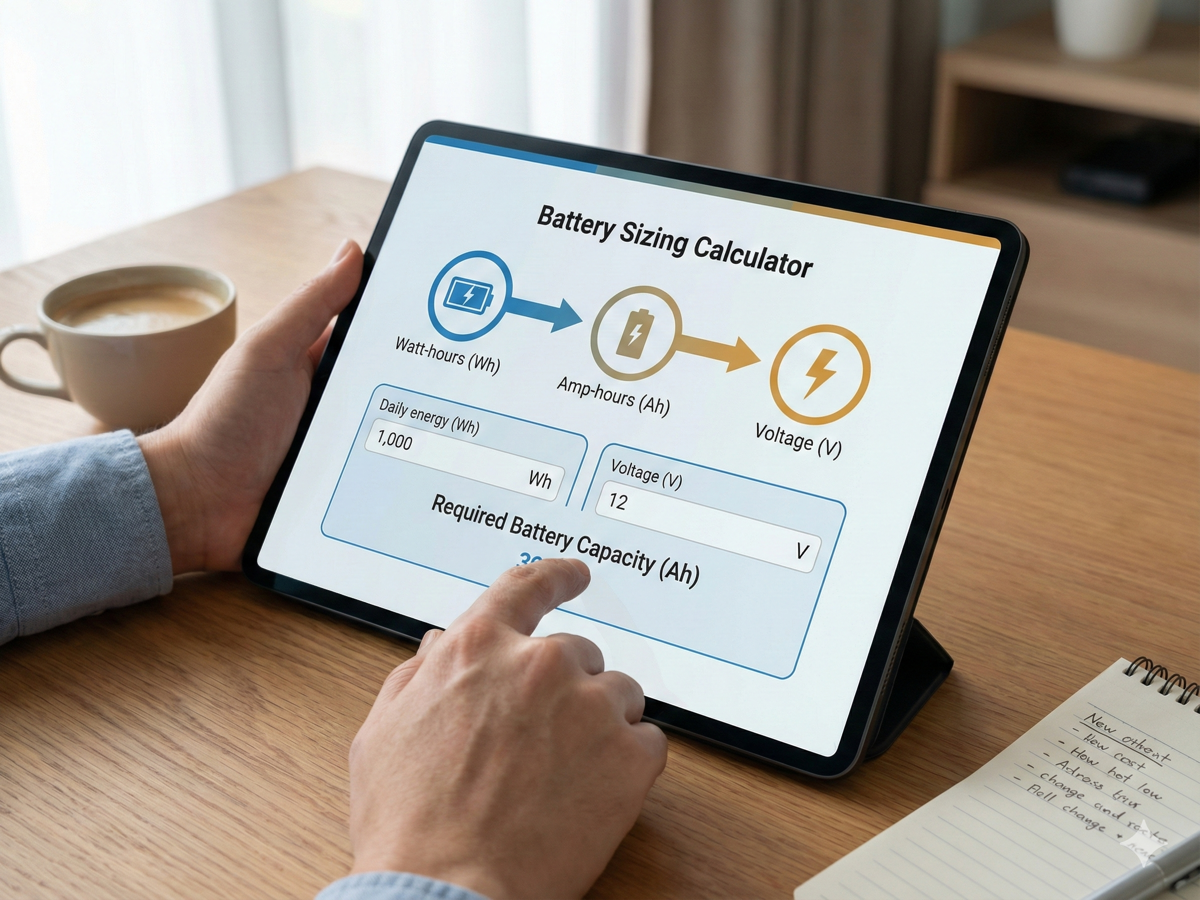
The core formula for calculating your required battery capacity combines several factors:
Required Ah = (Daily Wh × Days of Autonomy) ÷ (DoD × System Voltage × Efficiency)
Let's break down each component:
| Factor | Description | Typical Values |
|---|---|---|
| Daily Wh | Your daily energy consumption | Varies by home |
| Days of Autonomy | Backup days without solar | 1-2 (grid-tied) |
| DoD (Depth of Discharge) | Usable battery percentage | 80-100% (lithium) |
| System Voltage | Battery bank voltage | 48V (most efficient) |
| Efficiency | Round-trip efficiency | 85-90% |
Your system voltage significantly impacts the amp-hour requirement. Higher voltages require fewer amp-hours for the same amount of energy:
| System Voltage | Ah Required for 10 kWh |
|---|---|
| 12V | 833 Ah |
| 24V | 417 Ah |
| 48V | 208 Ah |
Most modern home battery systems use 48V for greater efficiency and smaller cable sizes.
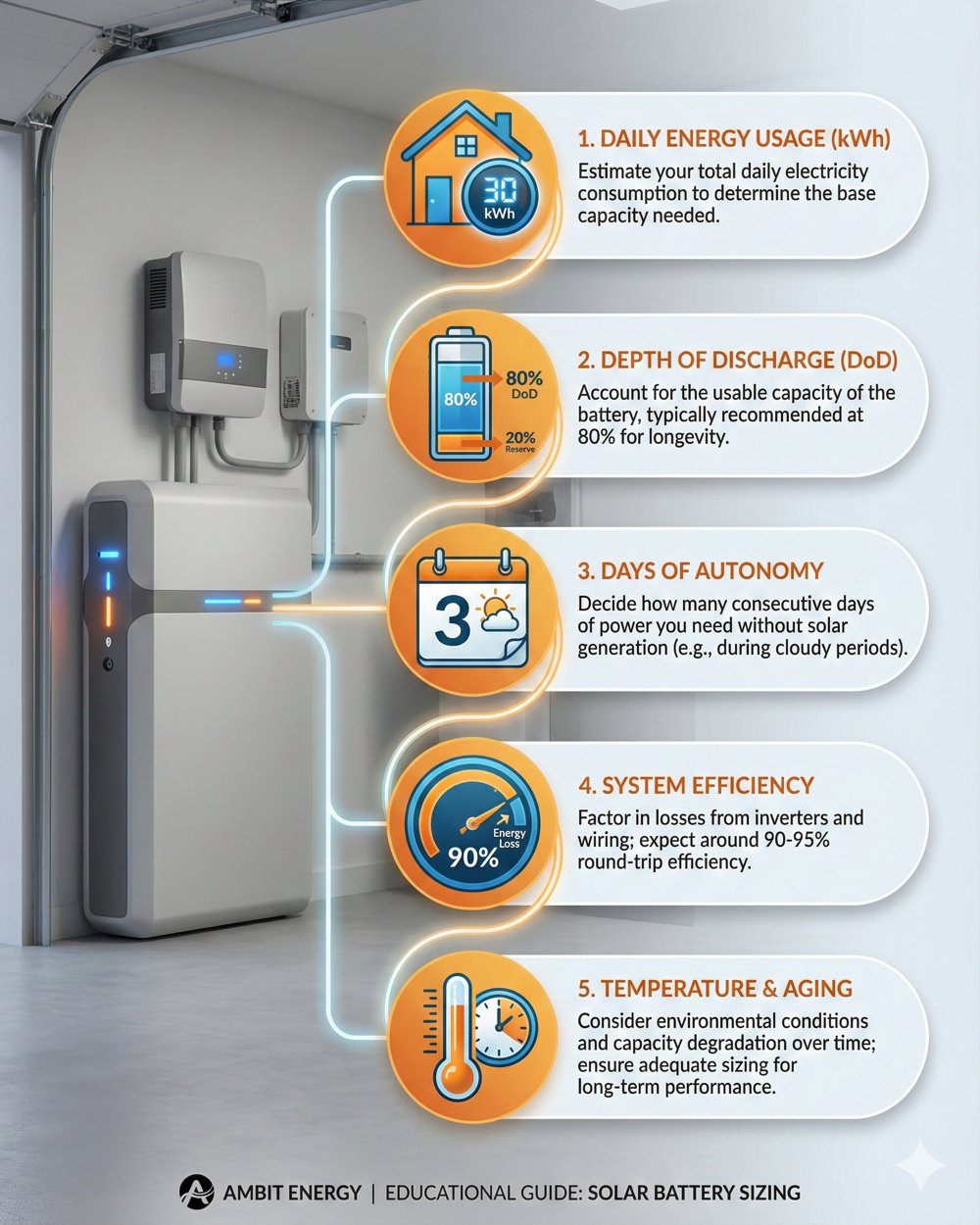
Getting accurate results from your solar battery Ah calculator requires understanding these five critical factors:
1. Daily Energy Usage
According to EIA data, Texas homes average 36-38 kWh per day. Larger homes around 2,000 square feet often consume 40-50 kWh daily. However, for backup purposes, you typically only need to power critical loads—not your entire home.
2. Depth of Discharge (DoD)
This determines how much of your battery capacity you can actually use. Lead-acid batteries should only discharge to 50% to preserve their lifespan. Lithium batteries can safely discharge 80-100% of their capacity without significant degradation.
3. Days of Autonomy
For grid-tied Texas homes, 1-2 days of autonomy typically provides adequate protection against outages. Off-grid solar systems may require 2-5 days depending on your location and weather patterns.
4. System Efficiency
No battery system is 100% efficient. Energy is lost during charging and discharging. Lithium batteries achieve 90-95% round-trip efficiency, while lead-acid systems manage only 80-85%. Apply an 85-90% efficiency factor in your calculations.
5. Temperature and Aging
Battery capacity decreases in extreme temperatures and as the battery ages. Industry experts recommend adding a 10-25% margin to account for these factors.
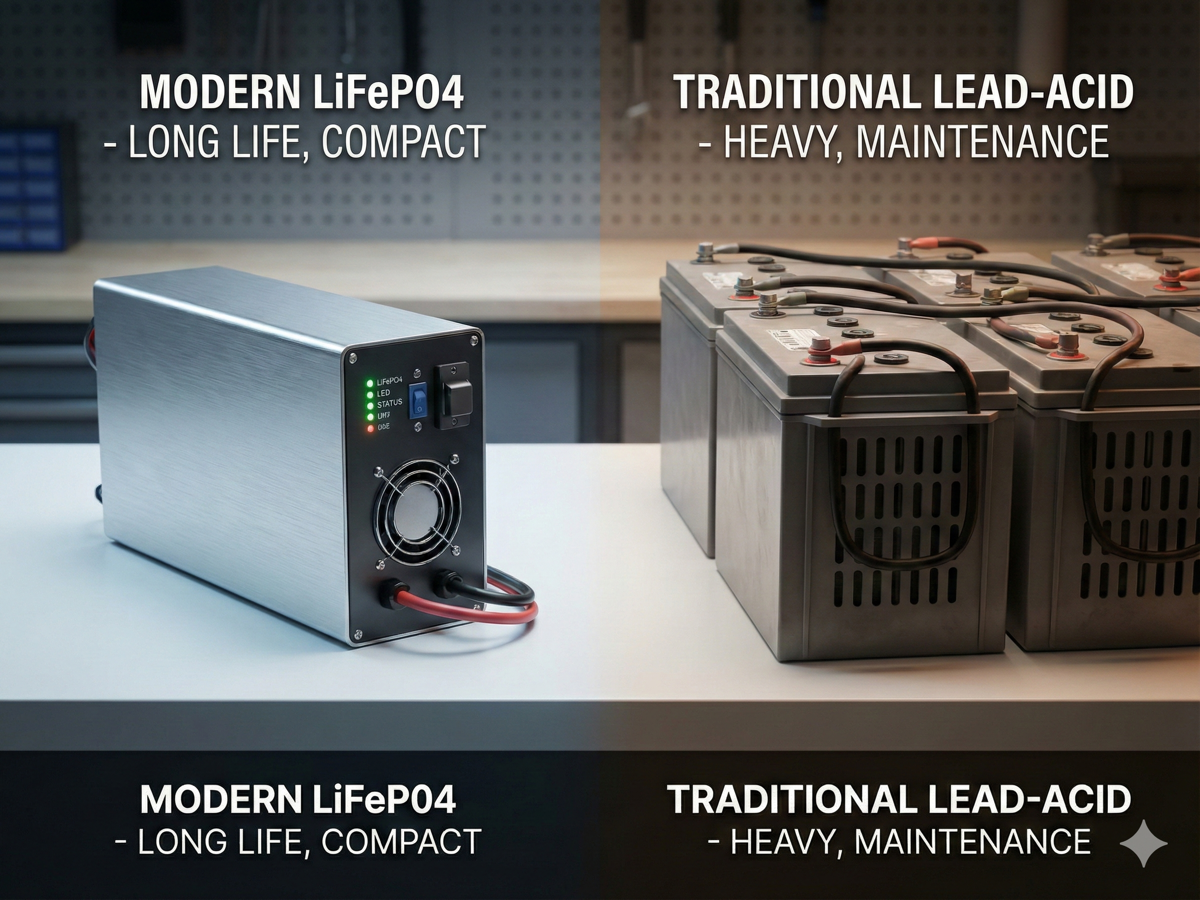
Choosing between battery types significantly affects your Ah requirements and total cost:
| Specification | Lead-Acid | Lithium (LiFePO4) |
|---|---|---|
| Usable Capacity | 50% | 80-100% |
| Cycle Life | 1,000-2,000 | 6,000-10,000 |
| Lifespan | 3-5 years | 10-15 years |
| Efficiency | 80-85% | 90-95% |
| Installed Cost | $400-800/kWh | $800-1,500/kWh |
While lithium batteries cost more upfront, their longer lifespan and higher usable capacity often make them more economical over time. For most Texas homes, lithium iron phosphate (LiFePO4) batteries represent the ideal battery choice due to their safety, longevity, and performance in our hot climate.
Let's walk through a real-world calculation for a typical Texas home:
Scenario: 2,000 sq ft home needing critical loads backup (refrigerator, lights, WiFi, medical equipment, one mini-split)
Step 1: Identify Critical Loads
Step 2: Apply the Formula
Calculation:
Required Ah = (5,000 × 1) ÷ (0.8 × 48 × 0.9)
Required Ah = 5,000 ÷ 34.56
Required Ah = 145 Ah
Recommendation: A 200 Ah battery bank at 48V (9.6 kWh) provides adequate capacity with a safety margin for aging and unexpected loads.
Based on our solar battery Ah calculator results, here are popular options that match common Texas home requirements:
| Battery System | Usable Capacity | Approximate Ah @ 48V |
|---|---|---|
| Tesla Powerwall 3 | 13.5 kWh | ~260 Ah |
| Enphase IQ Battery 10T | 10.1 kWh | ~205 Ah |
| 48V LiFePO4 Module | 9.6 kWh | 200 Ah |
These battery storage systems offer the reliability and capacity most Texas homeowners need for backup power during grid outages.
Understanding costs helps you make an informed decision:
| Capacity | Installed Cost | After 30% Tax Credit (2025 Installs Only) |
|---|---|---|
| 10 kWh | $9,000-$15,000 | $6,300-$10,500 |
| 13-14 kWh | $11,000-$18,000 | $7,700-$12,600 |
| 20-30 kWh | $18,000-$35,000 | $12,600-$24,500 |
The 30% federal tax credit for battery storage is not available for systems placed in service after December 31, 2025, so plan on the full system price for a new installation. Pairing your battery with a solar buyback program maximizes your energy savings and return on investment.
Proper battery capacity calculations ensure you get the backup power you need without overspending. Using a solar battery Ah calculator takes the guesswork out of sizing your system.
The key takeaways for Texas homeowners:
Ready to explore your battery storage options? Our energy consultants can help you determine the right system size for your home and energy goals. Get your free energy quote today and take the first step toward reliable backup power.















Copyright © 2026 VIPEnergyService.com. All rights reserved | PUCT# 10117