
Update, October 2026: According to the IRS, the 30% federal Residential Clean Energy Credit is not available for systems placed in service after December 31, 2025. Mentions of the credit below apply only to systems installed by then. Texas utility rebates and the Texas property tax exemption may still lower your cost.
Can you really get a free battery for solar panels? The honest answer is no, but you can significantly reduce or eliminate your upfront costs through the 30% federal tax credit (available through December 2025), utility rebates, and virtual power plant programs. In Texas, programs like SOLRITE-sonnen even offer $0-down battery installations in exchange for grid participation. The key is understanding exactly what you're trading for that "free" battery, and whether the trade makes sense for your situation.
If you're exploring ways to save on home energy storage, be sure to check out our complete guide to battery backup rebate programs, which covers every incentive option available to Texas homeowners in 2026.
The promise of free batteries for solar panels is everywhere, from online ads to door-to-door salespeople. But as someone who's helped hundreds of Texas homeowners navigate the energy market, I can tell you that "free" almost always comes with strings attached. This article will cut through the marketing hype to show you what "free" really means, where the hidden costs live, and how you can actually get a home battery at little or no cost by playing the incentive game strategically.
Let's be clear about one thing: no battery manufacturer is giving away equipment that costs $12,000 to $20,000 for a typical 10-15 kWh home system. When you see a "free battery for solar panels" offer, the cost is being recovered somewhere: you just need to understand where.
"There is no such thing as a free battery. If the installer is advertising a 'free' home storage system, you are paying for it somewhere—in a higher PPA rate, a bigger loan amount, or by giving the company the rights to use your battery in a virtual power plant and keep some or all of that value."
Vikram Aggarwal, Founder and CEO of EnergySage
There are three primary models behind "free" battery offers:
1. Virtual Power Plant (VPP) Enrollment
In this model, you receive a battery at reduced or no upfront cost in exchange for enrolling in a VPP program. Your battery becomes part of a larger network that utilities or grid operators can dispatch during peak demand periods. The company profits from grid services your battery provides, and you get backup power when it's not being used for grid support.
2. Power Purchase Agreements (PPAs)
With a PPA, a third party owns the solar panels and battery on your home. You pay a fixed rate for the energy produced, often lower than grid rates, but you don't own the equipment and typically can't claim the federal tax credit yourself.
3. Bundled Financing
Some installers offer a "free" battery by rolling its cost into a larger solar loan. You're still paying for the battery; it's just hidden in a higher overall payment or longer loan term.
In Texas's deregulated ERCOT market, VPP programs are particularly active. SOLRITE-sonnen, for example, offers what they call a "VPA" (Virtual Power Plant Agreement) where homeowners get free solar panels and sonnen batteries installed in exchange for VPP enrollment and paying a below-market rate for the energy their system produces. Since September 2024, SOLRITE has committed more than 40 MWh of residential battery capacity through this program.
If you're still wondering whether solar batteries are worth it, the answer depends entirely on understanding these tradeoffs.
The allure of a free battery for solar panels fades quickly when you understand what you're giving up.
"When a company promises 'no-cost solar' or a 'free battery,' it is almost always recouping those costs through a long-term contract with payments that are higher than they would otherwise be, or by keeping some of the financial benefits that would otherwise go to the homeowner."
Dan Gearino, Energy Journalist at Inside Climate News
Here's what "free" typically costs you:
Higher PPA or Lease Rates
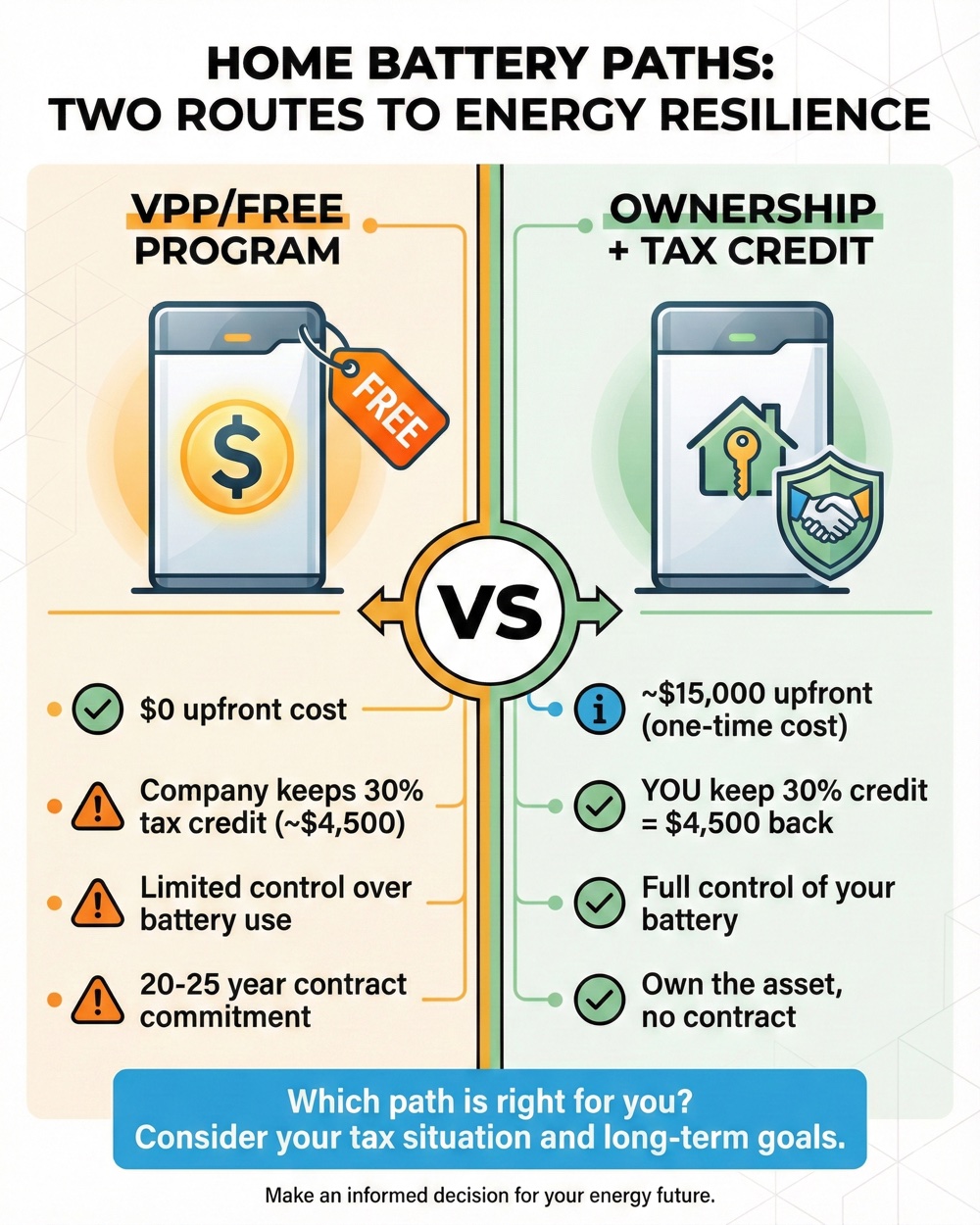
When a company gives you a "free" battery as part of a solar PPA, your per-kilowatt-hour rate is almost always higher than a solar-only PPA. That premium, multiplied over 20-25 years, often exceeds what you would have paid to buy the battery outright.
Lost Federal Tax Credits
The 30% federal Residential Clean Energy Credit can reduce a $15,000 battery system to $10,500 out of pocket. But in a PPA or lease arrangement, the third-party owner claims that credit, not you. That's $4,500 in value that goes to the company instead of into your pocket.
Loss of Battery Control
VPP agreements typically give the utility or aggregator the right to dispatch your battery during grid stress events. This means your battery might be discharged to help the grid exactly when you need it most, like during a summer heatwave when blackouts are most likely. Some programs limit this control; others are more aggressive.
Long Contract Terms
"Free" battery programs often lock you into 20-25 year agreements. If you want to sell your home, move, or simply exit the program, early termination fees can be substantial.
Limited Availability
Many "free" programs have funding caps. California's CEA Solar Plus Connect program, for example, had only about 6,000 eligible customers as of September 2025. Texas programs like Evergy's battery pilot charge $10/month fees and require qualifying through specific criteria.
The Consumer Financial Protection Bureau has warned consumers directly: "Claims of 'no-cost solar' or 'free equipment' can be misleading if consumers are locked into long-term payment obligations or if the provider retains valuable incentives or bill credits. Consumers should focus on the total cost over the life of the contract, not just upfront payments."

The battery market has transformed dramatically, and that changes the calculus for "free" battery programs versus outright ownership.
"After a 40% drop in battery equipment costs in 2024, the economics of battery storage are 'unrecognizable,' and the industry is still adjusting to this new reality."
Kostantsa Rangelova, Global Electricity Analyst at Ember
Here's what the numbers look like in 2026:
Dramatic Cost Reductions
Battery equipment costs fell approximately 40% in 2024 alone. The levelized cost of storage (LCOS) for utility-scale batteries has dropped to around $65 per MWh, with capital costs now approximately $125 per kWh for complete systems. While residential systems carry a premium for smaller scale and installation complexity, the trend is unmistakable: batteries are far more affordable than they were even two years ago.
Tesla Powerwall 3 Pricing
A Tesla Powerwall 3 installation typically runs $11,000 to $16,000 for a single unit before incentives. Additional units add $8,000 to $12,000 each. With the 30% federal tax credit, a single Powerwall's net cost drops to roughly $7,700 to $11,200.
Federal Tax Credit Status
Here's where timing becomes critical. The 30% Residential Clean Energy Credit is currently available through December 31, 2025, under current law. The original Inflation Reduction Act schedule had the credit continuing at 30% through 2032, then stepping down to 26% in 2033 and 22% in 2034. However, subsequent legislation modified this timeline, making the December 2025 deadline particularly important for homeowners considering battery purchases.
Both standalone batteries and solar-paired systems qualify for the credit, which represents a significant shift from earlier rules that required batteries to be charged by solar.
Why This Matters for "Free" Battery Decisions
When batteries cost $20,000+ and you couldn't claim tax credits on standalone systems, "free" VPP programs made more financial sense. But with prices down 40% and a 30% tax credit available, the math has shifted. In many cases, buying a battery outright and claiming the credit yourself delivers better long-term value than signing away grid-service rights for a "free" system.
Texas homeowners have several legitimate paths to reduce battery costs substantially, sometimes to near zero. Here's how to work the system strategically.
Option 1: Claim the Federal Tax Credit Yourself
Owning your battery and claiming the 30% Residential Clean Energy Credit is often the best value proposition. Here's the math:
If you're in a position to use the full tax credit (meaning you have at least $4,500 in federal tax liability), this path keeps you in full control of your battery while capturing significant savings. Remember, this credit is available through December 2025 under current law.
Option 2: Texas Utility Programs
Texas utilities and competitive providers offer various battery programs:
Option 3: Stack Incentives Strategically
The real power move is combining multiple incentives. Here's an example scenario:
"From a household balance-sheet perspective, a battery can make financial sense where tax credits, state rebates, and utility incentives combine to cover a substantial share of the upfront cost. But if those incentives are captured by the installer in a 'free battery' offer, the homeowner may be giving up more value than they realize."
Tom Konrad, PhD, CFA, Green Energy Investment Analyst
For comprehensive information on Texas-specific options, see our Texas battery storage guide and our best solar battery guide for equipment comparisons.
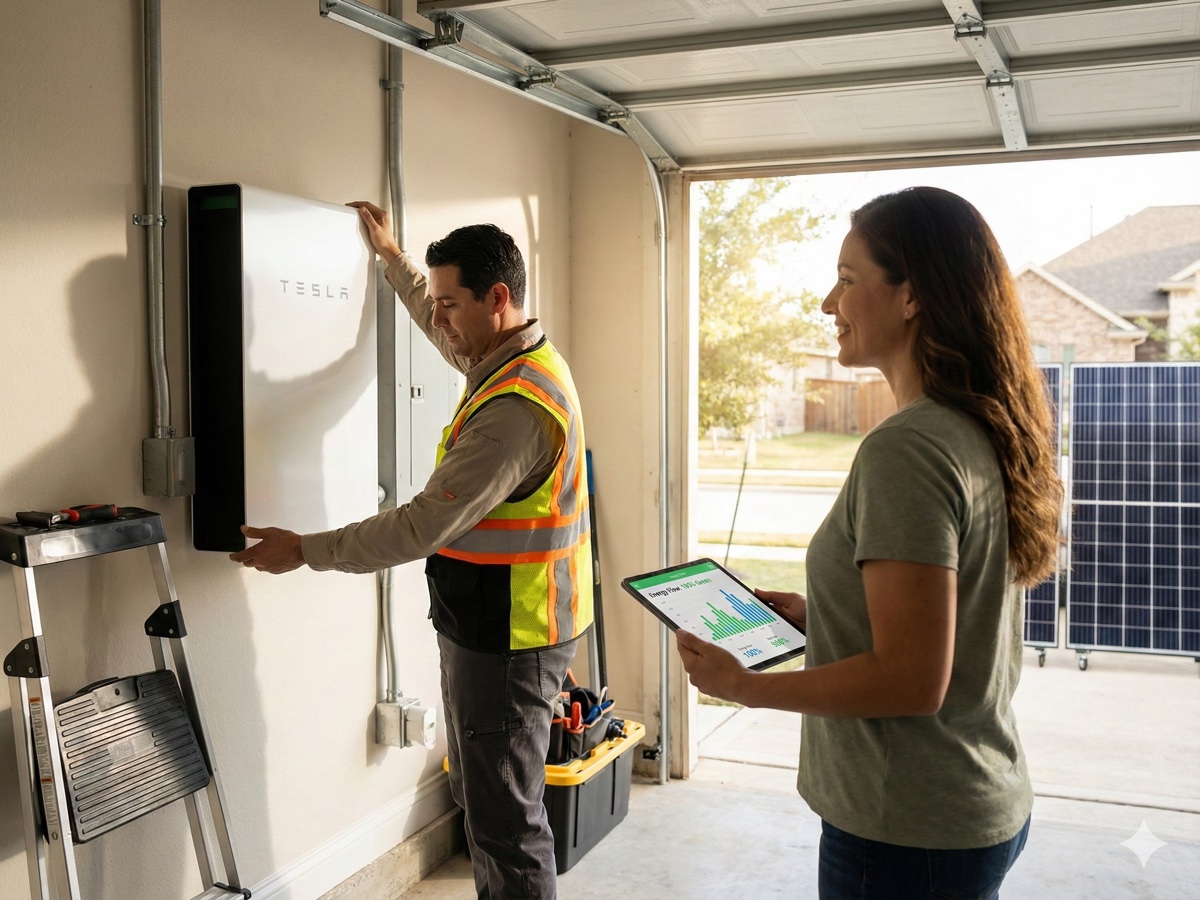
Despite the hidden costs, "free" battery programs genuinely work well for certain homeowners. Here's when a VPP or PPA arrangement might actually be your best choice:
Good Candidates for "Free"/VPP Programs:
Better to Buy Outright If:
To properly evaluate your options, you'll also want to understand how to size a battery for your solar system.
Not all "free battery" offers are created equal. Some represent legitimate value propositions; others are designed to obscure unfavorable terms. Watch for these warning signs:
Red Flag #1: No Clear Ownership Explanation
Legitimate programs clearly state who owns the equipment. If a salesperson can't give you a straight answer about whether you or the company owns the battery, walk away.
Red Flag #2: Vague or Missing Contract Terms
Any "free" offer should come with detailed written terms covering: contract length, monthly fees, escalation clauses, what happens if you sell your home, and early termination conditions. Verbal promises are worthless.
Red Flag #3: High-Pressure Tactics
"This offer expires today" or "We only have three spots left in your area" are classic pressure tactics. Legitimate programs don't need artificial urgency.
Red Flag #4: No Discussion of End-of-Contract
What happens when the 20-year PPA ends? Do you own the equipment? Does it need to be removed? Who pays for removal? These questions matter.
Red Flag #5: Claims That Seem Too Good
If someone offers you a free battery with no monthly fees, no contract obligations, and no strings attached, they're either lying or there's something they're not telling you.
Questions to Ask Any "Free Battery" Provider:
After analyzing the market, here's my perspective on the smartest approach for most Texas homeowners seeking a free or low-cost battery for solar panels in 2026.
For Most Texas Homeowners: Ownership + Tax Credit
If you have sufficient tax liability to use the 30% federal credit, buying your battery delivers the best long-term value. You maintain full control, capture all incentives yourself, and can potentially participate in VPP programs voluntarily for additional income without giving up ownership.
For Those Who Can't Use the Tax Credit: VPP Programs
If you're retired, have low income, or otherwise can't benefit from the federal tax credit, VPP programs like SOLRITE-sonnen offer genuine value. You get equipment at $0 down, and while the company profits from grid services, you get backup power you wouldn't otherwise have.
Timing Matters: The December 2025 Deadline
The 30% federal tax credit expires December 31, 2025, under current law. If you're considering battery ownership, acting before this deadline could save you thousands compared to waiting for a potentially lower (or nonexistent) credit.
Work with a Trusted Energy Consultant
The battery and solar landscape is complex, and what works for one homeowner might not work for another. At Ambit Energy VIP Energy Service, we help Texas homeowners understand all their options, including our competitive solar buyback program that maximizes the value of your solar investment.
To understand how solar and battery systems work together, explore our educational resources or reach out for a personalized assessment.
Can I really get a free battery for my solar panels?
Not truly free, but $0-down options exist through VPP programs and PPAs. In these arrangements, you typically trade control over your battery, the federal tax credit, and/or long-term flexibility for zero upfront cost. The company recovers its investment through grid services, higher energy rates, or by claiming incentives on your behalf.
What is a virtual power plant (VPP)?
A virtual power plant is a network of home batteries coordinated by a central operator to function like a single power plant. When the grid needs support during peak demand, the operator can discharge participating batteries to reduce strain. In exchange, homeowners typically receive reduced equipment costs, monthly credits, or other compensation.
Does the 30% federal tax credit apply to batteries?
Yes. Both standalone batteries and solar-paired systems qualify for the 30% Residential Clean Energy Credit. Under current law, this credit is available through December 31, 2025. The credit applies to the full installed cost, including equipment, labor, and related electrical work.
What's the average cost of a home battery in Texas?
A typical 10-15 kWh home battery system costs $12,000 to $20,000 installed before incentives. A Tesla Powerwall 3 specifically runs $11,000 to $16,000 for a single unit. After the 30% federal tax credit, net costs drop to roughly $8,400 to $14,000 for most systems.
How long do home batteries last?
Most lithium-ion home batteries are designed to last 10-15 years. Manufacturers typically offer warranties covering 10 years or approximately 6,000 charge cycles, guaranteeing the battery will retain at least 70-80% of its original capacity during that period.
Are "free battery" programs available in Texas?
Yes. Programs like SOLRITE-sonnen offer $0-down battery installations in the ERCOT market. These programs typically require VPP enrollment, meaning the company can dispatch your battery for grid services. Other Texas utilities offer rebate programs that can significantly reduce, though not eliminate, your out-of-pocket costs.
What's the catch with free solar batteries?
The main "catches" are: (1) you typically don't own the equipment, (2) the installer claims the federal tax credit instead of you, (3) you may have limited control over when your battery is available for your own use, and (4) you're usually locked into a 20-25 year contract. The company profits by aggregating your battery with others to provide profitable grid services.
Should I buy a battery or use a "free" program?
Buy if you can use the federal tax credit, want full control over your battery, and are planning to stay in your home long-term. Use a "free" program if you can't benefit from tax credits, prefer $0 upfront costs, and are comfortable with grid dispatch arrangements. There's no universal right answer: it depends on your financial situation and priorities.
"Free battery for solar panels" is rarely what it seems. The cost is there: it's just been shifted into higher rates, lost incentives, reduced control, or long-term contract obligations. But understanding these tradeoffs empowers you to make smarter decisions.
For Texas homeowners who can claim the federal tax credit, ownership usually delivers the best long-term value, especially with battery costs down 40% and the 30% credit available through December 2025. For those who can't use the credit or prefer zero upfront costs, VPP programs offer a legitimate alternative. Just make sure you understand exactly what you're trading away.
The Texas energy market offers genuine opportunities to reduce or eliminate battery costs. The key is approaching those opportunities with clear eyes and realistic expectations.
For a complete breakdown of every battery incentive available to Texas homeowners, visit our battery backup rebate guide. And if you want personalized guidance on your specific situation, the team at Ambit Energy VIP Energy Service is here to help you navigate your options.
This article reflects the perspective of Ambit Energy VIP Energy Service based on current market conditions in December 2025. Tax and incentive information should be verified with a qualified professional before making purchasing decisions.










Copyright © 2026 VIPEnergyService.com. All rights reserved | PUCT# 10117
Important message regarding earnings: Ambit Energy makes no guarantee or promise of income or business. Anyone considering building a full-time or part-time Ambit business should have realistic expectations of their potential income. Learn more at goambit.com/disclaimer.