
Update, October 2026: According to the IRS, the 30% federal Residential Clean Energy Credit is not available for systems placed in service after December 31, 2025. Mentions of the credit below apply only to systems installed by then. Texas utility rebates and the Texas property tax exemption may still lower your cost.
Unlock the full value of your solar investment by understanding how to carry forward your unused federal solar tax credits.
Installing solar panels on your Texas home is an excellent way to reduce your electricity bills and take advantage of the abundant sunshine in the Lone Star State. One of the most significant financial incentives for going solar is the federal Residential Clean Energy Credit, which allows you to claim 30% of your solar installation costs as a credit against your federal income taxes.
However, many homeowners discover that their tax liability in the year of installation isn't large enough to use the entire credit. The good news? You don't lose those unused credits. Through the solar tax credit carryover provision, you can roll over any remaining credit amount to future tax years, maximizing your solar investment's financial returns.
This guide will explain everything Texas homeowners need to know about the solar tax credit carryover process, how many years you can carry forward your credit, and strategies to ensure you capture every dollar of solar incentives you're entitled to receive.
The federal solar tax credit, officially called the Residential Clean Energy Credit, is a dollar-for-dollar reduction in your federal income tax liability based on qualified solar expenses. Currently, this credit equals 30% of the total cost of your solar energy system, including equipment, installation, and related expenses.
For example, if your solar system costs $20,000, your potential tax credit would be $6,000 ($20,000 × 30%). This credit directly reduces what you owe in federal taxes—if you owed $7,000 in federal income tax, applying this credit would reduce your tax bill to just $1,000.
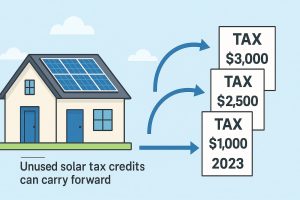
The solar tax credit is non-refundable, meaning it can only reduce your tax liability to zero—it won't result in a tax refund beyond what you've paid in. This is where the carryover provision becomes crucial.
If your solar tax credit exceeds your tax liability in the installation year, you can carry forward the unused portion to future tax years. This rollover capability ensures you can capture the full credit value over time, even if you can't use it all in a single year.
Let's look at an example:
In this scenario, you would apply $4,000 of your credit to eliminate your tax liability in Year 1, leaving $3,500 in unused credits. Instead of losing this amount, you can carry it forward to Year 2 and beyond until you've used the full $7,500 credit.
One of the most common questions about solar tax credit carryover is how long the credits remain available. According to current IRS guidelines, you can carry forward your unused solar tax credits for as long as the credit remains in effect.
Since the Residential Clean Energy Credit is currently authorized through December 31, 2034, you can continue to apply carried-over credits to your federal taxes until this date. However, the credit will step down from 30% to 26% in 2033 and then to 22% in 2034 before expiring completely.
This timeline is critical for Texas homeowners planning their solar investments. To maximize the available credits, it's advisable to install your system during the 30% credit period and ensure you have sufficient tax liability over the coming years to utilize any carried-over credits before the program expires.
Claiming your solar tax credit and carrying over unused amounts requires careful documentation and proper tax filing. Here's a step-by-step process:
In the year you install your solar system, you must file IRS Form 5695 (Residential Energy Credits) with your tax return to establish your credit. This initial filing is crucial even if you can't use the full credit amount that year.
Determine your tax liability for the year to understand how much of the credit you can use immediately. Remember, you can only apply the credit up to the amount of taxes you owe.
On Form 5695, you'll indicate the total credit amount and how much you're using for the current tax year. The difference represents your carryover amount.
In future tax years, you'll again file Form 5695, indicating the carryover amount from previous years. Continue this process until you've used the full credit or until the credit expires.
For Texas homeowners looking to optimize their solar tax benefits, consider these strategies:
If possible, time your solar installation to align with years when you expect higher tax liability. This could help you use more of the credit upfront.
If you have significant carried-over credits, you might consider reducing your tax withholdings for the following year. This allows you to benefit from the credit throughout the year rather than waiting for a tax refund.
For those with retirement accounts, strategically converting traditional IRA funds to a Roth IRA can create taxable income that can be offset by solar tax credits.
If you have flexibility in when you receive income (self-employed individuals, for example), you might accelerate income into years when you have unused solar credits.
Every homeowner's tax situation is unique. Working with a qualified tax professional familiar with renewable energy incentives can help you develop a personalized strategy to maximize your solar tax credits.
No, the Residential Clean Energy Credit is non-refundable. This means it can only reduce your tax liability to zero; any excess credit amount must be carried forward to future tax years rather than being refunded.
You must have tax liability to benefit from the solar tax credit. If you don't owe any federal income taxes in the installation year, you'll need to carry the entire credit forward to a future year when you do have tax liability.
If you haven't used all your carried-over credits by December 31, 2034 (when the credit is scheduled to expire), you may lose the remaining amount. This makes it important to plan your tax strategy to utilize the credits before this date.
You can claim the solar tax credit for each new solar installation. If you install solar on your primary residence and later add panels to a second property or expand your existing system, you can claim the credit for each project.
State incentives such as rebates may reduce the cost basis for your federal credit calculation. However, most state tax credits don't affect your federal credit calculation. Texas currently doesn't offer a state solar tax credit, but some utilities and local governments may offer rebate programs.
Let's look at how a hypothetical Texas homeowner might utilize the solar tax credit carryover:
John's Solar Journey:
By understanding and properly planning for the solar tax credit carryover, John was able to eliminate his federal tax liability in 2024 and reduce his 2025 taxes as well, maximizing the financial benefits of his solar investment.
The solar tax credit carryover provision ensures that Texas homeowners can capture the full value of their federal solar incentives, even if their tax liability in a single year isn't sufficient to use the entire credit. By understanding how this carryover works and developing a strategic approach to your taxes, you can maximize your solar investment's financial returns.
As you consider solar energy for your Texas home, remember that the current 30% credit rate is available through 2032, with reductions in subsequent years before expiring after 2034. This timeline makes now an ideal time to invest in solar, knowing you have several years to utilize any carried-over credits.
While maximizing your tax credits is crucial, it's just one aspect of optimizing your solar investment. For a complete strategy on getting the most value from your solar panels, check out our comprehensive guide on selling solar energy back to the grid.
Ready to explore how solar energy can benefit your Texas home? Contact Ambit Energy today to learn more about our solar buyback plans and how we can help you navigate the financial incentives available for renewable energy.
Request a Solar Buyback Analysis or call us at (817) 402-2664 to speak with our energy experts.















Copyright © 2026 VIPEnergyService.com. All rights reserved | PUCT# 10117