
Refrigeration usually uses the most electricity in a restaurant, followed by lighting and cooling, according to ENERGY STAR, and electric cooking and dishwashing add more. But a Texas restaurant electricity bill isn't just about kWh. In Oncor's area, once demand tops 10 kW, most variable delivery charges are billed on peak demand instead.
This guide covers where a kitchen's electricity goes, how much a restaurant typically uses, how demand billing works on Oncor and CenterPoint bills, and how to choose a plan that fits your hours. It's written for owner-operators of Texas restaurants, cafes and quick-service franchise locations, especially those near the 50 kW line that decides which customer protections apply.
ENERGY STAR's small business guidance for restaurants is direct about it: "Restaurants generally use the most electricity for refrigeration, followed by lighting, then cooling." Refrigeration stays on whether the dining room is full or empty. Lighting averages 13 percent of a restaurant's total energy use, ENERGY STAR says.
Total energy tells a different story. ENERGY STAR's 2014 guide for cafes, restaurants and institutional kitchens shows the average energy use of a full-service restaurant, with every fuel counted, gas included:
| End use | Share of total energy (full-service restaurant example) |
|---|---|
| Food preparation | 35% |
| HVAC | 28% |
| Sanitation | 18% |
| Lighting | 13% |
| Refrigeration | 6% |
That chart measures all fuels in Btu, which is why refrigeration ranks so differently there than in the electricity ranking above. Which list looks more like your bill depends on what runs on electricity in your kitchen. A kitchen that cooks on gas puts more of that food prep share on the gas bill, and an all-electric kitchen puts it on the electric bill.
Single pieces of equipment can be heavy users. The same guide says "a typical electric deep fat fryer uses more than 18,000 kilowatt-hours (kWh), while the average U.S. household electricity use is approximately 11,000 kWh annually."
Restaurants are intense users for their size, too. ENERGY STAR puts them at "about five to seven times more energy per square foot than other commercial buildings," and says high-volume quick-service restaurants "may even use up to 10 times more."
The U.S. Energy Information Administration's Commercial Buildings Energy Consumption Survey (CBECS) is a good public starting point, and more useful than chasing an average electricity bill for a restaurant, since a bill also depends on the price you pay. In its 2018 data, food service buildings used a median of 39.3 kWh per square foot per year. The middle half ran from 22.9 to 58.5 kWh per square foot, while the median for all commercial buildings was 8.6.
To turn that into a monthly number, multiply by your square footage and divide by 12. A 2,500-square-foot restaurant at the median would use about 98,000 kWh a year, or roughly 8,200 kWh a month. At the 25th and 75th percentiles, the same space lands near 4,800 and 12,200 kWh a month. Treat those as rough illustrations, not a forecast. Your hours, menu and equipment move the number a lot.
Your own bills are the real answer. Pull 12 months of usage, including peak kW if your bill lists it, from your provider or from Smart Meter Texas, where Oncor says you can "access your business's historic energy usage."
The monthly number matters for one more reason. A small commercial EFL only has to show prices at 1,500, 2,500 and 3,500 kWh a month. If you use 8,000, the sample prices may not reflect what you'd actually pay, so ask for the average price at your real usage.
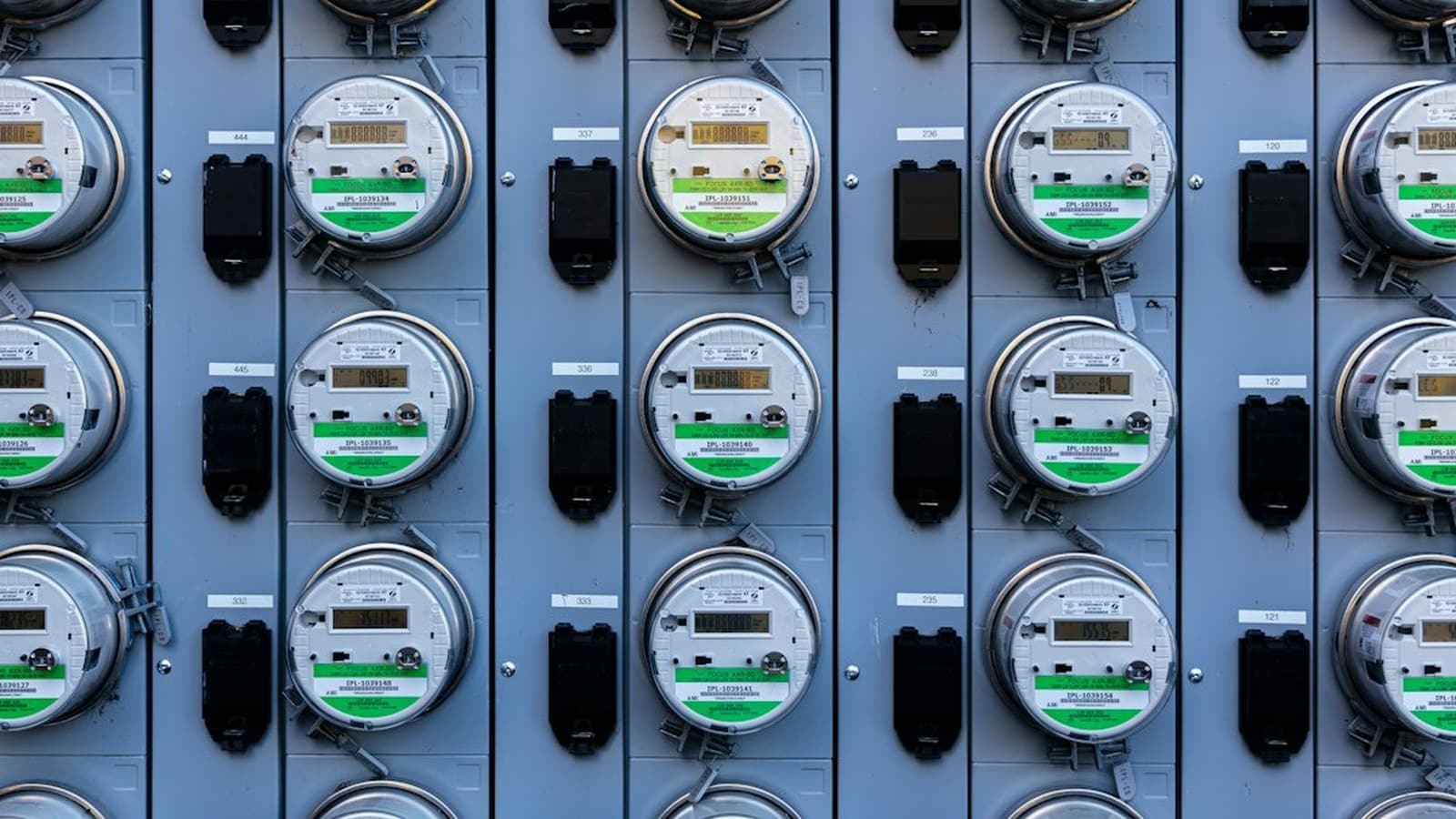
Your bill measures two different things. A kilowatt-hour (kWh) is energy used over time. A kilowatt (kW) is the rate you're using it at a given moment, and a demand-billed account cares about the highest one. Oncor records "the highest demand over a 15-minute period during the billing month." Its Delivery Charges 101 page compares kWh to a car's odometer and the demand register to a speedometer that leaves a mark at its top speed for the month.
That's why a lunch rush can cost more than its kWh suggests. Fryers and ovens recovering between orders, the dish machine running and rooftop units cooling a full dining room in August can all stack up inside the same 15 minutes. One busy interval sets the month's peak.
The PUCT's billing rule, 16 TAC §25.479, defines a demand charge as "a charge based on the rate at which electric energy is delivered to or by a system at a given instant, or averaged over a designated period, during the billing cycle." Load factor ties the two measures together. It compares your average demand with your peak, so a kitchen that spikes hard at lunch and idles in the afternoon runs a low load factor.
Delivery charges come from your TDU, the utility that owns the poles and wires, and the PUCT approves them. For a business, the TDU's rate schedule depends on demand.
Oncor. Oncor splits nonresidential secondary service at 10 kW. At or below 10 kW, the account pays a monthly customer charge and metering charge, and its variable delivery charges are billed per kWh. Above 10 kW, the distribution, distribution cost recovery and nuclear decommissioning charges are billed on billing kW, and transmission is billed on your peak (NCP) kW. Only the energy efficiency charge stays on kWh. Premises that have hit at least 700 kW are billed for transmission on a different method called 4CP, far above the small commercial line.
Two more Oncor rules are worth knowing, both from its Tariff for Retail Delivery Service (Section 6.1.1.1.3, effective June 1, 2026). First, a premise that goes over 10 kW stays on the larger schedule "until that Premises has completed 12 consecutive billing months with no recorded demand greater than 10 kW." Second, some charges use an 80 percent ratchet, where billing kW is the higher of this month's peak or 80 percent of the highest monthly peak in the previous 11 months. That ratchet applies to several riders on every account on the schedule, and to the main distribution charge once a premise has topped 20 kW in the prior 11 months with an annual load factor above 25 percent. So one hot August afternoon can follow you for most of a year.
CenterPoint. CenterPoint's Tariff for Retail Delivery Service splits nonresidential secondary service at 10 kVA, measured in your "fifteen-minute period of highest demand." If your monthly peak goes over 10 kVA, you're placed on the larger schedule "for a period of not less than twelve months," and its distribution charge is billed on that month's peak kVA (tariff sheets effective February 26, 2026).
AEP Texas and TNMP. Both publish their own delivery tariffs, so check the current schedule for your area rather than assuming the Oncor or CenterPoint thresholds apply.
Where's your peak on the bill? Texas billing rules call for the bill to show the units measured, including actual kW or kVA and, where it applies, billed kW or kVA, as long as your provider gets that data from the utility. Oncor also points customers to Smart Meter Texas or its Powered by Oncor tool to monitor kW. For a line-by-line view of the charges, see our guide to TDU delivery charges.
In Texas, a small commercial customer is a nonresidential customer with "a peak demand of less than 50 kilowatts during any 12-month period," unless its load is part of an aggregation program that tops 50 kW in the same 12 months (16 TAC §25.471(d)(11)). Where a restaurant lands depends on its kitchen. Power to Choose's glossary uses restaurants as an example of commercial customers "with a peak demand of 50kW or more during any 12-month period," so a busy full-service kitchen can sit on the other side of the line.
The line matters because the small commercial disclosures come with it. Your EFL must show the average price at 1,500, 2,500 and 3,500 kWh a month, assuming a 30 percent load factor if demand charges apply, and your terms of service must describe "the demand charge and how it will be applied, if applicable" (16 TAC §25.475(f)(2)(B) and (g)(2)(C)(ii)). Above 50 kW, a business can agree to terms with higher or lower protections than the rules set, and Power to Choose describes business shopping as often "a negotiated purchase process."
Start with time. Your term should fit your lease and any remodel or expansion plans, because a fixed rate product holds its price for the term apart from pass-through changes like TDU charges. If you move, a Texas contract is tied to the location, and there's no early termination fee for relocating when you give a forwarding address and, if asked, reasonable evidence that you've left.
Then match the plan to how you actually run. A breakfast-and-lunch cafe and a late-night bar use power on very different schedules, and Oncor notes that bills often run high in summer "when the air conditioning is running." The EFL's 30 percent load factor assumption may or may not look like your kitchen, so ask for the average price at your own usage.
Questions worth asking before you sign:
Timing matters as much as the plan. Our small business electricity renewal guide lays out the notices Texas requires and a 90-day renewal timeline.
Want to see how Ambit Energy's small business plans fit your restaurant? Request small business plan options
Cutting waste lowers your kWh and your restaurant energy costs, and spreading out heavy loads can lower your peak. ENERGY STAR's restaurant guidance gives practical places to start:
Running a coffee shop? See our power-saving tips for coffee shops.
Ambit Energy is the retail electric provider, so it sells you the electricity and sends the bill, while your TDU keeps delivering the power and reading the meter.
If you'd like to see Ambit's small business options for your restaurant, the business plan request form is the place to start. Sending it doesn't enroll you in anything. We'll reach out to talk through your options.
Send your service address in the form, and we'll confirm the business plans available there. Run more than one location? We can work out the setup for all of them.
Ready to compare plans for your restaurant? Request small business plan options
Opening a new location? Our guide to setting up electricity for a new business location covers ESI IDs, peak demand and move-in timing.
Refrigeration, according to ENERGY STAR, followed by lighting and then cooling. If you count every fuel, gas included, ENERGY STAR's full-service restaurant example puts food preparation (35 percent) and HVAC (28 percent) ahead of everything else.
It depends on size and hours. The EIA's 2018 survey puts the median food service building at 39.3 kWh per square foot per year, so a 2,500-square-foot restaurant at the median would use roughly 8,200 kWh a month. Your last 12 bills, or your history on Smart Meter Texas, will tell you your real number.
Air conditioning pushes up both your kWh and your peak demand. Oncor notes that high bills often come "during the summer when the air conditioning is running," and on a demand-billed Oncor account, the 80 percent ratchet can carry a summer peak into some charges for most of the next year.
A demand charge is based on how fast you use electricity at a given instant or over a short interval, not just your total kWh. In Oncor's area, accounts above 10 kW are billed largely on kW, and CenterPoint's line is 10 kVA. If your bill shows billed kW or kVA, you're paying demand-based charges.
It is if your peak demand stays under 50 kW during any 12-month period and your load isn't part of a larger aggregation that tops 50 kW. A busy full-service kitchen can land above that line, so check the peak kW on your bills.
A term that fits your lease, a clear description of how the demand charge is applied, the average price at your actual usage and load factor, the early termination fee and the exact end date. Plan the renewal before the final expiration notice, which must arrive at least 14 days before a small commercial fixed rate ends.
Plan details and rates subject to change. Electricity service is subject to credit approval. Rule text and tariff details in this article are as of November 3, 2026, and usage figures come from the survey years cited above. Published by Ambit Energy, VIP Energy Service.







Copyright © 2026 VIPEnergyService.com. All rights reserved | PUCT# 10117
Important message regarding earnings: Ambit Energy makes no guarantee or promise of income or business. Anyone considering building a full-time or part-time Ambit business should have realistic expectations of their potential income. Learn more at goambit.com/disclaimer.