If You Have Solar Panels and the Power Goes Out: What Really Happens

Solar panels on residential roof providing backup power during outage

If You Have Solar Panels and the Power Goes Out: What Really Happens

December 4, 2025
by
Shawn Cornett

Update, October 2026: According to the IRS, the 30% federal Residential Clean Energy Credit is not available for systems placed in service after December 31, 2025. Mentions of the credit below apply only to systems installed by then. Texas utility rebates and the Texas property tax exemption may still lower your cost.


When a solar panels power outage situation occurs, most Texas homeowners discover a frustrating truth: their grid-tied solar system shuts down completely. Even though the sun is shining and your panels are capable of producing electricity, standard solar installations cannot power your home during a blackout. The reason comes down to a critical safety feature called anti-islanding protection. However, pairing your solar system with solar battery storage creates a solution that keeps your essential circuits running when ERCOT goes dark.

Why Grid-Tied Solar Panels Shut Down During Outages

If you have solar panels and the power goes out, your inverter immediately stops sending electricity to your home. This automatic shutdown happens within milliseconds, faster than you would notice. The technology behind this response is called anti-islanding protection, and every grid-tied solar system in Texas is required to have it.

Anti-islanding protection exists to protect utility workers. According to Lone Star Solar Services, when the electrical grid goes down, repair crews work on power lines assuming those lines carry no current. If your solar panels continued feeding electricity back into the grid during an outage, workers could face lethal voltages they did not expect.

During Winter Storm Uri in 2021, over 4.5 million Texas homes and businesses lost power, some for days. ERCOT forecasts a 50% chance of rolling outages during extreme winter weather similar to December 2022 conditions. When the power grid fails, your grid-tied solar system cannot help because it has no way to safely disconnect from ERCOT while continuing to power your home.

How Anti-Islanding Protection Works

Your solar inverter constantly monitors grid voltage and frequency. When these readings fall outside a narrow acceptable range, as they do during any blackout or brownout, the inverter disconnects automatically. This applies to standard string inverters and microinverters alike.
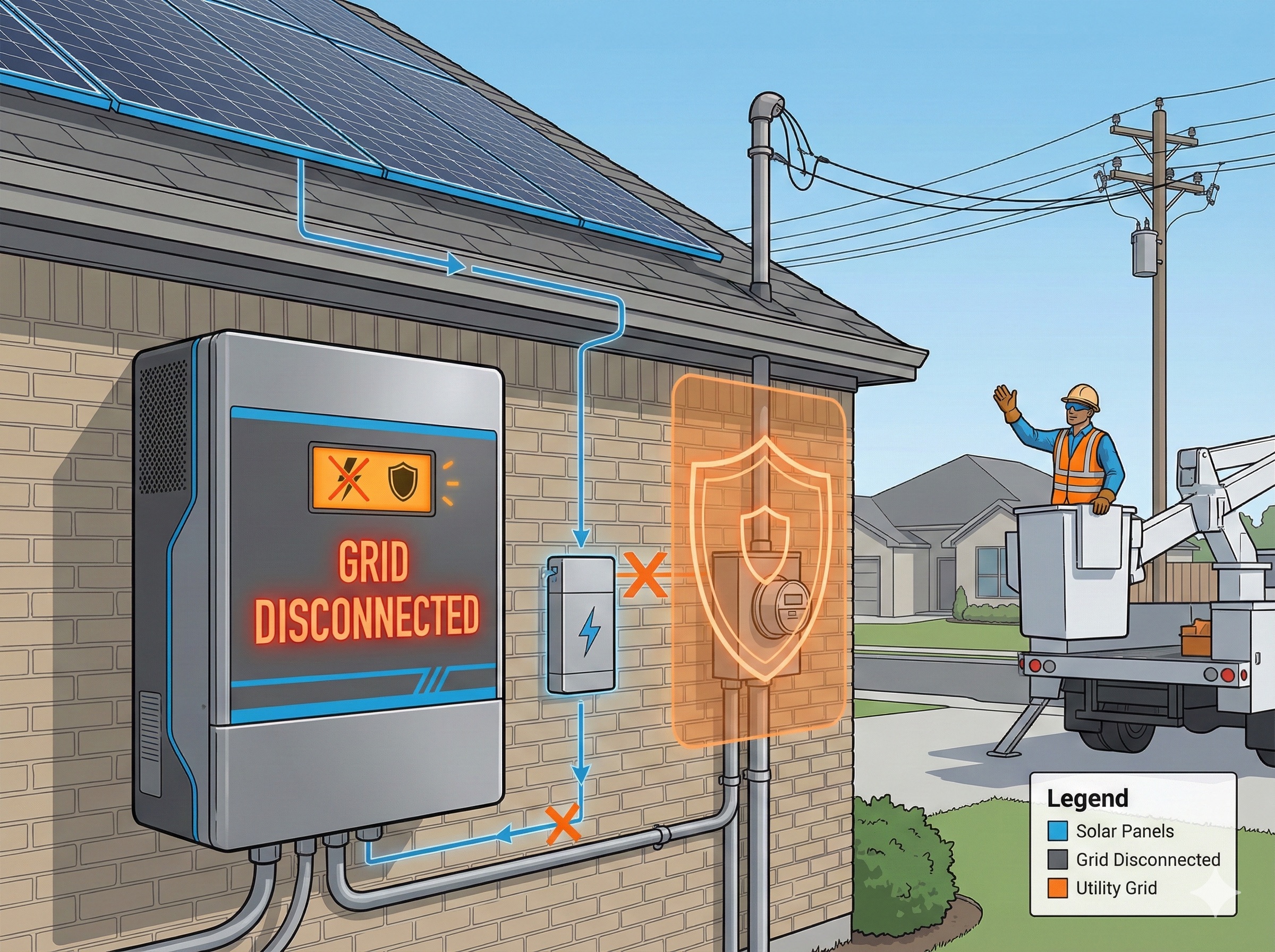
Diagram showing anti-islanding protection mechanism disconnecting solar panels from grid during outage

The solar panels power cut happens instantly because your equipment is designed to "listen" for the grid's presence. Without detecting stable grid power, the inverter will not operate, even with abundant sunshine on your panels.

The Solution: Solar Battery Storage Systems

Adding a home battery storage system transforms your solar installation from grid-dependent to backup-capable. According to energy experts interviewed by ABC13 Houston, "The first step to making a home or business more resilient to power outages is to look into some of the separate elements of a microgrid, such as solar panels, a generator, or battery energy storage systems."
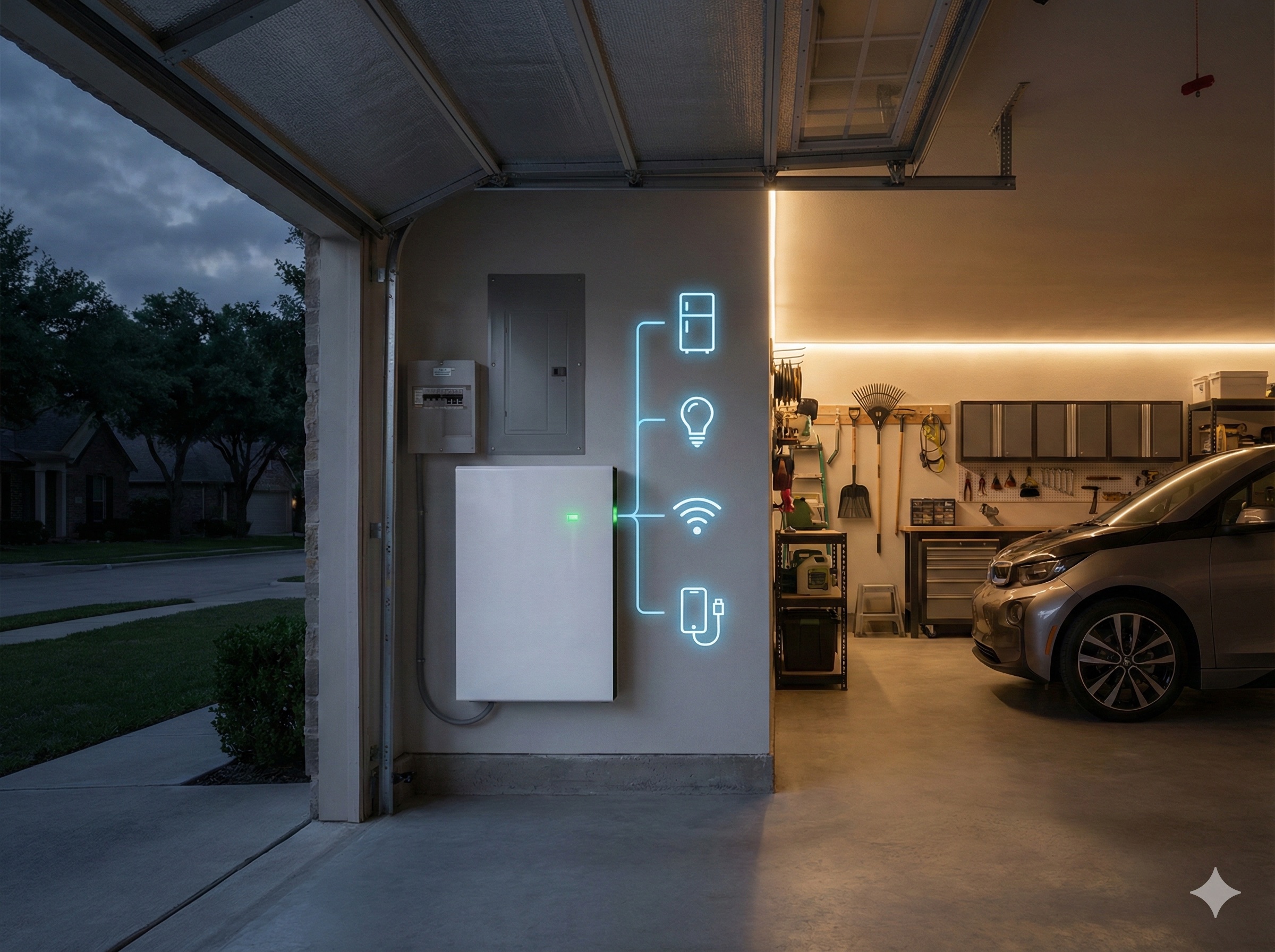
Home battery storage system connected to solar panels providing backup power during grid outage

A battery backup system includes:

  • Home battery storage (10-15 kWh capacity typical)
  • Hybrid inverter that can manage solar, battery, and grid connections
  • Critical loads panel that prioritizes essential circuits

When the power goes out, your hybrid inverter isolates your home from ERCOT and switches to battery power within seconds. Your solar panels continue generating electricity during daylight hours, charging the battery while simultaneously powering your home. At night, stored energy keeps your essential systems running.

During the September 2023 Texas heat wave, battery storage resources helped avoid grid failure by providing power equivalent to about 434,000 homes when traditional generation could not keep up.
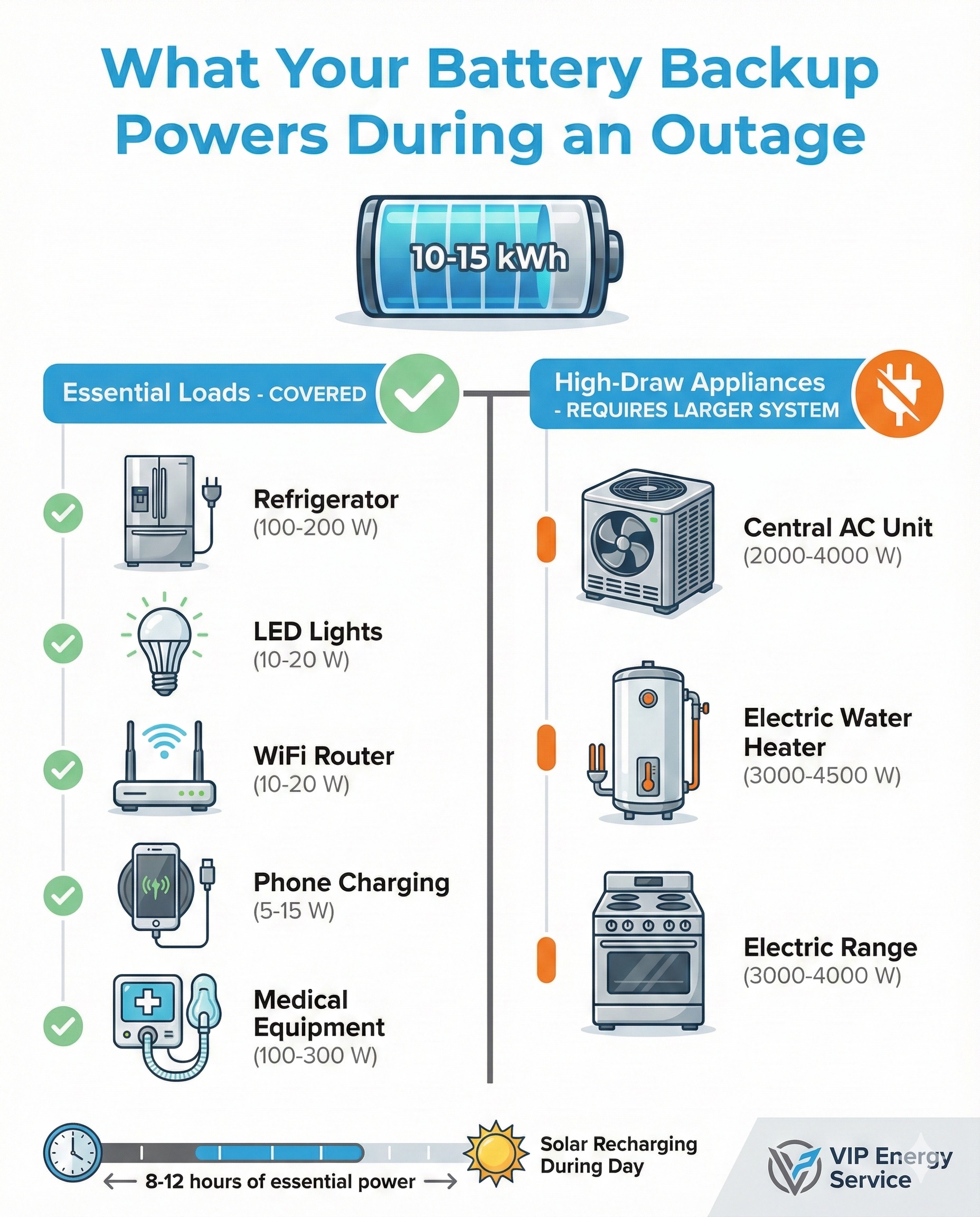
What a Battery Backup System Powers

Infographic showing what a battery backup can power during an outage including essential appliances and their runtime

Most residential battery systems in Texas provide 10-15 kWh of storage. Texas homes average 25-30 kWh of daily consumption, so batteries typically cover essential loads:

Usually covered: Refrigerator, LED lights, WiFi router, phone charging, medical equipment, garage door

Requires larger system: Central AC, electric water heater, electric range

Texas-Specific Considerations for Solar Backup

Texas faces unique challenges because ERCOT operates largely isolated from other U.S. grids. When extreme weather strikes, whether Winter Storm Uri or Hurricane Beryl, outside assistance cannot flow in easily.

The Texas Legislature recognized this vulnerability by approving $1.8 billion for the Texas Backup Power Package Program. According to UH Energy Innovation, this represents "a significant shift toward distributed energy resilience in the state's broader electricity reliability strategy."

For homeowners, the economics of battery storage continue improving. The 30% federal Investment Tax Credit applies to both solar and battery installations. Additionally, working with Ambit Energy provides access to a competitive solar buyback rate, one of only two such programs available in Texas. This rate helps offset battery costs by maximizing the value of your solar generation during normal grid operation.

Getting Started with Solar Battery Backup

If your home already has grid-tied solar, retrofitting a battery system is possible. You will need:

  1. Assessment of daily energy needs (typical Texas home: 25-30 kWh)
  2. Evaluation of existing inverter compatibility or upgrade to hybrid inverter
  3. Sizing calculation for battery capacity based on backup priorities
  4. Installation of transfer switch or critical loads panel

VIP Energy Service offers personalized energy consulting to evaluate your options. Unlike online-only providers, our local Texas energy consultants work face-to-face with homeowners to match solar buyback plans and backup solutions to specific needs.

The federal tax credit combined with competitive electricity rates and plans make 2025 an excellent time to add battery backup. Many homeowners also qualify for no-deposit electricity service, removing upfront barriers.

Ready to keep your home powered during the next Texas blackout? Get your free energy quote from VIP Energy Service and discover how solar battery storage protects your family when ERCOT cannot.

Sources

Your Texas Fixed Rate Can Still Change for 3 Reasons. The PUCT Is Now Weighing a Fourth

Fixed rate electricity plans in Texas can change only for TDU charges, ERCOT admin fees or new laws. The PUCT is now weighing a fourth: grid reserve costs.
Read More >>

Budget Billing Won't Lower What You Pay. Here's What Average Monthly Billing Does in Texas

Budget billing won't lower what you pay in Texas. See how Ambit's Average Monthly Billing works, when the carried balance peaks, and who should skip it.
Read More >>

Opening a New Business Location in Texas? How to Set Up Electricity Before Move-In Day

To set up electricity for a new Texas business location, find the ESI ID, confirm the TDU, estimate peak demand, choose a plan and schedule the move-in.
Read More >>

How to Use Smart Meter Texas to Price Your Next Electricity Plan

Smart Meter Texas holds up to two years of your usage. Here's how to register, download it and price any Texas plan's EFL at your real kWh, winter included.
Read More >>

$85.27 per 1,000 kWh: TNMP's New Delivery Rates Top the PUCT Table, and December Bills Add a One-Month Surcharge

TNMP TDU delivery charges are $7.56 a month plus 7.7710 cents per kWh as of October 1, 2026, or $85.27 at 1,000 kWh, the highest on the PUCT's table. Two September steps added $12.75, and December 2026 bills add a one-month Rider IS surcharge.
Read More >>

Texas Picked Its 2027-28 Backup Electricity Providers. How POLR Service Works If Your Provider Shuts Down

Texas approved its 2027-28 provider of last resort list on Oct. 9, 2026. Your power stays on if your provider fails, and you can leave POLR service any time.
Read More >>

ERCOT's December 2026 Outlook Puts Grid Emergency Odds at 2.95% in Its Riskiest Hour. What a Texas Winter Storm Can and Can't Do to Your Electric Bill

ERCOT's December 2026 outlook puts the riskiest hour, 8 a.m. on December's peak-load day, at a 2.95% chance of an Energy Emergency Alert, well under its 10% low-risk line. Here is what a Texas winter storm can and can't do to your electric bill.
Read More >>

Houston Delivery Charges Fell on August 15. They Jumped September 1 and Rose Again for Meters Read September 30. What That Does to Your October Bill.

CenterPoint delivery charges dipped on August 15, jumped back up September 1, and rose again for Houston meters read on or after September 30. Here's what it means for your October bill.
Read More >>

Lubbock Electricity Rates Change November 1: LP&L's New $2.50 Base Charge Means Smaller Homes Pay More and Bigger Homes Pay Less

LP&L adds a $2.50 monthly base charge and cuts delivery to 6.008 cents per kWh on Nov 1, 2026. Homes under 822 kWh a month pay more, bigger homes pay less.
Read More >>

How to Dispute an Electric Bill in Texas: What the PUCT's New Complaint Process Changes, and What It Doesn't

To dispute an electric bill in Texas, write to your provider first (21 days to answer), then file with the PUCT. On October 21, 2026 the PUCT ends formal complaints. Here is what changes and what stays the same.
Read More >>

Direct Energy Free Nights Review: What the EFL Actually Charges After the Free Window

Direct Energy free nights (Twelve Hour Power) is free 9 p.m. to 9 a.m. As of September 29, 2026, the 12-month EFLs charge 34.5 to 35.4 cents per kWh after the free window. Here is the break-even math.
Read More >>

27 Texas Electricity Plans Got Withdrawn on September 12 Alone. Here Is the Best Time to Renew Your Contract This Fall.

Best time to renew a Texas electricity contract: the fall shoulder window and the 14 days before your end date. 27 plans got pulled Sept 12. Here is the clock.
Read More >>

SmartEnergy Just Launched a $200 Bill Credit Plan on September 3. Here Is How Bill Credit Plans Actually Work in Texas (And When You Lose the Credit)

SmartEnergy launched a $200 bill credit plan on September 3, 2026. Here is how Texas bill credit plans actually work, and the four conditions that forfeit the credit.
Read More >>

No Deposit Light Companies in Texas: What You Actually Qualify For Without a Credit Check

Four legal ways to skip a Texas electricity deposit as of September 2026: soft-check plans, PUCT Rule 25.478 waivers, letters of credit, or prepaid Rule 25.498 plans. What each costs and who qualifies.
Read More >>

Every Ambit Energy Plan Compared for 2026: Rates, Terms, Fees and Who Each One Actually Suits

Compare every Ambit Energy plan in Texas for 2026 side by side: Lone Star Classic 12 and 24, Flex, Free and Clear Nights, Solar Buyback, small business TSC. Rates, fees, terms and who each one actually suits.
Read More >>

Oncor Delivery Charges Rose $8.38 on October 4, 2026. Here's What Changed on Your Bill.

As of October 4, 2026, Oncor's residential delivery charge is 6.8673 cents per kWh, about $8.38 more a month at 1,000 kWh. Here's the rider math, what August really did, and what you can control.
Read More >>
1 2 … 16

Important message regarding earnings: Ambit Energy makes no guarantee or promise of income or business. Anyone considering building a full-time or part-time Ambit business should have realistic expectations of their potential income. Learn more at goambit.com/disclaimer.