Update, October 2026: According to the IRS, the 30% federal Residential Clean Energy Credit is not available for systems placed in service after December 31, 2025. Mentions of the credit below apply only to systems installed by then. Texas utility rebates and the Texas property tax exemption may still lower your cost.
Are solar batteries worth it? For most Texas homeowners in 2025, the honest answer is: not yet for pure financial return—but the equation changes if you value backup power during outages or have specific rate structures that favor storage. With average costs of $9,000 to $18,000 before incentives and payback periods often exceeding 10 years, batteries remain primarily a resilience purchase rather than a money-saving investment.
However, Texas presents a unique situation. Unlike states with generous net metering, most Texas retail electric providers pay only 5-8 cents per kWh for exported solar—well below the 14-16 cents you pay for electricity. This gap makes batteries more valuable here than in many other states. Before deciding, you should also explore alternatives like competitive solar buyback programs that can maximize your solar value without the battery investment.

How Much Do Solar Batteries Cost in Texas?
Solar battery prices have dropped significantly over the past decade, but they still represent a substantial investment. Here's what Texas homeowners can expect to pay in 2025:
Average Installed Costs
- Before federal tax credit: $9,000 to $18,000
- After 30% federal tax credit (2025 installs only): $6,300 to $12,600
- Cost per kWh of storage: $700 to $1,000 installed
The 30% federal tax credit saved Texas homeowners an average of $3,000 to $5,000 on batteries placed in service by December 31, 2025. It is not available for newer installations.
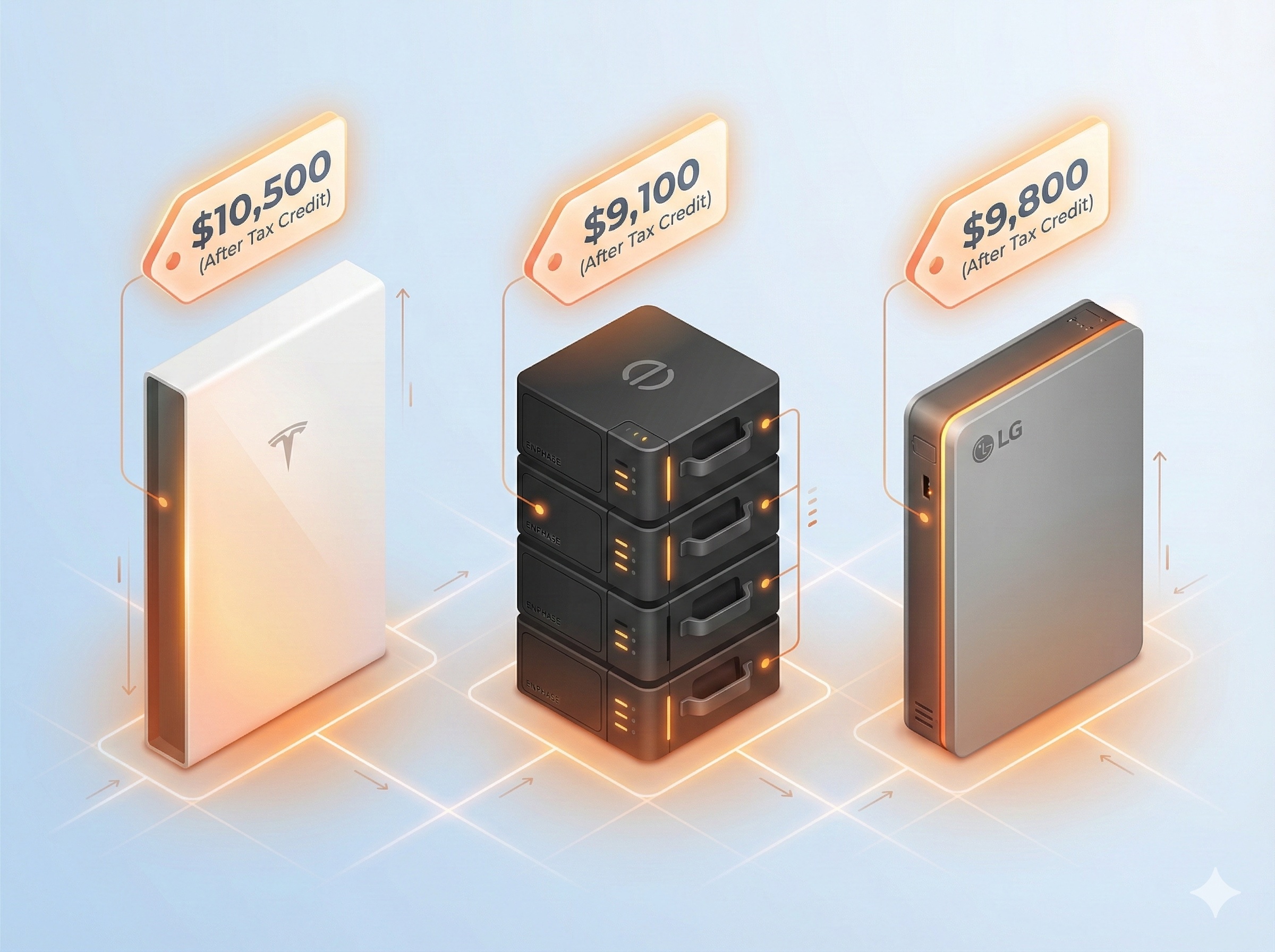
Popular Battery Comparison
| Battery | Capacity | Installed Cost | After 30% ITC (2025 Installs Only) |
|---|---|---|---|
| Tesla Powerwall 3 | 13.5 kWh | $15,000 | $10,500 |
| Enphase IQ 10 | 10 kWh | $13,000 | $9,100 |
| LG RESU Prime | 16 kWh | $14,000 | $9,800 |
| Generac PWRcell | 9-18 kWh | $10,000-$20,000 | $7,000-$14,000 |
5 Situations Where Solar Batteries Make Financial Sense
While batteries don't make sense for everyone, certain situations significantly improve the value proposition:
1. You Have Time-of-Use Electricity Rates
If your electricity plan charges different rates based on time of day, batteries can save you money through energy arbitrage. When the spread between off-peak (8-12 cents/kWh) and on-peak rates (18-30+ cents/kWh) exceeds 15 cents, you can save $500 to $800 annually by charging during cheap hours and discharging during expensive periods.
2. You Experience Frequent Power Outages
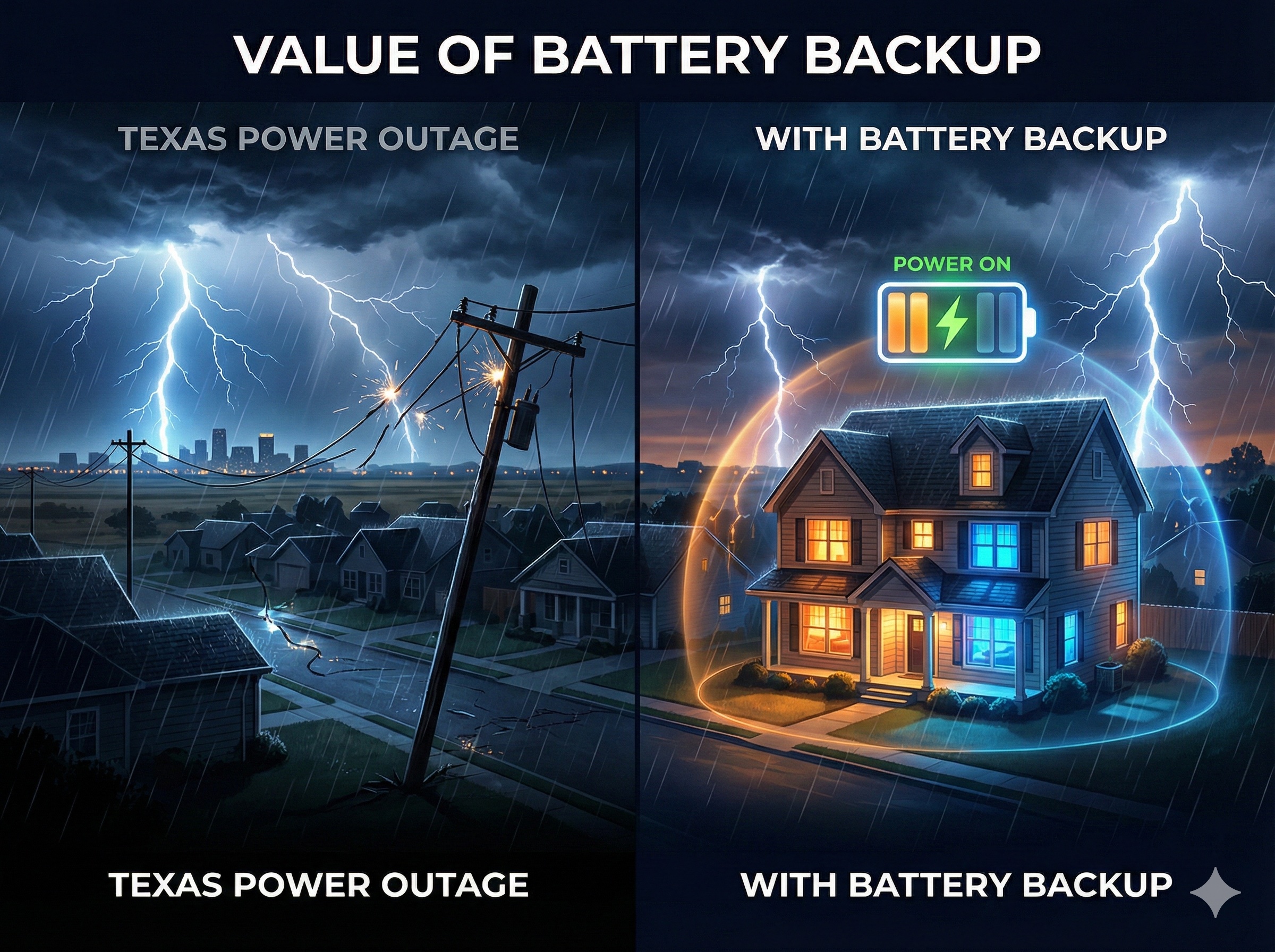
Texas grid reliability has become a serious concern since Winter Storm Uri in 2021. While the summer of 2025 saw improved performance—with no conservation alerts despite record heat—many homeowners now prioritize backup power. The value of keeping your refrigerator running, maintaining internet for work-from-home, or powering medical equipment during outages is difficult to quantify but very real.
3. Your Solar Buyback Rate Is Low
Most Texas retail electric providers pay only 5-8 cents per kWh for exported solar, while charging 14-16 cents for electricity you consume. That gap of 8-10 cents represents value lost on every kilowatt-hour you export to the grid. A battery lets you store that excess solar and use it yourself during evening hours when rates are higher.
4. You Can Participate in Virtual Power Plant Programs
Some utilities and battery manufacturers offer payments for allowing your battery to support the grid during peak demand. Tesla's VPP program and similar offerings can provide $50-100+ per year in additional value, improving your overall return on investment.
5. You Want Energy Independence
For some homeowners, the peace of mind from reduced grid dependence is worth the investment regardless of pure financial return. If energy independence aligns with your values, batteries deliver on that goal in ways that financial calculations can't capture.
When You Should Skip the Battery (For Now)
Batteries aren't the right choice for everyone. Here are situations where you might want to wait or explore alternatives:
1. You Have Access to competitive Solar Buyback
If your retail electric provider offers true competitive solar buyback—meaning you receive full retail credit for exported solar—the financial case for batteries weakens significantly. Only two Texas providers offer this rate: Ambit Energy and TX You Energy. With Ambit's competitive buyback program, you can export excess solar at the same rate you pay for electricity, effectively using the grid as free storage.
2. You Have Flat-Rate Electricity Under 12 Cents/kWh
When electricity is cheap and there's no time-of-use variation, the savings from shifting energy consumption are minimal. Low rates mean smaller potential savings from battery storage.
3. You Rarely Experience Outages
If your grid connection is reliable and outages are infrequent and short, the backup value of batteries diminishes. Resilience only matters if you need it.
4. Your Solar System Is Small
Batteries need sufficient excess solar production to charge daily. If your solar panels barely cover your daytime usage, there won't be enough surplus to fill a battery.
5. Your Budget Is Tight
With $10,000+ investment and 10-15 year payback periods, batteries tie up significant capital. In many cases, expanding your solar array first delivers better ROI than adding storage.
Not sure which category you fall into? Our energy consultants can analyze your specific situation and recommend the best approach. Get your free energy consultation to explore your options.
Why Texas Is Different: No Net Metering and Grid Challenges
Understanding Texas's unique energy landscape helps explain why battery decisions here differ from other states.
The Texas Net Metering Problem
Unlike California, New York, and many other states, Texas has no statewide net metering requirement. This means your retail electric provider isn't required to credit you at full retail rates for solar you export to the grid. Most Texas REPs pay "avoided cost"—typically 5-8 cents per kWh—while charging 14-16 cents for the electricity you buy.
This policy gap makes batteries more valuable in Texas than in states with favorable net metering. When you can't get fair value for exported solar, storing it for later use makes more financial sense.
ERCOT Grid Performance in 2025
The good news: Texas's grid has improved significantly. According to EIA data, the summer of 2025 saw no conservation alerts despite record demand near 80 GW. Solar and battery storage played crucial roles:
- Solar met 15.2% of ERCOT demand during June-August 2025—exceeding coal's 12.5% for the first time ever
- Peak solar output reached 29.8 GW on September 9, 2025
- Battery storage capacity on the ERCOT grid now exceeds 15 GW
- Batteries discharged a record 7.1 GW during the July 2025 heat wave
Heat Considerations for Battery Installation
Texas summers create challenges for battery performance. Most batteries operate optimally between 68-77°F, and sustained heat accelerates degradation. For Texas installations, consider:
- Installing batteries in a garage or shaded location
- Choosing Lithium Iron Phosphate (LFP) batteries, which handle heat better
- Ensuring adequate ventilation around the battery unit
ERCOT projects demand will grow 21% from 2024 to 2026, driven by data centers and population growth. This increasing strain on the grid may make backup power more valuable in coming years.
How Long Until a Solar Battery Pays for Itself?
The payback question is where battery economics get complicated. Here's what realistic scenarios look like:
| Your Situation | Annual Savings | Payback Period |
|---|---|---|
| Flat rates + competitive solar buyback | $200-$300 | 30+ years |
| Moderate TOU rate spread | $500-$800 | 12-18 years |
| High TOU + low buyback rates | $800-$1,200 | 8-12 years |
The reality check: Most battery warranties cover 10 years with a 70% capacity retention guarantee. If your payback period exceeds the warranty length, you're betting on the battery lasting longer than guaranteed—which many do, but it's not certain.
For most Texas homeowners today, batteries are better understood as a resilience purchase with some financial benefits, rather than a pure investment. The equation changes if you experience frequent outages, have high time-of-use rate spreads, or place significant value on energy independence.
Solar Battery FAQ: Your Questions Answered
How long do solar batteries last?
Most lithium-ion solar batteries last 10-15 years with proper care. Lithium Iron Phosphate (LFP) batteries can last 15-20 years. Standard warranties cover 10 years and guarantee at least 70% capacity retention—meaning your 13.5 kWh battery should still hold at least 9.45 kWh after a decade. Enphase offers an industry-leading 15-year warranty on their battery systems.
Can a solar battery power my whole house during an outage?
It depends on your home's energy needs and battery size. A single 13.5 kWh battery can typically power essential loads—refrigerator, lights, phone chargers, internet router—for 8-12 hours. Whole-home backup during an extended outage usually requires 27+ kWh of storage (two batteries) or careful load management. Most homeowners prioritize critical circuits rather than powering everything.
What size solar battery do I need?
Battery sizing depends on your goals and energy usage:
- Small homes (1-2 people): 5-10 kWh
- Average homes: 10-15 kWh
- Large homes or high usage: 15-20+ kWh
A common rule of thumb: plan for 1 kWh of storage per 1 kW of solar panel capacity. A 10 kW solar system pairs well with a 10-13 kWh battery.
Do solar batteries work without solar panels?
Yes, batteries can charge from the grid during off-peak hours and discharge during expensive peak periods. However, pairing with solar maximizes your savings.
What's the best solar battery brand in 2025?
The "best" depends on your priorities:
- Tesla Powerwall: Most recognized brand, excellent app, seamless whole-home backup
- Enphase IQ: Best warranty (15 years), modular design, pairs perfectly with Enphase microinverters
- LG RESU Prime: Reliable performance, competitive pricing, good value
- Generac PWRcell: Flexible capacity options, strong backup power features
Your choice may depend on your existing solar inverter—some batteries integrate better with certain systems.
Are solar batteries safe?
Modern solar batteries have excellent safety records. Lithium Iron Phosphate (LFP) chemistry offers the highest thermal stability and is considered the safest option for residential use. All reputable batteries carry UL 9540A certification, the industry safety standard for energy storage. There were no reported residential battery fires from major brands in 2024-2025.
Can I add a battery to my existing solar system?
Yes, most solar systems can be retrofitted with battery storage. The process may require an inverter upgrade or installing an AC-coupled battery system that works alongside your existing equipment. Retrofit installations typically cost $10,000-$15,000 including labor, though prices vary based on system complexity and local installation rates.
Is it better to get a battery or a generator?
Each has advantages:
- Batteries: Silent operation, no fuel needed, automatic switching, integrates with solar, lower ongoing costs
- Generators: Lower upfront cost ($3,000-$8,000), unlimited runtime with fuel, better for extended outages
Batteries work better for short outages and daily energy management. Generators make sense for budget-conscious homeowners or areas prone to multi-day outages where battery capacity would be exhausted.
Will solar battery prices drop?
Battery prices have fallen approximately 80% since 2010 and are expected to continue declining 5-10% annually. The 30% federal tax credit is not available for systems placed in service after December 31, 2025, so falling prices are now the main thing working in a buyer's favor.
How does Ambit's solar buyback compare to battery storage?
Ambit Energy offers true competitive solar buyback—you receive full retail credit for every kWh you export to the grid. This is rare in Texas; only Ambit and one other provider offer this rate. With competitive buyback, the financial case for batteries weakens because you're not losing value on exported solar. However, batteries still provide backup power during outages—something no buyback program can replace. Many solar homeowners combine competitive buyback for maximum bill savings with a smaller battery specifically for backup protection.
The Bottom Line: Should You Install a Solar Battery?
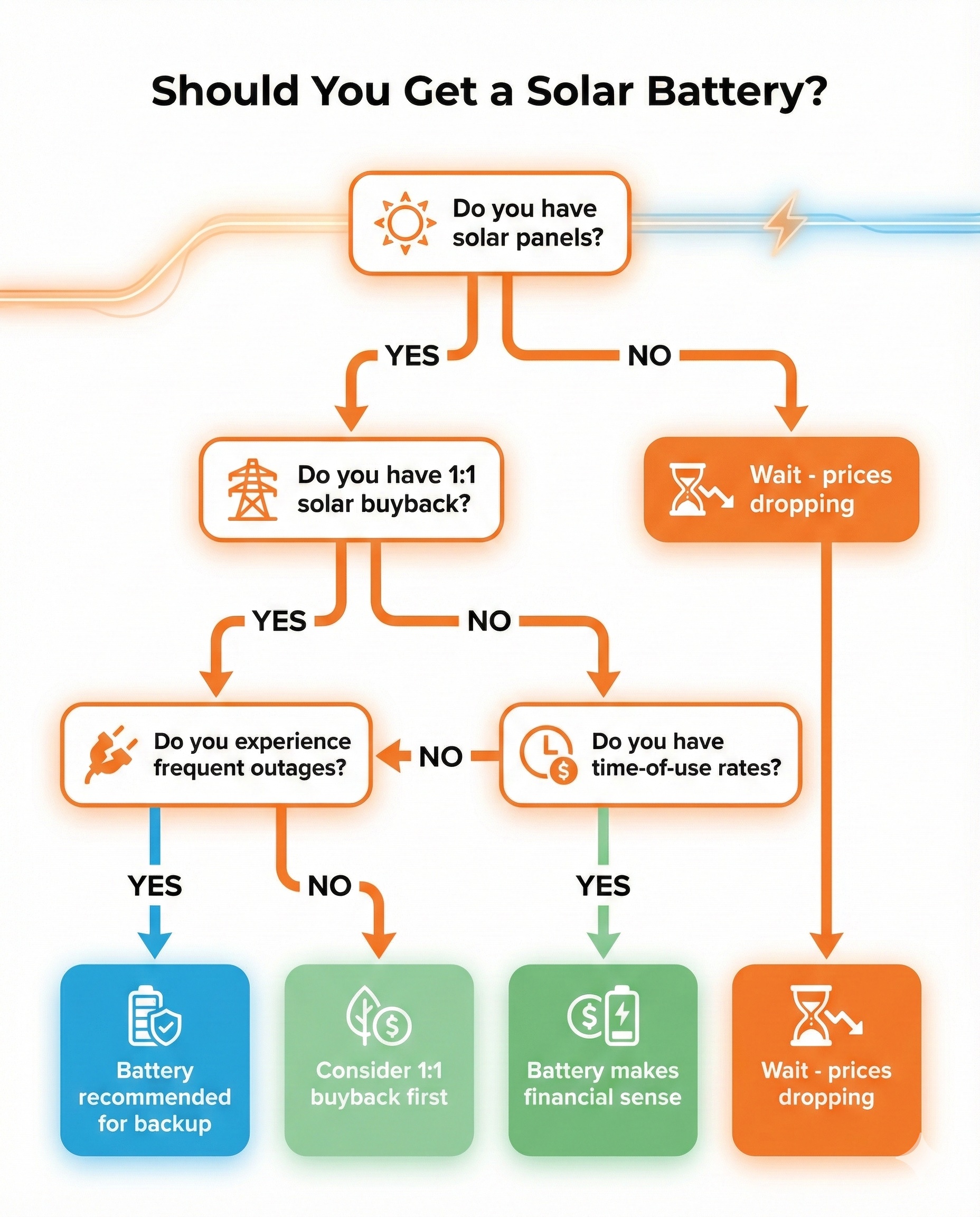
Solar batteries in 2025 make sense for Texas homeowners who:
- Experience frequent power outages and need reliable backup
- Have time-of-use electricity rates with significant peak/off-peak spreads
- Receive low buyback rates (under 8 cents/kWh) for exported solar
- Value energy independence regardless of pure financial return
Batteries may not be the best choice if you:
- Have access to competitive solar buyback programs
- Pay low flat-rate electricity prices
- Rarely experience outages in your area
- Want the best financial ROI on a limited budget
Before investing $10,000+ in battery storage, make sure you're maximizing your solar value through the right electricity plan. Explore Texas electricity options or learn about maximizing your solar returns with the right buyback program.
Whether you choose battery storage, solar buyback, or a combination of both, our energy consultants can help you find the best solution for your home and budget. Request your free energy consultation to get personalized recommendations based on your specific situation.