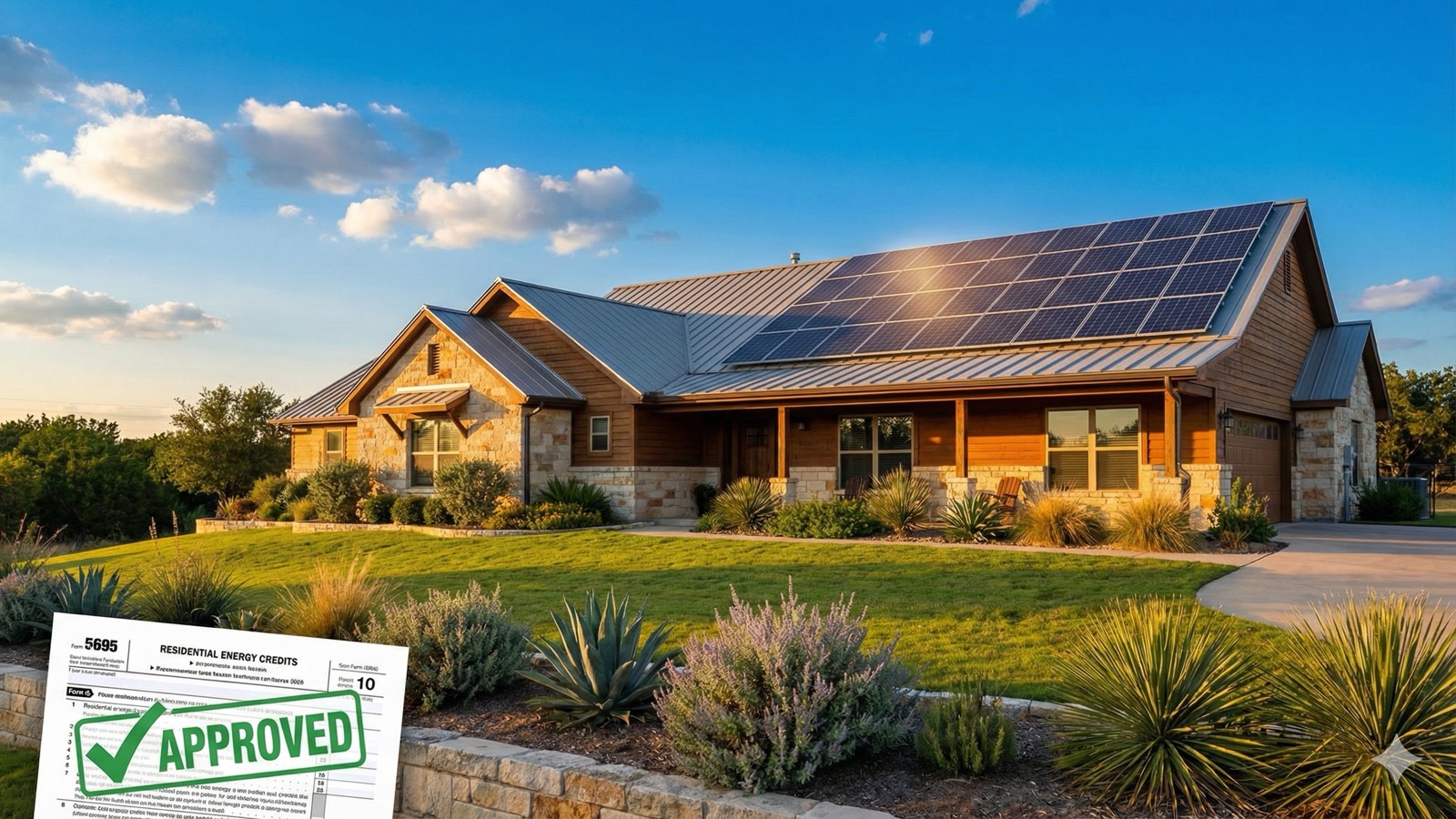
Residential energy credit carryforward allows homeowners to apply unused portions of the Residential Clean Energy Credit to future tax years until the entire credit is used. If your 30% solar tax credit exceeds your tax liability in the installation year, you don't lose the excess—the residential energy credit carryforward provision means it carries forward indefinitely until fully claimed.
Understanding residential energy credit carryforward rules is essential for Texas homeowners making major solar investments. According to IRS Statistics, 601,300 tax returns had credit balances to carry forward to 2024, while the Treasury Department reports the average Residential Clean Energy Credit claimed was $5,084 per household.
Texas homeowners exploring battery backup rebate programs should understand how the residential energy credit carryforward interacts with battery storage credits. This guide covers which credits can be carried forward, how to calculate your carryforward amount, and strategies to maximize your tax savings through 2026 and beyond.
In This Guide:
The residential energy credit carryforward is a tax provision that allows you to save unused portions of certain energy credits for future years. When your tax credit exceeds what you owe in taxes, the residential energy credit carryforward lets you apply that excess to reduce your tax bill in subsequent years.
The IRS states clearly: "You can carry forward any excess unused credit, though, and apply it to reduce the tax you owe in future years."
This carryforward provision exists because the Residential Clean Energy Credit is a nonrefundable credit. Your tax liability limits how much you can claim in any given year. If your credit is larger than your tax bill, you simply carry the remainder forward rather than losing it.
According to the Treasury Department, 3.42 million tax returns claimed residential energy credits in 2023, with the credit rate set at 30% of qualified costs with no dollar cap. The IRS confirms that this credit can be carried forward indefinitely until fully used.
Here's a practical example:
| Item | Amount |
|---|---|
| Solar system cost | $25,000 |
| 30% Residential Clean Energy Credit | $7,500 |
| Your tax liability | $4,500 |
| Credit used this year | $4,500 |
| Residential energy credit carryforward to next year | $3,000 |
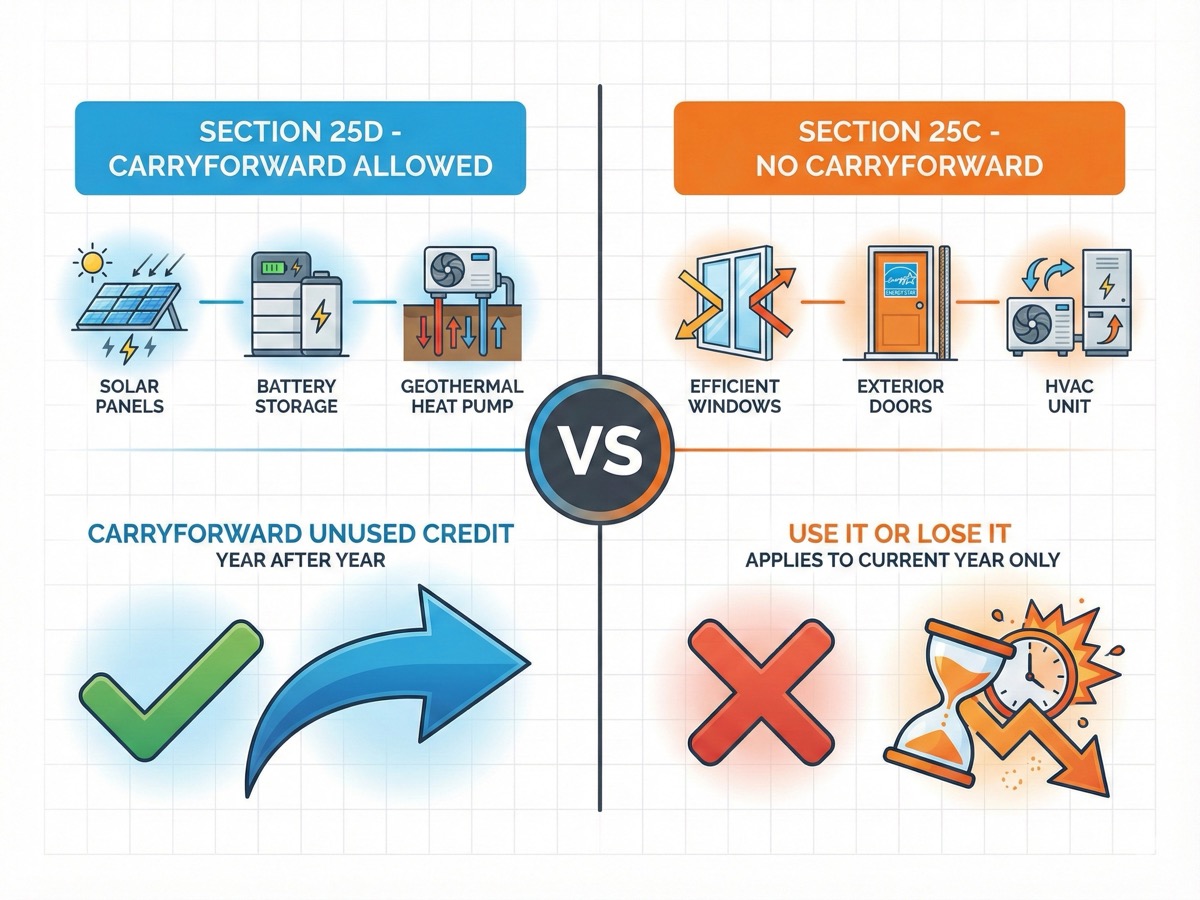
The key distinction lies between the two residential energy credits available to homeowners. The Residential Clean Energy Credit under Section 25D allows carryforward. The Energy Efficient Home Improvement Credit under Section 25C does not.
Report your residential energy credit carryforward using Form 5695, the official IRS form for claiming these credits. The form includes specific lines for tracking carryforward amounts year over year.
Not all residential energy credits work the same way. Understanding which credits allow carryforward helps you plan your home improvements strategically.
The Residential Clean Energy Credit covers major clean energy installations:
According to IRS Statistics, 1.25 million households claimed the Residential Clean Energy Credit in 2023, totaling $6.3 billion in credits. Of these filers, 539,630 returns carried forward credit from prior years.
When discussing net metering in Texas, homeowners should understand that the solar system generating those credits qualifies for the carryforward provision.
The Energy Efficient Home Improvement Credit covers efficiency upgrades:
The IRS FAQ explicitly states: "No. A taxpayer may not carry the credit forward. Thus, if a taxpayer does not have sufficient tax liability to claim all or a portion of the credit for a taxable year, the unused amount of the credit may never be claimed."
According to the Treasury Department, 2.34 million returns claimed the Energy Efficient Home Improvement Credit in 2023, with an average credit of $882.
| Credit Type | Carryforward | Annual Limit | Covers |
|---|---|---|---|
| Residential Clean Energy (25D) | YES — Indefinite | 30% of costs, no cap | Solar, batteries, geothermal |
| Energy Efficient Home Improvement (25C) | NO — Use or lose | $3,200/year | Windows, doors, HVAC |
Key Takeaway: Solar, batteries, and geothermal = residential energy credit carryforward allowed. Windows, doors, and HVAC = use it or lose it.
Calculating your residential energy credit carryforward requires completing IRS Form 5695. Here's a step-by-step guide to the process.
Part I — Residential Clean Energy Credit
According to the IRS Instructions for Form 5695: "Use Form 5695 to figure and take your residential energy credits… Also use Form 5695 to take any residential clean energy credit carryforward from 2024 or to carry the unused portion of the residential clean energy credit to 2026."
Consider a Texas homeowner who installed a solar electricity plan-eligible system:
| Calculation Step | Amount |
|---|---|
| Solar system cost | $28,000 |
| Battery storage cost | $12,000 |
| Total qualified costs | $40,000 |
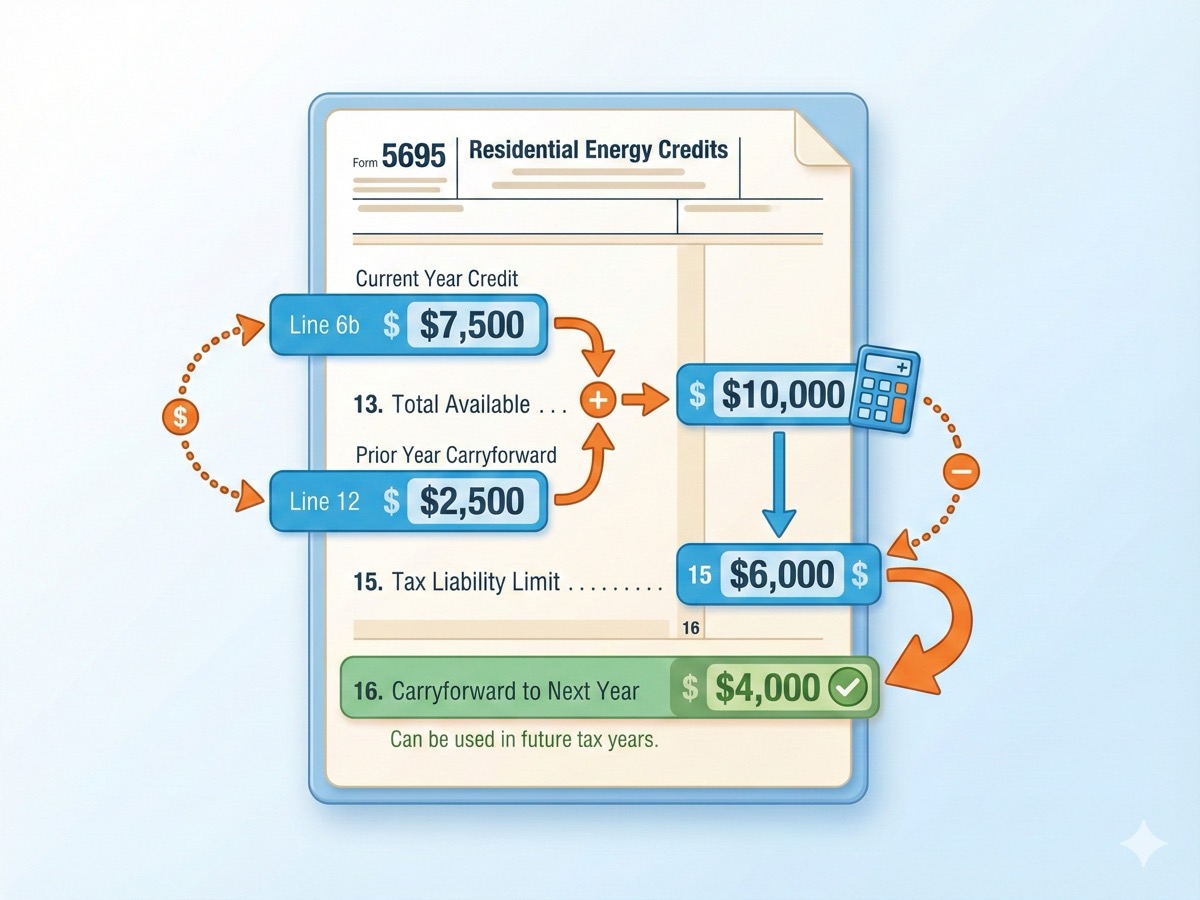
| 30% credit (Line 6b) | $12,000 |
| Prior year carryforward (Line 12) | $2,500 |
| Total available credit (Line 13) | $14,500 |
| Tax liability (Line 15) | $6,000 |
| Credit applied this year | $6,000 |
| Carryforward to next year (Line 16) | $8,500 |
This homeowner will carry $8,500 forward to 2027, then continue claiming the residential energy credit carryforward until the full $14,500 is used.
According to IRS Statistics, 645,000 returns fully used their credit in 2023 without needing carryforward.
The TurboTax Form 5695 Guide and TaxAct carryover support provide additional tax software guidance for completing this form.
Texas homeowners have unique advantages when it comes to the residential energy credit carryforward. The state's booming solar market and favorable policies create excellent conditions for maximizing your tax credits.
According to the Federal Reserve Bank of Dallas: "Solar electricity generation and utility-scale batteries within the Electric Reliability Council of Texas (ERCOT) power grid set records in summer 2024. On average, solar contributed nearly 25 percent of total power needs during mid-day hours between June 1 and Aug. 31."
Chariot Energy reports Texas added over 4,000 MW of solar capacity in 2023, representing a 36% increase year-over-year. The state saw 100,000+ new residential solar systems installed that year, ranking Texas #2 in U.S. solar capacity behind only California.
Texas homeowners can combine the federal residential energy credit carryforward with state-level benefits:
The ENERGY STAR program notes: "For these upgrades, you can carry forward any excess credit and apply it to reduce the tax you owe in future years."
| Cost Factor | Range |
|---|---|
| Average system cost | $17,000-$32,000 |
| 30% federal credit | $5,100-$9,600 |
| Battery add-on | $9,000-$18,000 |
| Typical payback period | 7-10 years |
Texas homeowners interested in finding the best solar providers in Texas should factor in the residential energy credit carryforward when calculating return on investment.
Key Takeaway: Texas homeowners can stack federal carryforward credits with state property tax exemptions. Texas has no state income tax to offset, but your solar value won't increase property taxes.
Smart planning helps you get the most from your residential energy credit carryforward. Consider these strategies when timing your clean energy investments.
If you expect higher income in future years, consider installing now and carrying the credit forward. The 30% rate remains available through 2032, giving you flexibility.
Installing solar panels one year and adding battery storage the next year can help match credits to your annual tax liability. This approach reduces carryforward complexity.
Since the Energy Efficient Home Improvement Credit doesn't allow carryforward, plan window and HVAC upgrades for years when you have sufficient tax liability to claim them fully.
Store receipts, contracts, and manufacturer certifications indefinitely. You'll need this documentation each year you claim a residential energy credit carryforward.
According to ENERGY STAR, the 30% credit rate applies through 2032. The Congressional Research Service confirms credits earned at the 30% rate remain at 30% when carried forward.
| Scenario | Recommendation |
|---|---|
| High tax liability | May use full credit in year 1 |
| Moderate liability | Expect 2-3 year carryforward |
| Low liability | Consider phased installation |
| Large system | Plan for extended carryforward |
Homeowners maximizing their investment should also explore electricity buyback rates in Texas to enhance overall solar savings.
Avoid these frequent errors when claiming your residential energy credit carryforward.
The most common mistake is assuming all residential energy credits allow carryforward. Only Section 25D (solar, batteries, geothermal) permits carryforward. Section 25C (windows, HVAC) does not.
You must file Form 5695 each year to claim your carryforward. Skipping a year doesn't forfeit the credit, but you must file the form to claim it.
Keep all installation documentation indefinitely. Your receipts, contracts, and certifications validate carryforward claims years later.
Line 12 on Form 5695 requires your prior year's Line 16 amount. Failing to transfer this number means losing credit you've already earned.
Only qualified costs count toward the credit. The IRS excludes interest paid, extended warranties, and certain labor costs from the calculation.
The Building Performance Association analysis provides detailed insights into how homeowners use these credits effectively.
Key Takeaway: Always file Form 5695 even in carryforward years—it's how you track and claim your remaining residential energy credit carryforward.
Understanding the credit timeline helps you plan installations and carryforward strategy through 2026 and subsequent years.
The Inflation Reduction Act established the following schedule, as confirmed by ENERGY STAR:
| Year | Credit Rate | Notes |
|---|---|---|
| 2022-2032 | 30% | Full rate, carryforward allowed |
| 2033 | 26% | Reduced rate |
| 2034 | 22% | Final year |
| 2035+ | 0% | Credit expires |
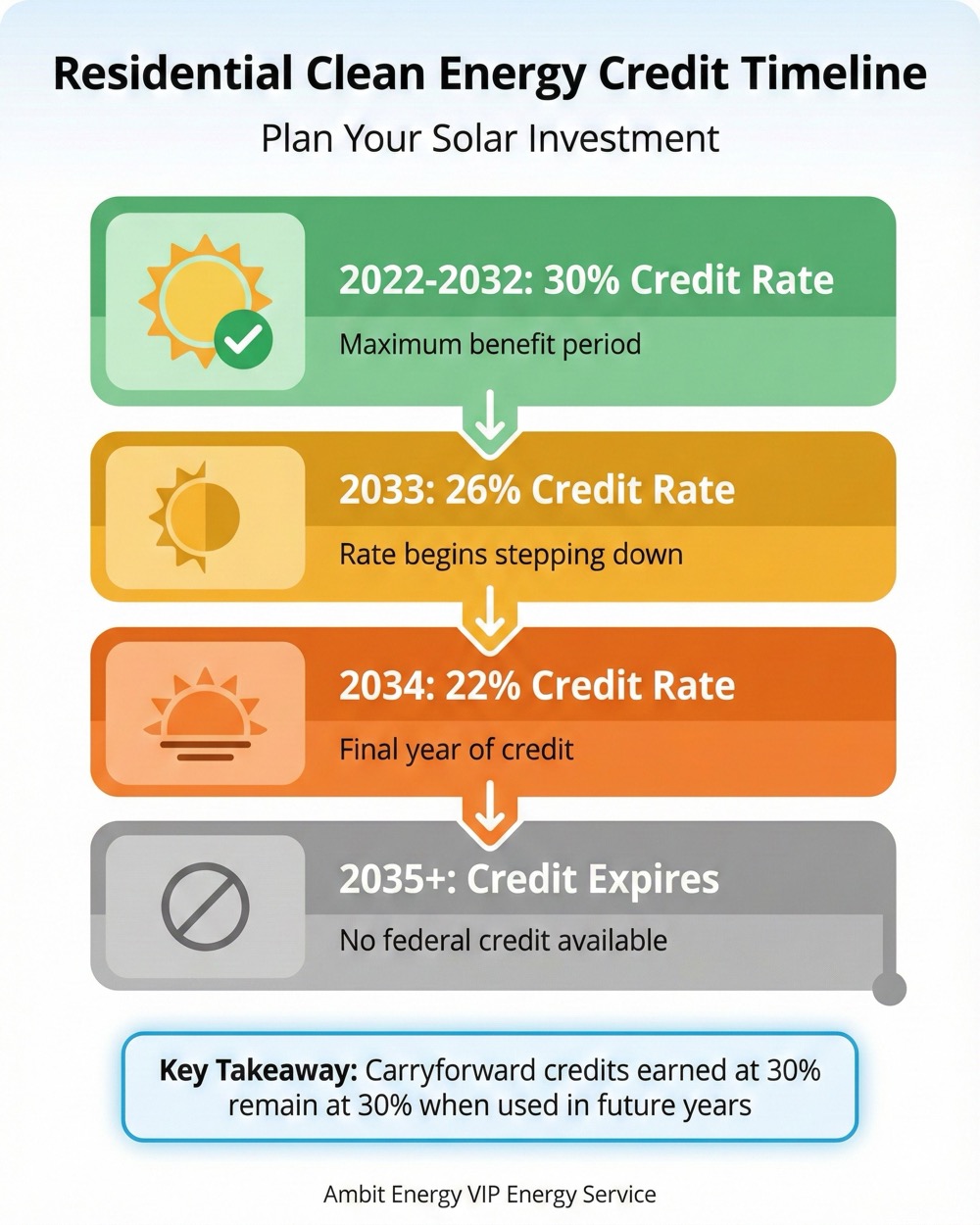
Credits earned at the 30% rate remain at 30% when carried forward, regardless of when you claim them. If you install solar in 2026 and carry the credit forward to 2034, you still receive the full 30% credit amount.
However, new installations in 2033 only qualify for the 26% rate. This creates a strong incentive to install before the step-down begins.
According to the Treasury Department, $8.4 billion in total residential energy credits were claimed in 2023 alone, demonstrating strong homeowner adoption of these incentives.
Texas homeowners considering solar should factor these timeline elements:
Research renewable energy companies in Texas to find qualified installers who can help you maximize your residential energy credit carryforward.
Yes, the Residential Clean Energy Credit (Section 25D) can be carried forward indefinitely until you've used the entire credit amount. There's no time limit on the residential energy credit carryforward provision.
Section 25D (solar, batteries, geothermal) allows carryforward of unused credits indefinitely. Section 25C (windows, doors, HVAC) does NOT allow carryforward—unused portions are lost forever.
Yes, file Form 5695 each year to claim your carryforward amount. Enter your prior year's Line 16 amount on the current year's Line 12 to track your residential energy credit carryforward.
Yes, Texas homeowners can stack the federal 30% tax credit with carryforward plus the Texas 100% property tax exemption on solar system value, plus any local utility rebates available in your area.
Credits earned at 30% remain at 30% when carried forward. The rate change only affects NEW installations in 2033 and later. Your existing residential energy credit carryforward maintains its original value.
It depends on your tax liability. In 2023, about 601,300 returns had credit to carry forward, while 645,000 used their full credit in one year. Most homeowners exhaust their carryforward within 2-4 years.
No, residential energy credits cannot be transferred to another person. The residential energy credit carryforward can only be used by the taxpayer who installed the qualifying equipment at their primary residence.
Yes, battery storage technology with at least 3 kWh capacity qualifies for the Residential Clean Energy Credit under Section 25D, which allows indefinite carryforward of unused credit amounts.
The residential energy credit carryforward makes solar and battery storage more accessible for Texas homeowners with varying tax situations. You don't need a massive tax bill to benefit—the carryforward provision ensures you eventually claim every dollar of your 30% credit.
With the current 30% rate guaranteed through 2032, now is an excellent time to explore your options. Texas homeowners enjoy additional advantages through property tax exemptions and competitive solar buyback plans that enhance overall savings.
Ready to Explore Your Solar Options?
Get your personalized savings estimate with the residential energy credit carryforward factored in.
Last updated: December 2025 | Generated by Blog Production System










Copyright © 2026 VIPEnergyService.com. All rights reserved | PUCT# 10117