A smart thermostat can help a Texas household cut costs on the home electricity bill by $40 to $60 a year on its own. A Nest, ecobee, or Honeywell will net an average of 8 percent savings on heating and cooling for the typical Texas home, and cost about $250 up front. The bigger opportunity is that a smart thermostat can save you a lot more when it is paired with utility rebates, a Free Nights plan, and a home battery, lowering your summer electricity bill significantly. This guide walks through how to build the stack, what each layer is worth, and where the numbers come from.
How Much a Smart Thermostat Actually Saves a Texas Home
Let me start with the honest baseline. ENERGY STAR, a partner program of the U.S. Environmental Protection Agency and the Department of Energy, reports that smart thermostats average 8 percent savings, or about $50, on annual heating and cooling costs for the typical American home. The U.S. Department of Energy says programmable setbacks can push savings closer to 10 percent. Ecobee's own research shows that well configured schedules can save up to 23 percent on HVAC energy.
Texas homes have unique concerns. Air conditioning consumes about 28 percent of home electricity use in the state, and every Texas home is a meaningful contributor to ERCOT peak demand. As of July 2026, Texas homeowners pay approximately $0.14 to $0.19 per kWh on typical residential fixed rate plans, and a three month stretch from June to August will result in total cooling costs of about $220 to $280 for a typical home. If you want to cut a $260 bill by $20 to $30 during the summer, trim the cooling costs by 8 to 10 percent.
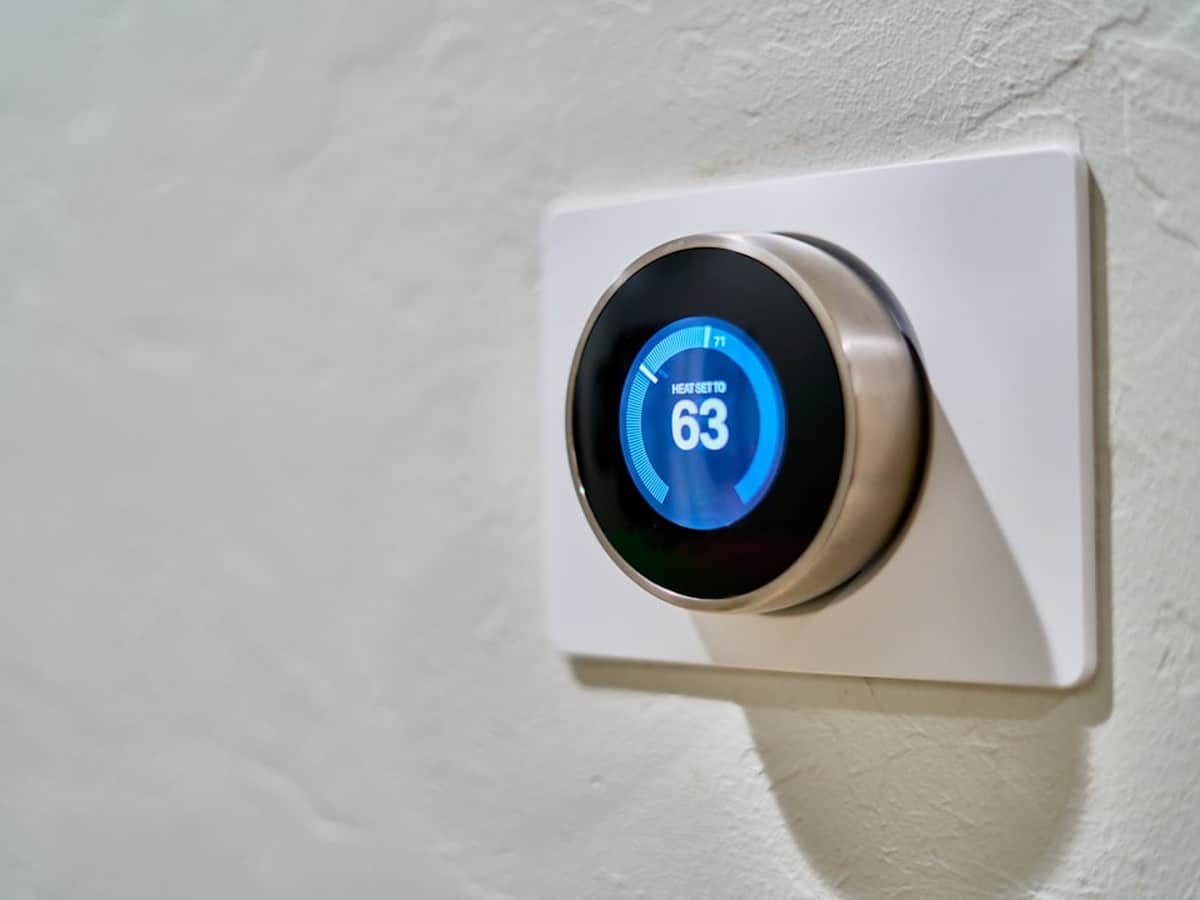
That baseline is real, but a thermostat alone will only take you so far. It is the only device on your wall that can talk to a rebate program, a Free Nights plan, and a home battery all at once. That is why I recommend one in every Texas home I work with.
The Texas Thermostat Stack: Four Layers That Compound Savings
Most Texas homeowners stop at "install a Nest and set a schedule." That misses the point in a deregulated ERCOT market, where the utility, the hardware, and the retail plan can each pay you separately for the same behavior. I call this pattern the Texas Thermostat Stack because each of the four layers has real dollar value on its own.
Layer 1: Setpoint Discipline (baseline 8 to 23 percent)
The first layer is the setpoint schedule itself. Guided by DOE Energy Saver, widen the setback window by at least 7 degrees Fahrenheit from your comfort temperature when the house is unoccupied, or when everyone is sleeping for 8 hours. The Texas summer occupied setpoint is generally between 76 to 78 degrees. The unoccupied setpoint is between 83 to 85 degrees. The intention becomes reality through the unit's motion sensors, geofencing, and learning algorithms. That is where the 8 to 23 percent range comes from.
Layer 2: Utility Rebates and Demand Response ($40 to $150 per year)
The second layer is the cash you can earn just for owning the thermostat. In Texas, where the retail market is deregulated, the transmission and distribution utilities and the retail providers each have their own thermostat incentives. The most recent documented figures include: Oncor, inside its Take a Load Off Texas program, provides an instant discount of $50 on qualifying smart thermostats. CenterPoint Energy offers a smart thermostat instant discount of up to $50 to eligible residential customers. In the Connected Conservation program, TXU Energy's customers can receive up to $150 in prepaid card, gift card, or energy product value in exchange for allowing brief demand response adjustments. Enrollees in Reliant Energy's Degrees of Difference program receive a one-time $50 bill credit at enrollment and are eligible for recurring reward value based on their participation.
In response programs, utilities or retailers shift your setpoint a few degrees during stress events on the grid. In ERCOT's 2026 filing with the Public Utility Commission of Texas, ERCOT estimated that smart thermostat participants earned an average of $63 per participant per year from 2019 to 2024 in energy and ancillary service benefits. The PUCT stated the obvious in its 2024 residential demand response goals memo: broader participation means more savings for electric customers, and a reduced burden on the ERCOT grid.
To keep this layer clean, follow two rules. First, check compatibility before buying. Each program has a limited list of accepted brands and models. Second, confirm your ability to opt out of any single event. Most Texas programs allow you to override in the app, but you have to know where the button is before a heat wave hits.
Layer 3: Pair the Thermostat with a Free Nights Plan (pre-cool and shift)
The third layer is where the retail plan you buy starts talking to the hardware. A Free Nights electricity plan gives you a zero charge overnight window in exchange for a higher daytime rate. Without a smart thermostat, you have to remember to run the dishwasher and dryer at 10 p.m. With one, you can schedule automatic pre-cool cycles that drop the house 2 to 4 degrees during the free window, then let the setpoint drift back up during the expensive daytime hours.
Layer 3 is working when you notice that your peak hour kWh usage (check your EFL for the exact hours) trends down every week while your overnight usage grows. That is exactly what a smart thermostat does on autopilot for an Ambit Free Nights plan.
Layer 4: Add Home Battery Storage (peak arbitrage)
Most Texas households have not built this layer, and this is where a smart thermostat goes from a savings device to a control system. Paired with a Free Nights plan or rooftop solar, a home battery can store cheap kilowatt hours overnight and discharge them during the very high priced afternoon peak hours. The smart thermostat is essential because it decides when to pull from the battery, when to pre-cool, and when to let ERCOT's real time price coast.
Texas is pushing distributed batteries and demand response in anticipation of its projected 2026 summer peak demand of 95 GW, up from 83.9 GW in 2025. The purpose of the top layer is simple. Without a smart thermostat that manages the discharge schedule, the battery is just an expensive UPS. With one, your battery functions as a peak shaving asset that stacks on top of your retail plan and the rebate.
A Worked Texas Example: What the Stack Looks Like on a July Bill
Picture a Houston home currently on a standard fixed rate plan, no rebate enrollment, no battery, on a $260 July bill. Layer 1 alone: an 8 to 10 percent cut on the cooling share (about 28 percent of the bill). That is about $6 to $9 monthly. Layer 2 added: an Oncor or CenterPoint instant $50 rebate plus TXU Connected Conservation's rewards of up to $150 blended to about $40 to $80 in annual value. Averaged monthly, that is an additional $3 to $7. Layer 3 added: with a Free Nights plan and disciplined pre-cool cycles, most Texas homes shift 25 to 40 percent of load into the free window. As of July 2026, for a 900 kWh summer month at an illustrative daytime rate of $0.16 per kWh (for modeling only), that is $36 to $58 avoided at daytime rates. Layer 4 added: a 10 to 13 kWh battery cycling through peak hours can offset an additional $25 to $60 in high priced kWh, depending on the retail rate and the number of discharge cycles.
Add all four layers and the same $260 bill can be reduced to $150 to $180 in a well tuned month. Not every home hits every layer. That is the point of a stack: pick the layers you can achieve, then build the next.
Selecting the Right Smart Thermostat for Your Texas Home
The Texas market is dominated by three units: Google Nest Learning Thermostat, ecobee Smart Thermostat Premium, and Honeywell Home T-Series (Resideo). Each offers ENERGY STAR certified options, and each is accepted in at least one major Texas rebate or demand response program. Adoption continues to grow, though many Texas homes still have not built even Layer 1. According to Parks Associates, approximately 16 to 17 percent of U.S. internet households own a smart thermostat.
When shopping, check three things in order. First, rebate compatibility with your TDU (Oncor, CenterPoint, AEP Texas, or TNMP) and your retail plan. Second, native support for the demand response protocol you intend to use (OpenADR, or the retailer's app based enrollment). Third, whether the unit can integrate with your battery or solar inverter's API. Nest and ecobee provide the most integrations for this.
If you already know your HVAC system is oversized or not properly maintained, the thermostat is not going to fix that. Get the HVAC properly sized and serviced first.
Common Mistakes Texas Homeowners Make with Smart Thermostats
Purchasing the unit without checking the rebate eligibility. Rebates cannot be added retroactively after purchase. Setting less than the recommended setback. Leaving it at 4 degrees instead of the recommended 7 to 10 feels safer, but you miss most of the Layer 1 savings. Not using the Free Nights window. If your plan offers a free window between 8 p.m. and 6 a.m., your schedule should pre-cool at 7 p.m., not 3 p.m. Opting out of every demand response event. A few overrides are tolerated, but complete opt outs often get people removed from the program and cost them the credit. Ignoring humidity. It is more important than temperature in coastal Texas and Houston. If you have an ecobee or Honeywell model, use humidity setpoints.
Frequently Asked Questions
What is the smart thermostat rebate in Texas? As of 2026, Oncor offers an instant $50 discount, CenterPoint Energy offers up to $50, TXU Energy's Connected Conservation program offers up to $150 in rewards to enrolled participants, and Reliant Energy's Degrees of Difference program offers a $50 bill credit at enrollment. Rebate amounts change every program year, so check with the utility or retailer before purchase.
Do smart thermostats save Texas homeowners money? Yes, but the size of the savings depends on how many layers of the stack you build. Layer 1 alone is worth about 8 to 10 percent of your cooling bill per DOE and ENERGY STAR. Adding the rebate, a Free Nights plan, and a home battery compounds the savings for a Texas household.
What smart thermostats work with Free Nights? Any Wi-Fi thermostat with programmable schedules will work. This includes thermostats from Nest, ecobee, and Honeywell Home. You just have to schedule a pre-cool cycle 30 to 60 minutes before the free window starts, and then a setback during the paid window.
How much can a smart thermostat plus a home battery save in Texas? With the full stack and a 10 to 13 kWh battery, a $260 summer bill can get tuned down to about $150 to $180 in a well tuned month. Actual savings depend on home size, condition of the HVAC, roof orientation, and the number of cycles the battery has used.
Are smart thermostats eligible for federal tax credits? Smart thermostats will typically not qualify for the federal Energy Efficient Home Improvement Credit alone, however, they may be eligible as part of an HVAC or heat pump project that qualifies. Speak to a tax pro to determine eligibility.
Details of the plan and rates may change. Before purchasing, check with your utility or retail provider for the most up-to-date information on rebate amounts, terms of demand response, and eligible models of smart thermostats, as these things change every program year. Each plan from Ambit Energy has an energy facts label available at ambitenergy.com.
You already made the smart move and signed up for a free nights plan. Here is the part nobody tells you at signup: those free overnight hours only save you money if your electricity use actually shows up inside them. The plan does not move your usage for you. You do. The good news is that for most Texas homes, the work takes about ten minutes to set up and then runs on autopilot.
This guide is the playbook for how to use a free nights plan to its full potential. We will walk through exactly how to shift energy usage to nights, appliance by appliance, with the real kilowatt-hours each one moves and the timer tricks that do the heavy lifting. If you are still deciding whether one of these plans fits your home, start with our guide to free nights electricity plans in Texas, then come back here to put it to work. The whole idea is simple: shift energy usage to nights, where it costs you nothing, and keep daytime use modest.
Quick Wins: Five Things to Do Tonight
- Set your EV to start charging after the free window opens. It is the single biggest lever you have.
- Load the dishwasher after dinner and hit the delay-start button so it runs overnight.
- Put the pool pump on a timer and move its full daily run into the free hours.
- Pre-cool the house just before your paid window begins, then let it coast.
- Run the dryer before bed, not at 3 a.m., so it finishes while you are awake.
How "Free" Nights Actually Work (in 30 Seconds)
A free nights plan zeroes out the energy charge during a set overnight window, usually somewhere between 8 or 9 p.m. and 6 or 9 a.m. To pay for that, the provider charges a higher rate during the day. Your delivery charges from the local utility, like Oncor or CenterPoint, still apply around the clock. According to ElectricityPlans, free windows range from a nine-hour overnight block up to a full twelve hours, so the exact hours matter.
Your plan's free hours are printed on its Electricity Facts Label. Pull that up before you do anything else. For the steps below we use a 9 p.m. to 6 a.m. window as the example, so just slide the times to match your own label.
The Night-Shift Playbook: Nine Steps to Capture the Free Window
Here is the full sequence, ordered from biggest impact to smallest. You do not need all nine. Start at the top and stop when the effort stops feeling worth it.

- Charge your electric vehicle overnight. This is the heaviest load most homes can move, and it is the easiest. A Level 2 charger delivers roughly 7 to 10 kilowatt-hours an hour, so a four-hour session adds about 30 free kilowatt-hours every night. In your car's app or your charger's app, turn off charging on plug-in and set the window to start at 9 p.m. An EV can nearly double a home's electricity use, so moving it into the free hours is what makes these plans pay.
- Delay-start the dishwasher. Load it after dinner, then press the delay button so it runs once the free window opens. A modern cycle uses about one kilowatt-hour, and almost every dishwasher built in the last decade has a delay timer, often a simple 4-hour or 8-hour button.
- Run laundry as a night block. Start the washer right as the window opens, then move the load straight to the dryer so both finish inside the free hours. A high-efficiency washer sips around half a kilowatt-hour, while an electric dryer is the bigger prize at 2.5 to 3 kilowatt-hours a load. Most newer washers and dryers offer delay-start in one-hour steps.
- Put the pool pump on a night timer. A single-speed pump pulls 1 to 2 kilowatts while it runs, and Texas pools often run eight hours or more a day. Shift that turnover to 10 p.m. through 6 a.m. and you move 5 to 12 kilowatt-hours into the free window daily. Nearly every pool already has a timer, so this is a five-minute change.
- Shift your electric water heater. A standard tank heater quietly uses 10 to 15 kilowatt-hours a day. A smart switch or a Wi-Fi-enabled breaker lets you heat mostly during the free hours and lean on the tank's stored hot water through the day. Heat-pump water heaters usually have a built-in time-of-use mode that does this for you.
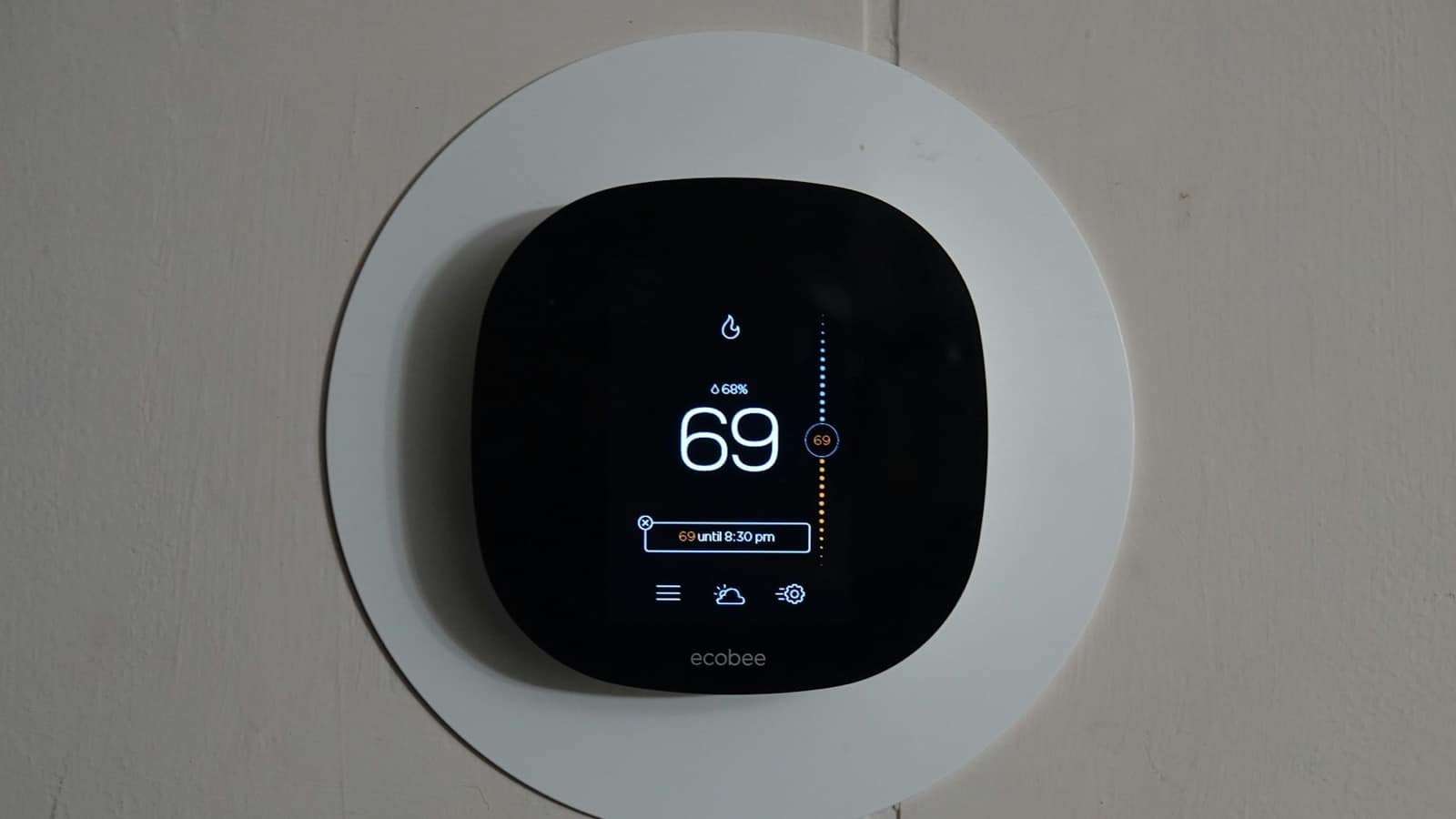
- Pre-cool the house before the paid window. Air conditioning is the largest load in most Texas homes, and you cannot move all of it to the night. You can move some. With a smart thermostat, drop the temperature a few degrees during the free hours, then let it drift up during the expensive daytime. PowerWizard and other Texas providers point to pre-cooling as one of the most effective free-nights habits, especially in a well-insulated home.
- Schedule the dehumidifier and other always-on plug loads. A dehumidifier running at 500 watts adds up to 4 to 6 kilowatt-hours a day. Use its built-in timer or a smart plug to run it overnight, with a short daytime boost only on very humid days.
- Batch the small stuff. Robot vacuums, phone and laptop charging, and power-tool batteries barely move the needle, but there is no reason to run them during the pricey daytime. Schedule the vacuum for early morning and plug devices in at bedtime.
- Automate it once, then forget it. Set these schedules a single time. Between appliance delay timers, a smart thermostat, an EV charging window, and a couple of smart plugs, your home will shift energy usage to nights every evening without you lifting a finger.
The Break-Even Test: Is the Shift Actually Saving You Money?
To save money on free nights electricity, enough of your usage has to land in the free window to cover the higher daytime rate. A free nights plan only beats a plain fixed-rate plan when that math works out. That premium is real. According to Texas Electricity Ratings, paid-hours rates on free plans often run well above a standard plan, sometimes 50 percent higher. So the more your daytime rate jumps, the more usage you need to move just to break even.
| Daytime premium over a fixed plan | Free-window share you need to break even |
|---|---|
| About 3 cents more | Around 20% |
| About 5 cents more | Around 29% |
| About 7 cents more | Around 37% |
| About 10 cents more | Around 45% |
How much can a normal home realistically move? With ordinary effort, most households land 20 to 40 percent of their usage in the free window. Homes with an EV or a pool can push past 50 percent. And there is more at stake in Texas than almost anywhere: the U.S. Energy Information Administration puts the average Texas home near 1,096 kilowatt-hours a month, about a quarter higher than the national average, thanks to our cooling load. More usage means a bigger reward when the plan fits.
Run Appliances Overnight Safely
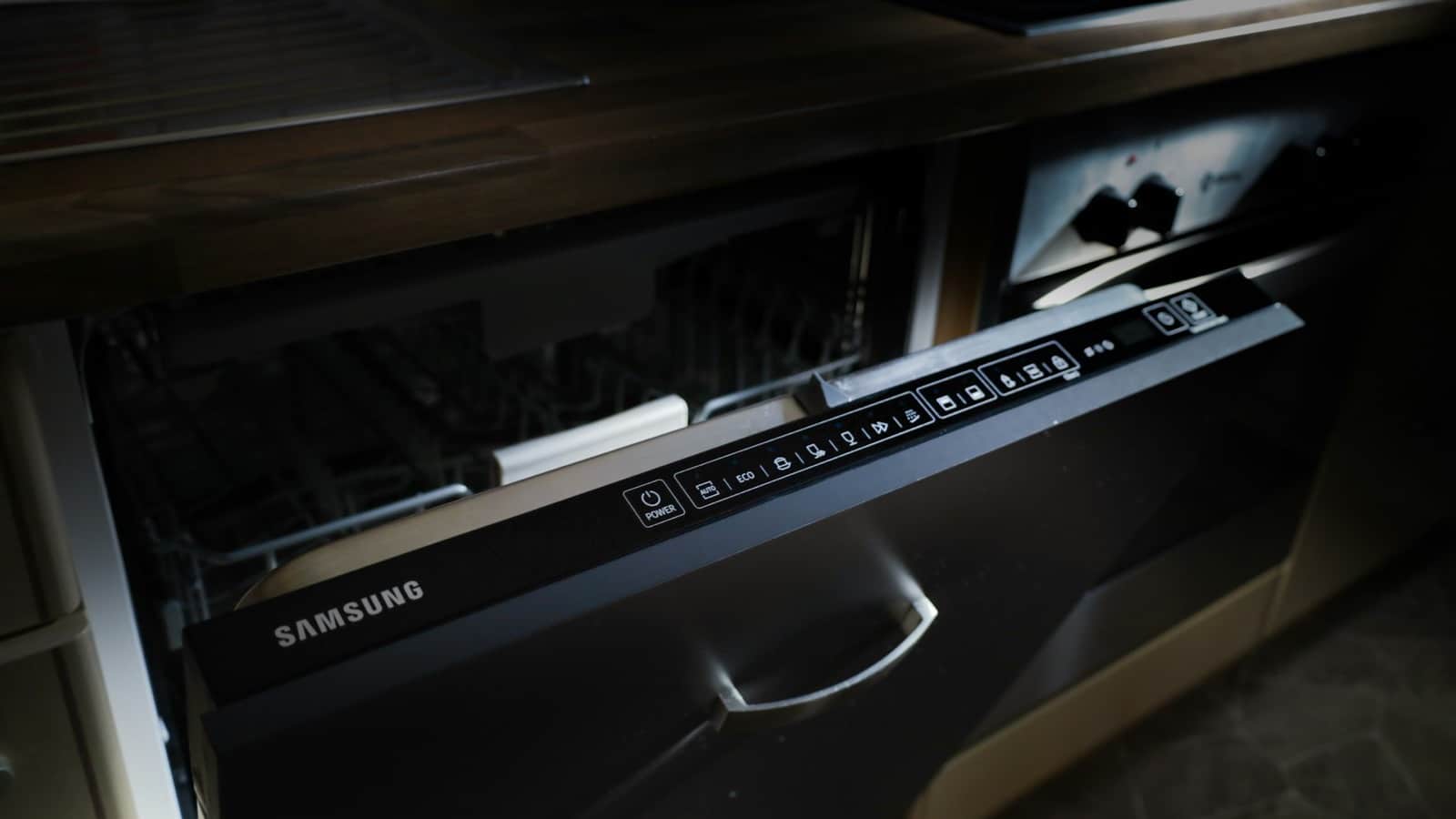
One honest caution, because most guides skip it. Fire-safety authorities advise against running a clothes dryer while you are asleep or out of the house, since lint and vent fires are a leading cause of home fires and need someone awake to catch them early. So run the dryer first thing in the free window and let it finish before bed, rather than scheduling it for the middle of the night. Clean the lint filter before every load and keep the vent duct clear. For dishwashers and washers, glance at the hoses now and then, and make sure your smoke alarms work. These habits cost nothing and keep the savings worry-free.
Verify Your Night Share with Smart Meter Texas
You do not have to guess whether the shift is working. Texas smart meters record your usage in 15-minute intervals, and Smart Meter Texas data lets you view and download it. Log in, export a month of intervals, add up the kilowatt-hours that fall inside your free window, and divide by your total. That night share is the number that tells you, in plain math, whether your new habits are paying off.
Let Us Match the Plan to Your Usage
Here is where we come in. Because VIP Energy Service offers both free nights options and steady fixed-rate plans, we have no reason to push you toward one over the other. If your usage shifts easily, a free nights plan can be a genuine winner. If it does not, an affordable fixed rate may treat you better. Either way, we will run the numbers with you. You can request a free quote or view current rates and plans any time. And if you want the full picture on how these plans work, our free nights electricity plans guide walks through it from the ground up.
Frequently Asked Questions
What time do free nights start in Texas?
Most plans start between 8 and 9 p.m. and end around 6 to 9 a.m., though the exact window varies by provider. A few offer a full twelve free hours. Your plan's Electricity Facts Label lists the precise hours, so confirm them before you build your schedule.
When should I run appliances on a free nights plan?
Run power-hungry appliances like the dishwasher, washer, dryer, and pool pump inside your free window. Use delay-start timers so they begin shortly after the window opens and finish before it closes, which puts nearly all of their energy in the free period.
Do I still pay delivery charges at night?
Yes, on most plans. Only the energy charge from your provider drops to zero during the free window. Delivery charges from your local utility and any fixed monthly fees still apply around the clock, so nights are free on the energy portion, not the entire bill.
Is a free nights plan worth it without an EV?
It can be, if you can move a good share of your usage with laundry, dishwashing, the pool pump, water heating, and pre-cooling. Without an EV you have to be more deliberate, but homes that shift 30 percent or more of their use often still come out ahead.
Is it safe to run the dryer overnight?
Run it before bed rather than in the middle of the night. Fire-safety guidance discourages running a dryer while you sleep because lint and vent fires need someone awake to respond. Clean the lint filter every load and keep the vent clear.
How do I know if shifting is actually saving me money?
Pull your 15-minute interval data from Smart Meter Texas, total the kilowatt-hours inside your free window, and divide by your total usage. Compare that night share against the break-even table above for your plan's daytime premium. If you are over the line, you are saving.
Rates and plan details vary by location and usage and are subject to change. Review the Electricity Facts Label for each plan, and note that free electricity plans are available only in deregulated Texas (ERCOT) service areas.
Photos via Unsplash: Devon MacKay, Priscilla Du Preez, Ostbacher Stern, Sean.

Both plans wave the same magic word at you: free. Free nights promises zero-cost power overnight, every night. Free weekends hands you Saturday and Sunday on the house. So the question that brings most Texans to a comparison like this one is simple, even if the answer is not: which one actually saves more money?
Here is the honest version up front. Neither plan is the winner for everyone. The free nights vs free weekends decision comes down to one thing, when your home uses the most electricity. Pick the plan whose free window lines up with your real habits and you can save real money. Pick the wrong one and you will quietly pay a premium for hours you are barely awake to use. We offer both plan types at VIP Energy Service, so we have no reason to push you toward one over the other. We would rather you land on the plan that fits. If you want the bigger picture first, start with our guide to free nights electricity plans in Texas, then come back here to settle the head-to-head.
Free Nights vs. Free Weekends at a Glance
Here is the side-by-side, so you can see the trade-off in one look.
| Free Nights | Free Weekends | |
|---|---|---|
| When power is free | Every night, a set overnight block | A continuous weekend window |
| Typical free hours | 8 or 9 p.m. to 6 or 9 a.m. | Friday evening to late Sunday or early Monday |
| Free hours per week | About 49 to 84 | About 48 to 72 |
| Daytime/weekday rate | Higher than a standard plan | Higher than a standard plan |
| Ideal for | Night owls, EV owners, daily late-evening chores | Weekend-heavy homes, lake houses, seasonal use |
| The catch | You pay more for weekday daytime power | You pay more for weekday power, Monday through Friday |
The free windows are wider than people expect. According to ElectricityPlans, Direct Energy's Twelve Hour Power gives free electricity 9 p.m. to 9 a.m., which adds up to 84 free hours a week, while Gexa Energy's Free 3-Day Weekends gives you a full 72-hour block from Friday midnight to Monday midnight. The hours sound generous either way. What matters is whether your usage actually falls inside them.
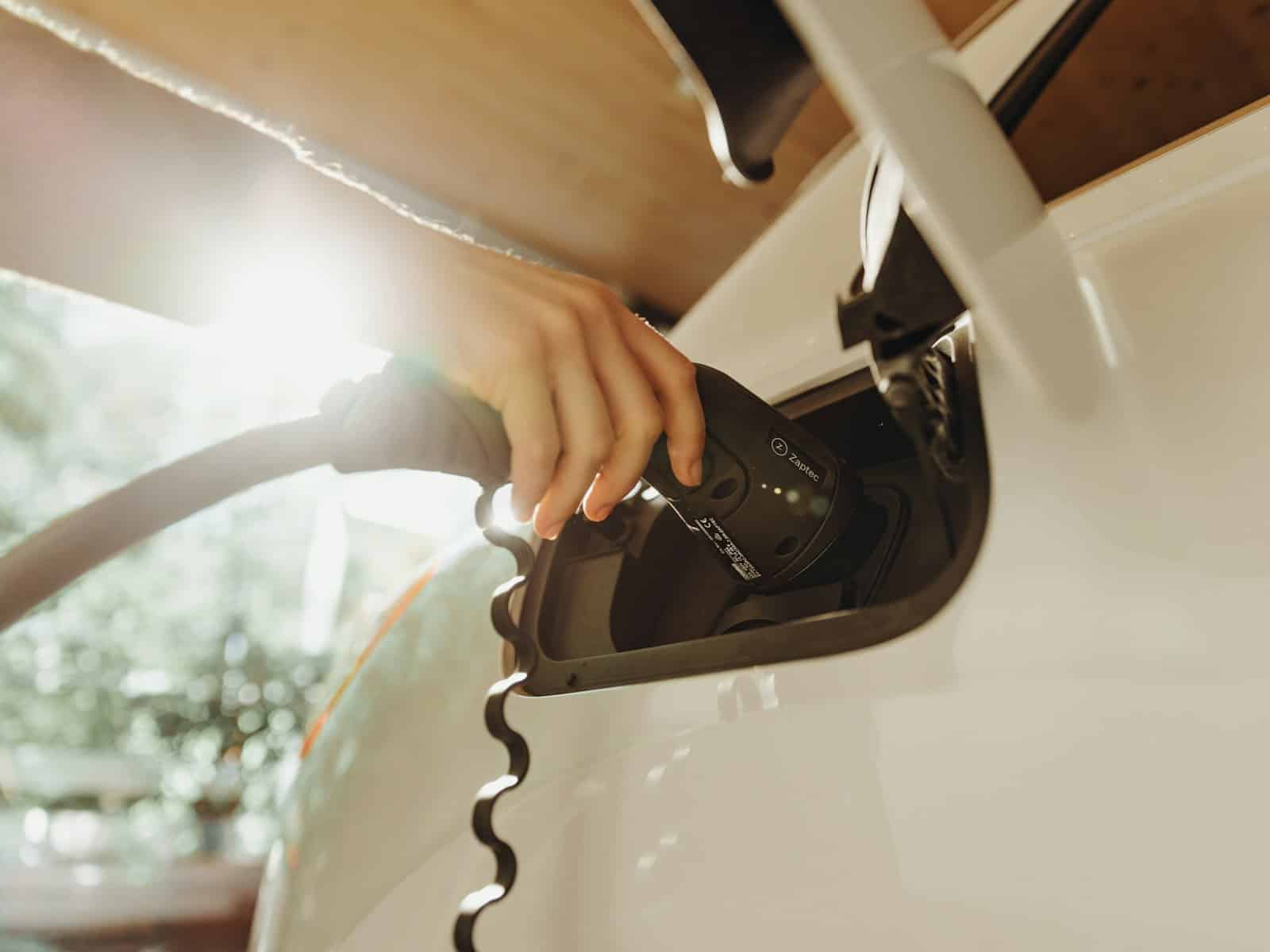
How "Free" Electricity Actually Works in Texas
These are time-of-use plans, and there is a quiet trade baked into every one. Only the energy charge drops to zero during the free window. To pay for those free hours, the provider raises the rate you pay during everything else.
That gap is bigger than the word free suggests. According to Texas Electricity Ratings, the paid-hours rate on free plans often runs 50 percent or more above a standard plan. One well-known free nights product sits near 20 cents per kWh, and a free weekends version near 17 cents. For comparison, ChooseEnergy data puts the average Texas rate around 14.94 cents per kWh, with some affordable fixed-rate offers closer to 7 cents. So the free hours are not a gift. You pre-pay for them through a higher price on your daytime and weekday power.
None of that makes these plans a bad deal. It just means the math has to work in your favor. Used well, an electricity plan free nights and weekends structure can genuinely lower your bill. Used carelessly, it costs more than a plain rate would have.
Do You Still Pay Delivery Charges During Free Hours?
This is the part most comparisons skip, and it surprises people on their first bill. The word free covers the energy charge only. Your delivery charges keep showing up.
Those delivery fees come from your TDU, the regulated utility that owns the poles and wires in your area, such as Oncor or CenterPoint. According to BKV Energy, TDU delivery charges still apply during the free window on most free nights plans. The utility sets these fees, and every customer pays them no matter which plan they choose. CleanSky Energy makes the same point: only the energy portion goes free, while delivery fees and fixed monthly charges stay on the bill.
A handful of plans go further and waive delivery charges during the free period too, which is a meaningful extra perk. The only way to know is to read the plan's Electricity Facts Label, the standard disclosure every Texas provider must give you. The label spells out the exact free hours and the full charge structure, so it is the document that settles any "is this really free" question before you sign.
The Break-Even Test: Will a Free Plan Actually Save You Money?
Here is a simple tool you will not find on most comparison sites, and it removes the guesswork. A free plan saves you money only when enough of your usage lands in the free window to cover the higher rate you pay the rest of the time. We call that your break-even share.
The rule of thumb works like this: the bigger the daytime premium, the more of your usage you need to shift into the free hours just to break even.
| Paid-hours premium vs. a fixed plan | Example rate jump | Free-window share needed to break even |
|---|---|---|
| Plus 3 cents | 12 to 15 cents | About 20% |
| Plus 5 cents | 12 to 17 cents | About 29% |
| Plus 7 cents | 12 to 19 cents | About 37% |
| Plus 10 cents | 12 to 22 cents | About 45% |

So how much can a normal home realistically move into those free hours? Based on typical Texas usage patterns, a household lands roughly 25 to 35 percent of its electricity in nights and weekends with a little effort, running the dishwasher late, starting laundry after dark, putting the pool pump on a timer. Homes with an EV or a pool can push that to 40 to 60 percent, because overnight EV charging is a heavy, easily-shifted load.
The size of the prize is bigger in Texas than almost anywhere. According to the U.S. Energy Information Administration, a typical Texas home uses around 1,200 to 1,300 kWh a month, well above the roughly 900 kWh national average, thanks to our air-conditioning load. More usage means more to gain when you get the plan right, and more to lose when you get it wrong.
Which Plan Fits Your Household?
Match the plan to how you actually live, and the choice gets easy.
| Your situation | Better fit | Why |
|---|---|---|
| Night-shift worker or natural night owl | Free Nights | Your heaviest hours already fall in the free overnight window |
| Work from home, heavy weekday A/C | Usually a fixed-rate plan | Your peak usage hits during the expensive paid hours |
| EV owner who charges overnight | Free Nights | One scheduled charge captures a big block of free kWh nightly |
| Weekend-focused family or lake house | Free Weekends | Most meaningful usage clusters Friday night through Sunday |
| Snowbird or seasonal second home | Free Weekends | Light weekday load, with visits concentrated on weekends |
The pattern is clear. Free nights rewards people who are awake, charging, or running appliances after dark on a daily basis. The free weekends plan rewards homes whose real life happens Saturday and Sunday. And if your power use is steady through the weekday daytime, a straightforward fixed rate will usually treat you better than either free option.
How to Choose with Confidence
You do not have to guess. Four quick steps get you to the right answer.
- Pull your hourly usage from Smart Meter Texas or your provider portal and see how much already falls at night and on weekends.
- Read the Electricity Facts Label and note the average price at your usage level, not just the headline.
- Run the break-even test above against your realistic free-window share.
- Pick the plan whose free hours your life actually fills.
Whichever way the math points, we can set you up. Because VIP Energy Service offers both free nights or free weekends options alongside steady fixed-rate plans, you can request a free quote and we will help you match the plan to your usage rather than the other way around. You can also view current rates and plans any time.
The Bottom Line
Free nights vs free weekends is not a contest with one champion. Free nights wins for night owls, EV drivers, and anyone who can move daily chores past sunset. Free weekends wins for weekend-centric homes and seasonal properties. And if you cannot reliably shift your usage, an affordable fixed-rate plan is often the smarter call. Run the break-even test, read the label, and choose the window that fits your life. If you want to go deeper on how these plans work before you decide, our free nights electricity plans guide walks through it step by step, and our team is ready to help you get a free quote whenever you are.
Frequently Asked Questions
Are free nights and free weekends plans really free?
The energy charge drops to zero during the free window, so that portion is genuinely free. You still pay TDU delivery charges, fixed monthly fees, and a higher rate during your paid hours, which is how the provider funds the free period.
Do free weekends plans include Friday night?
It depends on the plan. Some free weekends offers start Friday evening, while others begin at midnight Saturday. The Electricity Facts Label lists the exact window, so check it before you enroll.
Do delivery (TDU) charges still apply during free hours?
Yes, on most plans. Delivery charges are set by your local utility and apply no matter which plan you choose. A few plans waive them during the free window, so read the label to see if yours is one of them.
Which is better if I work from home?
If most of your usage happens during weekday daytime hours, a fixed-rate plan is often the better fit, since both free plans charge more during those hours. A free plan only helps if you can shift heavy loads into the free window.
Can I switch from a free nights plan to a free weekends plan?
Usually yes, though switching mid-contract can trigger an early termination fee unless you are in the last few weeks of your term. At the end of your contract you can move to any plan type you like.
What is a free nights and weekends plan?
It combines both structures, giving you free energy every night plus a weekend block. The trade-off is typically an even higher weekday daytime rate, so the same break-even math applies.
Rates and plan details vary by location and usage and are subject to change. Review the Electricity Facts Label for each plan, and note that free electricity plans are available only in deregulated Texas (ERCOT) service areas.
Photos via Unsplash: Braden Egli, Zaptec, Aaron Lefler, Matthew LeJune.
In Texas, plans that offer free nights electricity services charge no fees per kilowatt-hour for energy used at designated hours during the night, which range from 8 pm to 6 am. To compensate for this, they charge higher than average rates for electricity used during the day. Depending on the household, these plans could either save you hundreds of dollars or cost you hundreds. The key factor that determines this is how much energy you use during the night hours and how much energy you use during the day.
This guide is for Texans trying to figure out whether a free nights energy plan will save them money or quietly cost them more. We walk through how these plans work, who they actually fit, the hidden costs most marketing pages skip over, and how to evaluate any plan against your real usage pattern before you sign.
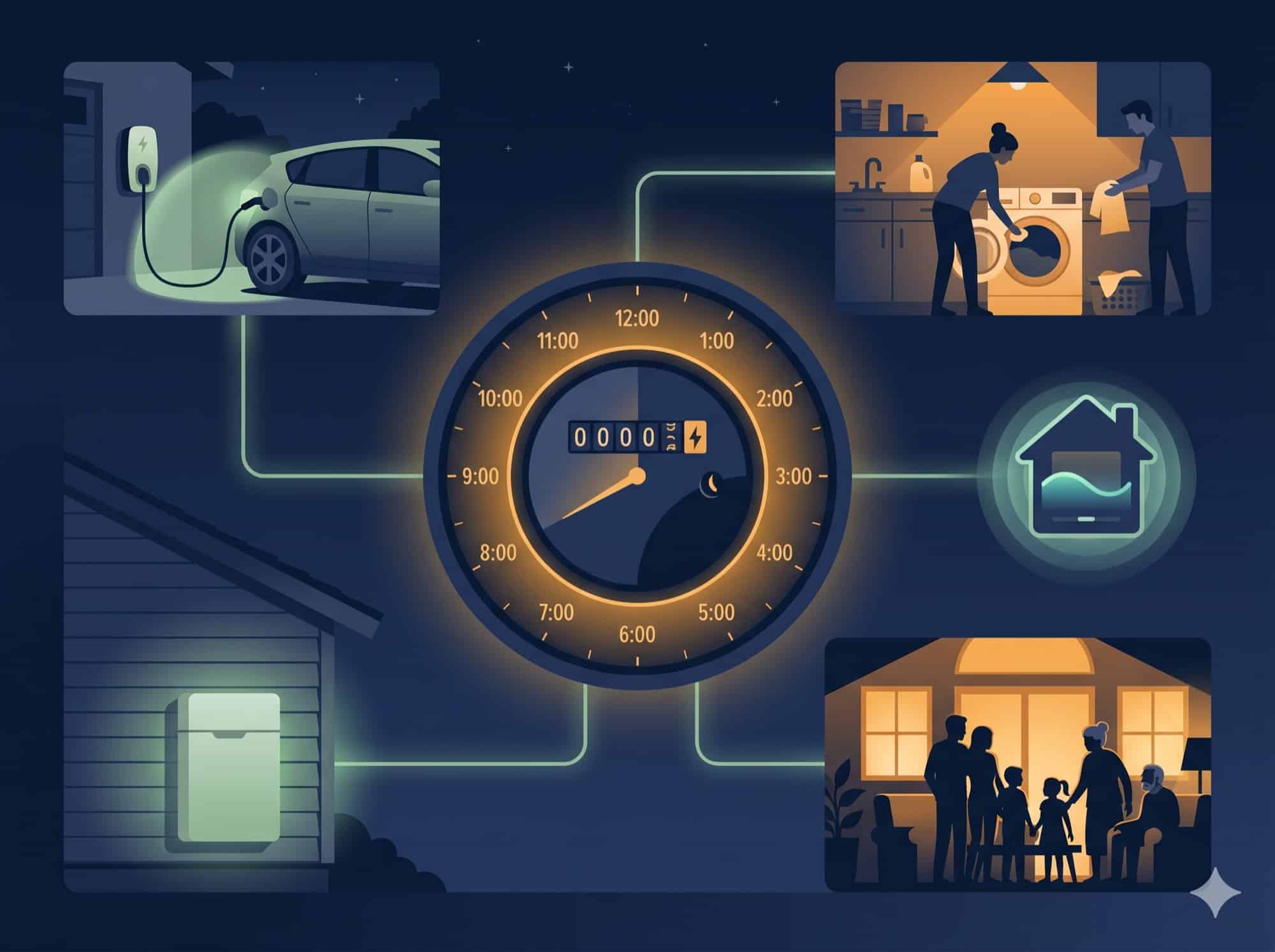
The free nights electricity plan is a time-of-use plan, which means you will pay nothing for electricity during specific daytime hours while also paying a premium for electricity during daytime hours. Your smart meter tracks and reports your energy (measured in kilowatt-hours or kWh) usage in 15-minute increments, and each time-of-use electricity retailer assigns you a different cost per kWh for each of those increments.
Let's break down the two pricing windows:
-
Free Window: From 8 or 9 pm to 5 or 6 am, you will pay $0.00 per kWh. Some plans do waive the transmission and distribution utility (TDU) delivery charge, while other plans do not.
-
Paid Window: During the rest of the day and evening, you will pay a cost per kWh that is much higher than what you would pay on a fixed-rate plan. On free nights plans, daytime cost ranges from 15 to 25 cents per kWh; whereas, a competitive fixed-rate offer costs 8 to 12 cents per kWh.
Your monthly cost will equal (the number of kWh used during the paid-window multiplied by the paid energy rate) plus the TDU delivery charges plus a monthly base fee plus taxes. Free-window kWh do not contribute to the energy charge, while still potentially incurring TDU delivery charges depending on the plan.
The mechanics of free nights plans are simple; however, the economics can be more complex. As long as you are able to decrease your usage during peak hours, you will ultimately save more money with this plan.
Time Slots for Free Hours are Different for Each Provider
Texas retail electric providers have different free hour windows, base fees and how they treat TDUs. Here is how the major free nights plans looked like in 2026:
| Plan | Free Window | Hours/Night | TDU Waived at Night |
|---|---|---|---|
| TXU Free Nights & Solar Days 12 | 8pm to 5am | 9 | Yes |
| Reliant Truly Free Nights 12 | 8pm to 6am | 10 | Yes |
| Direct Energy Twelve Hour Power | 9pm to 9am | 12 | Yes |
| Chariot Free Nights | 11pm to 6am | 7 | No |
| Pulse Power Free Energy Nights 12 | 8pm to 6am | 10 | Yes |
Source: ElectricityPlans free nights comparison chart and Texas Electricity Ratings Dallas overview.
When reading an Electricity Facts Label (EFL), there are three numbers that matter most: the free hour window, the daytime energy rate, and the percent of usage assumed in the average price against (typically around 30-50%). If your actual usage during the free window is less than what the EFL states, your average rate is going to be higher than the given number on PowerToChoose.
Who Benefits from Free Nights Electricity Plan
To be frank, not many Texan households as the marketing claims. Free nights electricity plans suit households with certain usage patterns, and we have done the math for five scenarios.
1. Owners Of Electric Vehicles Who Charge Their Cars At Night
One of the major residential electrical needs is EV charging, though it is relatively simple to schedule. If a Tesla Model Y is added to an average house in Houston or Dallas, it can shift 50 to 70% of total energy usage to the overnight charging window of 9pm to 6am. This aligns perfectly with the usage pattern that free nights plans are based on.
2. Workers on Night Shifts and Folks Who Sleep at Night
If your household uses power between 8pm and 6am, and is awake at that time, then you have the advantage. Everything from laundry to cooking, entertainment, and even air conditioning ends up being billable during the day, but in the free zone at night.
3. Users of Smart Home Automation
By setting a limit to when your home starts cooling, it can be done from 3am to 6am (a time when power is free), and then you can avoid any additional costs by not cooling it during the expensive hours. This shifts a significant amount of your cooling load into the free window without sacrificing comfort. Smart plugs for the dishwasher, washer, dryer, and pool pump can help to turn a frame filler into a profitable unit, even when it seemed like a bad fit.
4. Large Households Open to Rescheduling
Households who spend between 1,800 to 2,500 kWh/month can save several hundreds of dollars if they are able to shift laundry loads, dishwashing, and any other deferrable loads to the free time window. The more energy used, the greater the savings as energy used during the day is more expensive.
5. Homes With Storage Batteries
Residential battery systems can shift an additional 20% to 30% of daily energy usage from the expensive daytime hours to the free time window. While there’s a 10% to 15% loss in round-trip efficiency, the savings can be significant when combined with any behavioral shifts.
Who Will Lose Money on a Free Nights Plan
For households that can’t shift their usage, the same product becomes more expensive. We don’t recommend free nights energy plans for the following profiles:
Work-from-home families. If computers, lights, an air conditioner, and even a kitchen are running during business hours, the high daytime rate cancels out any savings from the free time windows. If kids are home during the day, the situation becomes even worse.
Standard retirees. A retiree who is home all day with the thermostat set comfortably will use most of their energy during expensive hours. Unless they are willing to be active during the night and pre-cool the house, fixed-rate plans will be less expensive.
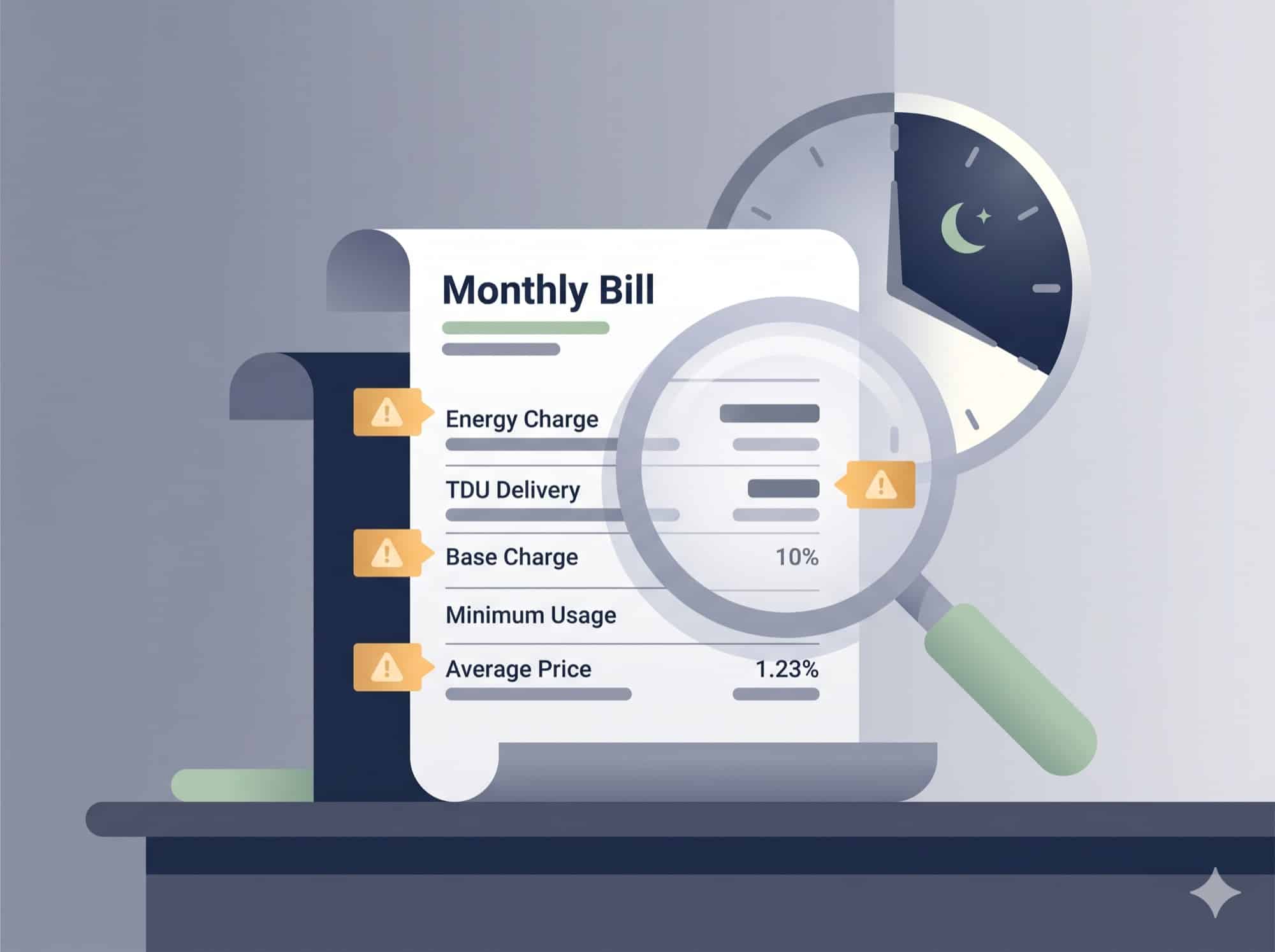
Households with low usage below 800 kWh monthly. Base charges (typically $9.95 per month) and minimum usage fees penalize low usage customers. The savings during the free hours are too small to offset the fixed charges.
People with permanent behavior. A free nights plan incentivizes positive change. If your washing machine is going off at 4 pm on a Saturday, a fixed-rate plan is the way to go.
The Hidden Costs Most Marketing Pages Skip
Five frequent ways a free nights energy plan ends up costing more than the advertised rate:
-
Higher daytime prices. Most free nights plans have daytime prices of 18 to 25 cents per kWh. In contrast, day rates on fixed-rate plans are 8 to 12 cents. If you only manage to shift 30% of your usage to the free hours, the daytime price will more than offset any savings you may have. The Energy Ogre analysis details this.
-
TDU delivery charges during “free” hours. Most plans only waive the energy part. The TDU (Oncor in DFW, CenterPoint in Houston, TNMP in the Rio Grande Valley, AEP in Corpus Christi) still charges 4 to 7 cents per kWh of delivery plus a fixed monthly charge. “Free” is not zero on your bill. This is directly confirmed in BKV Energy’s free nights explainer.
-
Charge that baseline survive everything. On plans where the free window literally costs you zero dollars per kWh, the monthly base charge of $9.95 is still owed. If your usage is low, that base charge can increase your effective rate significantly.
-
Minimum usage charge. Some free nights plans add a charge if you total monthly usage drops below a certain point, like 1,000 kWh. Customers who decrease daytime usage enough can cause these charges and lose a large portion of their savings back.
-
EFL average prices that consider aggressive free-window usage. The average price per kWh shown on PowerToChoose and the EFL is based on an assumed free-window usage rate between 35 and 50 percent. If your actual usage is lower than that, your bill will be higher than the average price.
The Public Utility Commission of Texas (PUCT) accepts consumer complaints about misleading marketing, billing issues, and charges consumers did not expect. You can check a provider’s complaint rate on the PUCT consumer complaint portal before signing up, as it shows the number of complaints by retail electric providers.
Break-Even Math: When Do Free Nights Plans Make Sense?
When deciding whether a free nights plan makes sense for you, the first step is determining your share of nights (%) and comparing it to our break-even night-share % for the plan. We’ll show the break-even calculations for TXU and Pulse Power-style plans.
-
For TXU-style plans (20c/kWh daytime + 0c/kWh nighttime + $9.95 base): break-even occurs when > 43% of your total kWh used are in the free window, while the plan is competitive with a 12c fixed rate offer.
-
For Pulse Power-style plans (15c/kWh daytime + no base): break-even is at 30% night-share for your free nights.
We’ll use real-life examples to clarify:
EV household, 1,500 kWh/month, 55% night usage:
-
TXU-style free nights: ~$1,739/year (savings of ~$420)
-
Pulse-style free nights: ~$1,710/year (savings of ~$450)
-
12-cent fixed plan: $2,160/year
Work-from-home family, 1,200 kWh/month, 30% night usage:
-
TXU-style free nights: ~$2,135/year (costs more ~$407)
-
Pulse-style free nights: at break-even
-
12-cent fixed plan: $1,728/year
While it is not a pleasant conclusion to draw, if you are on a true free nights plan and your night usage is less than 43%, you are likely better off with a fixed-rate plan.
Checking Your Household Fit
Here is a four step process you can use to check if you qualify for a specific free nights electricity plan.
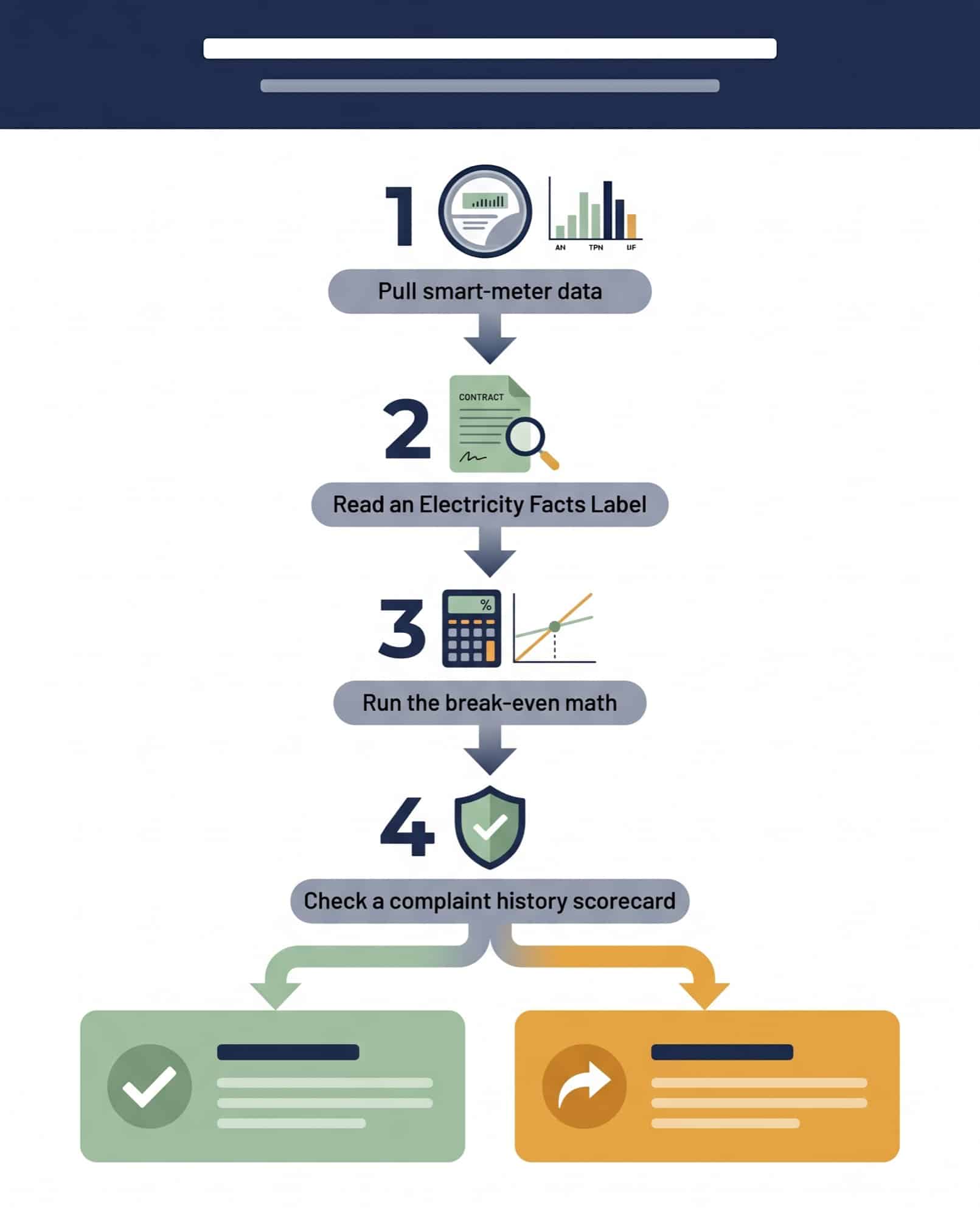
Step 1: Smart meter data. Most customers in Texas can access 15 minute interval data from Smart Meter Texas (smartmetertexas.com). This data shows usage for the last 6 months to 12 months. Determine the percent of total kWh usage that is captured between 8pm and 6am (whenever the plan is).
Step 2: EFL fine print. Get a copy of the EFL and read it closely. Check to see if the daytime energy rate is confirmed, the exact free hour time windows are listed, if free hours are listed as TDU delivery, the monthly base charge is listed, if there is a minimum usage charge, and if the average price calculation has free window % assumed.
Step 3: Real usage pattern comparisons. Estimate your average monthly kWh usage. Divide it by the actual percentage of night share and multiply that against the daytime rate plus TDU. Add base charges to that number. If you are attempting to compare this to a fixed-rate plan (12 to 13 cent) know that if the numbers from this plan do not come out lower than the free nights plan then the fixed-rate plan is a better/simpler option.
Step 4: Provider complaint checks. Providers with higher complaint scores in relation to their customer base should be avoided. Check the complaint scorecard offered by PUCT for this data.
Where VIP Energy Service Fits
VIP Energy Service is an authorized independent consultant for Ambit Energy in Texas. Ambit Energy (PUCT REP #10117) is the licensed retail electric provider that supplies your power and handles billing. We help Texas customers compare Ambit's plan options, enroll efficiently, and understand the trade-offs before signing a contract.
Ambit Energy offers a time-of-use option called Free & Clear Nights, a fixed-rate plan built for night owls, EV owners, and any household that can naturally shift a significant share of usage into the overnight window. The plan provides zero cents per kWh during the defined free hours and a competitive fixed rate for the rest of the day.
If you are weighing Free & Clear Nights against a standard Ambit fixed-rate plan, we recommend the same exercise we walked through above: pull your smart meter data, calculate your real night-share percentage, and run the break-even math. We are happy to help you work through that calculation directly. We would rather steer you to a fixed-rate plan that saves you money than enroll you in a free nights plan you will regret in three months.
Conclusion Regarding Free Nights Electricity Plans
A fixed-rate plan is not necessarily better or worse than a free nights electricity plan. They both operate on what are called time-of-use strategies, and these strategies only work if about 40% of your kilowatt hours (kWh) can be shifted into that free time window. EV owners who charge their cars at night, night-shift workers, users of smart-home technology, large families where members are willing to reschedule some of their activities to defer electricity usage, and homes that use battery storage are able to take full advantage of these plans. Conversely, work-at-home families, retirees, and individuals who use electricity infrequently will typically be at a disadvantage.
The math behind time-of-use strategies are not catchy slogans meant for advertising, rather, they require detail-oriented spreadsheets and are directly related to your pattern of use, your postal code, your Transmission and Distribution Utility (TDU), and the specific Electricity Fact Label (EFL) of the plan you are considering. When done correctly, free nights energy plans can allow a household that matches well $400 to $500 worth of savings each year. However, if done incorrectly, free nights plans will cost you $300 to $400 more than fixed-rate plans.
If you would like help running the math against your actual usage, contact VIP Energy Service and we will walk through the calculation with you before you sign anything. For more on the broader landscape of free time-of-use products across the ERCOT deregulated market, our companion Free Nights Electricity Plans in Texas pillar covers it in detail.
About VIP Energy Service
VIP Energy Service is an authorized independent consultant for Ambit Energy (PUCT REP #10117). We serve Texas residents in the deregulated ERCOT market, including Houston, Dallas-Fort Worth, Corpus Christi, the Rio Grande Valley, and Lubbock. We do not serve Austin (Austin Energy) or San Antonio (CPS Energy) because those markets are municipal and not part of the deregulated REP system.
Hero photo by Jeff Le on Unsplash
If you want to know how much a whole house solar generator costs, the answer ranges from $3,500 to $25,000 depending on capacity and features. Texas homeowners are increasingly turning to solar generators for backup power and energy independence, especially after experiencing grid reliability issues. Understanding the true cost helps you make an informed decision about protecting your home.
This guide breaks down solar generator pricing by system size, compares popular brands, and shows you how to maximize savings through federal tax credits and Texas utility rebates. For a complete overview of backup power options, see our guide to whole house battery backup cost.
Average Whole House Solar Generator Costs by System Size
The solar generator cost you pay depends primarily on power output and storage capacity. Larger systems with more battery storage cost more but can power your entire home including HVAC systems.
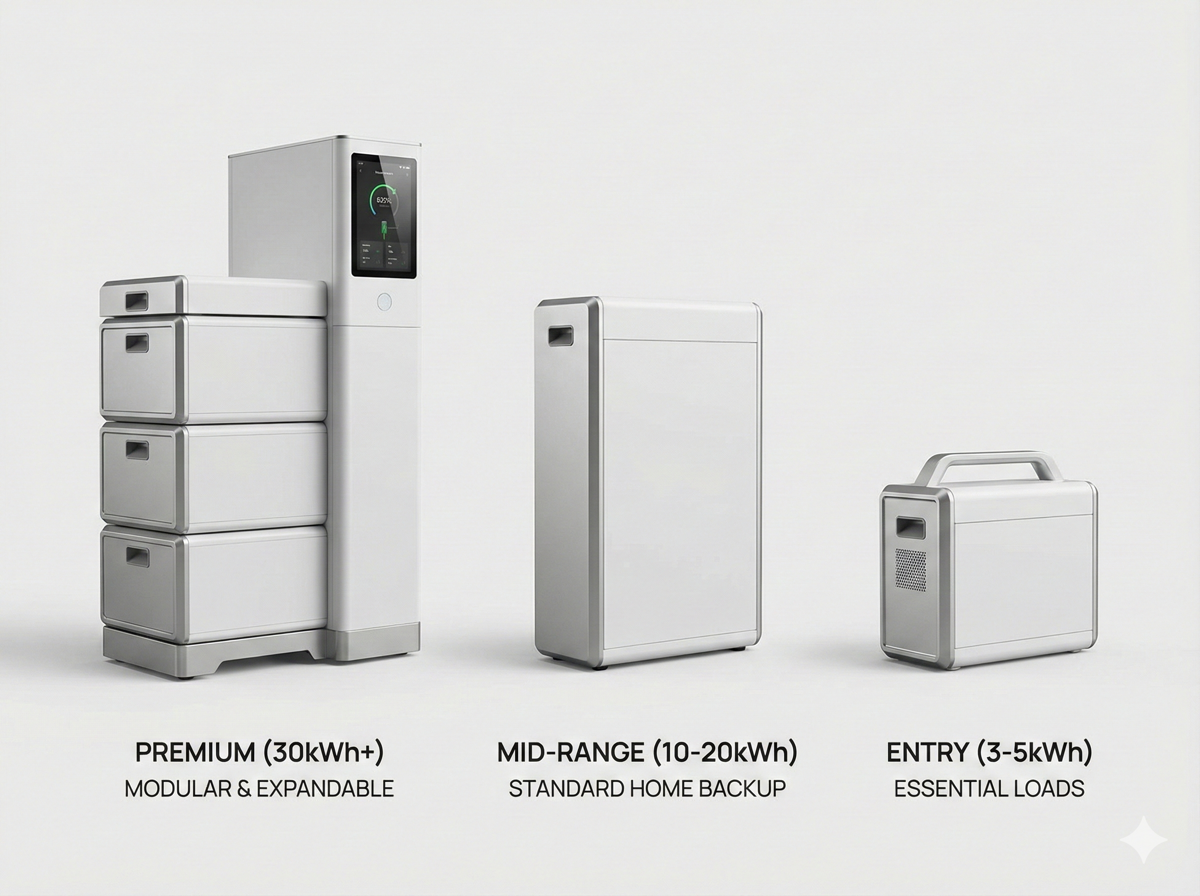
| System Tier | Cost Range | Capacity | What It Powers |
|---|---|---|---|
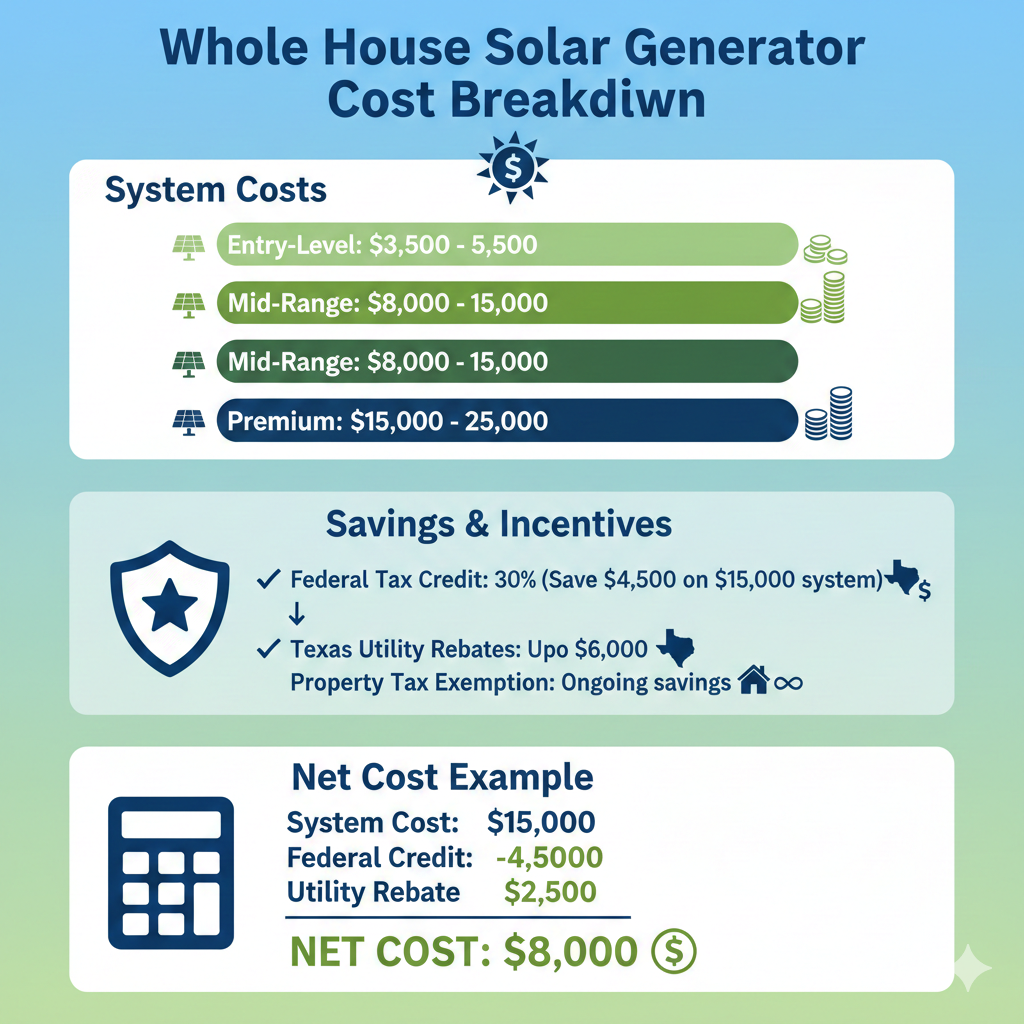
| Entry-Level | $3,500 - $5,500 | 5-7 kWh | Essential appliances only |
| Mid-Range | $8,000 - $15,000 | 10-18 kWh | Most home electrical needs |
| Premium | $15,000 - $25,000 | 20-36+ kWh | Entire home including A/C |
Entry-level systems handle essential appliances like refrigerators, lights, and phone chargers during outages. Mid-range solar power systems can run most of your home for 8-12 hours. Premium whole house solar generators provide complete energy independence with enough output and storage capacity to power everything including air conditioning.
According to EcoFlow, the average American home consumes about 10,566 kWh annually. For Texas homes running air conditioning heavily in summer, daily energy consumption often exceeds 40 kWh, requiring larger battery capacity.
Popular Solar Generator Brands and Pricing
Several manufacturers produce solar powered generators designed for whole-home backup. Here are the leading options with current pricing:
| Brand | Model | Capacity | Price | Best For |
|---|---|---|---|---|
| EcoFlow | DELTA Pro Ultra | 6 kWh | $5,199 | Small homes |
| EcoFlow | DELTA Pro Ultra | 18 kWh | $13,500 | Medium homes |
| EcoFlow | DELTA Pro Ultra | 36 kWh | $24,000 | Large homes |
| Bluetti | AC200MAX+ | Up to 8.2 kWh | $2,000 - $8,000 | Budget buyers |
| Goal Zero | Home Backup | 10.8 kWh | $8,829 | Reliable backup |
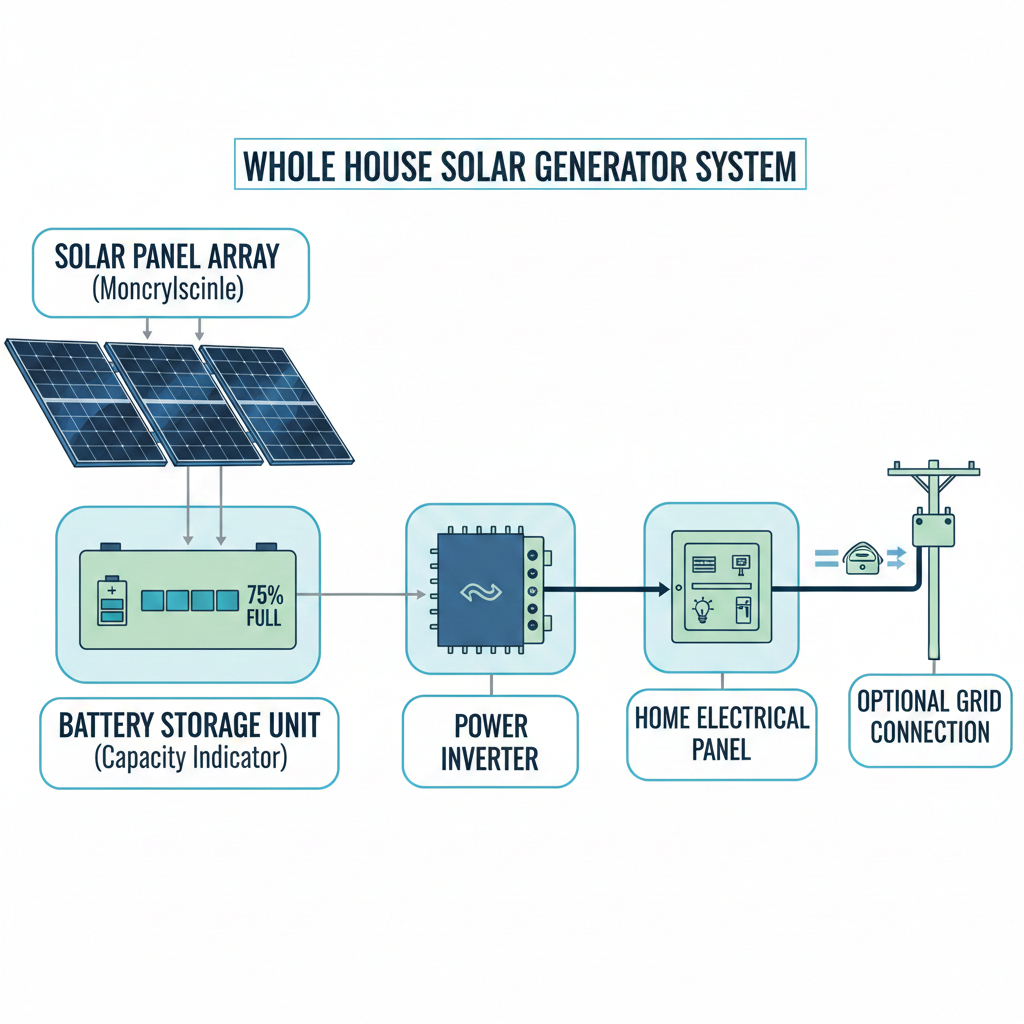
EcoFlow leads the market for scalable house solar generator systems. Their modular design lets you start smaller and add capacity later. Bluetti offers more affordable initial cost options for homeowners watching their budget. Goal Zero provides rock-solid reliability backed by years of portable solar power systems experience.
Key Factors That Affect Solar Generator Pricing
Several factors include the final price you pay for installing a solar generator system.
Battery Type and Capacity
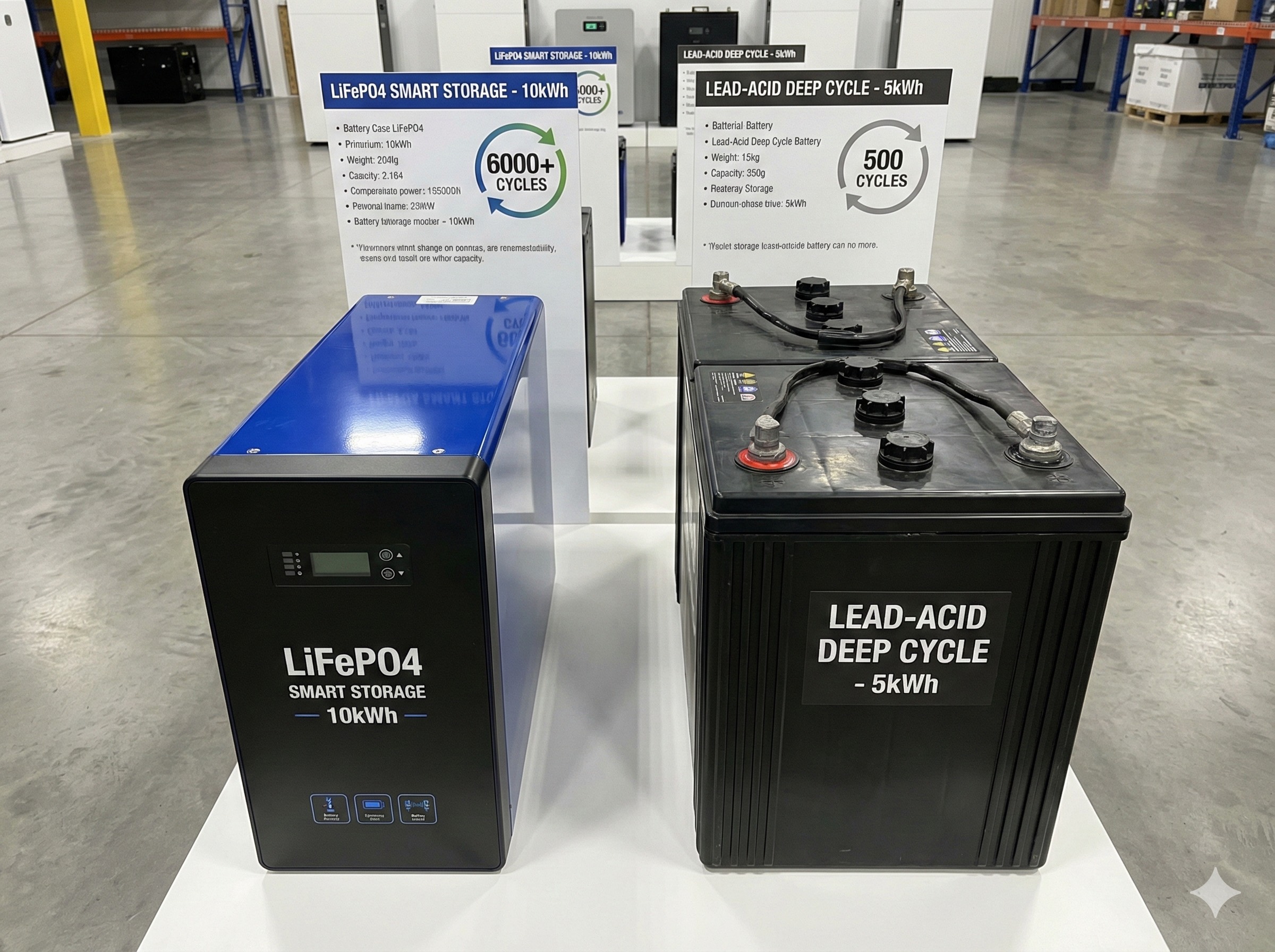
Battery technology significantly impacts cost. Lithium iron phosphate (LiFePO4) batteries cost $800-$1,500 per kWh but last 3,000+ cycles. Standard lithium-ion runs $1,000-$3,000 per kWh with fewer cycles. Lead-acid batteries have the lowest upfront cost at $500-$1,200 per kWh but require replacement sooner.
For detailed battery pricing, check our cost of battery storage per kWh breakdown.
Solar Panel Requirements
The type of solar panels you choose affects total system cost. A solar panel array with monocrystalline panels costs more but produces more power per square foot. Determining the size of the solar array depends on your roof space and energy needs. Most whole-home systems require 4-10 panels rated at 400W each.
Installation Complexity
DIY installation saves thousands but requires electrical knowledge. Professional installation adds $1,000-$5,000 depending on complexity. Homes needing electrical panel upgrades or permitting face additional costs. Texas requires licensed electricians for grid-tied systems.
Federal Tax Credits and Texas Incentives
Smart homeowners stack available incentives to dramatically reduce their net cost.
30% Federal Tax Credit
The Residential Clean Energy Credit provides a 30% tax credit on qualified solar and battery systems through 2032. This applies to both equipment and installation costs.
Example savings on a $15,000 system:
- System cost: $15,000
- Federal credit (30%): -$4,500
- Your federal tax bill reduces by $4,500
The credit applies to standalone battery storage of 3 kWh or larger, making most whole house solar generators eligible.
Texas-Specific Savings
Texas offers no state tax credit, but provides valuable property tax exemption. The added value from your solar energy system does not increase your property taxes. This saves hundreds annually on larger systems.
Texas utility rebates vary by provider:
- Austin Energy: $2,500 flat rebate
- AEP Texas: Up to $6,000
- Oncor: Varies by project
- CPS Energy: Up to $2,500
For a $15,000 system in Austin Energy territory:
- Federal credit: -$4,500
- Utility rebate: -$2,500
- Net cost: $8,000
Whole House Solar Generator vs Traditional Generators
Solar generators offer significant long term advantages over fossil fuel alternatives.
| Factor | Solar Generator | Gas Generator |
|---|---|---|
| Fuel Cost | Free (sunlight) | $50-150/month |
| Noise Level | Silent operation | 65-75 decibels |
| Maintenance | Minimal | Regular oil and filters |
| Lifespan | 10-25 years | 10-15 years |
| Emissions | Zero | Carbon output |
Solar generators eliminate ongoing fuel costs entirely. A gas generator running 8 hours daily during an extended outage costs $20-40 in fuel per day. Solar generators recharge free from your solar panel array or grid power when available.
The silent operation makes solar generators ideal for residential neighborhoods. No fumes means safe placement near your home without ventilation concerns.
How to Choose the Right Size System
Proper sizing ensures your solar generator meets your energy consumption needs without overspending.
Use our solar battery ah calculator to determine your specific requirements.
Quick Sizing Guidelines
| Home Size | Recommended Capacity | Estimated Cost |
|---|---|---|
| 1,500 sq ft | 10-15 kWh | $8,000 - $12,000 |
| 2,500 sq ft | 15-25 kWh | $12,000 - $18,000 |
| 3,500+ sq ft | 25-36+ kWh | $18,000 - $25,000 |
Start by listing your essential appliances and their wattage. Refrigerators typically draw 150-400W, while central A/C requires 3,000-5,000W. Your solar generator must handle peak loads while maintaining enough storage for overnight backup power.
Is a Whole House Solar Generator Worth the Investment?
For Texas homeowners, whole house solar generators provide genuine energy independence and long term value.
Key Benefits
Outage protection: After Winter Storm Uri showed ERCOT grid vulnerabilities, many Texans prioritize backup power. Solar generators keep essential appliances running regardless of grid status.
Long-term savings: Rising electricity rates make solar energy increasingly attractive as a renewable energy source. Systems typically achieve payback within 5-10 years through reduced utility bills and avoided outage costs.
Home value: Homes with solar and battery backup systems command premium prices. Buyers recognize the value of energy independence.
Environmental impact: Solar generators produce zero emissions, reducing your carbon footprint while saving money.
Get Expert Guidance for Your Solar Generator Purchase
Now you know how much a whole house solar generator costs and how to maximize your savings. Prices range from $3,500 for basic systems to $25,000+ for premium whole-home solutions. Federal tax credits reduce costs by 30%, and Texas utility rebates can save an additional $2,500-$6,000.
The right system depends on your home size, energy needs, and budget. VIP Energy Service helps Texas homeowners navigate solar generator options and find the best fit for their situation. Contact our team to discuss your backup power needs and get a personalized recommendation.
Ready to explore your options? Get your free energy quote from VIP Energy Service and discover how solar backup can protect your Texas home.
Sources
- EcoFlow - How Much Does a Whole House Solar Generator Cost in 2025
- EnergySage - Solar Panel Cost Data 2025
- IRS - Residential Clean Energy Credit
- U.S. Energy Information Administration - Residential Energy Consumption Survey
- Texas Comptroller State Energy Conservation Office - Solar Incentives
- Goal Zero - Home Backup Solar Generators
Last updated: January 2026
Update, October 2026: According to the IRS, the 30% federal Residential Clean Energy Credit is not available for systems placed in service after December 31, 2025. Mentions of the credit below apply only to systems installed by then. Texas utility rebates and the Texas property tax exemption may still lower your cost.
The cost of battery storage per kWh ranges from $700 to $1,300 installed for residential systems and $125 to $334 for utility-scale projects as of late 2025. Battery pack prices alone have dropped to a record low of $70-$108/kWh, representing a 93% decline over the past decade. For Texas homeowners evaluating whole house battery backup cost, understanding these numbers is essential for making an informed investment in home energy storage.
Table of Contents
How Battery Costs Are Measured
The cost of battery storage per kWh serves as the standard metric for comparing energy storage systems. However, this number can mean different things depending on what's included.
Battery pack cost refers to the cells themselves, which have reached historic lows. According to BloombergNEF, lithium-ion battery pack prices dropped to $108/kWh in 2025, with stationary storage packs even lower at approximately $70/kWh according to Battery Tech Online.
Installed system cost includes the battery, inverter, wiring, permits, and labor. Residential battery storage costs range from $700 to $1,300 per kWh fully installed, depending on system size and complexity.
Levelized Cost of Storage (LCOS) measures the total cost per kWh over the battery's lifetime, accounting for cycle life and round-trip efficiency (typically 90% for lithium-ion systems). According to Ember Energy, utility-scale LCOS has reached $65/MWh as of October 2025, while residential systems range from $200 to $400/MWh according to Lazard's 2025 analysis.
Battery Storage Costs in 2026: Current Pricing Data
Understanding the cost of battery storage per kWh requires examining different market segments. Here's what you can expect to pay in 2026:
2026 Battery Storage Cost Comparison
| Category | Cost per kWh | Notes |
|---|---|---|
| Battery Pack (cells only) | $70-$108 | Lowest prices ever recorded |
| Utility-scale BESS (4-hour) | $125-$334 | All-in project costs |
| Residential Installed | $700-$1,300 | Includes installation |
| Tesla Powerwall | $700-$780 | Per kWh installed |
| Enphase IQ Battery | ~$1,510 | Per kWh installed |
| Lead-acid | $200-$500 | Shorter cycle life |
According to NREL's 2025 Benchmark, utility-scale 4-hour battery energy storage systems (BESS) cost approximately $334/kWh. However, Ember Energy reports that all-in BESS project capital expenditure has reached as low as $125/kWh for the most competitive projects.
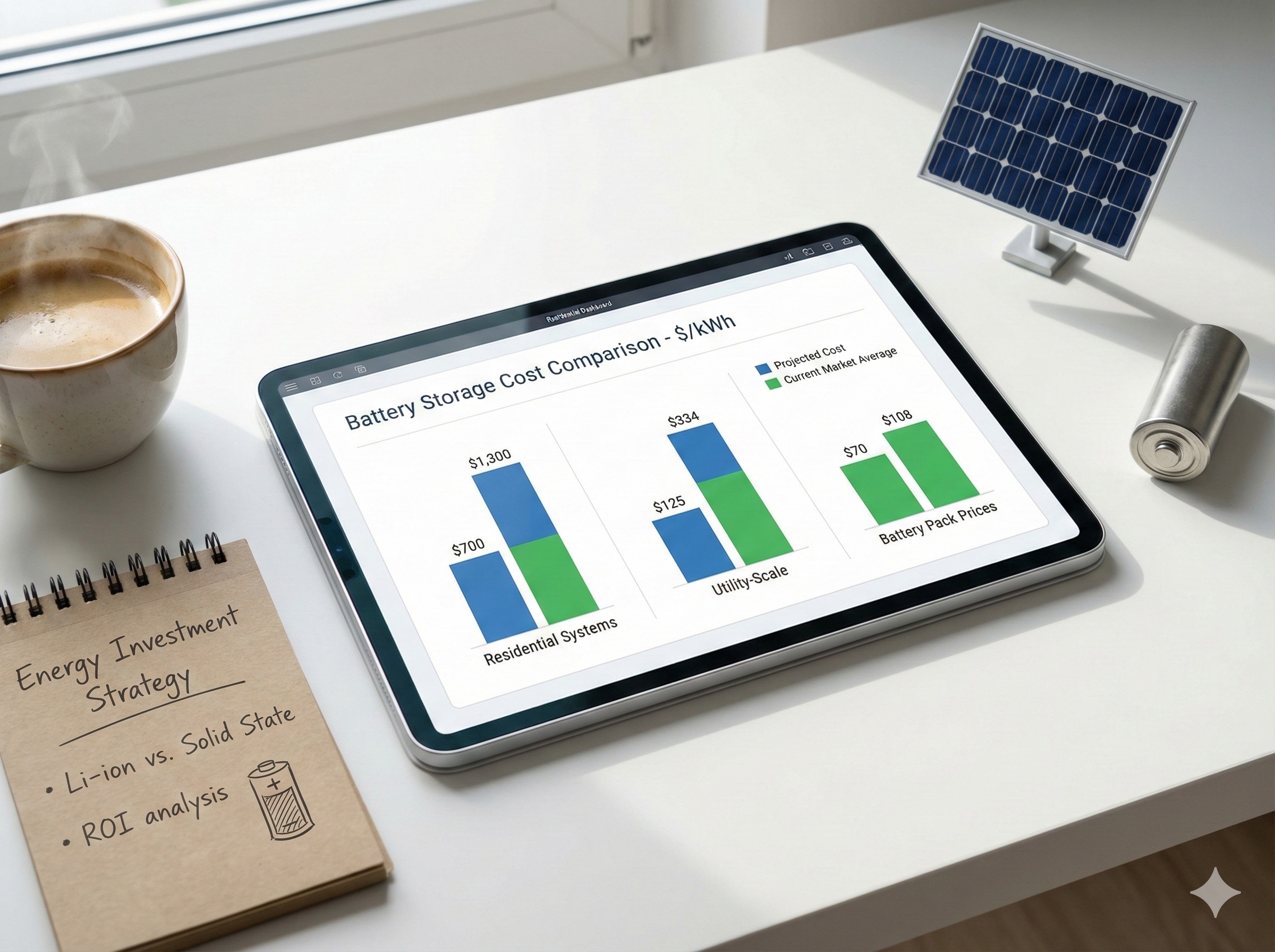
For residential battery systems, EnergySage data shows installed costs ranging from $700 to $1,300 per kWh. The Tesla Powerwall remains a market leader at $700-$780 per kWh installed, while premium options like Enphase batteries cost approximately $1,510 per kWh. A typical 10 kWh home battery system costs between $8,000 and $13,000 before any incentives.
Factors Affecting Battery Cost Per kWh
Several factors influence the cost of battery storage per kWh for your home:
Battery Chemistry: Lithium iron phosphate (LFP) batteries are gaining market share due to their lower cost, longer cycle life (4,000-10,000 cycles), and improved safety compared to nickel manganese cobalt (NMC) alternatives. This shift toward LFP has been a major driver of falling storage costs.
System Size: Larger battery systems typically offer lower cost per kWh. The fixed costs of installation, permitting, and electrical work are spread across more storage capacity.
Installation Complexity: Labor, wiring, and permit costs typically add $1,000-$2,000 to your total investment. Homes requiring electrical panel upgrades or complex installations may see higher costs.
Depth of Discharge (DoD): Most lithium-ion batteries allow 80-100% usable capacity. Understanding DoD helps you accurately calculate the true cost per usable kWh. Learn more about sizing a battery for your solar system.
Cycle Life: Batteries with longer cycle life deliver more kWh over their lifetime, reducing your effective cost per kWh even if the upfront price is higher.

What to Expect: 2026-2030 Cost Projections
The cost of battery storage per kWh will continue falling through 2030, driven by manufacturing scale and supply chain improvements.
According to BloombergNEF:
"Lithium-ion battery pack prices have dropped 8% since 2024 to a record low of $108 per kilowatt-hour. Continued cell manufacturing overcapacity, intense competition, and the ongoing shift to lower-cost lithium iron phosphate (LFP) batteries helped drive down pack prices."
Key projections from industry analysts:
- 2026: Battery pack prices expected to reach ~$80/kWh (BloombergNEF)
- 2030: Pack prices projected below $60/kWh (Wood Mackenzie/Goldman Sachs)
- 2035: Utility-scale installed costs forecasted at $243/kWh (NREL mid-case)
The 19% learning rate—meaning costs drop approximately 19% for every doubling of cumulative production—suggests continued price declines as global energy storage deployment accelerates. According to industry data, battery costs have fallen 93% over the past decade, and this trend shows no signs of slowing.
What This Means for Texas Homeowners
For Texas homeowners, the falling cost of battery storage per kWh creates new opportunities for energy independence and savings.
Texas Energy Economics:
- Retail electricity rates: 10-18 cents per kWh
- Solar buyback credits: 3-7 cents per kWh (varies by provider)
- Battery payback period: 8-15 years depending on usage patterns
The gap between what you pay for electricity (10-18 cents) and what you receive for excess solar (3-7 cents) makes battery storage increasingly attractive. Instead of selling solar power at a loss, you can store it for evening use when rates are higher.
When Battery Storage Makes Sense:
- Backup power: ERCOT grid stress events and severe weather make home battery wall options in Texas valuable for keeping essential systems running.
- Time-of-use optimization: If your electricity plan has variable rates, batteries let you use stored solar during peak pricing.
- Low solar buyback compensation: With buyback rates of 3-7 cents per kWh, storing power delivers more value than selling it.
The 30% federal tax credit for home batteries is not available for systems placed in service after December 31, 2025, so a 2026 installation is priced without it. Learn more about solar battery storage in Texas and your options.
Is Battery Storage Worth the Investment in 2026?
The cost of battery storage per kWh has never been lower, and projections show continued price declines through 2030. For Texas homeowners, the combination of falling costs and unreliable grid conditions makes 2026 an attractive time to consider home energy storage.
Whether you're looking for backup power during outages or want to maximize your solar investment, understanding battery costs helps you make the right decision for your home and budget.
Ready to explore battery storage for your Texas home? Get your free energy quote from VIP Energy Service and discover which battery system fits your needs.
Sources
- BloombergNEF - Lithium-ion Battery Pack Prices Fall to $108/kWh (2025)
- NREL - Cost Projections for Utility-Scale Battery Storage (2025)
- Ember Energy - How Cheap Is Battery Storage? (October 2025)
- EnergySage - How Much Do Batteries Cost? (2025)
- Lazard - LCOE+ Analysis (June 2025)
- NZero - The Falling Cost of Battery Storage (2025)


