Are free nights electricity plans worth it? For most Texas homes, no. A study of 501 consumers found free nights plans cost 30% more ($1,435/year) than fixed-rate plans. The break-even threshold requires shifting 65% of usage to free hours — but the average Texas home naturally uses only 33–35% at night. Free nights plans are worth it only for EV owners, battery storage owners, or households that can genuinely shift the majority of consumption to nighttime hours.
Are free nights electricity plans worth it for your Texas home? The short answer: for the average household, the best free nights electricity plan in Texas still costs more than a standard fixed-rate plan. A study of 501 Texas consumers found that free nights plans cost 30% more ($1,435/year) than traditional plans. But the math changes completely if you can shift 65% or more of your usage to free hours — especially with battery storage. Here's our data-driven breakdown of who saves and who doesn't with free nights electricity plans in Texas.
Free electricity at night sounds like a great deal — until you look at the full bill. "Free" means the energy charge drops to $0 during nighttime hours (typically 9 PM to 6 AM). But two costs remain:
TDU delivery charges apply 24/7. Your local utility (Oncor, CenterPoint, AEP) charges 5.58–6.00 cents per kWh for delivery regardless of when you use electricity. At 400 kWh of nighttime usage, that's still $22–$24/month during "free" hours, according to QuickElectricity.
Daytime rates jump 2–3x higher. To offset the free hours, providers charge 18–32 cents per kWh during the day — compared to 8.8–12 cents on a standard fixed-rate plan. A study by EnergyBot found that 50% of Texas consumers chose free nights plans thinking they'd save money, yet 87% ended up not selecting the least expensive option available.
The Electricity Facts Label (EFL) can be misleading: providers assume 35–50% nighttime usage when calculating the "average" rate shown on the label. If your actual nighttime usage is lower, your effective rate is higher than advertised.
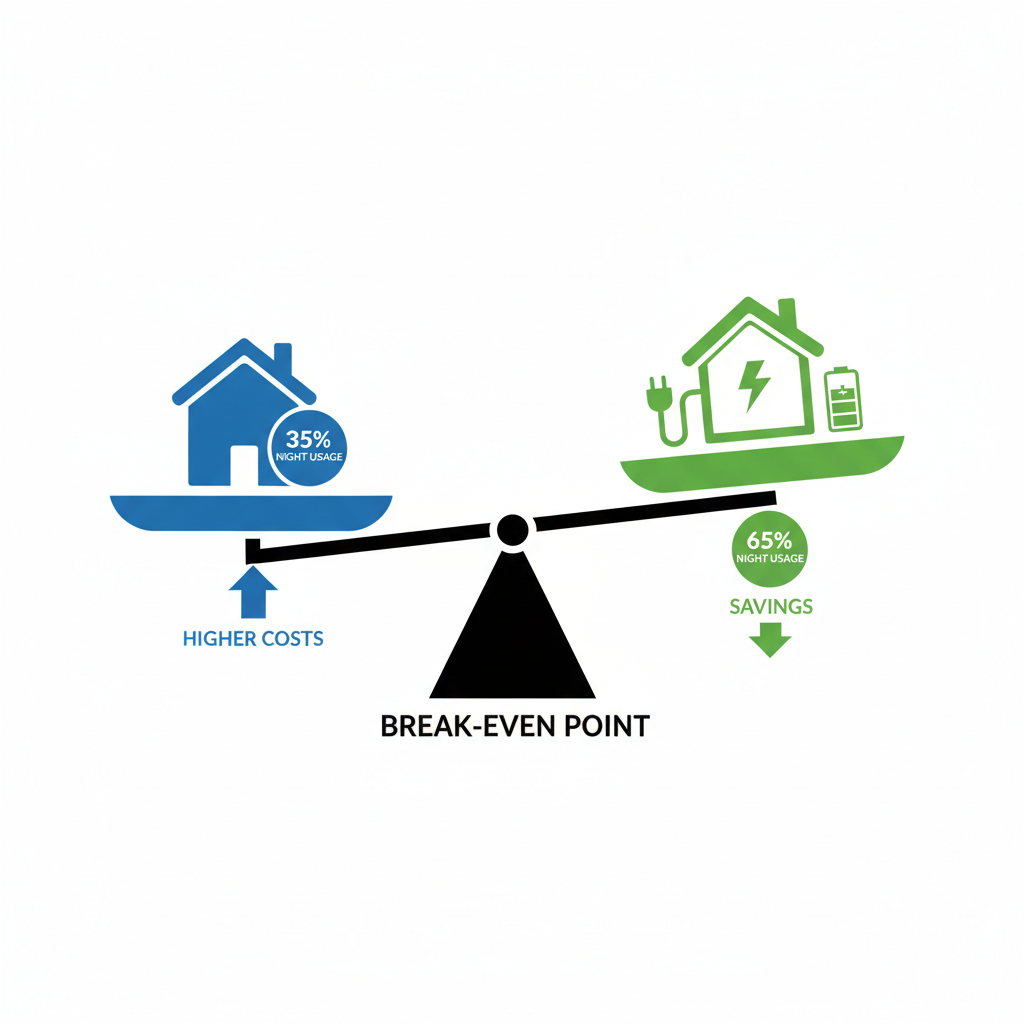
Is free nights electricity worth it? Here's what the numbers show for the average Texas home using 1,100 kWh per month, according to the U.S. Energy Information Administration:
| Night Usage | Free Nights Cost/Mo | Fixed-Rate Cost/Mo | Annual Difference |
|---|---|---|---|
| 35% (average) | $204 | $132 | +$858 more |
| 60% (optimized) | $149 | $132 | +$198 more |
| 65% | ~$132 | $132 | Break even |
| 75% (EV + battery) | $158 | $180 | -$270 savings |
The 65% rule: You need approximately 65% of your total electricity consumption during free hours to break even with the best free nights electricity plan in Texas. The average Texas household naturally uses only 33–35% at night — meaning most homes would need to nearly double their nighttime usage to benefit.
Check your own numbers first. Before signing up, download your 15-minute interval usage data from Smart Meter Texas to calculate your actual nighttime percentage.
Free electricity at night genuinely pays off for these specific households:
EV owners charge vehicles overnight when the energy cost drops to $0. With 90% of EV charging happening at home overnight, an EV owner charging 300 kWh monthly saves the full energy charge — though TDU delivery (~$17/month) still applies.
Battery storage owners unlock the biggest advantage. A home battery charges from the grid at $0 during free hours and discharges during expensive daytime peaks. This energy arbitrage approach effectively reduces all electricity to TDU-only costs (~5.5 cents/kWh). For details on system pricing, see our guide to the cost of battery storage per kWh.
Pool owners can shift pump operation (3,000–5,000 kWh/year) entirely to nighttime hours, saving 30–50% on pump electricity costs without any lifestyle changes.
The common thread: you need infrastructure (EV, battery, pool timer) plus intentional scheduling to make free electricity at night worthwhile.
If your household looks like the ones above, you can compare Ambit's Free & Clear Nights plan for your address before you decide.
Is free nights electricity worth it if you work from home? Probably not. The International Energy Agency reports that work-from-home arrangements increase household energy consumption 7–23%, with most of that increase during expensive daytime hours — the opposite of what free nights plans require.
Low-usage households (<800 kWh/month) lose money regardless of scheduling. With fewer total kWh, the savings from free nighttime energy cannot offset the premium daytime rates. At 500 kWh/month, expect to pay roughly $360/year more than a fixed-rate plan.
Families home during the day — with children, elderly family members, or caregivers — generate heavy daytime usage from HVAC, cooking, and electronics. Shifting enough usage to nighttime hours is unrealistic.
Renters without automation face limited options. Without smart plugs, programmable thermostats, or the ability to install battery storage, meaningful usage shifting requires manual effort that rarely sustains long-term.
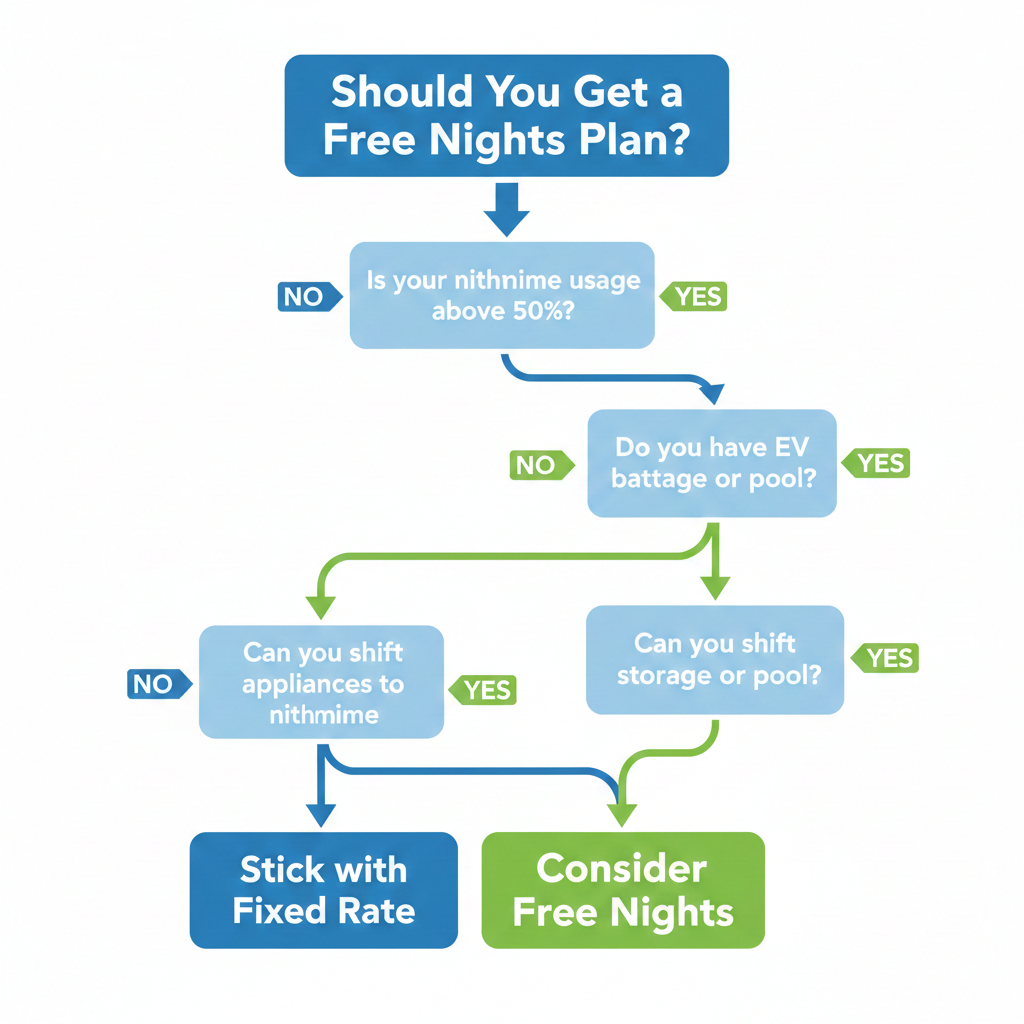
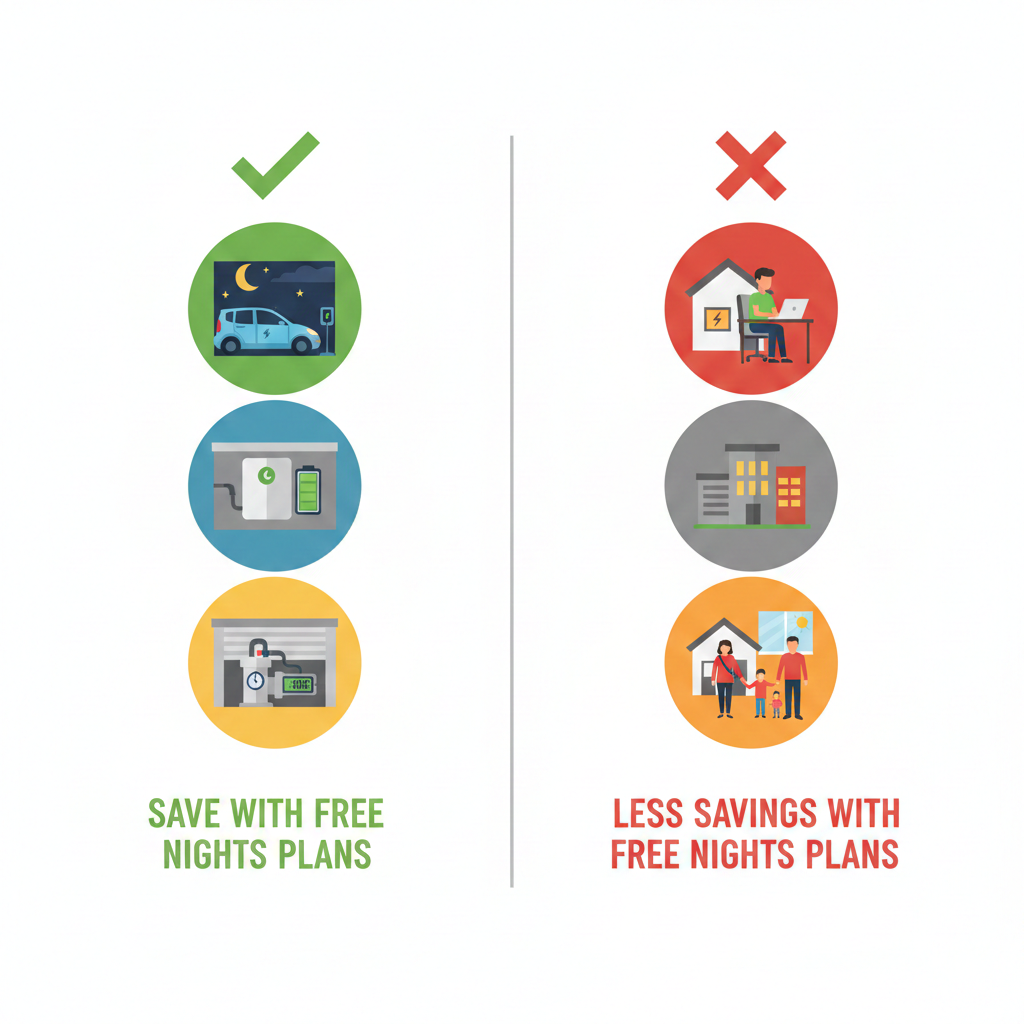
Before committing to the best free nights electricity plan in Texas:
Ready to find the right electricity plan for your home? Compare Ambit Energy rates and plans or explore no-deposit electricity plans if upfront costs are a concern.
Not Sure Which Plan Fits Your Home?
Get a personalized energy recommendation from Ambit Energy VIP Energy Service.
For the average Texas home using 1,100 kWh/month with typical 35% nighttime usage, a free nights plan costs approximately $204/month — about $72 more per month ($858/year more) than a comparable fixed-rate plan. The "free" nighttime energy comes with daytime rates of 18–32 cents/kWh, which is 2–3x higher than standard fixed-rate plans.
You need approximately 65% of your total electricity consumption during free hours to break even with a fixed-rate plan. The average Texas household naturally uses only 33–35% at night. To reach 65%, most homes require EV charging, battery storage, or significant appliance scheduling changes.
Yes — battery storage is the most effective way to make free nights plans profitable. A home battery charges from the grid at $0 during free nighttime hours and discharges during expensive daytime peaks, effectively reducing all energy costs to TDU delivery charges only (about 5.5–6.0 cents/kWh). For the average Texas home, battery arbitrage with a free nights plan can save $100+ per month compared to paying full daytime rates.
Sources:
EnergyBot |
Smart Meter Texas |
U.S. Energy Information Administration |
QuickElectricity
Rates and plans subject to change. Always review the Electricity Facts Label (EFL) before signing up. Rates vary by location, TDU service area, and usage level.




Copyright © 2026 VIPEnergyService.com. All rights reserved | PUCT# 10117