In Texas, plans that offer free nights electricity services charge no fees per kilowatt-hour for energy used at designated hours during the night, which range from 8 pm to 6 am. To compensate for this, they charge higher than average rates for electricity used during the day. Depending on the household, these plans could either save you hundreds of dollars or cost you hundreds. The key factor that determines this is how much energy you use during the night hours and how much energy you use during the day.
This guide is for Texans trying to figure out whether a free nights energy plan will save them money or quietly cost them more. We walk through how these plans work, who they actually fit, the hidden costs most marketing pages skip over, and how to evaluate any plan against your real usage pattern before you sign.
The free nights electricity plan is a time-of-use plan, which means you will pay nothing for electricity during specific daytime hours while also paying a premium for electricity during daytime hours. Your smart meter tracks and reports your energy (measured in kilowatt-hours or kWh) usage in 15-minute increments, and each time-of-use electricity retailer assigns you a different cost per kWh for each of those increments.
Let's break down the two pricing windows:
-
Free Window: From 8 or 9 pm to 5 or 6 am, you will pay $0.00 per kWh. Some plans do waive the transmission and distribution utility (TDU) delivery charge, while other plans do not.
-
Paid Window: During the rest of the day and evening, you will pay a cost per kWh that is much higher than what you would pay on a fixed-rate plan. On free nights plans, daytime cost ranges from 15 to 25 cents per kWh; whereas, a competitive fixed-rate offer costs 8 to 12 cents per kWh.
Your monthly cost will equal (the number of kWh used during the paid-window multiplied by the paid energy rate) plus the TDU delivery charges plus a monthly base fee plus taxes. Free-window kWh do not contribute to the energy charge, while still potentially incurring TDU delivery charges depending on the plan.
The mechanics of free nights plans are simple; however, the economics can be more complex. As long as you are able to decrease your usage during peak hours, you will ultimately save more money with this plan.
Time Slots for Free Hours are Different for Each Provider
Texas retail electric providers have different free hour windows, base fees and how they treat TDUs. Here is how the major free nights plans looked like in 2026:
| Plan | Free Window | Hours/Night | TDU Waived at Night |
|---|---|---|---|
| TXU Free Nights & Solar Days 12 | 8pm to 5am | 9 | Yes |
| Reliant Truly Free Nights 12 | 8pm to 6am | 10 | Yes |
| Direct Energy Twelve Hour Power | 9pm to 9am | 12 | Yes |
| Chariot Free Nights | 11pm to 6am | 7 | No |
| Pulse Power Free Energy Nights 12 | 8pm to 6am | 10 | Yes |
Source: ElectricityPlans free nights comparison chart and Texas Electricity Ratings Dallas overview.
When reading an Electricity Facts Label (EFL), there are three numbers that matter most: the free hour window, the daytime energy rate, and the percent of usage assumed in the average price against (typically around 30-50%). If your actual usage during the free window is less than what the EFL states, your average rate is going to be higher than the given number on PowerToChoose.
Who Benefits from Free Nights Electricity Plan
To be frank, not many Texan households as the marketing claims. Free nights electricity plans suit households with certain usage patterns, and we have done the math for five scenarios.
1. Owners Of Electric Vehicles Who Charge Their Cars At Night
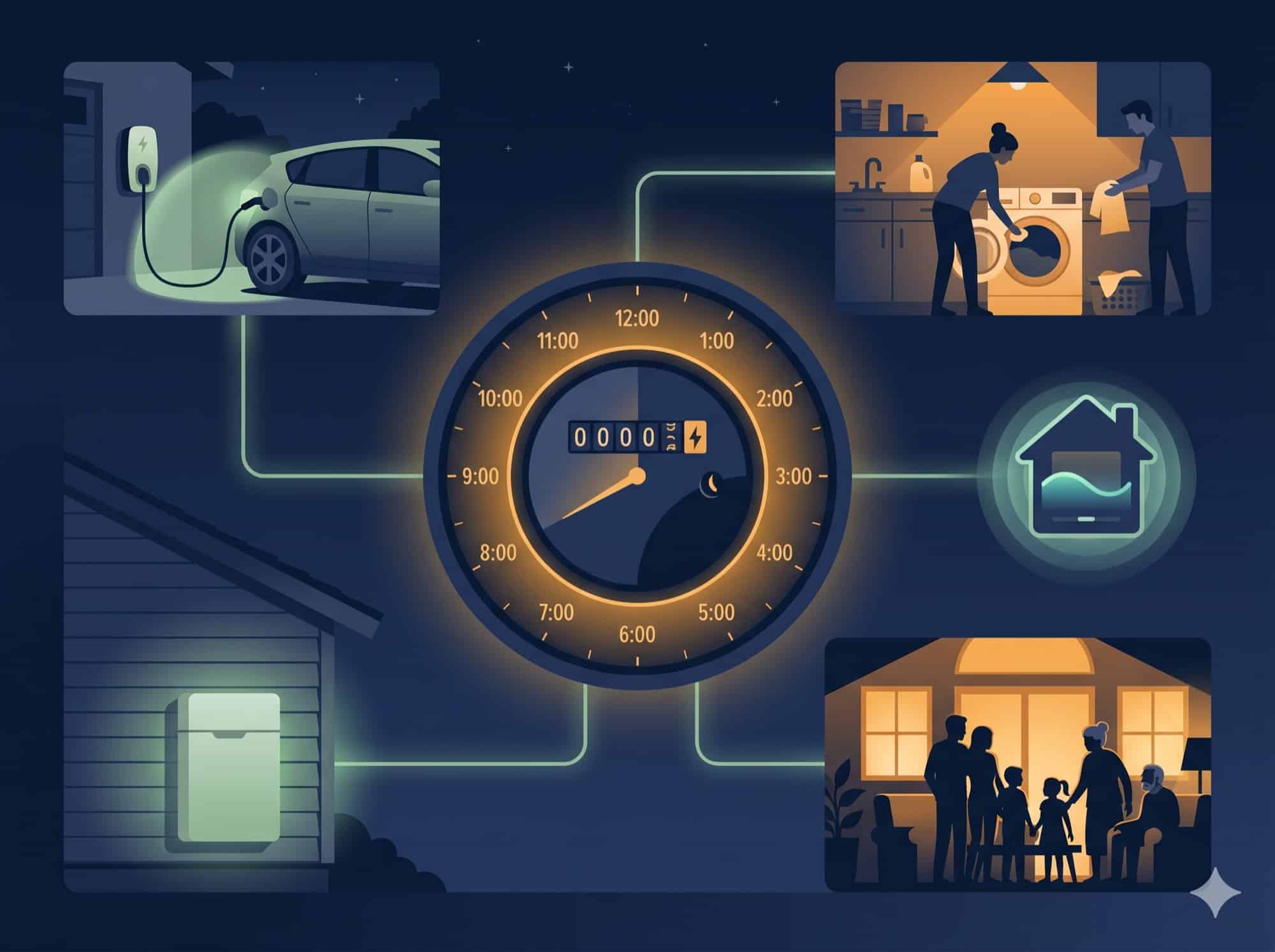
One of the major residential electrical needs is EV charging, though it is relatively simple to schedule. If a Tesla Model Y is added to an average house in Houston or Dallas, it can shift 50 to 70% of total energy usage to the overnight charging window of 9pm to 6am. This aligns perfectly with the usage pattern that free nights plans are based on.
2. Workers on Night Shifts and Folks Who Sleep at Night
If your household uses power between 8pm and 6am, and is awake at that time, then you have the advantage. Everything from laundry to cooking, entertainment, and even air conditioning ends up being billable during the day, but in the free zone at night.
3. Users of Smart Home Automation
By setting a limit to when your home starts cooling, it can be done from 3am to 6am (a time when power is free), and then you can avoid any additional costs by not cooling it during the expensive hours. This shifts a significant amount of your cooling load into the free window without sacrificing comfort. Smart plugs for the dishwasher, washer, dryer, and pool pump can help to turn a frame filler into a profitable unit, even when it seemed like a bad fit.
4. Large Households Open to Rescheduling
Households who spend between 1,800 to 2,500 kWh/month can save several hundreds of dollars if they are able to shift laundry loads, dishwashing, and any other deferrable loads to the free time window. The more energy used, the greater the savings as energy used during the day is more expensive.
5. Homes With Storage Batteries
Residential battery systems can shift an additional 20% to 30% of daily energy usage from the expensive daytime hours to the free time window. While there’s a 10% to 15% loss in round-trip efficiency, the savings can be significant when combined with any behavioral shifts.
Who Will Lose Money on a Free Nights Plan
For households that can’t shift their usage, the same product becomes more expensive. We don’t recommend free nights energy plans for the following profiles:
Work-from-home families. If computers, lights, an air conditioner, and even a kitchen are running during business hours, the high daytime rate cancels out any savings from the free time windows. If kids are home during the day, the situation becomes even worse.
Standard retirees. A retiree who is home all day with the thermostat set comfortably will use most of their energy during expensive hours. Unless they are willing to be active during the night and pre-cool the house, fixed-rate plans will be less expensive.
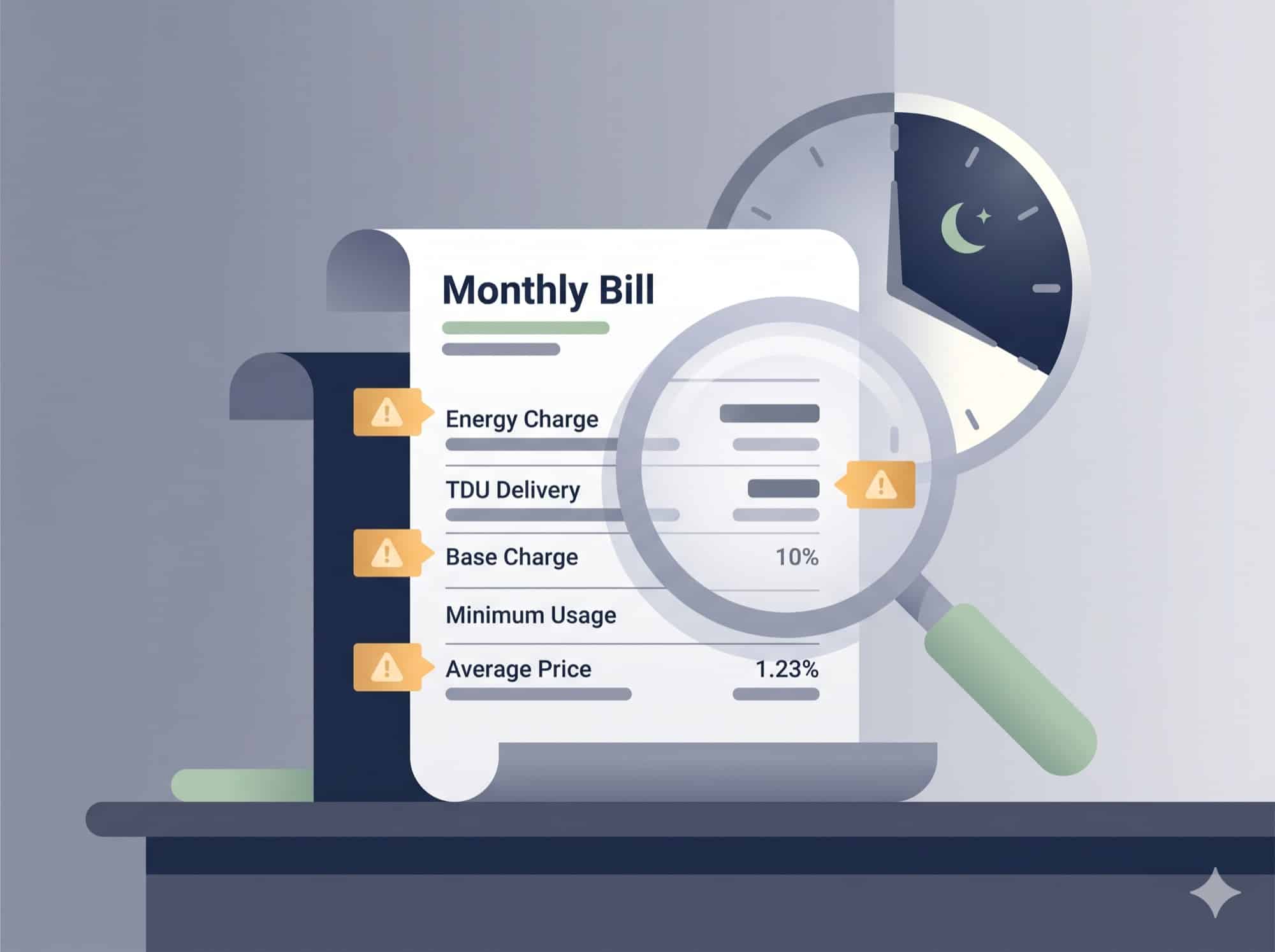
Households with low usage below 800 kWh monthly. Base charges (typically $9.95 per month) and minimum usage fees penalize low usage customers. The savings during the free hours are too small to offset the fixed charges.
People with permanent behavior. A free nights plan incentivizes positive change. If your washing machine is going off at 4 pm on a Saturday, a fixed-rate plan is the way to go.
The Hidden Costs Most Marketing Pages Skip
Five frequent ways a free nights energy plan ends up costing more than the advertised rate:
-
Higher daytime prices. Most free nights plans have daytime prices of 18 to 25 cents per kWh. In contrast, day rates on fixed-rate plans are 8 to 12 cents. If you only manage to shift 30% of your usage to the free hours, the daytime price will more than offset any savings you may have. The Energy Ogre analysis details this.
-
TDU delivery charges during “free” hours. Most plans only waive the energy part. The TDU (Oncor in DFW, CenterPoint in Houston, TNMP in the Rio Grande Valley, AEP in Corpus Christi) still charges 4 to 7 cents per kWh of delivery plus a fixed monthly charge. “Free” is not zero on your bill. This is directly confirmed in BKV Energy’s free nights explainer.
-
Charge that baseline survive everything. On plans where the free window literally costs you zero dollars per kWh, the monthly base charge of $9.95 is still owed. If your usage is low, that base charge can increase your effective rate significantly.
-
Minimum usage charge. Some free nights plans add a charge if you total monthly usage drops below a certain point, like 1,000 kWh. Customers who decrease daytime usage enough can cause these charges and lose a large portion of their savings back.
-
EFL average prices that consider aggressive free-window usage. The average price per kWh shown on PowerToChoose and the EFL is based on an assumed free-window usage rate between 35 and 50 percent. If your actual usage is lower than that, your bill will be higher than the average price.
The Public Utility Commission of Texas (PUCT) accepts consumer complaints about misleading marketing, billing issues, and charges consumers did not expect. You can check a provider’s complaint rate on the PUCT consumer complaint portal before signing up, as it shows the number of complaints by retail electric providers.
Break-Even Math: When Do Free Nights Plans Make Sense?
When deciding whether a free nights plan makes sense for you, the first step is determining your share of nights (%) and comparing it to our break-even night-share % for the plan. We’ll show the break-even calculations for TXU and Pulse Power-style plans.
-
For TXU-style plans (20c/kWh daytime + 0c/kWh nighttime + $9.95 base): break-even occurs when > 43% of your total kWh used are in the free window, while the plan is competitive with a 12c fixed rate offer.
-
For Pulse Power-style plans (15c/kWh daytime + no base): break-even is at 30% night-share for your free nights.
We’ll use real-life examples to clarify:
EV household, 1,500 kWh/month, 55% night usage:
-
TXU-style free nights: ~$1,739/year (savings of ~$420)
-
Pulse-style free nights: ~$1,710/year (savings of ~$450)
-
12-cent fixed plan: $2,160/year
Work-from-home family, 1,200 kWh/month, 30% night usage:
-
TXU-style free nights: ~$2,135/year (costs more ~$407)
-
Pulse-style free nights: at break-even
-
12-cent fixed plan: $1,728/year
While it is not a pleasant conclusion to draw, if you are on a true free nights plan and your night usage is less than 43%, you are likely better off with a fixed-rate plan.
Checking Your Household Fit
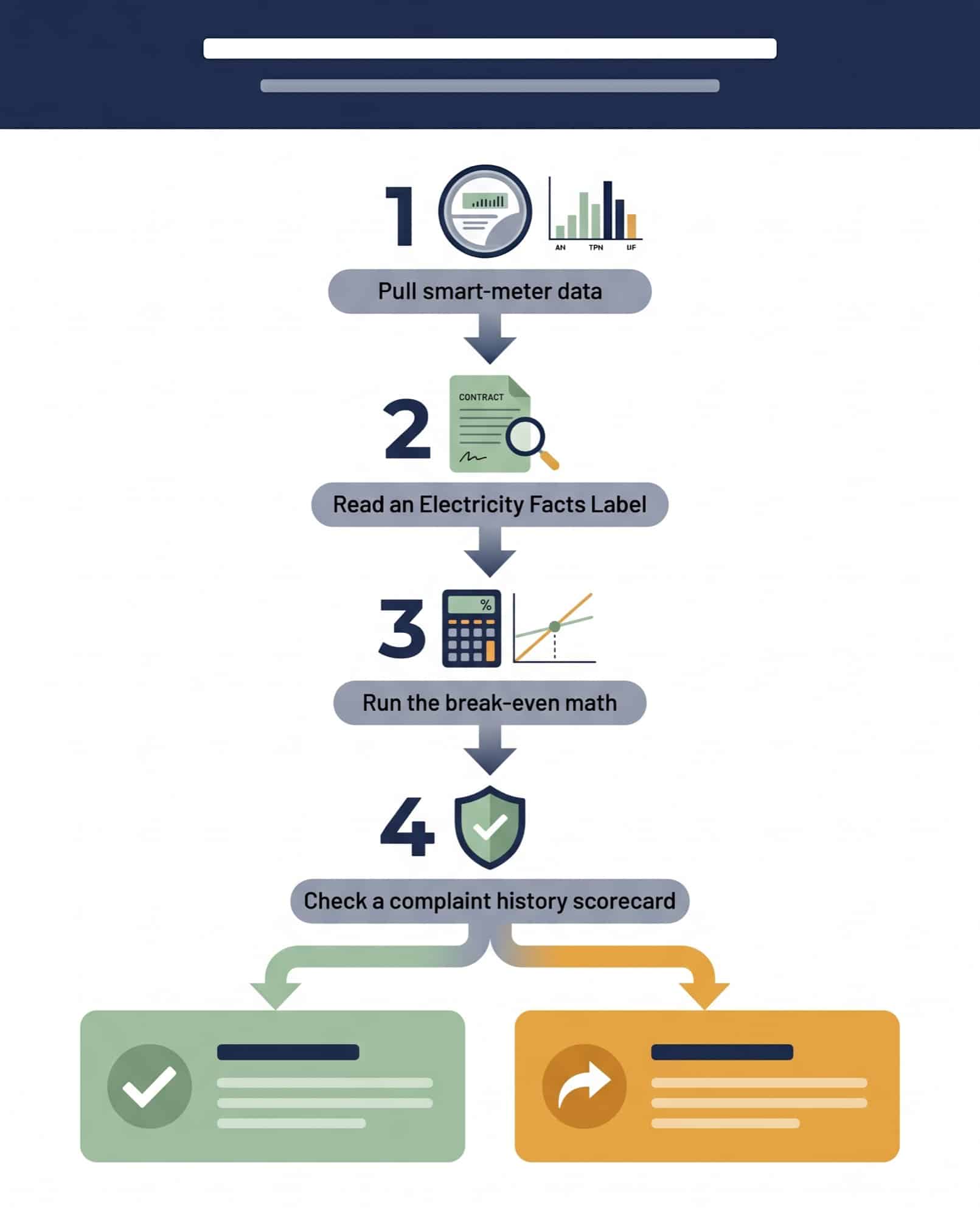
Here is a four step process you can use to check if you qualify for a specific free nights electricity plan.
Step 1: Smart meter data. Most customers in Texas can access 15 minute interval data from Smart Meter Texas (smartmetertexas.com). This data shows usage for the last 6 months to 12 months. Determine the percent of total kWh usage that is captured between 8pm and 6am (whenever the plan is).
Step 2: EFL fine print. Get a copy of the EFL and read it closely. Check to see if the daytime energy rate is confirmed, the exact free hour time windows are listed, if free hours are listed as TDU delivery, the monthly base charge is listed, if there is a minimum usage charge, and if the average price calculation has free window % assumed.
Step 3: Real usage pattern comparisons. Estimate your average monthly kWh usage. Divide it by the actual percentage of night share and multiply that against the daytime rate plus TDU. Add base charges to that number. If you are attempting to compare this to a fixed-rate plan (12 to 13 cent) know that if the numbers from this plan do not come out lower than the free nights plan then the fixed-rate plan is a better/simpler option.
Step 4: Provider complaint checks. Providers with higher complaint scores in relation to their customer base should be avoided. Check the complaint scorecard offered by PUCT for this data.
Where VIP Energy Service Fits
VIP Energy Service is an authorized independent consultant for Ambit Energy in Texas. Ambit Energy (PUCT REP #10117) is the licensed retail electric provider that supplies your power and handles billing. We help Texas customers compare Ambit's plan options, enroll efficiently, and understand the trade-offs before signing a contract.
Ambit Energy offers a time-of-use option called Free & Clear Nights, a fixed-rate plan built for night owls, EV owners, and any household that can naturally shift a significant share of usage into the overnight window. The plan provides zero cents per kWh during the defined free hours and a competitive fixed rate for the rest of the day.
If you are weighing Free & Clear Nights against a standard Ambit fixed-rate plan, we recommend the same exercise we walked through above: pull your smart meter data, calculate your real night-share percentage, and run the break-even math. We are happy to help you work through that calculation directly. We would rather steer you to a fixed-rate plan that saves you money than enroll you in a free nights plan you will regret in three months.
Conclusion Regarding Free Nights Electricity Plans
A fixed-rate plan is not necessarily better or worse than a free nights electricity plan. They both operate on what are called time-of-use strategies, and these strategies only work if about 40% of your kilowatt hours (kWh) can be shifted into that free time window. EV owners who charge their cars at night, night-shift workers, users of smart-home technology, large families where members are willing to reschedule some of their activities to defer electricity usage, and homes that use battery storage are able to take full advantage of these plans. Conversely, work-at-home families, retirees, and individuals who use electricity infrequently will typically be at a disadvantage.
The math behind time-of-use strategies are not catchy slogans meant for advertising, rather, they require detail-oriented spreadsheets and are directly related to your pattern of use, your postal code, your Transmission and Distribution Utility (TDU), and the specific Electricity Fact Label (EFL) of the plan you are considering. When done correctly, free nights energy plans can allow a household that matches well $400 to $500 worth of savings each year. However, if done incorrectly, free nights plans will cost you $300 to $400 more than fixed-rate plans.
If you would like help running the math against your actual usage, contact VIP Energy Service and we will walk through the calculation with you before you sign anything. For more on the broader landscape of free time-of-use products across the ERCOT deregulated market, our companion Free Nights Electricity Plans in Texas pillar covers it in detail.
About VIP Energy Service
VIP Energy Service is an authorized independent consultant for Ambit Energy (PUCT REP #10117). We serve Texas residents in the deregulated ERCOT market, including Houston, Dallas-Fort Worth, Corpus Christi, the Rio Grande Valley, and Lubbock. We do not serve Austin (Austin Energy) or San Antonio (CPS Energy) because those markets are municipal and not part of the deregulated REP system.
Hero photo by Jeff Le on Unsplash
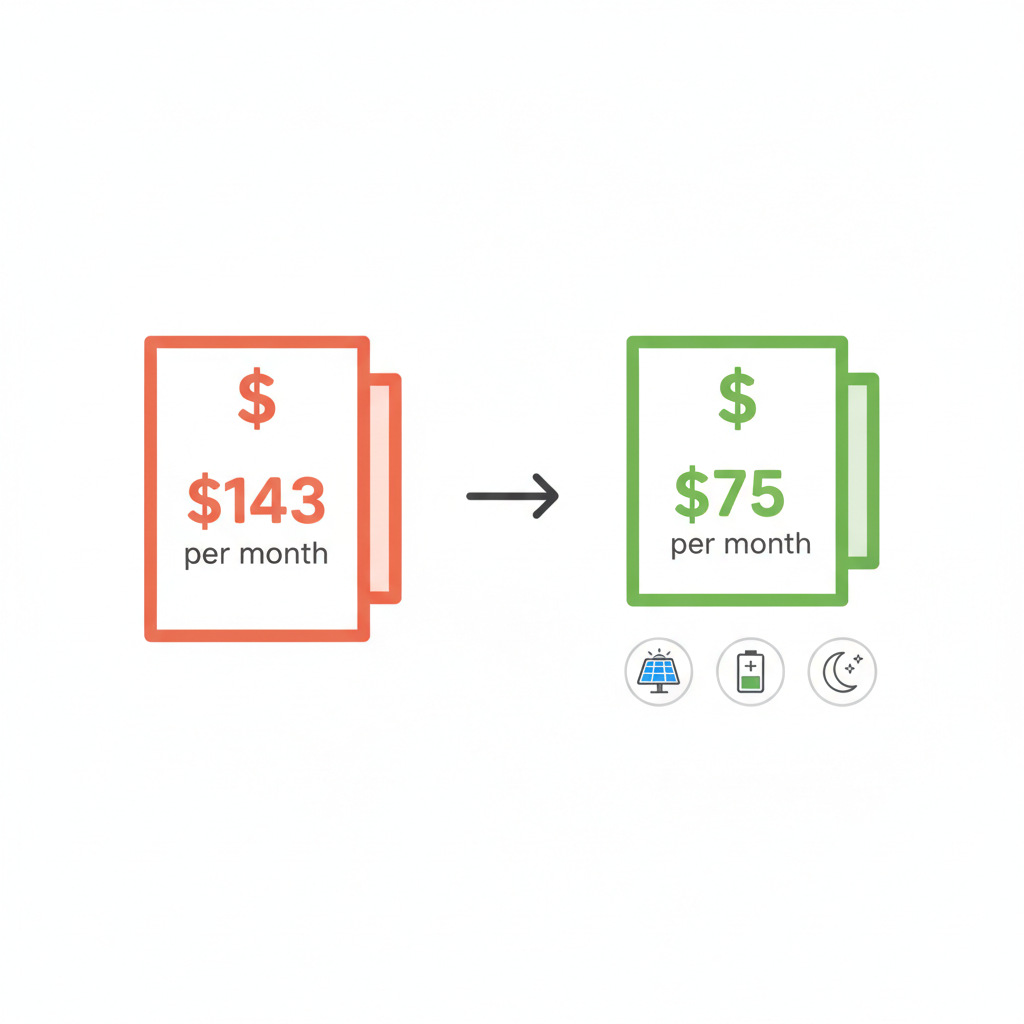
Combining solar panels, battery storage, and a free nights electricity plan creates a 24-hour energy strategy that can cut Texas electricity costs from ~$143/month to as low as $71–$82/month, saving approximately $732–$864 per year. Solar covers daytime usage, the battery bridges peak evening hours, and the free nights plan eliminates overnight energy charges. Total system cost: $32,000–$40,500 before incentives (Oncor rebate up to $9,000 available).
What if your solar panels, home battery, and electricity plan all worked together around the clock? That's the idea behind the Texas triple play — combining solar electricity plans with home battery storage in Texas alongside a free nights plan to slash your electricity costs from every angle. For the average Texas home, this strategy can cut monthly bills from ~$143 to as low as $71–$82, saving $732–$864 per year. Here's how each layer works together, what it costs in 2026, and whether it makes sense for your home. For background on free nights plans, see our guide to free nights electricity plans in Texas.
How the Triple Play Works
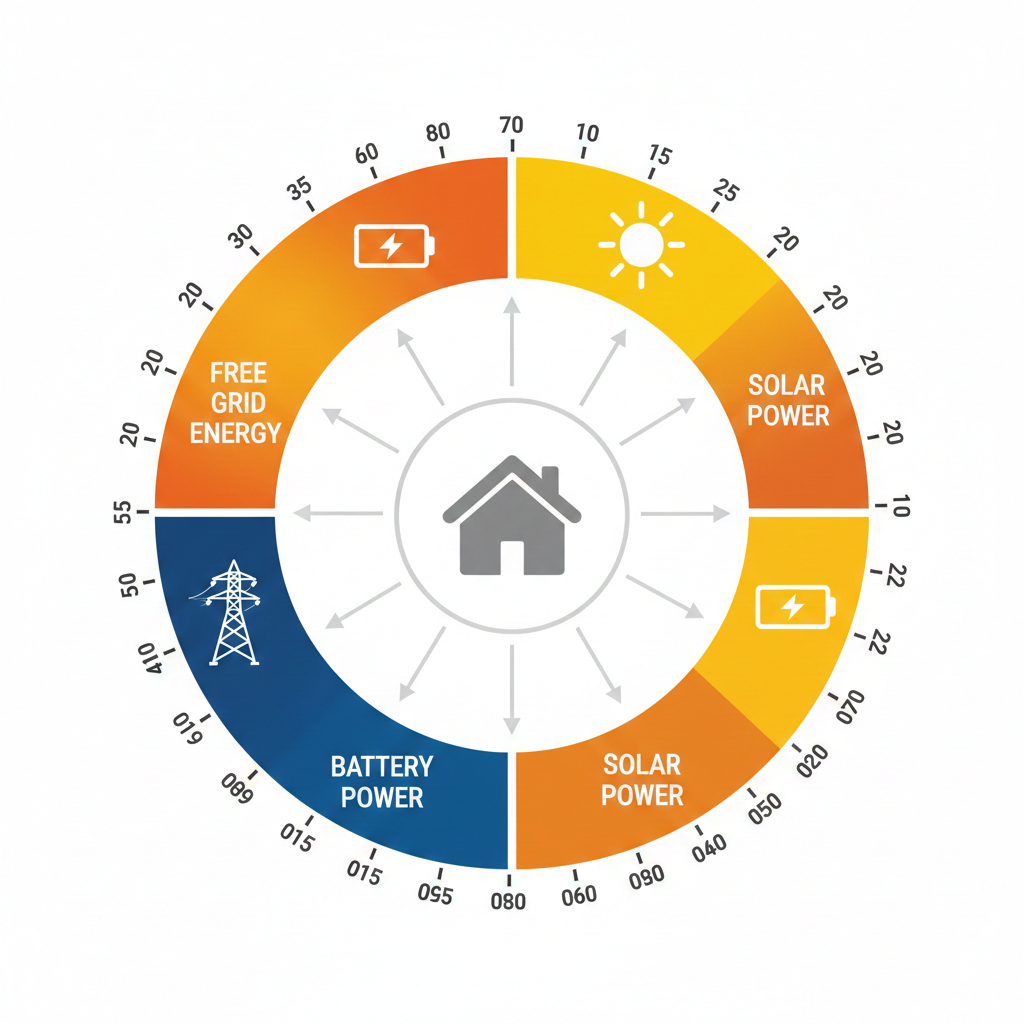
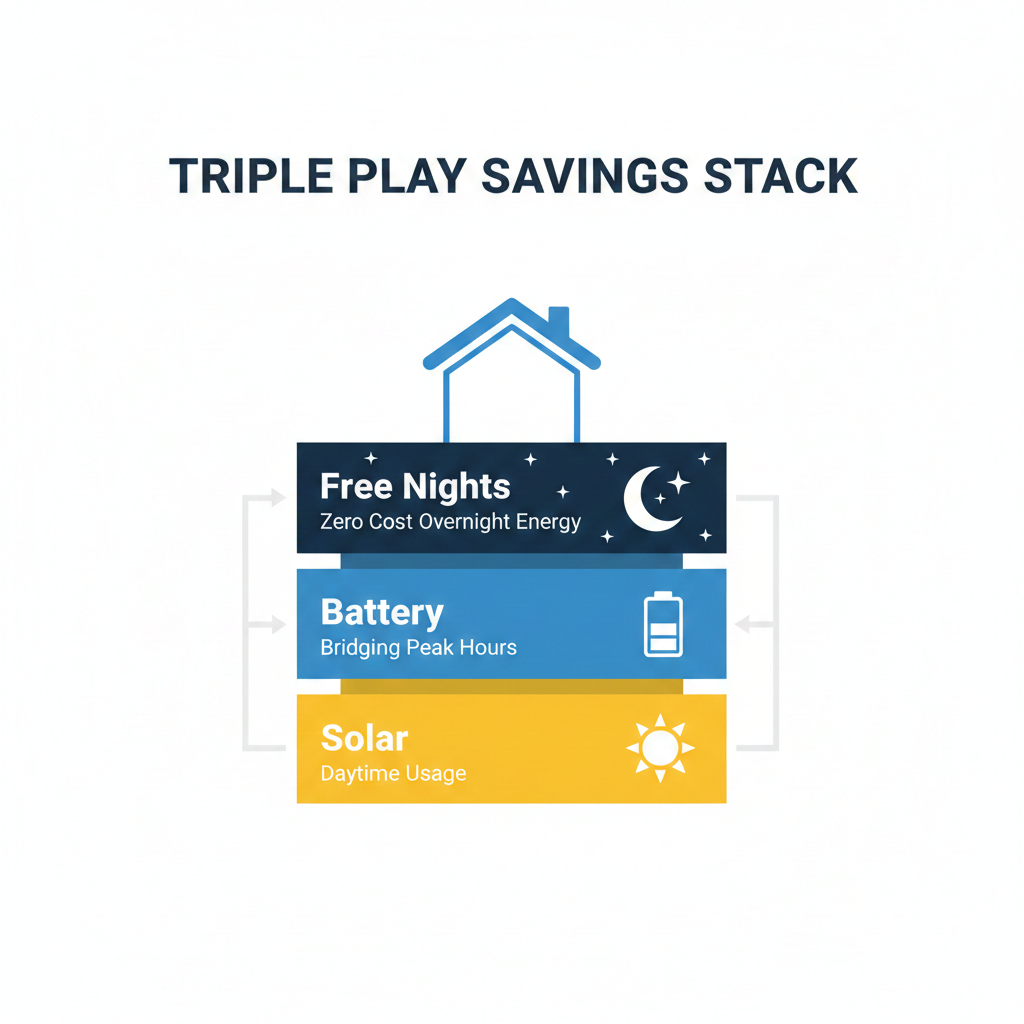
The triple play creates a 24-hour energy cycle where you rarely pay full price for electricity:
| Time Window | Power Source | Cost |
|---|---|---|
| 9 PM – 6 AM | Free grid electricity | $0 energy (TDU only ~5.58¢) |
| 6 AM – 9 AM | Battery discharge | $0 (charged overnight for free) |
| 9 AM – 5 PM | Solar panels | $0 (self-generated) |
| 5 PM – 9 PM | Battery discharge | $0 (charged by solar during the day) |
Each layer covers the others' weaknesses. Solar alone can't help at night — but the free nights plan and battery handle that. A free nights plan alone has expensive daytime rates (21.9¢/kWh) — but solar and battery eliminate most daytime grid purchases. A battery alone is expensive to charge from the grid — but solar and free nights provide zero-cost energy to charge it.
The result: your home draws from the grid primarily during free hours, and your battery bridges the gaps. According to Good Faith Energy, Texas solar-battery owners can configure time-based controls on systems like Tesla Powerwall and FranklinWH to automate this daily cycle.
The 3-Layer Savings Stack
Here's how each layer contributes to home battery storage electricity bills savings for the average Texas home (1,100 kWh/month):
Layer 1 — Solar generation: An 8 kW system in Texas generates approximately 1,200 kWh/month, according to EnergySage. That's enough to cover most or all daytime consumption — eliminating the 21.9¢/kWh daytime energy charge.
Layer 2 — Battery arbitrage: Your battery charges for free during nighttime hours and discharges during the expensive 6 AM–9 AM and 5 PM–9 PM windows. This captures value from the price gap between $0 nighttime energy and 21.9¢/kWh daytime rates.
Layer 3 — Free nights plan: Overnight usage (battery charging, appliances, HVAC) costs $0 in energy charges. You only pay TDU delivery at ~5.58¢/kWh, according to QuickElectricity.
Combined monthly estimate:
| Component | Fixed-Rate (13¢/kWh) | Triple Play |
|---|---|---|
| Daytime energy | $93 | $0–$11 |
| Nighttime energy | $50 | $0 (free plan) |
| TDU delivery | Included | $61 |
| Base charge | $0 | $9.95 |
| Monthly total | ~$143 | ~$71–$82 |
| Annual savings | — | ~$732–$864 |
Real-world results back this up: Texas homeowners on DIY Solar Forum report achieving near-zero electricity bills with solar + battery + free nights configurations, with one user paying just $77 total over six months.
What the System Costs in 2026
Transparency matters here. An 8 kW solar array in Texas costs $20,000–$24,000 before incentives, and a 13.5 kWh Tesla Powerwall 3 runs $12,000–$16,500 installed, according to SolarReviews. Total system cost: approximately $32,000–$40,500.
Important for 2026 buyers: The federal 30% Residential Clean Energy Credit expired December 31, 2025. This increases out-of-pocket costs compared to previous years. However, key incentives remain:
- Oncor rebate: Up to $9,000 for solar + battery installations in the DFW service area, according to QuickElectricity
- Third-party ownership (TPO): Solar leases and PPAs still qualify for the federal tax credit through 2027 — you get the benefits without the upfront cost
- Battery cost trends: Lithium battery costs are declining 8–12% per year, with prices projected to reach $550–$850/kWh by late 2026, according to Native Solar
For current battery pricing, see our cost of battery storage per kWh guide. To understand how solar and battery systems work together, we have a dedicated explainer.
Why Ambit's Free & Clear Nights Fits This Strategy
Ambit Energy's Free & Clear Nights plan is built for solar electricity plans with home battery storage in Texas:
- 9 PM – 5:59 AM free window — 9 hours of $0 energy for battery charging and overnight usage
- 100% wind-powered — your nighttime grid electricity comes from renewable sources, complementing your solar investment
- TLC Pledge — Ambit gives you 60 days to test the plan. If it doesn't fit, switch to any other Ambit plan at no cost. No early termination fee during the trial period
- TDU delivery charges still apply (~5.58¢/kWh in Oncor territory), but the energy charge — typically the largest line item — is eliminated during free hours
For solar buyback plans with free nights, Ambit also offers 1:1 solar buyback on other plans if you decide to sell excess generation back to the grid instead.
Is the Triple Play Right for Your Home?
The triple play makes the most sense if you:
- Own your home (roof access for solar, ability to install battery)
- Use 1,000+ kWh/month (higher usage = more savings to capture)
- Live in Oncor or CenterPoint territory (TDU rebates and competitive delivery rates)
- Plan to stay 7+ years (allows the system to pay for itself)
Not sure where you stand? Check your nighttime usage percentage at Smart Meter Texas, then compare Ambit Energy rates and plans to see which free nights option fits your home.
Ready to Build Your Triple Play System?
Get a personalized solar + battery + free nights recommendation from Ambit Energy VIP Energy Service.
Frequently Asked Questions
How much can I save with solar + battery + free nights in Texas?
The average Texas home (1,100 kWh/month) can save approximately $732–$864 per year with the triple play strategy compared to a standard fixed-rate plan. Your actual savings depend on solar system size, battery capacity, daytime consumption patterns, and your TDU service area.
Did the federal solar tax credit expire?
The 30% Residential Clean Energy Credit (Section 25D) for customer-owned systems expired December 31, 2025. However, third-party-owned systems (solar leases and PPAs) remain eligible through 2027. The Oncor residential solar program also offers up to $9,000 in rebates for qualifying solar + battery installations.
Can I add battery storage to my existing solar system?
Yes — battery storage can be retrofitted to most existing solar installations. A 13.5 kWh battery like the Tesla Powerwall 3 costs $12,000–$16,500 installed and can be configured to work with free nights plans using time-based charging controls. Battery costs are declining 8–12% per year, making 2026 pricing more accessible than previous years for the battery component.
Sources:
EnergySage |
SolarReviews |
QuickElectricity |
Native Solar |
Good Faith Energy
Rates and plans subject to change. Always review the Electricity Facts Label (EFL) before signing up. System costs and savings estimates are approximate and vary by location, installer, and usage patterns.
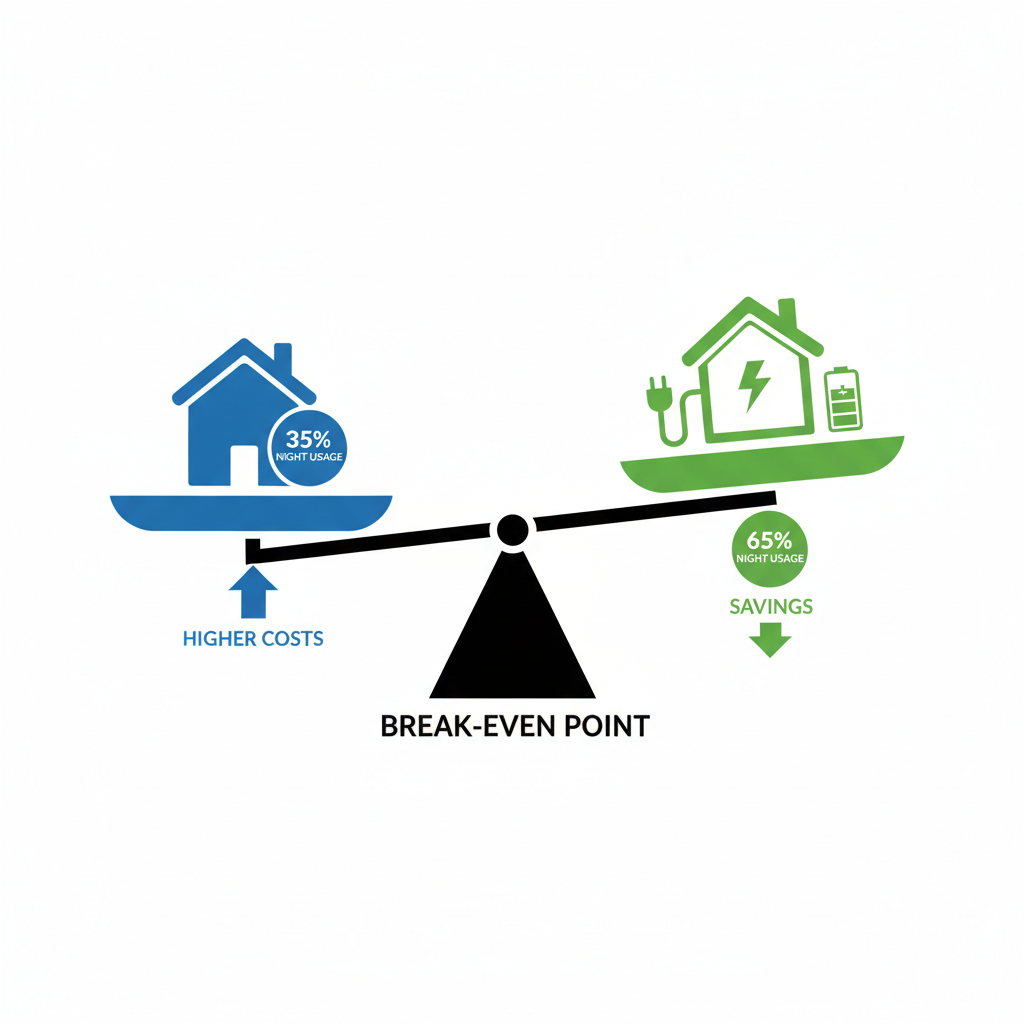
Are free nights electricity plans worth it? For most Texas homes, no. A study of 501 consumers found free nights plans cost 30% more ($1,435/year) than fixed-rate plans. The break-even threshold requires shifting 65% of usage to free hours — but the average Texas home naturally uses only 33–35% at night. Free nights plans are worth it only for EV owners, battery storage owners, or households that can genuinely shift the majority of consumption to nighttime hours.
Are free nights electricity plans worth it for your Texas home? The short answer: for the average household, the best free nights electricity plan in Texas still costs more than a standard fixed-rate plan. A study of 501 Texas consumers found that free nights plans cost 30% more ($1,435/year) than traditional plans. But the math changes completely if you can shift 65% or more of your usage to free hours — especially with battery storage. Here's our data-driven breakdown of who saves and who doesn't with free nights electricity plans in Texas.
What "Free" Really Costs
Free electricity at night sounds like a great deal — until you look at the full bill. "Free" means the energy charge drops to $0 during nighttime hours (typically 9 PM to 6 AM). But two costs remain:
TDU delivery charges apply 24/7. Your local utility (Oncor, CenterPoint, AEP) charges 5.58–6.00 cents per kWh for delivery regardless of when you use electricity. At 400 kWh of nighttime usage, that's still $22–$24/month during "free" hours, according to QuickElectricity.
Daytime rates jump 2–3x higher. To offset the free hours, providers charge 18–32 cents per kWh during the day — compared to 8.8–12 cents on a standard fixed-rate plan. A study by EnergyBot found that 50% of Texas consumers chose free nights plans thinking they'd save money, yet 87% ended up not selecting the least expensive option available.
The Electricity Facts Label (EFL) can be misleading: providers assume 35–50% nighttime usage when calculating the "average" rate shown on the label. If your actual nighttime usage is lower, your effective rate is higher than advertised.
The Break-Even Math
Is free nights electricity worth it? Here's what the numbers show for the average Texas home using 1,100 kWh per month, according to the U.S. Energy Information Administration:
| Night Usage | Free Nights Cost/Mo | Fixed-Rate Cost/Mo | Annual Difference |
|---|---|---|---|
| 35% (average) | $204 | $132 | +$858 more |
| 60% (optimized) | $149 | $132 | +$198 more |
| 65% | ~$132 | $132 | Break even |
| 75% (EV + battery) | $158 | $180 | -$270 savings |
The 65% rule: You need approximately 65% of your total electricity consumption during free hours to break even with the best free nights electricity plan in Texas. The average Texas household naturally uses only 33–35% at night — meaning most homes would need to nearly double their nighttime usage to benefit.
Check your own numbers first. Before signing up, download your 15-minute interval usage data from Smart Meter Texas to calculate your actual nighttime percentage.
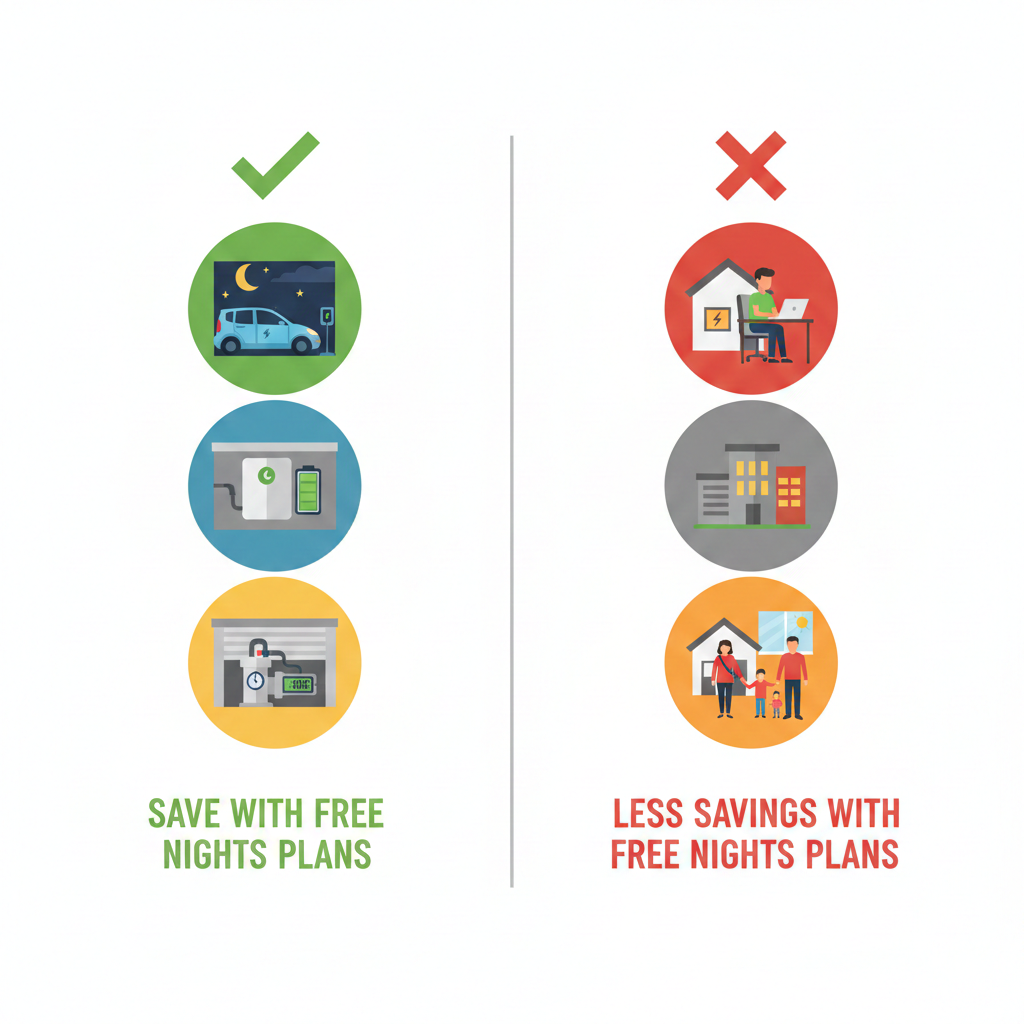
Who Actually Saves with Free Nights Plans
Free electricity at night genuinely pays off for these specific households:
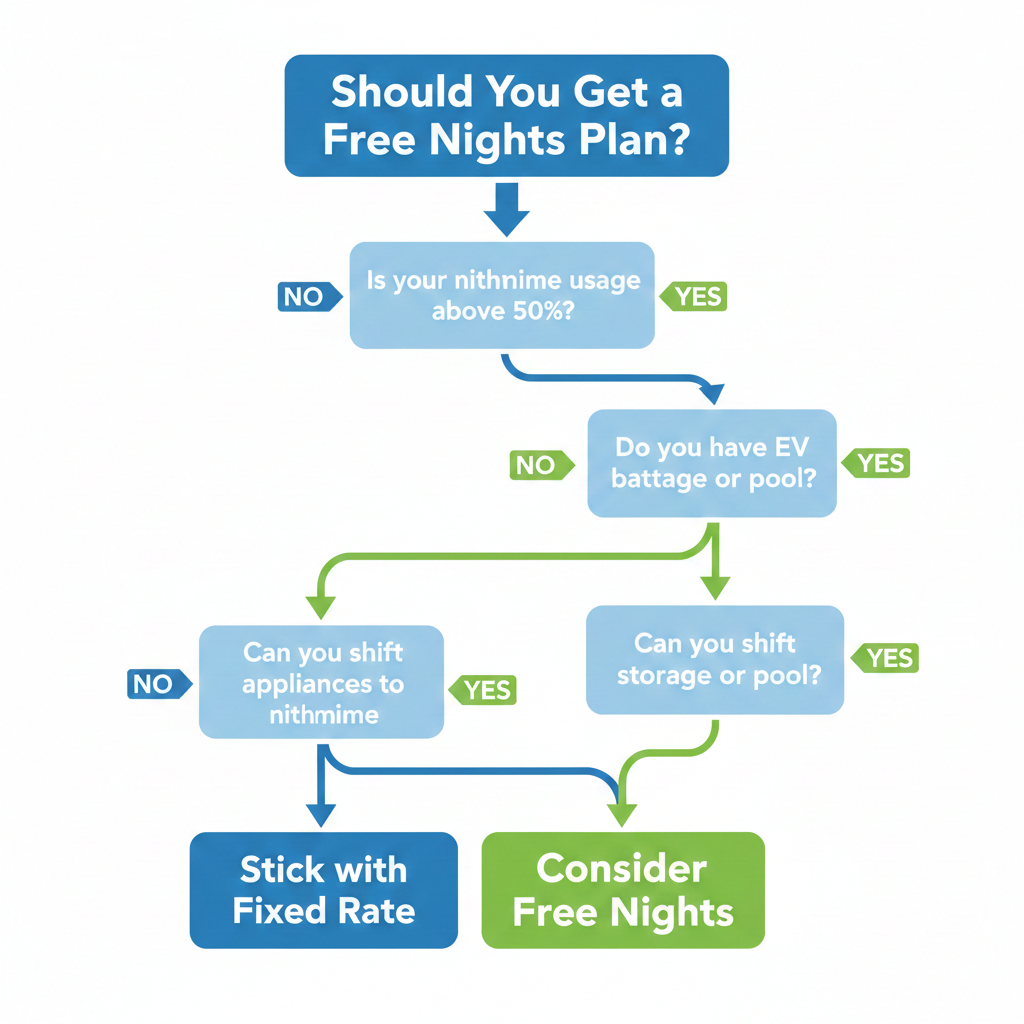
EV owners charge vehicles overnight when the energy cost drops to $0. With 90% of EV charging happening at home overnight, an EV owner charging 300 kWh monthly saves the full energy charge — though TDU delivery (~$17/month) still applies.
Battery storage owners unlock the biggest advantage. A home battery charges from the grid at $0 during free hours and discharges during expensive daytime peaks. This energy arbitrage approach effectively reduces all electricity to TDU-only costs (~5.5 cents/kWh). For details on system pricing, see our guide to the cost of battery storage per kWh.
Pool owners can shift pump operation (3,000–5,000 kWh/year) entirely to nighttime hours, saving 30–50% on pump electricity costs without any lifestyle changes.
The common thread: you need infrastructure (EV, battery, pool timer) plus intentional scheduling to make free electricity at night worthwhile.
Who Should Skip Free Nights Plans
Is free nights electricity worth it if you work from home? Probably not. The International Energy Agency reports that work-from-home arrangements increase household energy consumption 7–23%, with most of that increase during expensive daytime hours — the opposite of what free nights plans require.
Low-usage households (<800 kWh/month) lose money regardless of scheduling. With fewer total kWh, the savings from free nighttime energy cannot offset the premium daytime rates. At 500 kWh/month, expect to pay roughly $360/year more than a fixed-rate plan.
Families home during the day — with children, elderly family members, or caregivers — generate heavy daytime usage from HVAC, cooking, and electronics. Shifting enough usage to nighttime hours is unrealistic.
Renters without automation face limited options. Without smart plugs, programmable thermostats, or the ability to install battery storage, meaningful usage shifting requires manual effort that rarely sustains long-term.
How to Know Before You Sign Up
Before committing to the best free nights electricity plan in Texas:
- Check your actual nighttime usage at Smart Meter Texas — if it's below 50%, free nights plans will cost you more
- Compare fixed-rate alternatives — plans starting at 8.8–12 cents/kWh are widely available for Texas homeowners
- Read the Electricity Facts Label (EFL) carefully — compare the 1,000 kWh rate, not the advertised average
- Consider Ambit's TLC Pledge — Ambit Energy's 60-day pledge lets you switch to any other Ambit plan at no cost if free nights doesn't fit your lifestyle, giving you a risk-free trial period
Ready to find the right electricity plan for your home? Compare Ambit Energy rates and plans or explore no-deposit electricity plans if upfront costs are a concern.
Not Sure Which Plan Fits Your Home?
Get a personalized energy recommendation from Ambit Energy VIP Energy Service.
Frequently Asked Questions
How much do free nights electricity plans really cost?
For the average Texas home using 1,100 kWh/month with typical 35% nighttime usage, a free nights plan costs approximately $204/month — about $72 more per month ($858/year more) than a comparable fixed-rate plan. The "free" nighttime energy comes with daytime rates of 18–32 cents/kWh, which is 2–3x higher than standard fixed-rate plans.
What percentage of usage needs to shift to free hours to save money?
You need approximately 65% of your total electricity consumption during free hours to break even with a fixed-rate plan. The average Texas household naturally uses only 33–35% at night. To reach 65%, most homes require EV charging, battery storage, or significant appliance scheduling changes.
Can battery storage make free nights plans worth it?
Yes — battery storage is the most effective way to make free nights plans profitable. A home battery charges from the grid at $0 during free nighttime hours and discharges during expensive daytime peaks, effectively reducing all energy costs to TDU delivery charges only (about 5.5–6.0 cents/kWh). For the average Texas home, battery arbitrage with a free nights plan can save $100+ per month compared to paying full daytime rates.
Sources:
EnergyBot |
Smart Meter Texas |
U.S. Energy Information Administration |
QuickElectricity
Rates and plans subject to change. Always review the Electricity Facts Label (EFL) before signing up. Rates vary by location, TDU service area, and usage level.
Free nights electricity plans in Texas charge $0 for energy during off-peak hours (typically 9 PM – 6 AM) and higher rates during the day. To save money, you need to shift 50–65% of your usage to free hours. Without deliberate shifting, the average household pays about 30% more than a fixed-rate plan. The biggest savings opportunity: pairing a home battery with a free nights plan — charging at $0 overnight and discharging during expensive daytime hours — which can save $1,000+ per year for the average Texas home.
Free nights electricity plans let Texas homeowners get $0 energy charges during off-peak hours — typically 9 PM to 6 AM. But "free" doesn't mean zero cost, and the math only works in your favor if you know how to use these plans correctly. This guide breaks down how free nights electricity plans work in the Texas deregulated market, which providers offer the best deals, and how pairing battery storage with a free nights plan can unlock savings most homeowners miss.
What Are Free Nights Electricity Plans?
In Texas's deregulated electricity market, about 85% of households can choose their electricity provider through ERCOT (Electric Reliability Council of Texas). Free nights electricity plans are a type of time-of-use pricing where your retail electric provider charges $0.00 per kWh for energy during designated nighttime hours.
Here's the key: wind energy generates heavily at night in Texas — accounting for 24% of the state's total electricity generation — creating surplus capacity on the grid. Providers buy this cheap wholesale electricity and offer it as "free" to customers, while charging higher-than-average rates during daytime hours.
Your smart meter tracks electricity usage at 15-minute intervals — 96 data points per day — so your provider knows exactly when you used power, according to Smart Meter Texas.
Important: TDU delivery charges from your local utility (Oncor, CenterPoint, AEP) still apply 24/7, even during "free" hours. These charges typically represent 30–40% of your total electricity bill, according to ElectricityPlans.com.
How Free Nights Plans Compare in Texas
Not all free nights electricity plans are created equal. Here's how the leading providers compare:
| Provider | Plan Name | Free Hours | Peak Rate | Base Charge |
|---|---|---|---|---|
| Ambit Energy | Free & Clear Nights | 9 PM – 5:59 AM | 21.9¢/kWh | $9.95/mo |
| TXU Energy | Free Nights & Solar Days | 8 PM – 4:59 AM | ~19.9¢/kWh | $9.95/mo |
| Reliant Energy | Truly Free Nights | 8 PM – 6 AM | ~18.2¢/kWh | Included |
| Direct Energy | Twelve Hour Power | 9 PM – 9 AM | ~23.6¢/kWh | Varies |
| Chariot Energy | Free Nights 24 | 11 PM – 5:59 AM | ~15.5¢/kWh | N/A |
Ambit Energy's Free & Clear Nights stands out with 100% wind-powered electricity and the TLC Pledge — a 60-day window to switch to any other Ambit plan at no cost if the free nights plan doesn't fit your lifestyle.
For more on Ambit's full plan lineup, see our guide to Ambit Energy plans.
Can Free Nights Plans Actually Save You Money?
The honest answer: it depends entirely on how much electricity you use during free hours.
For the average Texas household using 1,096 kWh per month, according to Choose Texas Power:
- 40% shifted to free hours: You'll pay about $22 MORE per month than a fixed-rate plan
- 60% shifted to free hours: You'll save about $26 per month ($307/year)
- 75% shifted to free hours: You'll save about $62 per month ($739/year)
The break-even threshold falls around 50–65% of usage during free hours, according to industry analyses from EnergyBot. Without deliberate usage shifting, the average household pays about 30% more on a free nights and weekends electricity plan compared to a traditional fixed-rate plan.
Who saves the most with free nights electricity plans:
- Night owls and evening-heavy households
- EV owners who charge overnight (TXU estimates $500+/year in EV charging savings)
- Battery storage owners (the biggest opportunity — more on this below)
- Workers away from home during daytime peak hours
- Pool pump owners who schedule pumps for nighttime
Who should consider a fixed-rate plan instead:
- Work-from-home professionals with heavy daytime usage
- Families with young children home during the day
- Households unable to shift 50%+ of usage to nighttime
What "Free" Really Means: The Hidden Costs
The biggest misconception about free nights electricity in Texas: customers think ALL costs disappear during free hours. Here's the reality:
TDU delivery charges apply 24/7. In the Oncor service area (Dallas/Fort Worth), delivery charges run about 5.58 cents per kWh. If you use 400 kWh during "free" nighttime hours, you still pay $22.32 in delivery charges. CenterPoint Energy (Houston) recently raised its delivery rate to about 6.00 cents per kWh.
Other costs to watch for:
- Higher daytime rates: Free nights electricity plans charge 15–24¢/kWh during peak hours — 50% or more above traditional fixed-rate plans (7–12¢/kWh)
- Monthly base charges: $9.95–$15.00/month regardless of usage
- Early termination fees: $150–$375 if you cancel before your contract ends
- Free delivery varies: Some providers (Reliant, TXU, Direct Energy) waive TDU charges during free hours. Others (Ambit, Chariot) do not — a difference of $20–$40/month depending on nighttime usage
The Battery Storage Advantage: Unlocking Real Savings
Here's where free nights electricity plans get genuinely exciting. Pairing a home battery storage system with a free nights plan creates an energy arbitrage opportunity that transforms how the math works.
How it works:
- Night (9 PM – 6 AM): Your battery charges from the grid at $0/kWh energy cost
- Day (6 AM – 9 PM): Your battery discharges to power your home, avoiding the 21.9¢/kWh peak rate
- Net effect: You pay only TDU delivery charges (~5–6¢/kWh) for ALL electricity, 24 hours a day
Savings example for the average Texas home (1,096 kWh/month):
- Typical daytime usage without battery: 658 kWh at 21.9¢ = $144.10
- With battery (daytime powered from nighttime charge): $0.00 energy cost
- Additional TDU for nighttime battery charging: ~658 kWh × 5.6¢ = $36.85
- Monthly savings from battery arbitrage: ~$107
- Annual savings: ~$1,287
A typical system like the Tesla Powerwall 3 (13.5 kWh) covers partial daytime usage. For full arbitrage, you'll need 20–25 kWh of capacity — about two batteries. For detailed pricing, see our cost of battery storage per kWh guide.
At Ambit Energy VIP Energy Service, we help homeowners combine the best free nights electricity plan with the right battery storage solution to maximize savings.
How to Maximize Your Free Nights Savings
Whether or not you add battery storage, here are practical steps to get the most from your free nights electricity plan:
- Shift heavy appliances to nighttime: Run your dishwasher, washing machine, and dryer after 9 PM
- Charge EVs overnight: Use your vehicle's scheduled charging feature to start after free hours begin
- Pre-cool your home: Drop the thermostat a few degrees before free hours end so your AC runs less during peak pricing
- Use smart plugs and timers: Automate water heaters, pool pumps, and other high-draw appliances
- Track your usage: Check Smart Meter Texas weekly to see what percentage of usage falls in free hours
- Consider no-deposit electricity plans if upfront costs are a concern
Ready to Start Saving with Free Nights Electricity?
Find the right Ambit Energy plan and battery storage combination for your home.
Frequently Asked Questions
Are free nights electricity plans really free?
Free nights electricity plans charge $0 for the energy portion of your bill during off-peak hours (typically 9 PM to 6 AM). However, TDU delivery charges from your local utility (Oncor, CenterPoint, AEP) still apply 24/7. These delivery charges run 5–6 cents per kWh, so "free" electricity still costs something.
How much can I save with a free nights plan in Texas?
Savings depend on how much electricity you shift to free hours. If you move 60% of usage to free hours, you could save about $300/year. With battery storage enabling 75%+ shifting, savings can reach $740–$1,287/year compared to a standard fixed-rate plan. Without deliberate shifting, you'll likely pay more.
Can I pair battery storage with a free nights plan?
Yes — and it's the most powerful savings strategy available. A home battery charges for $0 at night and discharges during expensive daytime hours, effectively reducing your energy costs to TDU delivery charges only (~5–6¢/kWh). This energy arbitrage approach can save over $100/month for the average Texas household.


