Update, October 2026: According to the IRS, the 30% federal Residential Clean Energy Credit is not available for systems placed in service after December 31, 2025. Mentions of the credit below apply only to systems installed by then. Texas utility rebates and the Texas property tax exemption may still lower your cost.
If you're a Texas homeowner exploring solar battery storage, understanding solar battery price is crucial for making a smart investment. The good news? Battery costs have dropped dramatically—from over $1,000 per kWh in 2022 to between $200 and $400 at the pack level today. This shift has made home energy storage more accessible than ever.
Whether you're adding a battery to an existing solar panel system or starting fresh with a complete solar power system, this comparison guide breaks down the total costs across leading brands. For a deeper look at sizing and overall system expenses, check out our comprehensive whole house battery backup cost guide.
How We Evaluated Solar Battery Prices
Understanding solar battery price variations requires comparing multiple factors. We evaluated leading solar battery storage options based on five key criteria:
- Cost per kWh — The primary metric for comparing value across different capacity batteries
- Total installed system cost — What you'll actually pay, including equipment and labor
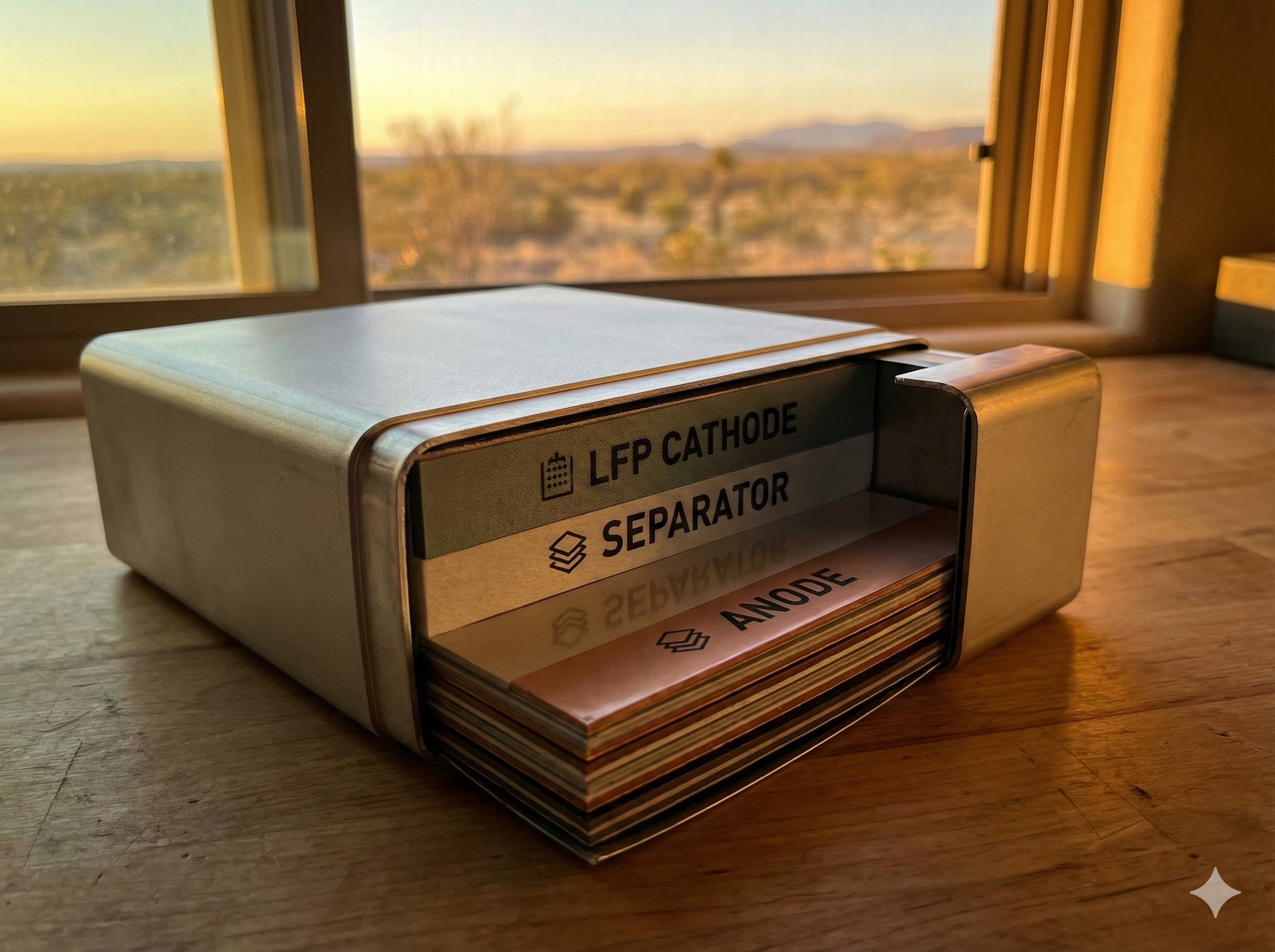
- Battery chemistry — LFP (lithium iron phosphate) versus NMC (lithium ion batteries) and how it affects performance
- Warranty coverage — Long term protection and capacity guarantees
- Heat tolerance — Critical for Texas summers where temperatures regularly exceed 100°F
These factors determine not just upfront solar battery cost, but also the long term value of your investment.
Tesla Powerwall 3: Overview, Pros & Cons
Tesla's Powerwall 3 consistently ranks as the best value in home battery storage. According to industry analysts, it "undercuts most competitors by 15-30%."
Pricing:
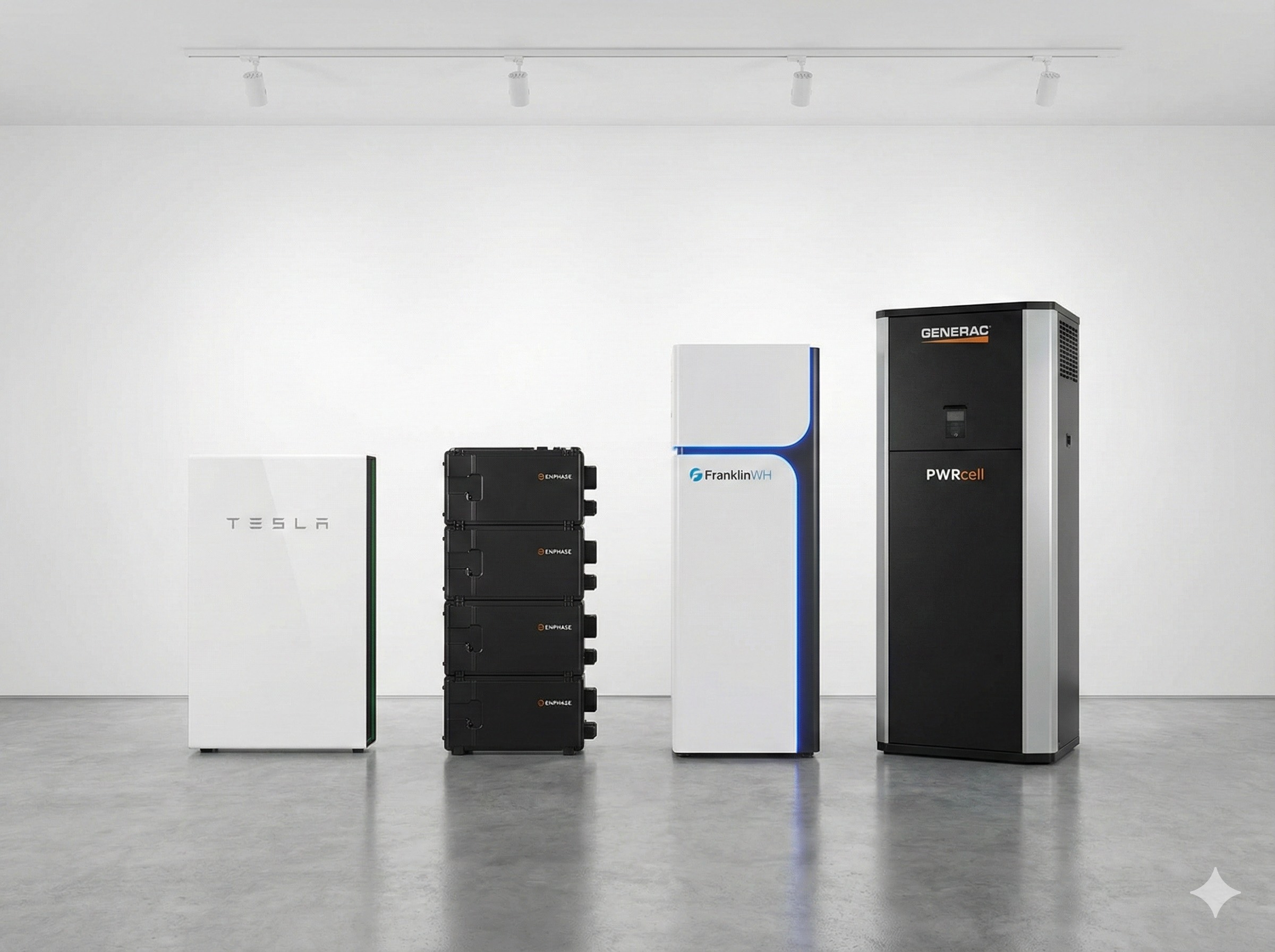
- Full system installed: $12,000–$16,779 before incentives
- With the 30% credit (2025 installs only): $9,450–$10,780
- Cost per kWh: $1,140 (lowest in market)
Specifications:
- Capacity: 13.5 kWh
- Chemistry: Lithium iron phosphate (LFP)
- Continuous power output: 11.5 kW
Pros:
- Lowest cost per kWh among major brands
- Integrated solar inverter saves $2,000–$3,000 on installation
- Scalable up to 54 kWh with four units
- LFP battery chemistry handles Texas heat up to 113°F
- 89% round-trip efficiency
Cons:
- Requires Tesla-certified installers
- No DIY installation option
- Regional price variation depending on location
The system includes everything needed for backup power, and the integrated inverter makes it particularly cost-effective for new solar panel systems.
Enphase IQ Battery 5P: Overview, Pros & Cons
Enphase offers a modular approach to solar battery storage, ideal for homeowners who want to scale their system over time.
Pricing:
- Cost per kWh: $1,300–$1,400 installed
- Per unit capacity: 5 kWh (modular design)
Pros:
- Modular design allows custom sizing from 5 kWh to 80 kWh
- Excellent integration with Enphase microinverters
- Industry-leading 15-year warranty
- LFP chemistry for safety and heat tolerance
Cons:
- 15–30% more expensive than Tesla per kWh
- Lower power output per unit
- Best value requires existing Enphase equipment
For homeowners already invested in an Enphase solar power system, this storage system offers seamless integration and the flexibility to become energy independent incrementally.
FranklinWH & Generac: Budget vs Premium Options
Two additional brands deserve consideration depending on your priorities and budget.
FranklinWH aPower
Pricing:
- Cost per kWh: $1,220
- Total installed (15 kWh): $18,300
- With the 30% credit (2025 installs only): $12,810
The FranklinWH system is designed specifically for whole-home backup power. Its intelligent energy management system optimizes stored energy usage, making it a solid mid-range choice for families prioritizing outage protection.
Generac PWRcell
Pricing:
- Full system: ~$18,000 per battery
- Position: Above industry average
Generac brings its reputation from the generator market to home batteries. The PWRcell is highly scalable for large homes with significant power needs. However, its premium pricing—among the highest in the market—means it's best suited for homeowners who prioritize brand trust and maximum backup capacity over cost of a solar battery per kWh.
Solar Battery Price Comparison Table
| Brand | Cost/kWh | Total (13-15 kWh) | After 30% Credit (2025 Installs Only) | Warranty |
|---|---|---|---|---|
| Tesla Powerwall 3 | $1,140 | $15,390 | $10,773 | 10 years |
| Enphase IQ 5P | $1,350 | $18,225 | $12,758 | 15 years |
| FranklinWH | $1,220 | $18,300 | $12,810 | 12 years |
| Generac PWRcell | $1,385 | $18,000+ | $12,600+ | 10 years |
| EG4 | $986 | $12,719 | $8,903 | 10 years |
Note: Prices reflect 2025 market data. Actual costs vary by location, installer, and electrical panel upgrades required.
Texas Solar Battery Costs: What to Expect
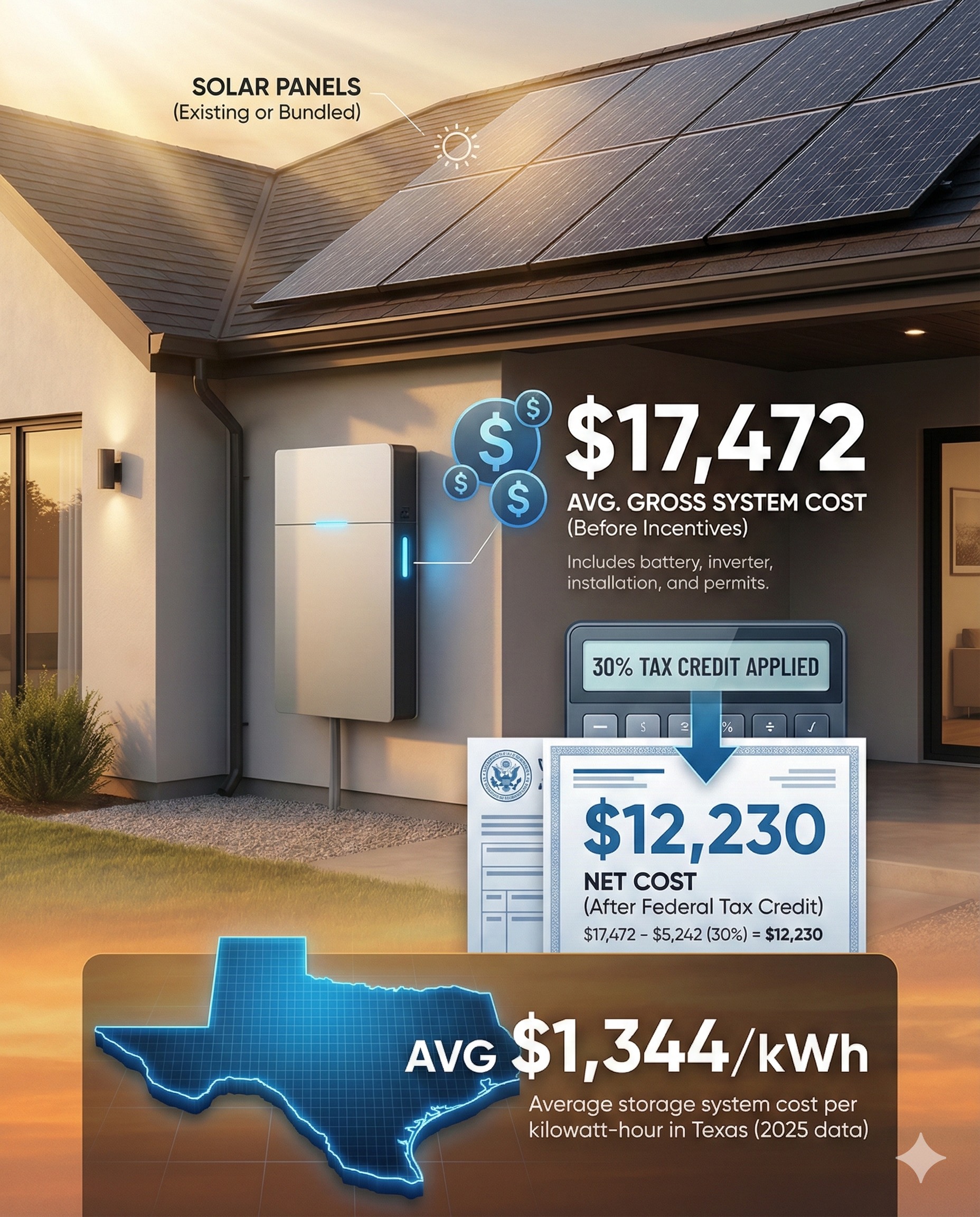
When comparing solar battery price in Texas, the numbers favor local buyers. According to EnergySage marketplace data from November 2025, Texas homeowners pay an average of $1,344 per kWh for installed solar battery storage—roughly 10–20% below the national average due to competitive labor markets.
Texas System Cost Examples:
| System Size | Gross Cost | After 30% Credit (2025 Installs Only) |
|---|---|---|
| 10 kWh | $13,440 | $9,408 |
| 13 kWh | $17,472 | $12,230 |
| 20 kWh | $26,880 | $18,816 |
Texas has no state-specific battery rebates, and the federal Residential Clean Energy Credit is not available for systems placed in service after December 31, 2025. Even so, competitive pricing and frequent grid instability keep Texas a strong market for home battery investment.
If you have solar panels, pairing them with our solar buyback program can maximize your energy savings while batteries provide security during outages.
Which Solar Battery Is Right for You?
Now that you understand solar battery price differences, here's how to choose the right option for your home.
Choose Tesla Powerwall 3 if:
- Best value is your top priority
- You want the lowest solar battery cost per kWh
- Texas heat tolerance matters for long term performance
- You're installing a new solar power system
Choose Enphase IQ Battery if:
- You already have Enphase microinverters
- Modular expansion is important to your plans
- You prefer longer warranty coverage (15 years)
- Gradual investment fits your budget better
Choose FranklinWH if:
- Whole-home backup power is essential
- Mid-range budget with solid features
- Intelligent energy management appeals to you
Choose Generac PWRcell if:
- You have a large home with high power needs
- Brand familiarity from generators matters
- Maximum scalability is required
Our Recommendation
After analyzing every major solar battery price point, the Tesla Powerwall 3 delivers the best combination of value, performance, and reliability for most Texas homeowners.
At $1,140 per kWh installed, it's the most affordable option among major brands. The lithium iron phosphate chemistry handles Texas summers without degradation, and the integrated inverter eliminates additional equipment costs. For systems installed by the end of 2025, the 30% federal tax credit brought that to $9,450–$10,780 for a complete 13.5 kWh system.
Budget Pick: The EG4 at $986 per kWh offers the absolute lowest cost for homeowners willing to work with smaller installers.
Important: The 30% tax credit is not available for systems placed in service after December 31, 2025. A battery installed in 2026 doesn't qualify, so budget for the full system price.
Ready to explore your options? Get your free energy quote to compare solar battery prices for your specific situation.
Frequently Asked Questions
How much does a solar battery cost in 2025?
The average solar battery price ranges from $9,000 to $19,000 nationally. In Texas, the average 13 kWh system costs $17,472 before incentives. Cost per kWh varies from $986 (EG4) to $1,385 (Generac) depending on brand.
What is the cheapest solar battery per kWh?
For the lowest solar battery price per kWh, Tesla Powerwall 3 offers $1,140 installed. For absolute budget buyers, EG4 provides $986 per kWh through select installers. Both use lithium ion batteries with solid warranties.
Is the 30% tax credit still available for batteries?
No. According to the IRS, the federal Residential Clean Energy Credit is not available for systems placed in service after December 31, 2025. Batteries installed by then, including standalone batteries not paired with solar, could qualify.
How long do solar batteries last?
Modern solar batteries last 10–15 years under normal use, with LFP chemistry often reaching 15–20 years. Most manufacturers warranty 6,000–10,000 cycles with guaranteed 70% capacity retention. Lead acid batteries, by comparison, typically last only 3–5 years.
Are solar batteries worth it in Texas?
Yes, particularly given Texas grid reliability concerns and extreme summer temperatures. LFP batteries handle heat better than other chemistry types, and frequent outages make backup power increasingly valuable.
Last updated: December 2025 | Solar battery price data current as of publication
Update, October 2026: According to the IRS, the 30% federal Residential Clean Energy Credit is not available for systems placed in service after December 31, 2025. Mentions of the credit below apply only to systems installed by then. Texas utility rebates and the Texas property tax exemption may still lower your cost.
When Winter Storm Uri left 4.5 million Texas homes without power in 2021, many homeowners realized the true value of energy independence. Today, whole house battery backup cost has become one of the most searched topics among Texans seeking reliable backup power solutions. Whether you're preparing for the next grid emergency or simply want to reduce your electricity bills, understanding what you'll pay for a home battery system is essential.
According to EnergySage, the median whole house battery backup cost in 2025 is $1,037 per kilowatt-hour of storage capacity. For a typical 13.5 kWh system that can power essential home loads, expect to pay around $14,000 before incentives. This guide breaks down everything you need to know about battery backup costs, from brand comparisons to Texas-specific incentives.
What Does Whole House Battery Backup Cost in 2025?
The whole house battery backup cost varies significantly based on system size, brand, and installation requirements. Current market data shows prices ranging from $1,000 to $1,600 per kWh, with 2025 marking record-low pricing at $1,133 per kWh according to Solar Builder Magazine.
For perspective, here's what typical system costs look like:
| System Size | Before Tax Credit | After 30% ITC (2025 Installs Only) |
|---|---|---|
| 10 kWh | $10,000-$12,000 | $7,000-$8,400 |
| 13.5 kWh (most common) | $13,000-$15,500 | $9,100-$10,850 |
| 20 kWh | $18,000-$22,000 | $12,600-$15,400 |
| 27 kWh (2 batteries) | $24,000-$30,000 | $16,800-$21,000 |
These prices include the battery unit, installation, gateway or controller, and standard electrical work. Additional costs may apply if your electrical panel needs upgrading or if complex installation conditions exist.
Breaking Down Your Battery Backup Investment
Understanding what goes into your whole house battery backup cost helps you make informed decisions and spot fair pricing. Let's examine each component.
Battery Unit Costs
The battery itself represents 50-60% of total system cost. Per-kWh pricing varies dramatically by manufacturer, from budget options like Pytes USA at $651/kWh to premium brands like Enphase at $1,510/kWh. This price difference reflects variations in technology, warranty coverage, and performance characteristics.
Installation Costs
Professional installation typically runs $2,000 to $4,000, depending on:
- Complexity of electrical connections
- Distance from main panel
- Whether indoor or outdoor mounting
- Local labor rates in your area
- Permit requirements
Additional Components
Beyond the battery, you'll need:
- Gateway or controller: $1,000-$2,000 (manages power flow and grid connection)
- Transfer switch: Often included, but may add $500-$1,500
- Monitoring system: Usually included in modern battery systems
- Electrical upgrades: $500-$3,000 if your panel needs updating
Tesla Powerwall Cost Example
| Component | Cost Range |
|---|---|
| Battery unit (13.5 kWh) | $6,700 |
| Installation | $2,000-$4,000 |
| Gateway and extras | $3,000-$4,000 |
| Total before incentives | $11,700-$14,700 |
| After 30% ITC (2025 Installs Only) | $8,190-$10,290 |
Best Home Battery Brands and Their Costs
Choosing the right battery system affects both your upfront whole house battery backup cost and long-term value. Here's how popular brands compare in 2025.
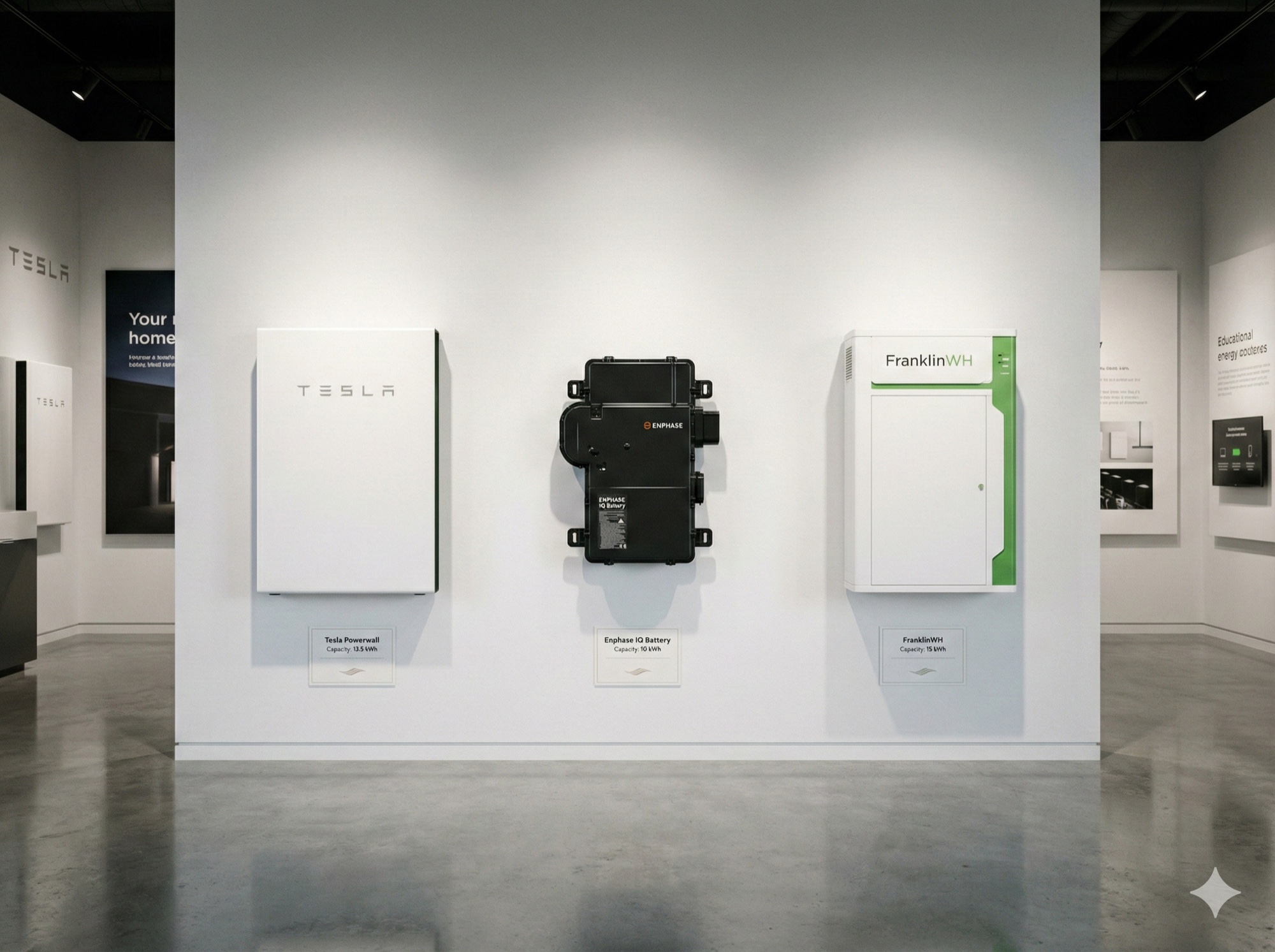
Tesla Powerwall
The most recognized name in home batteries, Tesla Powerwall offers:
- 13.5 kWh usable capacity
- $9,400 average installed cost after tax credit, for 2025 installs (EnergySage)
- 10-year warranty with 70% capacity retention
- Seamless solar integration
- Storm Watch feature for automatic charging before weather events
Enphase IQ Battery
Enphase commands premium pricing but delivers exceptional quality:
- Modular design (scalable from 5 to 15+ kWh)
- $1,510/kWh (highest market pricing)
- 10-15 year warranty
- LFP chemistry for better heat tolerance
- Best-in-class monitoring and support
FranklinWH
A growing competitor with strong value:
- 15 kWh standard capacity
- $18,300 total installed
- 12-year warranty
- Integrated whole-home management system
- Excellent for complex installations
Budget-Friendly Options
For cost-conscious homeowners:
- Pytes USA: $651/kWh (most affordable on EnergySage)
- EG4: $986/kWh for 12.9 kWh systems ($12,719 total)
- SolarEdge: $1,336/kWh with excellent solar integration
Brand Comparison Table
| Brand | Cost/kWh | Capacity | Total Cost* | Warranty |
|---|---|---|---|---|
| Pytes USA | $651 | Various | Lowest | 10 years |
| EG4 | $986 | 12.9 kWh | $12,719 | 10 years |
| Tesla | ~$725 | 13.5 kWh | $9,800 | 10 years |
| FranklinWH | $1,220 | 15 kWh | $18,300 | 12 years |
| SolarEdge | $1,336 | 9.7 kWh | $12,959 | 10 years |
| Enphase | $1,510 | Various | Highest | 10-15 years |
What Determines Your Whole House Battery Backup Cost?
Several factors influence your final investment. Understanding these helps you budget accurately and potentially reduce costs.
Capacity Requirements
Larger homes with higher energy consumption need more battery capacity. A 2,000 square foot home with average usage might function well with 13.5 kWh, while a 4,000 square foot home may require 27+ kWh for adequate backup power.
Brand and Technology Choice
Premium brands like Enphase cost more upfront but often provide:
- Longer warranties
- Better thermal management
- Superior monitoring
- Higher round-trip efficiency
Budget brands may save money initially but could have shorter lifespans or fewer features.
Installation Complexity
Your installation cost increases if:
- Your electrical panel is outdated (requires upgrade)
- The battery location is far from your panel
- You need trenching for outdoor installation
- Local permitting is complex
- Your home has unique electrical requirements
Geographic Location
Texas homeowners generally benefit from:
- Competitive installer markets keeping labor costs reasonable
- Faster permitting than many other states
- Strong installer network due to high demand
- Deregulated utility market simplifying interconnection
How to Reduce Your Battery Backup Cost with Incentives
Smart homeowners can significantly reduce their whole house battery backup cost through available incentives. Here's what's available in 2025.
Federal Investment Tax Credit (30%, Ended After 2025)
Until it ended for systems placed in service after December 31, 2025, the federal ITC offered:
- 30% credit on total battery system cost
- Applies to standalone batteries (no solar required)
- Minimum 3 kWh capacity to qualify
- Critical deadline: December 31, 2025
- Dollar-for-dollar reduction in federal tax liability
- Excess credit carries forward to future years
Example calculation:
- Battery system cost: $14,000
- 30% ITC (2025 installs only): $4,200
- Your cost after credit: $9,800
Texas-Specific Incentives
While Texas lacks a statewide battery rebate, several programs exist:
Property Tax Exemption: The added home value from your battery system is exempt from property taxes statewide—automatic, no application needed.
Austin Energy: Offers up to $2,500 in rebates for qualifying battery installations.
CPS Energy (San Antonio): Provides $10 bill credits each time your battery supports grid events.
Reliant Octo GridBoost: Pays $40 monthly credits plus market-rate exports for participating batteries.
Ready to maximize your savings? Get your free energy quote to discover which incentives apply to your situation.
Understanding Battery Technology: LFP vs Lithium-Ion
The chemistry inside your battery affects performance, longevity, and safety—all factors in your whole house battery backup cost over time.
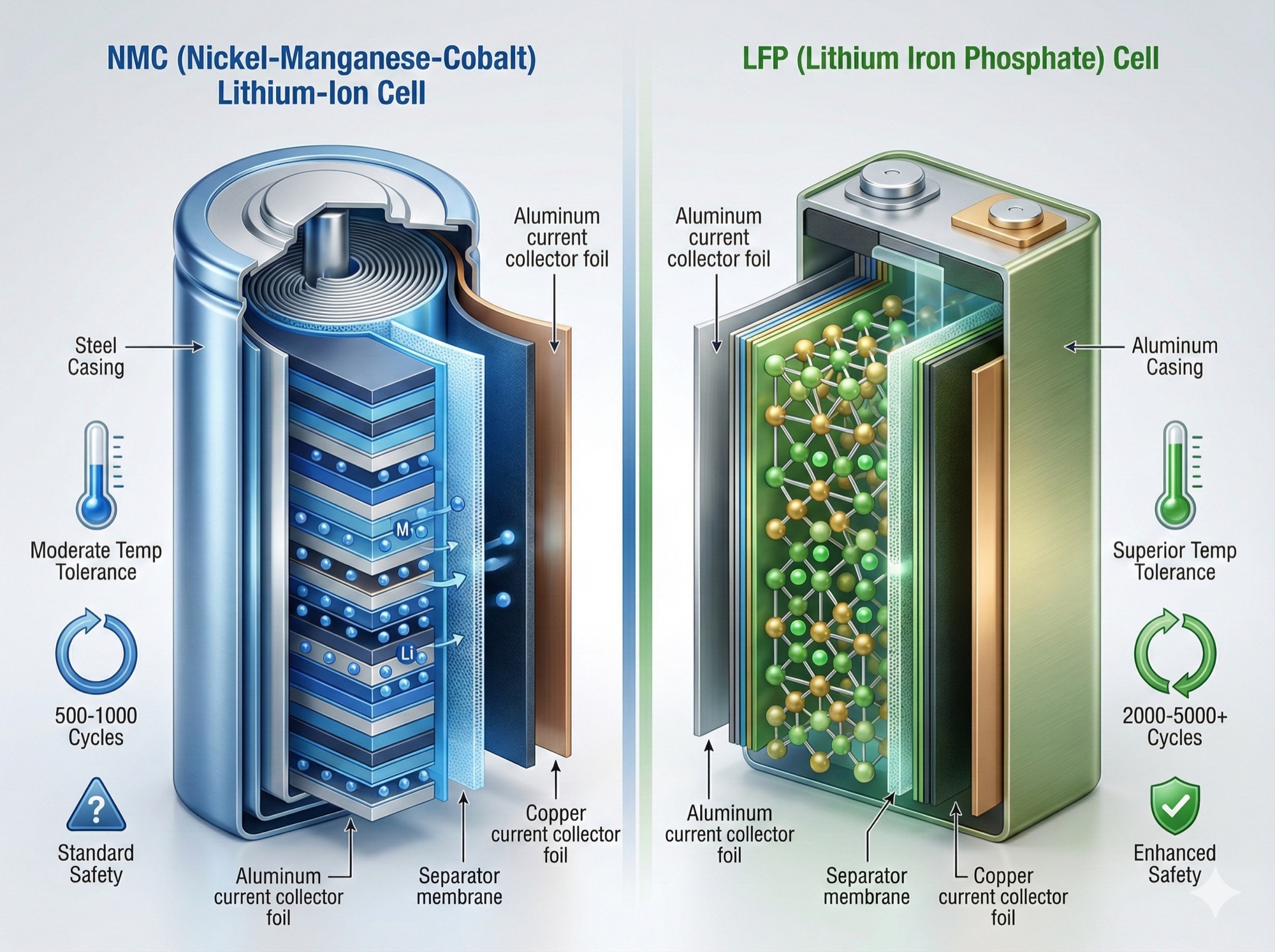
Lithium-Ion (NMC/NCA)
Traditional lithium-ion batteries using nickel-manganese-cobalt or nickel-cobalt-aluminum chemistry:
- 3,000-5,000 cycle lifespan (10-15 years)
- 90-95% round-trip efficiency
- Higher energy density (smaller footprint)
- More sensitive to heat
- Lower upfront cost ($500-800/kWh)
LFP (Lithium Iron Phosphate)
The newer standard for home batteries:
- 6,000-10,000 cycle lifespan (15-20 years)
- 95-98% round-trip efficiency
- Better thermal stability
- Safer chemistry (no thermal runaway)
- Slightly higher cost ($600-1,000/kWh)
- Recommended for Texas due to excellent heat tolerance
Technology Comparison
| Feature | NMC/NCA | LFP |
|---|---|---|
| Cycle life | 3,000-5,000 | 6,000-10,000 |
| Lifespan | 10-15 years | 15-20 years |
| Efficiency | 90-95% | 95-98% |
| Heat tolerance | Moderate | Excellent |
| Fire safety | Good | Better |
| Cost | Lower | Slightly higher |
For Texas homeowners, LFP chemistry provides better long-term value despite slightly higher upfront costs. The extreme summer heat can degrade NMC batteries faster, while LFP maintains performance in high temperatures.
How Much Battery Capacity Does Your Texas Home Need?
Properly sizing your battery system ensures you get adequate backup power without overspending. Here's how to calculate your needs.
Understanding Texas Home Energy Usage
The average Texas home consumes:
- 10,000-15,000 kWh annually
- 30-40 kWh daily (average)
- 40+ kWh daily during summer (air conditioning peak)
- 5-10 kW peak demand
Essential vs Whole Home Backup
Essential loads backup (refrigerator, lights, fans, phones, internet):
- Requires 15-20 kWh per day
- 1 battery (13.5 kWh) provides 8-12 hours
- Most cost-effective approach
Whole home backup (including air conditioning):
- Requires 30-40 kWh per day
- 2-3 batteries (27-40 kWh) needed
- Significantly higher cost
- May require electrical panel modifications
Sizing Recommendations
| Backup Goal | Daily Load | Recommended Capacity | Approx. Cost* |
|---|---|---|---|
| Essentials (1 day) | 15-20 kWh | 20-27 kWh | $14,000-$18,900 |
| Whole home (12 hrs) | 20-25 kWh | 27-35 kWh | $18,900-$24,500 |
| Whole home (1 day) | 30-40 kWh | 40-54 kWh | $28,000-$37,800 |
| Extended backup (2 days) | 40+ kWh | 54+ kWh | $37,800+ |
Sizing Formula
For precise calculations:
Required Capacity = (Daily Needs × Backup Days) / (DoD × Efficiency × 0.85)Where:
- DoD = Depth of Discharge (typically 80-90%)
- Efficiency = Round-trip efficiency (90-95%)
- 0.85 = Derating factor for Texas heat and battery aging
Whole House Battery Backup vs Traditional Generator
Understanding how battery systems compare to generators helps justify the whole house battery backup cost.
Upfront Investment
| System Type | Cost Range |
|---|---|
| Battery backup (13.5 kWh) | $9,800-$14,000 |
| Portable generator (3-5 kW) | $500-$1,500 |
| Standby generator (10-20 kW) | $5,000-$15,000 |
Ongoing Costs
Battery Systems:
- Fuel: $0
- Maintenance: Minimal (monitoring only)
- Expected annual cost: Near zero
Generators:
- Fuel: $50-$200 per outage event
- Maintenance: $200-$500 annually
- Oil changes, filter replacements required
When Each Makes Sense
Choose Battery Backup If:
- You want silent operation
- Solar panels are installed or planned
- You prefer zero-emission backup
- You value automatic, seamless transition
- Long-term cost savings matter
Choose a Generator If:
- Budget is extremely limited
- You need unlimited runtime
- Rural location with extended outages
- Whole-home AC backup is essential
- Fuel storage is not a concern
Comparison Summary
| Factor | Battery | Generator |
|---|---|---|
| Upfront cost | $9,800-$14,000 | $5,000-$15,000 |
| Fuel costs | $0 | $50-200/event |
| Noise | Silent | 65-75 dB |
| Maintenance | Minimal | Regular |
| Solar integration | Yes | No |
| Automatic operation | Yes | Some models |
| Runtime | 4-12+ hours | Unlimited |
| Emissions | Zero | High |
The Case for Battery Backup in Texas
Texas presents unique circumstances that make battery backup particularly valuable—and help justify the whole house battery backup cost.
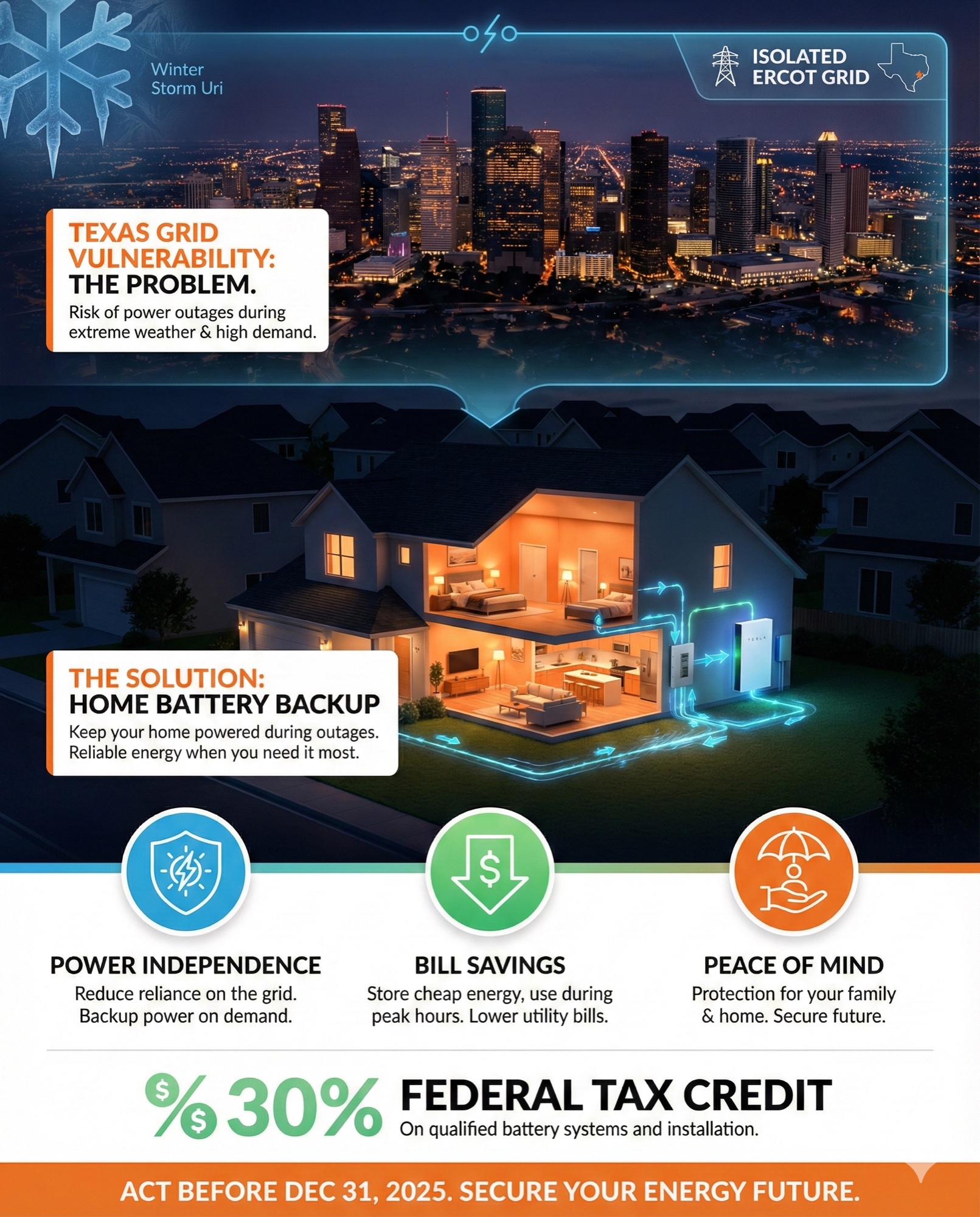
ERCOT Grid Vulnerabilities
The Texas grid (managed by ERCOT) operates in isolation from the rest of the country. This means:
- No interstate power sharing during emergencies
- Higher vulnerability to extreme weather
- Growing demand straining infrastructure
- 10+ emergency alerts issued in 2024-2025
Growing Reliability Concerns
ERCOT projects energy demand to nearly double by 2030, with potential supply shortages during peak periods as early as 2026. Population growth, extreme weather patterns, and increasing electrification all stress the system.
Winter Storm Uri Impact
The February 2021 disaster demonstrated Texas grid fragility:
- 4.5 million homes and businesses lost power
- Outages lasted days for many families
- Over 240 deaths attributed to the event
- $195 billion in total damages
"Home battery storage systems in Texas... provide essential backup power during grid outages while reducing your monthly electricity bills." — Lone Star Solar Services
Maximizing Value with Solar
For Texas homeowners considering solar, Ambit Energy offers a solar buyback program that credits excess energy at retail rates rather than wholesale. Combined with battery storage, this creates a powerful energy independence solution.
What to Expect During Battery Installation
Understanding the installation process helps you plan around the whole house battery backup cost timeline.
Overall Timeline: 6-12 Weeks
| Phase | Duration |
|---|---|
| Site assessment and quote | 1-2 weeks |
| Permitting | 2-4 weeks |
| Equipment delivery | 2-4 weeks |
| Installation | 1-3 days |
| System commissioning | 1 day |
| Utility interconnection | 1-4 weeks |
Step-by-Step Process
- Free consultation: Assess your needs and home requirements
- Site assessment: Evaluate electrical panel, installation location, and complexity
- System design: Customize capacity and configuration for your goals
- Permitting: Submit plans to local building department
- Equipment delivery: Battery, gateway, and components arrive
- Professional installation: Licensed electricians mount and wire system
- Commissioning: Test all functions and configure settings
- Utility approval: Final interconnection authorization
Texas's deregulated market generally speeds the interconnection process compared to other states.
Frequently Asked Questions About Battery Backup Costs
How much does a whole house battery backup cost in Texas?
A typical 13.5 kWh system costs $13,000-$15,500 before incentives. With the 30% federal tax credit, available only for systems installed by the end of 2025, the cost was $9,100-$10,850. Larger systems for whole-home backup range from $18,000 to $30,000+ before credits.
Is there a tax credit for home batteries in 2025?
Yes, for systems placed in service by December 31, 2025. The 30% federal Residential Clean Energy Credit covered standalone battery systems with 3+ kWh capacity. According to the IRS, it is not available for property placed in service after that date.
How long do home batteries last?
Lithium-ion batteries typically last 10-15 years, while LFP (lithium iron phosphate) batteries can last 15-20 years. Most manufacturers offer 10-year warranties guaranteeing at least 70% capacity retention.
Can I install a battery without solar panels?
Absolutely. Standalone batteries can charge from grid power. They provide backup during outages and enable time-of-use arbitrage (charging during cheap hours, using stored power during expensive peaks).
How many batteries do I need for whole house backup?
Most Texas homes need 2-3 batteries (27-40 kWh) for adequate whole-home backup during outages. For essential loads only (refrigerator, lights, internet), one 13.5 kWh battery often suffices for 8-12 hours.
Which battery brand is best for Texas?
LFP chemistry batteries perform best in Texas heat. Top choices include Tesla Powerwall, Enphase IQ Battery, and FranklinWH—all using heat-tolerant LFP technology that maintains performance in extreme temperatures.
How much can I save with battery backup?
Beyond outage protection, batteries enable time-of-use savings of $20-$50 monthly by shifting consumption to off-peak hours. Combined with solar and programs like Reliant's GridBoost ($40 monthly credits), savings can exceed $100 monthly.
Do batteries work during power outages?
Yes. Home batteries automatically detect outages and switch to backup power within milliseconds—fast enough that you won't notice the transition. Your home operates normally on stored battery power until grid service returns.
Take Control of Your Energy Future
The whole house battery backup cost represents an investment in energy independence, bill savings, and peace of mind. Battery prices are near record lows, though the 30% federal tax credit is not available for systems placed in service after December 31, 2025.
Key takeaways:
- Median cost: $1,037/kWh ($9,800-$14,000 for typical systems, after the tax credit for 2025 installs)
- The 30% federal ITC ended for systems installed after 2025
- LFP technology offers best value for Texas climate
- Size based on essential loads for cost-effective backup
- Installation takes 6-12 weeks from quote to operation
Ready to protect your Texas home with reliable backup power? Our energy consultants can help you calculate costs, maximize available incentives, and select the right battery system for your needs.
Get Started Today
Request your free energy quote or call (817) 402-2664 to speak with a VIP Energy Service consultant about battery and solar solutions for your home.
Last updated: December 2025
Update, October 2026: According to the IRS, the 30% federal Residential Clean Energy Credit is not available for systems placed in service after December 31, 2025. Mentions of the credit below apply only to systems installed by then. Texas utility rebates and the Texas property tax exemption may still lower your cost.
California homeowners can save up to $7,500 through the PG&E permanent battery storage rebate program. With power outages increasing across the state and grid reliability concerns growing nationwide, battery backup systems have become essential for energy independence. This comprehensive battery backup rebate guide answers your most pressing questions about PG&E's program and what it means for homeowners considering battery storage.
Whether you live in California or Texas, understanding battery storage incentives helps you make informed decisions about protecting your home from power disruptions.
Frequently Asked Questions About the PG&E Battery Storage Rebate
What is the PG&E Permanent Battery Storage Rebate?
The PG&E permanent battery storage rebate is a $7,500 incentive program designed to help California homeowners install backup power systems. According to PG&E, this program provides a flat rebate amount to first-time battery storage customers on a first-come, first-served basis. The rebate covers battery equipment costs but excludes installation labor and additional components like gateways or controllers.
PG&E created this battery rebate program specifically for customers in wildfire-prone areas who experience frequent power outages due to safety shutoffs.
How much is the PG&E battery storage rebate worth?
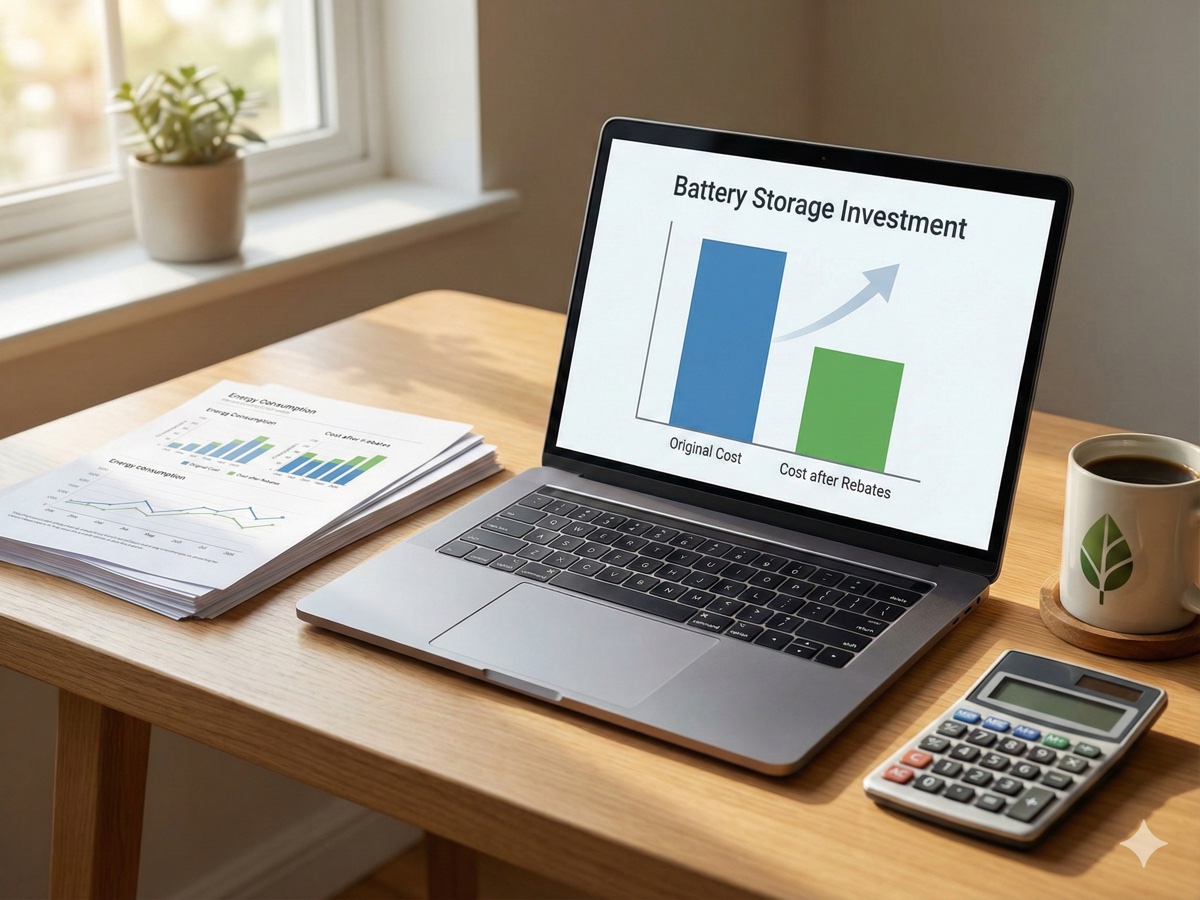
The PG&E permanent battery storage rebate offers a maximum of $7,500 toward qualifying battery systems. For systems placed in service by December 31, 2025, it could be stacked with the 30% federal tax credit for total savings of over $10,000. That federal credit is not available for systems installed after 2025.
For a typical $12,000 battery system, combined savings could look like this:
- PG&E rebate: $7,500
- Remaining cost: $4,500
- Federal tax credit (30%, 2025 installs only): $1,350
- Final out-of-pocket: $3,150
Who qualifies for the PG&E permanent battery storage rebate?
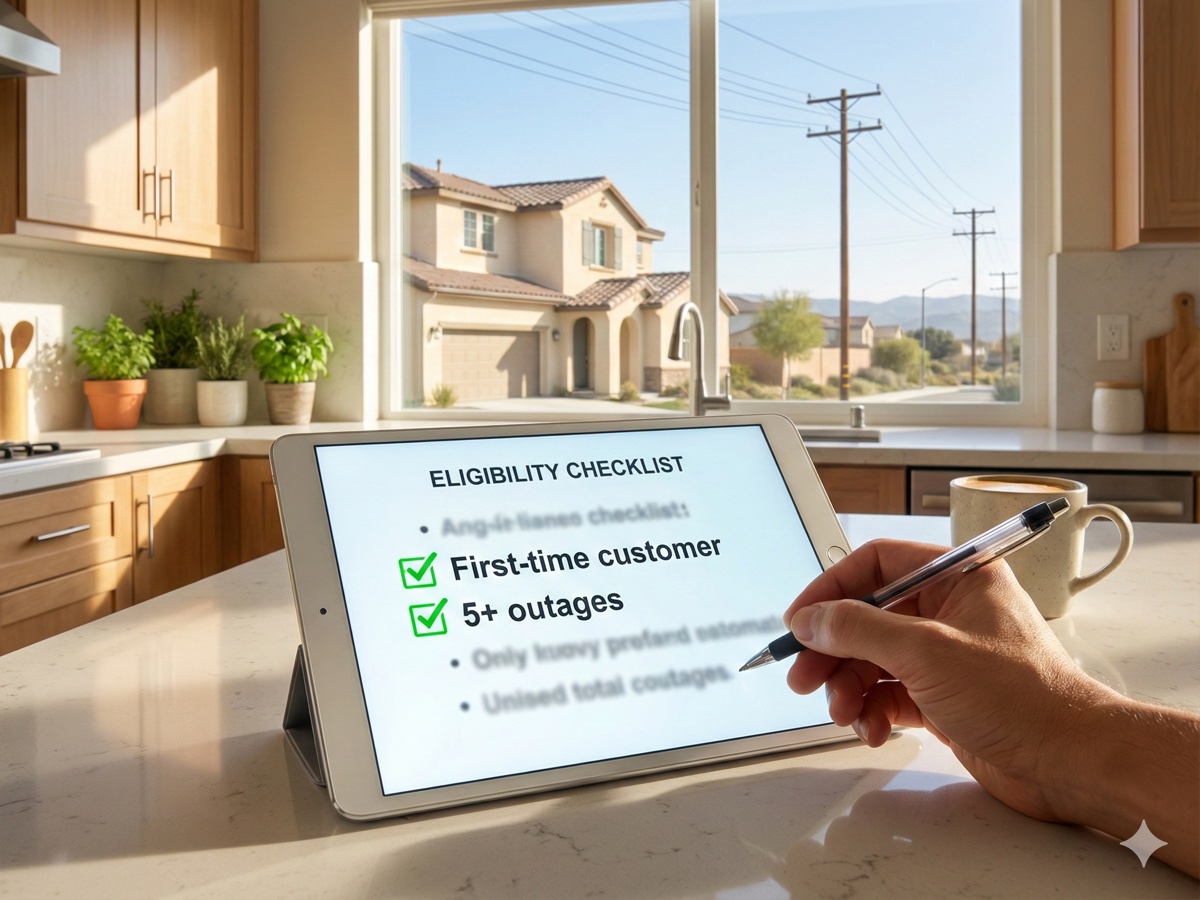
According to PG&E's program requirements, qualifying customers must meet these criteria:
- Be a first-time PG&E battery storage customer
- Have experienced five or more Enhanced Powerline Safety Settings (EPSS) outages since January 1, 2023
- Enroll in a Time-of-Use (TOU) rate plan
- Join a Demand Response Program like Power Saver Rewards or Smart Rate
- Install a battery from PG&E's Qualified Product List
- Obtain Permission to Operate (PTO) from PG&E
Approximately 190,000 PG&E customers currently qualify for this program.
What is EPSS and why does it matter for eligibility?
EPSS stands for Enhanced Powerline Safety Settings. This technology allows PG&E to quickly de-energize power lines when wildfire risk is high, preventing utility-sparked fires. While EPSS protects communities, it also causes brief power outages for safety.
According to High Country News analysis, fast-trip outages in PG&E territory reached 2,869 events in 2024, representing a 19% increase over 2022 and 23% over 2023. If your address has experienced five or more of these enhanced powerline safety settings outages since January 1, 2023, you qualify for the permanent battery storage rebate.
When does the PG&E battery rebate program expire?
The PG&E permanent battery storage rebate program deadline is December 31, 2025. However, with only 600 slots remaining and 190,000 eligible customers, funding could run out before the deadline.
Applications must be submitted within 12 months of battery purchase or by December 31, 2025, whichever comes first. The program operates on a first-come, first-served basis while funding lasts.
Can I combine the PG&E rebate with federal tax credits?
Only for systems placed in service by December 31, 2025. According to the IRS, the 30% federal Residential Clean Energy Credit is not available for property placed in service after that date. For 2025 installations, the credit applied to the battery cost remaining after the rebate.
This means a $15,000 battery storage system could see total incentives of:
- PG&E rebate: $7,500
- Federal ITC on remaining $7,500 (2025 installs only): $2,250
- Total incentives: $9,750
The federal tax credit is not available for systems placed in service after December 31, 2025.
What battery systems qualify for the PG&E rebate?
Qualifying batteries must appear on PG&E's Qualified Product List, which aligns with Self-Generation Incentive Program (SGIP) standards. Popular qualifying battery storage systems include:
- Tesla Powerwall
- Enphase IQ Battery
- LG Energy Solution systems
- Other SGIP-approved manufacturers
Importantly, standalone batteries qualify without requiring solar panels. Typical qualifying systems range from 5-26 kWh capacity. Check PG&E's qualified product list for the complete and current list of approved battery storage systems.
How do I apply for the PG&E permanent battery storage rebate?
The application process for the permanent battery storage rebate involves four steps:
- Verify eligibility: Use PG&E's Address Lookup Tool to confirm your address experienced five or more EPSS outages
- Purchase and install: Choose a battery from the Qualified Product List and complete battery installation
- Obtain PTO: Receive Permission to Operate approval from PG&E's Electric Generation Interconnection Department
- Submit application: Apply through PG&E within 12 months of purchase
Work with a certified installer familiar with PG&E's program requirements to ensure smooth processing.
Is there a similar battery rebate program in Texas?
Currently, Texas does not offer a state-level battery storage rebate comparable to PG&E's permanent battery storage rebate. Texas homeowners can still lower their costs through some utility programs and the Texas property tax exemption for solar and storage.
Additionally, ERCOT grid reliability concerns are driving increased interest in backup power solutions across Texas. Ambit Energy customers benefit from the solar buyback program, which maximizes the value of battery and solar combinations by crediting excess energy at retail rates rather than wholesale.
Ready to explore your options? Get your free energy quote to explore battery storage options for your Texas home.
How much does a home battery system cost without rebates?
According to the National Renewable Energy Laboratory's 2024 benchmark analysis, fully installed residential battery costs average $1,000-$1,200 per kWh of capacity. For a typical 10-13.5 kWh battery storage system, expect:
- Before incentives: $10,000-$15,000
- After 30% federal tax credit (2025 installs only): $7,000-$11,000
- Payback period with incentives: 8-12 years
California customers using the PG&E permanent battery storage rebate see even better economics, with combined incentives covering 60-70% of typical system costs.
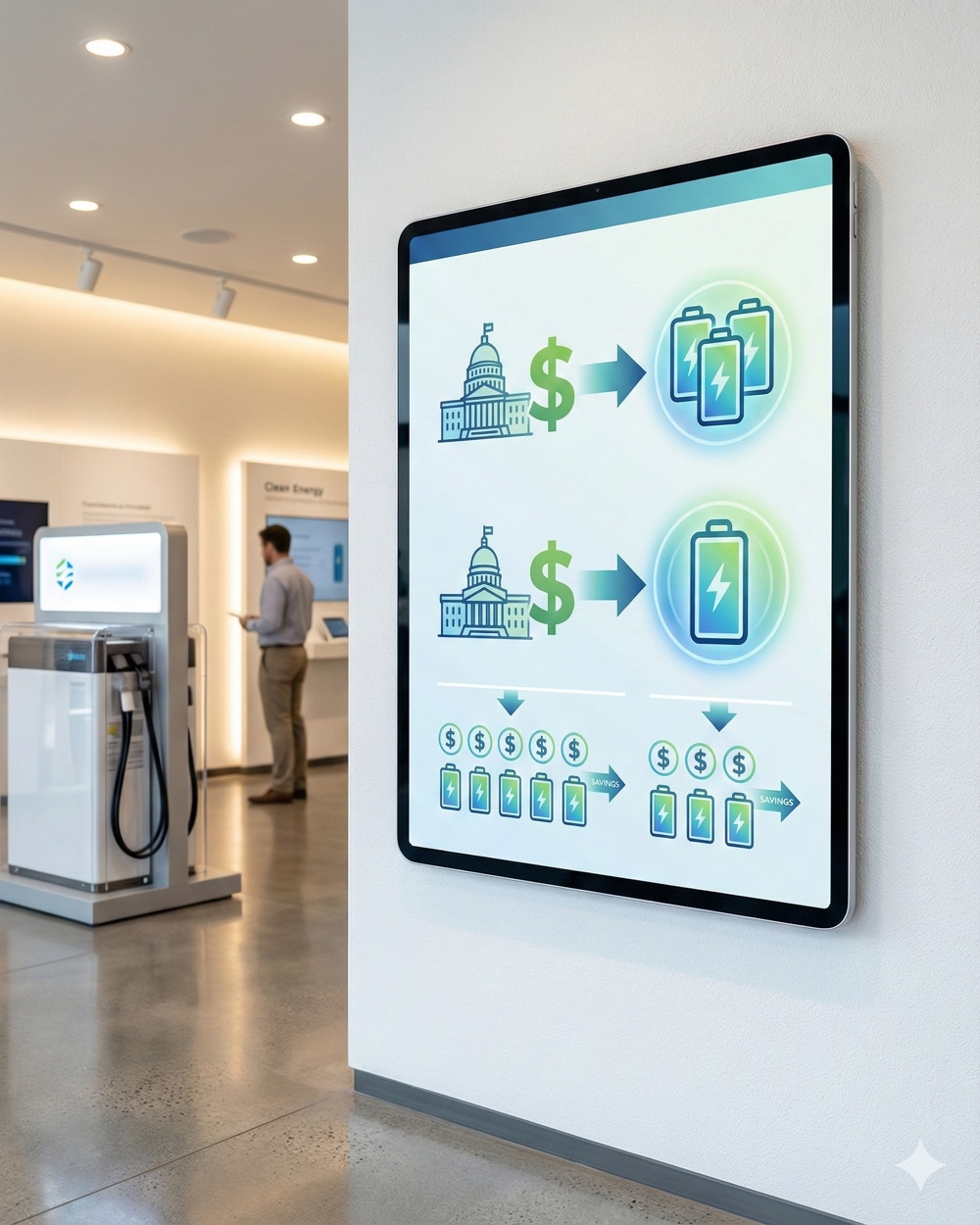
Why Battery Storage Matters for Texas Homeowners
Grid reliability concerns extend far beyond California. The ERCOT grid serving Texas has faced its own challenges, making backup power increasingly valuable for Texas homeowners. While California's aggressive rebates like the PG&E permanent battery storage rebate signal industry direction, Texas offers unique advantages for energy independence.
Through Ambit Energy's solar buyback rate, Texas homeowners with battery and solar systems maximize their investment.
Take Action on Battery Storage Today
The PG&E permanent battery storage rebate represents one of the most generous battery incentives available, though limited to California customers. For Texas homeowners, favorable solar buyback rates now drive most of the economics of battery storage.
Ready to explore battery storage for your Texas home? Our energy consultants can help you understand your options and calculate potential savings with available incentives.
Get Started Today
Request your free energy quote today, or call (817) 402-2664 to speak with a VIP Energy Service consultant about battery and solar solutions.
Last updated: December 2025
Update, October 2026: According to the IRS, the 30% federal Residential Clean Energy Credit is not available for systems placed in service after December 31, 2025. Mentions of the credit below apply only to systems installed by then. Texas utility rebates and the Texas property tax exemption may still lower your cost.
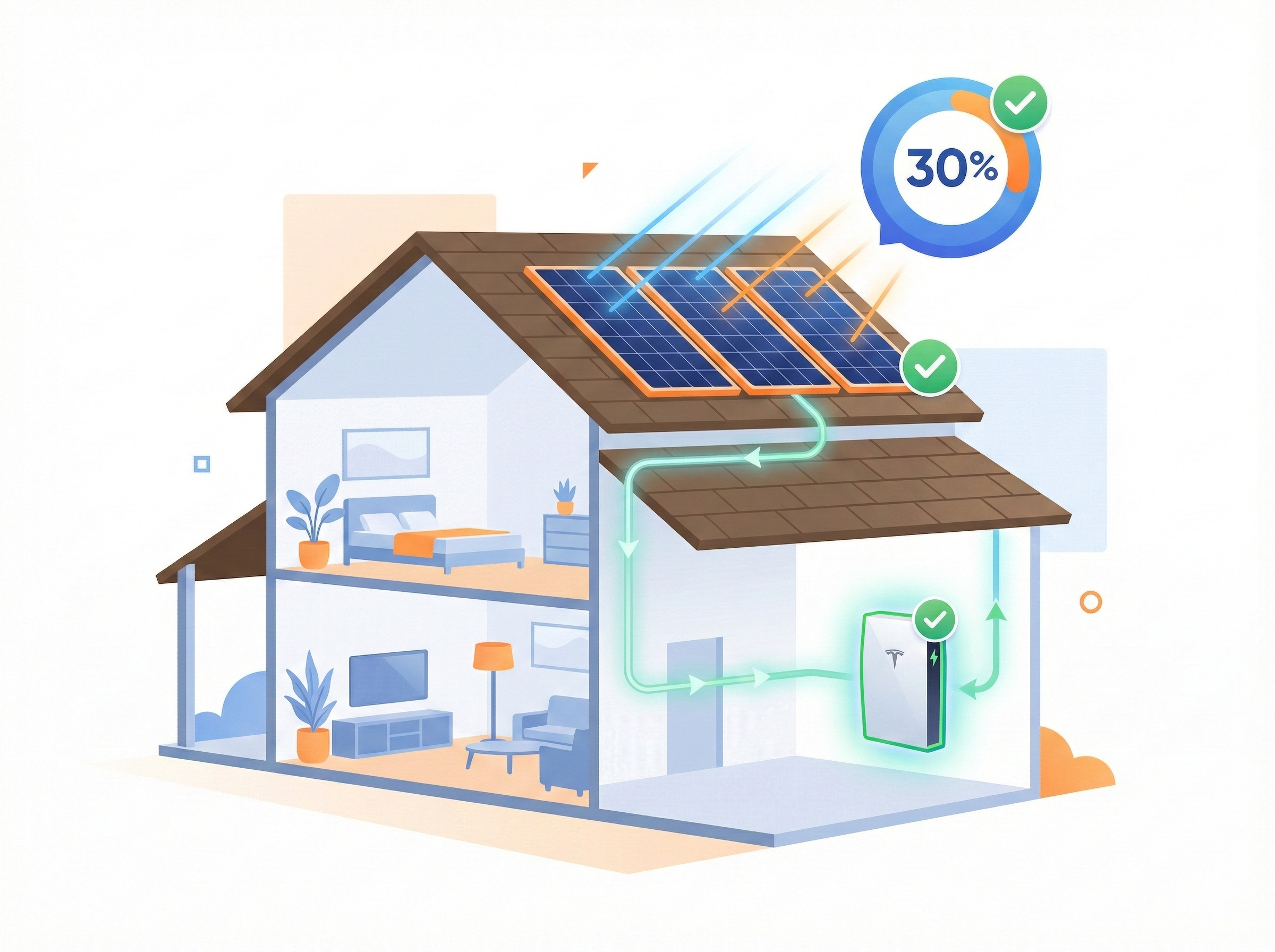
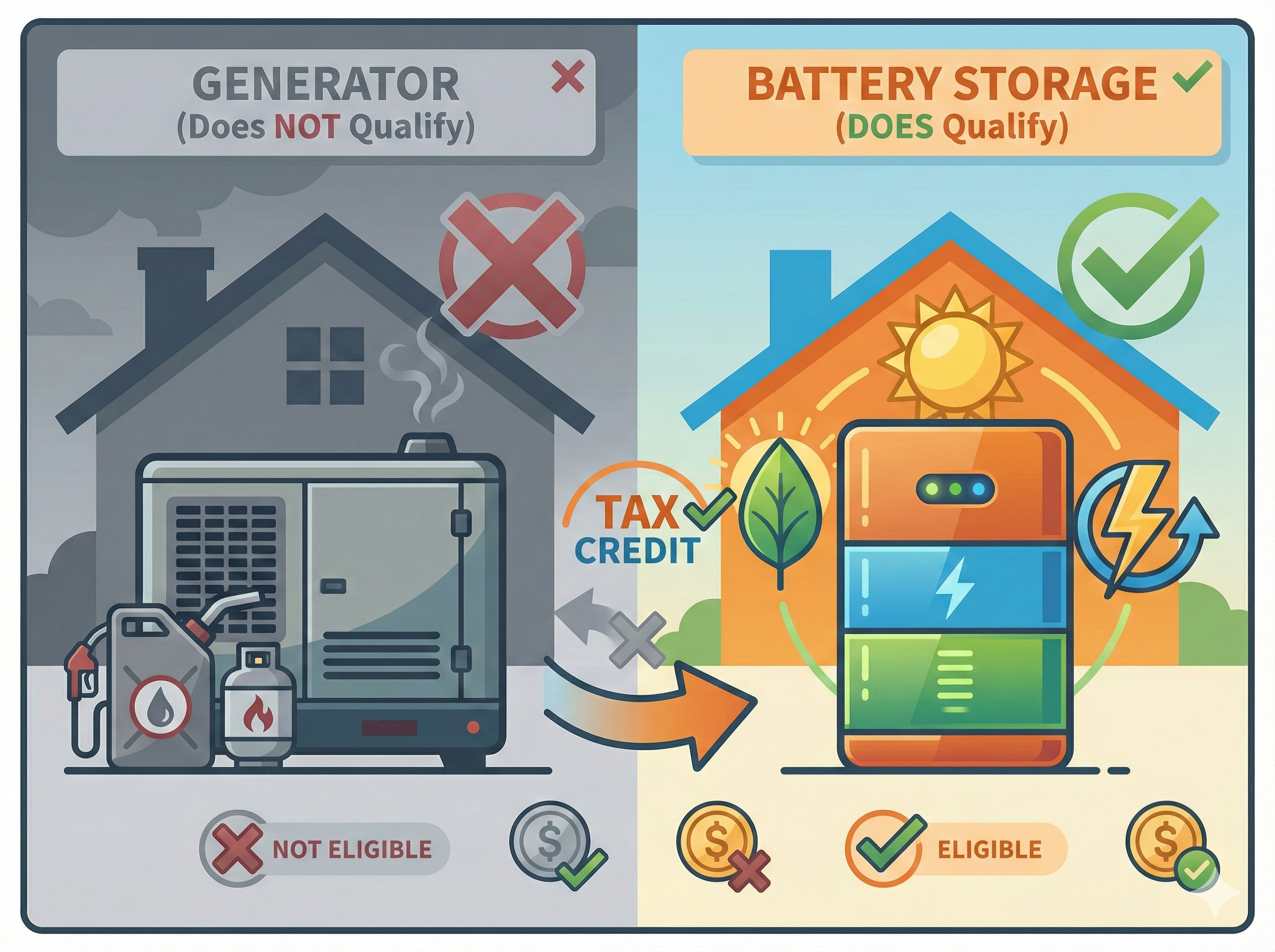
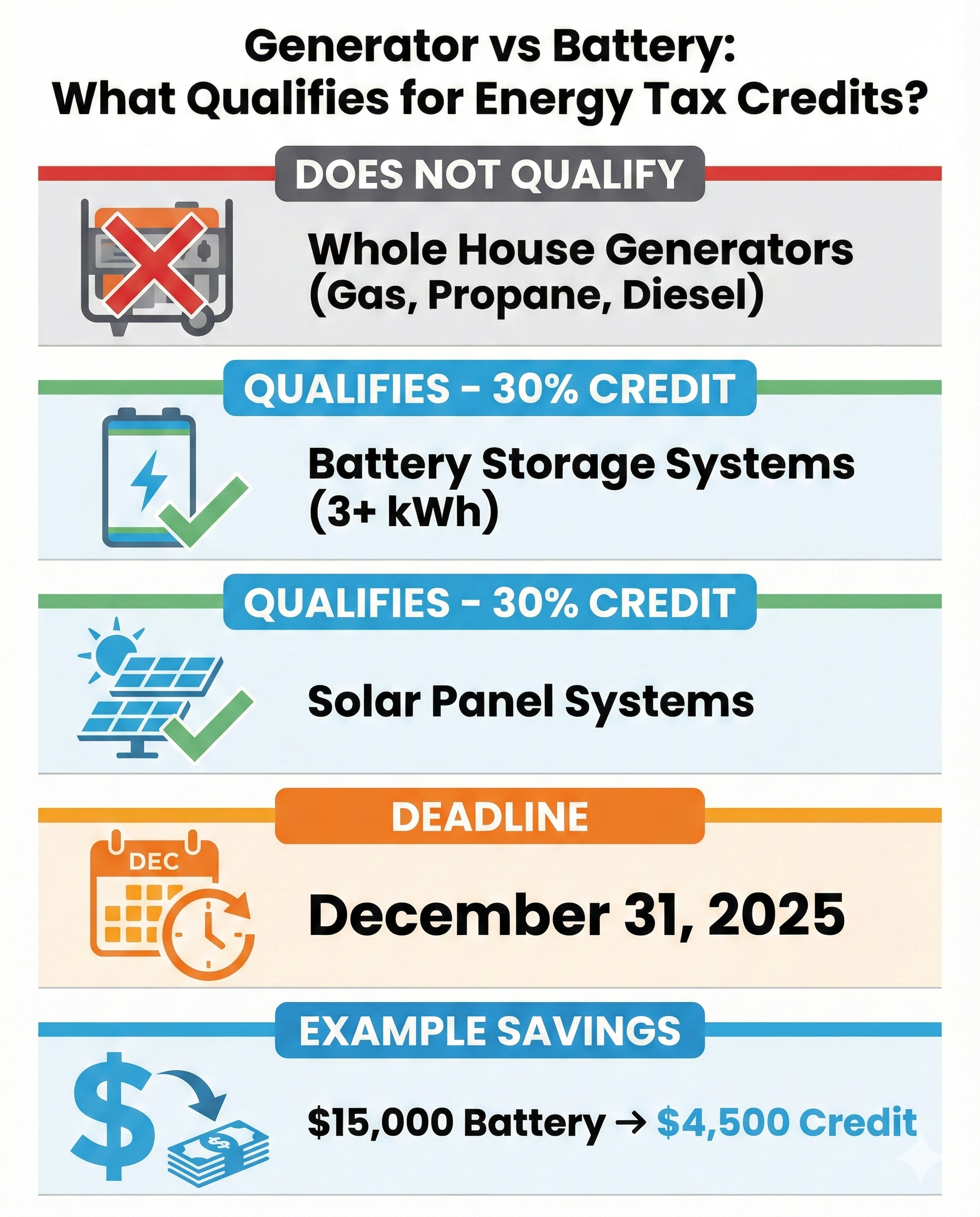
No, a whole house generator does not qualify for federal energy tax credits. The Residential Clean Energy Credit (Section 25D) and Energy Efficient Home Improvement Credit (Section 25C) specifically exclude backup generators powered by natural gas, propane, or diesel. However, battery storage systems with 3+ kWh capacity—like Tesla Powerwall or Enphase IQ Battery—do qualify for the 30% federal tax credit through December 31, 2025. If you're exploring battery backup rebate options in Texas, understanding what qualifies can save you thousands.
Frequently Asked Questions About Generator Energy Credits
After Hurricane Beryl left 2.2 million Houston households without power in 2024, many Texas homeowners started exploring backup power solutions. Federal tax credits can make clean energy more affordable—but not all backup systems qualify equally. Here's what you need to know about whole house generators and energy credits for 2026.
Does a Whole House Generator Qualify for Energy Credit?
No, whole house generators do not qualify for any federal energy tax credit. The IRS is clear on this: Section 25D (Residential Clean Energy Credit) only covers clean energy property that generates or stores renewable energy. Section 25C (Energy Efficient Home Improvement Credit) covers efficiency upgrades like heat pumps and insulation.
Traditional generators—whether Generac, Kohler, or Briggs & Stratton—run on fossil fuels. According to the IRS, only "qualified clean energy property" qualifies. Since generators combust natural gas, propane, or diesel, they're explicitly excluded from both credits.
The core issue comes down to energy source. Generators create electricity through combustion, producing emissions. Tax credits exist to incentivize clean, renewable alternatives—not fossil fuel systems.
What Backup Power Options DO Qualify for the Federal Tax Credit?
Several backup power solutions qualify for the 30% Residential Clean Energy Credit through December 31, 2025:
Battery Storage Systems (3+ kWh capacity):
- Tesla Powerwall (13.5 kWh per unit)
- Enphase IQ Battery (modular 5-10+ kWh)
- LG Chem RESU (9.8-16 kWh models)
Solar Panel Systems:
- Photovoltaic panels qualify for 30% credit
- Solar and battery systems working together maximize both backup power and tax savings
Other Qualifying Systems:
- Geothermal heat pumps (ENERGY STAR certified)
- Small wind turbines (up to 100 kW residential)
- Fuel cells (minimum 0.5 kW)
According to the Department of Energy, these credits help households "lower their energy bills while cutting climate pollution."
Can I Get a Tax Credit for a Generac Generator?
No—the brand doesn't change eligibility. Generac, Kohler, Briggs & Stratton, and all other fossil fuel generator manufacturers produce equipment that doesn't qualify for federal energy tax credits. The credit applies to technology type, not brand name.
However, Generac does manufacture battery storage products like the PWRcell system. These battery systems, not generators, can qualify for the 30% credit if they meet the 3 kWh minimum capacity requirement.
If backup power with tax benefits matters to you, consider exploring battery backup for home options instead of traditional generators.
What's the Difference Between Generators and Battery Backup for Tax Purposes?
The IRS distinguishes these systems based on how they produce and store energy:
| Feature | Whole House Generator | Battery Backup System |
|---|---|---|
| Federal Tax Credit | No | 30% (through 2025) |
| Fuel Required | Yes (gas/propane/diesel) | No |
| Emissions | Yes | None |
| Silent Operation | No | Yes |
| Clean Energy | No | Yes |
Generators create electricity through combustion—a process that produces emissions and requires ongoing fuel costs. Battery storage systems store electricity electrochemically, producing zero emissions during operation.
For Texas homeowners, understanding this distinction matters. The home battery wall approach offers both backup power and significant tax savings that generators simply cannot provide.
How Much Is the Federal Tax Credit for Battery Storage?
The Residential Clean Energy Credit provides 30% of qualified installation costs with no annual cap for residential systems.
Example calculation:
- Battery system cost: $15,000
- Tax credit (30%): $4,500
- Net cost after credit: $10,500
According to Misty Erickson, CPA and Senior Manager at AICPA, "The expanded credits are likely to make consumer energy-efficient purchases even more common in the coming years."
The credit is non-refundable but carries forward if you can't use it all in one year. Claim it using IRS Form 5695.
What's the Deadline for Energy Tax Credits?
The current 30% rate expires December 31, 2025 for residential installations. After that, the Inflation Reduction Act originally planned this phase-out:
| Year | Credit Percentage |
|---|---|
| 2022-2032 | 30% |
| 2033 | 26% |
| 2034 | 22% |
| 2035+ | 0% |
However, pending legislation may accelerate this timeline. Paul Rasor, CPA and Partner at Plante Moran, notes: "Taxpayers who plan ahead can potentially claim up to $3,200 in credits each year through 2032 for qualifying energy-efficient home improvements."
If you're considering battery backup, acting before the 2025 deadline locks in the full 30% credit rate.
Are There Texas Rebates for Generators or Battery Backup?
Texas currently has no state-level rebates for whole house generators. Utility programs are limited:
- Oncor: Rebates for high-efficiency A/C ($300-$3,500), but not generators or batteries
- CenterPoint Energy: Occasional generator promotions, not ongoing programs
- Generac Grid Support Program: Earn $5/hour for grid support runtime (not a rebate)
Texas has allocated $690 million for HOMES/HEAR efficiency rebates, though these programs haven't launched yet and likely won't cover traditional generators.
The federal 30% credit remains the primary incentive for Texas homeowners considering battery backup in Texas.
Is a Generator Tax Deductible for Any Other Reason?
While generators don't qualify for energy credits, limited deduction scenarios exist:
Medical Necessity (Section 213):
If a physician documents that backup power is medically necessary (life support equipment, medication refrigeration), a portion may qualify as a medical expense deduction.
Business Use (Section 179):
Home-based businesses may depreciate generator costs proportional to business use.
Home Office Deduction:
If you work from home, a percentage might be deductible based on office square footage.
These require proper documentation and professional tax guidance—they're exceptions, not standard deductions.
What Should Texas Homeowners Do?
The bottom line: whole house generators don't qualify for federal energy tax credits, but battery storage systems do. With the 30% credit deadline approaching December 31, 2025, Texas homeowners have limited time to maximize savings on qualifying backup power.
If you're evaluating whether solar batteries are worth it for your situation, consider:
- Calculate potential savings: A $15,000 battery system yields $4,500 in tax credits
- Act before 2025 deadline: Lock in the full 30% rate
- Explore your options: Battery backup provides silent, clean power with tax benefits generators can't match
Ready to explore backup power solutions that qualify for federal tax credits? Get your free energy quote from our Texas energy consultants today.
Sources
- IRS - Residential Clean Energy Credit (Section 25D)
- IRS - Energy Efficient Home Improvement Credit (Section 25C)
- Department of Energy - Clean Energy Tax Credits for Consumers
- ENERGY STAR - Federal Tax Credits for Home Efficiency
- Rewiring America - Battery Storage Tax Credit Guide
Update, October 2026: According to the IRS, the 30% federal Residential Clean Energy Credit is not available for systems placed in service after December 31, 2025. Mentions of the credit below apply only to systems installed by then. Texas utility rebates and the Texas property tax exemption may still lower your cost.
Can you really get a free battery for solar panels? The honest answer is no—but you can significantly reduce or eliminate your upfront costs through the 30% federal tax credit (available through December 2025), utility rebates, and virtual power plant programs. In Texas, programs like SOLRITE-sonnen even offer $0-down battery installations in exchange for grid participation. The key is understanding exactly what you're trading for that "free" battery—and whether the trade makes sense for your situation.
If you're exploring ways to save on home energy storage, be sure to check out our complete guide to battery backup rebate programs, which covers every incentive option available to Texas homeowners in 2026.
The promise of free batteries for solar panels is everywhere—from online ads to door-to-door salespeople. But as someone who's helped hundreds of Texas homeowners navigate the energy market, I can tell you that "free" almost always comes with strings attached. This article will cut through the marketing hype to show you what "free" really means, where the hidden costs live, and how you can actually get a home battery at little or no cost by playing the incentive game strategically.
Table of Contents
- What "Free Battery" Really Means
- The Hidden Costs of "Free" Battery Programs
- Battery Economics in 2026: What's Changed
- How to Actually Get a Low-Cost Battery in Texas
- When a "Free" Battery Makes Sense
- Red Flags in Battery Marketing
- Your Best Path to a Low-Cost Battery in 2026
- Frequently Asked Questions
What "Free Battery" Really Means
Let's be clear about one thing: no battery manufacturer is giving away equipment that costs $12,000 to $20,000 for a typical 10-15 kWh home system. When you see a "free battery for solar panels" offer, the cost is being recovered somewhere—you just need to understand where.
"There is no such thing as a free battery. If the installer is advertising a 'free' home storage system, you are paying for it somewhere—in a higher PPA rate, a bigger loan amount, or by giving the company the rights to use your battery in a virtual power plant and keep some or all of that value."
— Vikram Aggarwal, Founder and CEO of EnergySage
There are three primary models behind "free" battery offers:
1. Virtual Power Plant (VPP) Enrollment
In this model, you receive a battery at reduced or no upfront cost in exchange for enrolling in a VPP program. Your battery becomes part of a larger network that utilities or grid operators can dispatch during peak demand periods. The company profits from grid services your battery provides, and you get backup power when it's not being used for grid support.
2. Power Purchase Agreements (PPAs)
With a PPA, a third party owns the solar panels and battery on your home. You pay a fixed rate for the energy produced—often lower than grid rates—but you don't own the equipment and typically can't claim the federal tax credit yourself.
3. Bundled Financing
Some installers offer a "free" battery by rolling its cost into a larger solar loan. You're still paying for the battery; it's just hidden in a higher overall payment or longer loan term.
In Texas's deregulated ERCOT market, VPP programs are particularly active. SOLRITE-sonnen, for example, offers what they call a "VPA" (Virtual Power Plant Agreement) where homeowners get free solar panels and sonnen batteries installed in exchange for VPP enrollment and paying a below-market rate for the energy their system produces. Since September 2024, SOLRITE has committed more than 40 MWh of residential battery capacity through this program.
If you're still wondering whether solar batteries are worth it, the answer depends entirely on understanding these tradeoffs.
The Hidden Costs of "Free" Battery Programs
The allure of a free battery for solar panels fades quickly when you understand what you're giving up.
"When a company promises 'no-cost solar' or a 'free battery,' it is almost always recouping those costs through a long-term contract with payments that are higher than they would otherwise be, or by keeping some of the financial benefits that would otherwise go to the homeowner."
— Dan Gearino, Energy Journalist at Inside Climate News
Here's what "free" typically costs you:
Higher PPA or Lease Rates
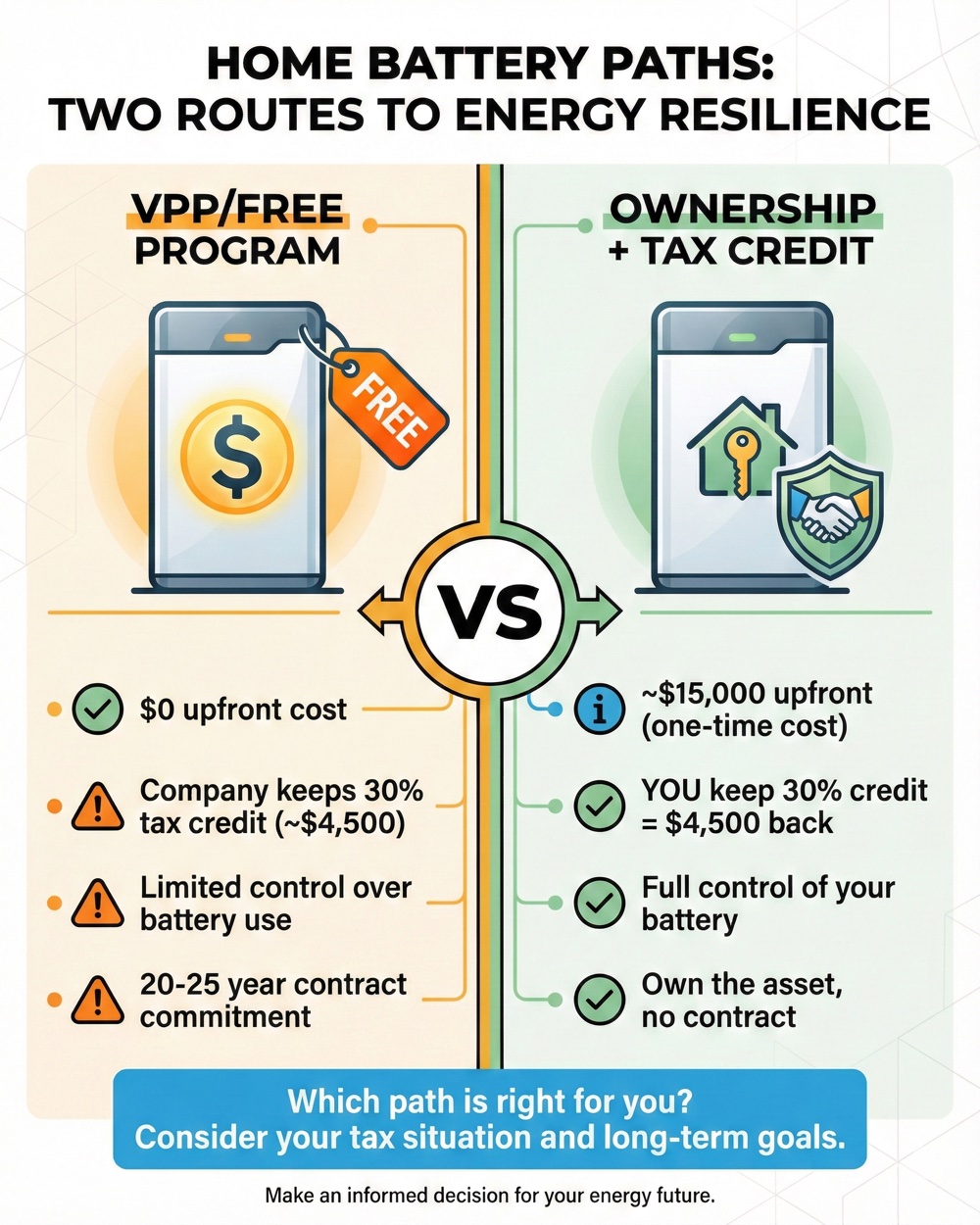
When a company gives you a "free" battery as part of a solar PPA, your per-kilowatt-hour rate is almost always higher than a solar-only PPA. That premium, multiplied over 20-25 years, often exceeds what you would have paid to buy the battery outright.
Lost Federal Tax Credits
The 30% federal Residential Clean Energy Credit can reduce a $15,000 battery system to $10,500 out of pocket. But in a PPA or lease arrangement, the third-party owner claims that credit—not you. That's $4,500 in value that goes to the company instead of into your pocket.
Loss of Battery Control
VPP agreements typically give the utility or aggregator the right to dispatch your battery during grid stress events. This means your battery might be discharged to help the grid exactly when you need it most—like during a summer heatwave when blackouts are most likely. Some programs limit this control; others are more aggressive.
Long Contract Terms
"Free" battery programs often lock you into 20-25 year agreements. If you want to sell your home, move, or simply exit the program, early termination fees can be substantial.
Limited Availability
Many "free" programs have funding caps. California's CEA Solar Plus Connect program, for example, had only about 6,000 eligible customers as of September 2025. Texas programs like Evergy's battery pilot charge $10/month fees and require qualifying through specific criteria.
The Consumer Financial Protection Bureau has warned consumers directly: "Claims of 'no-cost solar' or 'free equipment' can be misleading if consumers are locked into long-term payment obligations or if the provider retains valuable incentives or bill credits. Consumers should focus on the total cost over the life of the contract, not just upfront payments."

Battery Economics in 2026: What's Changed
The battery market has transformed dramatically, and that changes the calculus for "free" battery programs versus outright ownership.
"After a 40% drop in battery equipment costs in 2024, the economics of battery storage are 'unrecognizable,' and the industry is still adjusting to this new reality."
— Kostantsa Rangelova, Global Electricity Analyst at Ember
Here's what the numbers look like in 2026:
Dramatic Cost Reductions
Battery equipment costs fell approximately 40% in 2024 alone. The levelized cost of storage (LCOS) for utility-scale batteries has dropped to around $65 per MWh, with capital costs now approximately $125 per kWh for complete systems. While residential systems carry a premium for smaller scale and installation complexity, the trend is unmistakable—batteries are far more affordable than they were even two years ago.
Tesla Powerwall 3 Pricing
A Tesla Powerwall 3 installation typically runs $11,000 to $16,000 for a single unit before incentives. Additional units add $8,000 to $12,000 each. With the 30% federal tax credit, a single Powerwall's net cost drops to roughly $7,700 to $11,200.
Federal Tax Credit Status
Here's where timing becomes critical. The 30% Residential Clean Energy Credit is currently available through December 31, 2025, under current law. The original Inflation Reduction Act schedule had the credit continuing at 30% through 2032, then stepping down to 26% in 2033 and 22% in 2034. However, subsequent legislation modified this timeline, making the December 2025 deadline particularly important for homeowners considering battery purchases.
Both standalone batteries and solar-paired systems qualify for the credit, which represents a significant shift from earlier rules that required batteries to be charged by solar.
Why This Matters for "Free" Battery Decisions
When batteries cost $20,000+ and you couldn't claim tax credits on standalone systems, "free" VPP programs made more financial sense. But with prices down 40% and a 30% tax credit available, the math has shifted. In many cases, buying a battery outright and claiming the credit yourself delivers better long-term value than signing away grid-service rights for a "free" system.
How to Actually Get a Low-Cost Battery in Texas
Texas homeowners have several legitimate paths to reduce battery costs substantially—sometimes to near zero. Here's how to work the system strategically.
Option 1: Claim the Federal Tax Credit Yourself
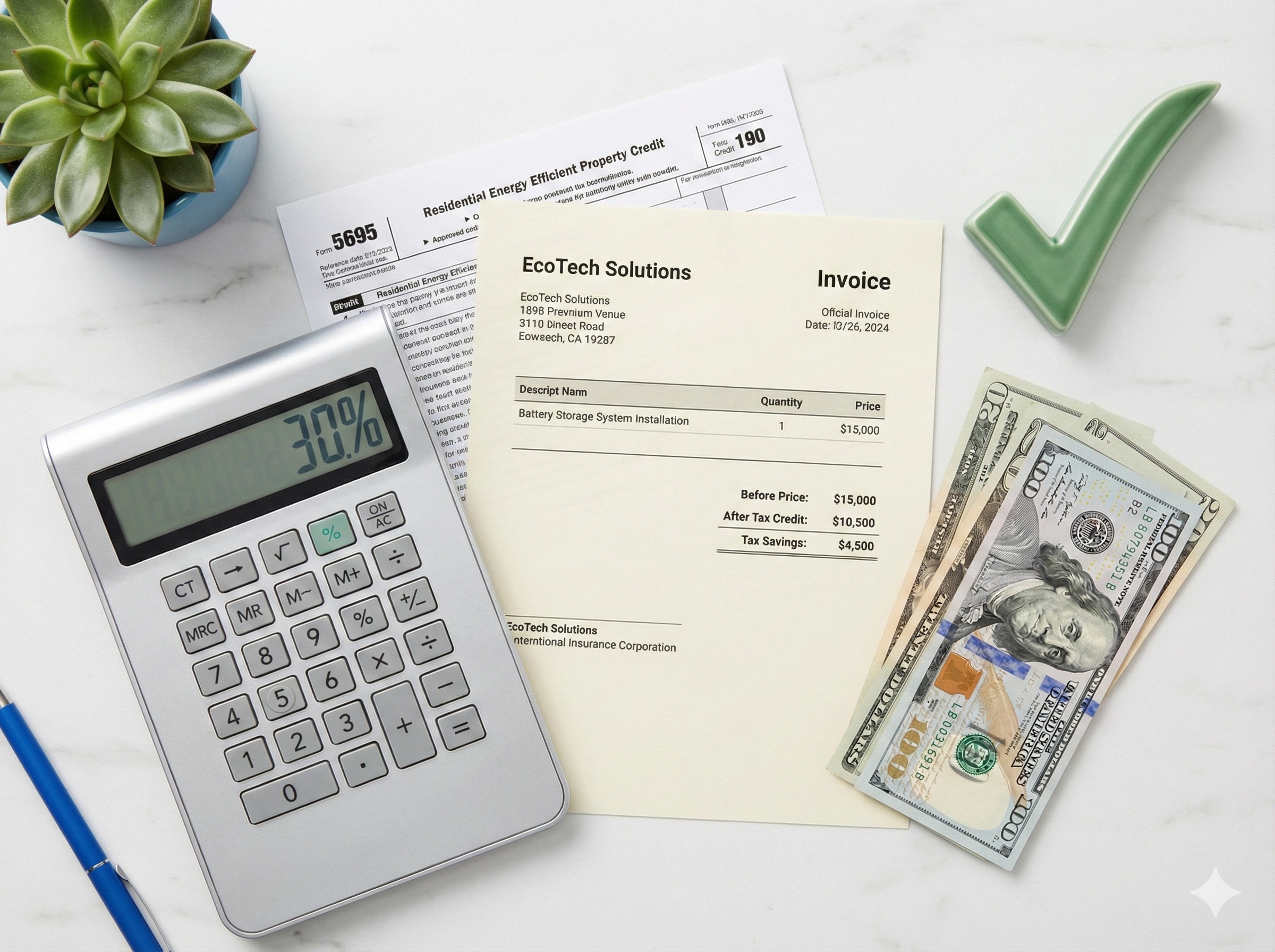
Owning your battery and claiming the 30% Residential Clean Energy Credit is often the best value proposition. Here's the math:
- $15,000 installed battery cost
- 30% federal credit = $4,500 back
- Net cost = $10,500
If you're in a position to use the full tax credit (meaning you have at least $4,500 in federal tax liability), this path keeps you in full control of your battery while capturing significant savings. Remember, this credit is available through December 2025 under current law.
Option 2: Texas Utility Programs
Texas utilities and competitive providers offer various battery programs:
- SOLRITE-sonnen VPA: $0 down installation with VPP enrollment. You pay a below-market rate for the energy produced. The catch: the company owns the system and profits from grid services.
- Gexa Energy Battery Management: $50/month for battery management (works with Enphase, SolarEdge, and LG systems) with unlimited credits.
- Octo GridBoost: $40/month credit plus real-time buyback in the ERCOT market.
- Utility Rebates: Various Texas utilities offer rebates ranging from $300 to $5,000 per battery system, depending on the utility and program specifics. Common structures include $300-$400 per kWh up to program caps.
Option 3: Stack Incentives Strategically
The real power move is combining multiple incentives. Here's an example scenario:
- Purchase a 13.5 kWh battery system: $14,000 installed
- Federal 30% tax credit: -$4,200
- Local utility rebate (example $400/kWh capped at $4,000): -$4,000
- Annual VPP participation payments (estimated $300/year): -$3,000 over 10 years
- Net 10-year cost: $2,800 (essentially $280/year for backup power and peak shaving)
"From a household balance-sheet perspective, a battery can make financial sense where tax credits, state rebates, and utility incentives combine to cover a substantial share of the upfront cost. But if those incentives are captured by the installer in a 'free battery' offer, the homeowner may be giving up more value than they realize."
— Tom Konrad, PhD, CFA, Green Energy Investment Analyst
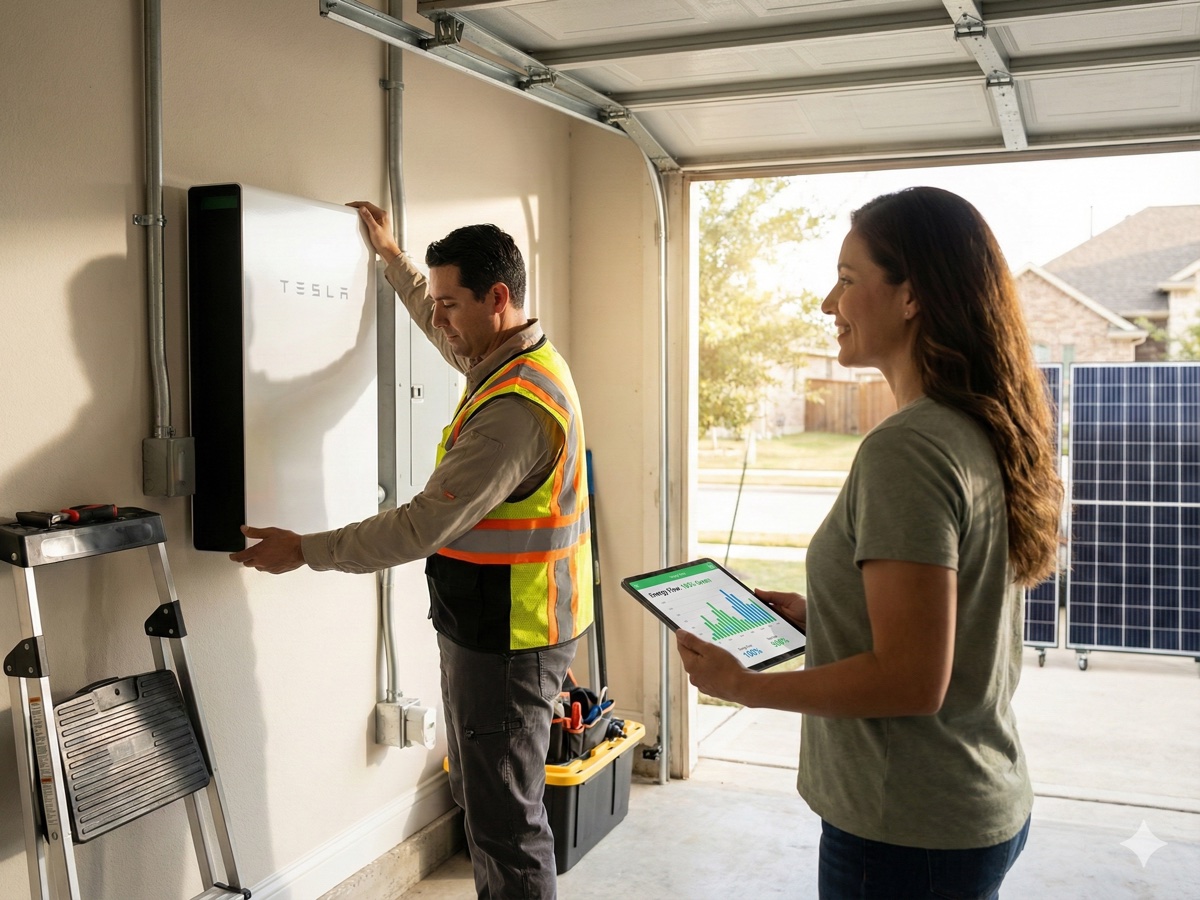
For comprehensive information on Texas-specific options, see our Texas battery storage guide and our best solar battery guide for equipment comparisons.
When a "Free" Battery Makes Sense
Despite the hidden costs, "free" battery programs genuinely work well for certain homeowners. Here's when a VPP or PPA arrangement might actually be your best choice:
Good Candidates for "Free"/VPP Programs:
- Low tax liability: If you don't have enough federal tax liability to use the 30% credit, the credit's value to you is reduced or zero. In this case, letting a third party claim it in exchange for a $0-down system makes more sense.
- Cash-constrained but creditworthy: If you want backup power but can't afford $10,000+ out of pocket (even with financing), a "free" program gets you the equipment immediately.
- Comfortable with grid dispatch: If you primarily want emergency backup and don't mind your battery being used for grid support during 90% of the year, VPP programs deliver genuine value.
- Short-term homeownership: If you're planning to move in 5-7 years, the long-term economics of ownership matter less, and getting battery benefits without large upfront costs may be attractive.
Better to Buy Outright If:
- You can use the full tax credit: With $4,500+ in federal tax liability, you capture significant value by owning.
- You want full battery control: If your primary goal is blackout protection, having a third party potentially discharge your battery during grid emergencies defeats the purpose.
- You're staying long-term: Over 15-20 years, owned systems typically deliver better total value than PPAs.
- You want to maximize incentive stacking: Ownership allows you to combine federal, state, and utility incentives that might be captured by the installer in "free" programs.
To properly evaluate your options, you'll also want to understand how to size a battery for your solar system.
Red Flags in "Free Battery" Marketing
Not all "free battery" offers are created equal. Some represent legitimate value propositions; others are designed to obscure unfavorable terms. Watch for these warning signs:
Red Flag #1: No Clear Ownership Explanation
Legitimate programs clearly state who owns the equipment. If a salesperson can't give you a straight answer about whether you or the company owns the battery, walk away.
Red Flag #2: Vague or Missing Contract Terms
Any "free" offer should come with detailed written terms covering: contract length, monthly fees, escalation clauses, what happens if you sell your home, and early termination conditions. Verbal promises are worthless.
Red Flag #3: High-Pressure Tactics
"This offer expires today" or "We only have three spots left in your area" are classic pressure tactics. Legitimate programs don't need artificial urgency.
Red Flag #4: No Discussion of End-of-Contract
What happens when the 20-year PPA ends? Do you own the equipment? Does it need to be removed? Who pays for removal? These questions matter.
Red Flag #5: Claims That Seem Too Good
If someone offers you a free battery with no monthly fees, no contract obligations, and no strings attached, they're either lying or there's something they're not telling you.
Questions to Ask Any "Free Battery" Provider:
- Who owns the battery—me or your company?
- Who claims the federal tax credit and any state rebates?
- When can I use the battery for my own backup, and when does it get dispatched to the grid?
- What happens if I sell my house or want to exit the program?
- What are the terms at the end of the contract period?
- What are my all-in monthly costs for the life of the contract?
Your Best Path to a Low-Cost Battery in 2026
After analyzing the market, here's my perspective on the smartest approach for most Texas homeowners seeking a free or low-cost battery for solar panels in 2026.
For Most Texas Homeowners: Ownership + Tax Credit
If you have sufficient tax liability to use the 30% federal credit, buying your battery delivers the best long-term value. You maintain full control, capture all incentives yourself, and can potentially participate in VPP programs voluntarily for additional income without giving up ownership.
For Those Who Can't Use the Tax Credit: VPP Programs
If you're retired, have low income, or otherwise can't benefit from the federal tax credit, VPP programs like SOLRITE-sonnen offer genuine value. You get equipment at $0 down, and while the company profits from grid services, you get backup power you wouldn't otherwise have.
Timing Matters: The December 2025 Deadline
The 30% federal tax credit expires December 31, 2025, under current law. If you're considering battery ownership, acting before this deadline could save you thousands compared to waiting for a potentially lower (or nonexistent) credit.
Work with a Trusted Energy Consultant
The battery and solar landscape is complex, and what works for one homeowner might not work for another. At Ambit Energy VIP Energy Service, we help Texas homeowners understand all their options—including our competitive solar buyback program that maximizes the value of your solar investment.
To understand how solar and battery systems work together, explore our educational resources or reach out for a personalized assessment.
Frequently Asked Questions
Can I really get a free battery for my solar panels?
Not truly free, but $0-down options exist through VPP programs and PPAs. In these arrangements, you typically trade control over your battery, the federal tax credit, and/or long-term flexibility for zero upfront cost. The company recovers its investment through grid services, higher energy rates, or by claiming incentives on your behalf.
What is a virtual power plant (VPP)?
A virtual power plant is a network of home batteries coordinated by a central operator to function like a single power plant. When the grid needs support during peak demand, the operator can discharge participating batteries to reduce strain. In exchange, homeowners typically receive reduced equipment costs, monthly credits, or other compensation.
Does the 30% federal tax credit apply to batteries?
Yes. Both standalone batteries and solar-paired systems qualify for the 30% Residential Clean Energy Credit. Under current law, this credit is available through December 31, 2025. The credit applies to the full installed cost, including equipment, labor, and related electrical work.
What's the average cost of a home battery in Texas?
A typical 10-15 kWh home battery system costs $12,000 to $20,000 installed before incentives. A Tesla Powerwall 3 specifically runs $11,000 to $16,000 for a single unit. After the 30% federal tax credit, net costs drop to roughly $8,400 to $14,000 for most systems.
How long do home batteries last?
Most lithium-ion home batteries are designed to last 10-15 years. Manufacturers typically offer warranties covering 10 years or approximately 6,000 charge cycles, guaranteeing the battery will retain at least 70-80% of its original capacity during that period.
Are "free battery" programs available in Texas?
Yes. Programs like SOLRITE-sonnen offer $0-down battery installations in the ERCOT market. These programs typically require VPP enrollment, meaning the company can dispatch your battery for grid services. Other Texas utilities offer rebate programs that can significantly reduce—though not eliminate—your out-of-pocket costs.
What's the catch with free solar batteries?
The main "catches" are: (1) you typically don't own the equipment, (2) the installer claims the federal tax credit instead of you, (3) you may have limited control over when your battery is available for your own use, and (4) you're usually locked into a 20-25 year contract. The company profits by aggregating your battery with others to provide profitable grid services.
Should I buy a battery or use a "free" program?
Buy if you can use the federal tax credit, want full control over your battery, and are planning to stay in your home long-term. Use a "free" program if you can't benefit from tax credits, prefer $0 upfront costs, and are comfortable with grid dispatch arrangements. There's no universal right answer—it depends on your financial situation and priorities.
The Bottom Line
"Free battery for solar panels" is rarely what it seems. The cost is there—it's just been shifted into higher rates, lost incentives, reduced control, or long-term contract obligations. But understanding these tradeoffs empowers you to make smarter decisions.
For Texas homeowners who can claim the federal tax credit, ownership usually delivers the best long-term value, especially with battery costs down 40% and the 30% credit available through December 2025. For those who can't use the credit or prefer zero upfront costs, VPP programs offer a legitimate alternative—just make sure you understand exactly what you're trading away.
The Texas energy market offers genuine opportunities to reduce or eliminate battery costs. The key is approaching those opportunities with clear eyes and realistic expectations.
For a complete breakdown of every battery incentive available to Texas homeowners, visit our battery backup rebate guide. And if you want personalized guidance on your specific situation, the team at Ambit Energy VIP Energy Service is here to help you navigate your options.
Sources
- IRS - Residential Clean Energy Credit - Federal tax credit eligibility and percentages
- Ember - How Cheap Is Battery Storage? - LCOS data and 40% cost reduction statistics
- Consumer Financial Protection Bureau - Consumer guidance on solar/battery financing
- EnergySage - Best Home Batteries - Battery pricing and market data
- Renewable Energy World - SOLRITE-sonnen VPA - Texas VPP program details
This article reflects the perspective of Ambit Energy VIP Energy Service based on current market conditions in December 2025. Tax and incentive information should be verified with a qualified professional before making purchasing decisions.
Update, October 2026: According to the IRS, the 30% federal Residential Clean Energy Credit is not available for systems placed in service after December 31, 2025. Mentions of the credit below apply only to systems installed by then. Texas utility rebates and the Texas property tax exemption may still lower your cost.
Texas homeowners can lower the costs of home energy storage systems by taking advantage of federal tax credits and state incentive programs. One of the main incentives is called the 30% federal Residential Clean Energy Credit, which is also known as a battery backup rebate. In order to qualify for this incentive, the battery system must have a storage capacity of 3 kilowatt-hours (kWh) or more. In other words, Texas homeowners receive a federal tax credit for 30% of the installation cost of the battery. This means that Texans receive $3,600-$5,400 in tax credits for an installation that costs $12,000-$18,000.
This is a comprehensive guide to everything related to battery backup rebates, including how to claim federal tax credits, understand state programs, and collect your incentives in 2026.
Table of Contents
What Is a Battery Backup Rebate?
A battery backup rebate refers to a type of financial incentive, such as a tax credit or direct cash rebate, that helps defray the cost of installing home energy storage systems. These rebates stem from federal, state, and utility programs that promote the adoption of residential clean energy.
The biggest battery backup rebate comes from IRS, Residential Clean Energy Credit, which gives a tax credit/rebate for energy storage systems. The IRS states that the tax rebate/credit covers 30% of your total installed battery system cost through 2032. Your battery must have a minimum capacity of 3 kilowatt-hours (kWh) to qualify.
It is also important to note the distinction between a “rebate” and a “tax credit.” A rebate is given as cash back at the point of purchase, while a tax credit is an amount subtracted from the total federal income tax owed. The tax credit for battery backups is actually a tax credit, which means that you will claim it when you file taxes at the end of the year.
The 30% Federal Tax Credit Explained
The battery backup tax rebates are due to the Residential Clean Energy Credit, which is under IRS Section 25D. This credit allows a tax deduction to homeowners of 30% of their total battery installation costs from their federal tax liability.
The ENERGY STAR battery storage guide states that installation labor, battery unit, and associated components are considered eligible expenses. The average cost of a residential battery storage system is $12,000-$18,000 before tax credits/ rebates and so your battery backup rebate will range from $3,600 to $5,400.
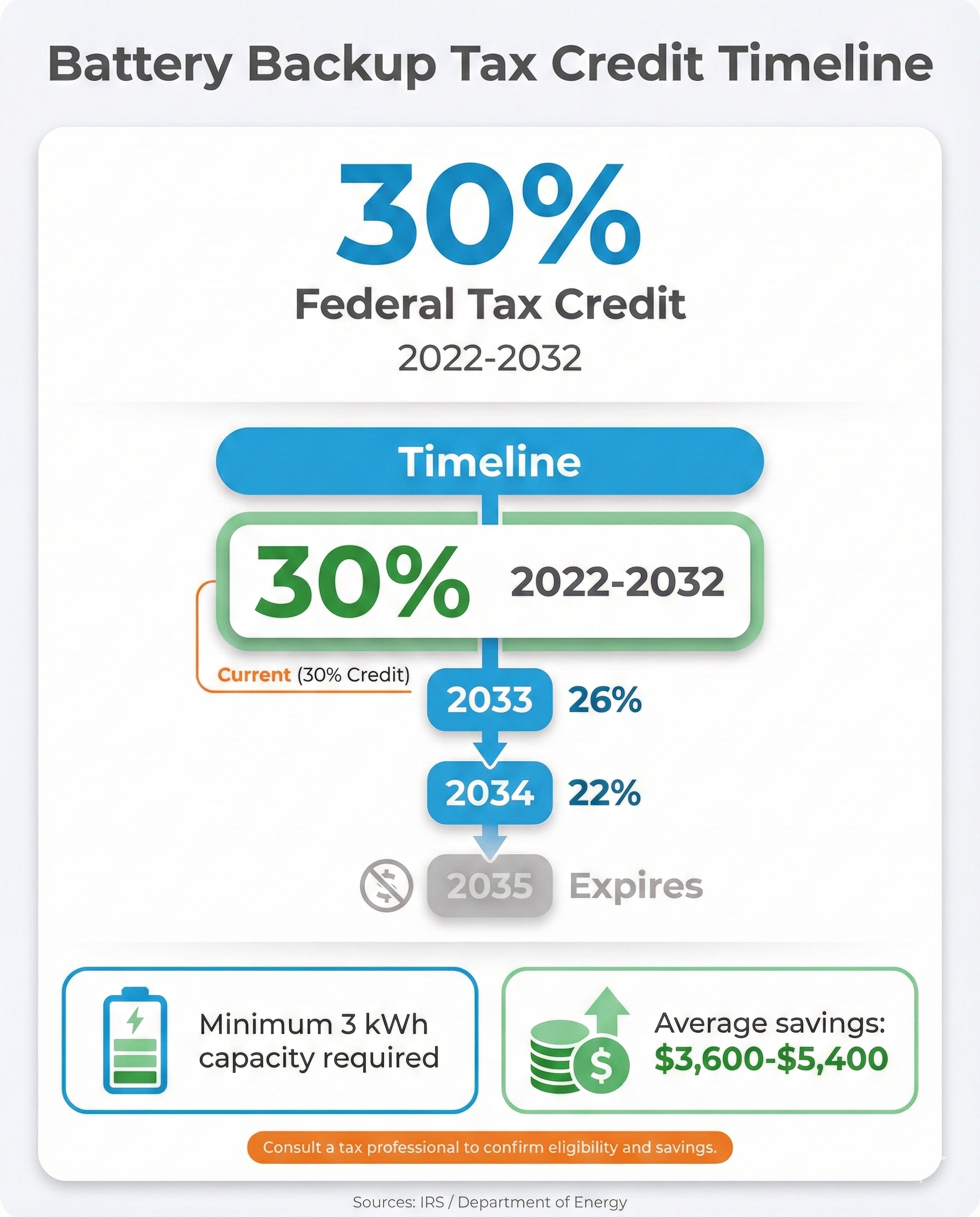
Understanding the timeline of federal tax credits is very valuable:
- 2022-2032: 30% tax credit (current rate)
- 2033: Credit reduces to 26%
- 2034: Credit reduces to 22%
- 2035: Credit expires for residential installations
The amount of tax benefits that you can get with the Residential Clean Energy Credit can be carried over without an expiration date. This means that if there is a benefit that you did not use this year, you will be able to file for it in the upcoming years.
For you to be eligible for this battery backup rebate, you must have installed a battery in your primary or secondary residence in the United States. This also means that rental properties will not fit the criteria. If you want to get the most out of your investment, then this means you would have to learn how to size your battery system correctly.
State and Utility Battery Rebate Programs
Even though there are federal tax credits that have been established for battery backup rebates, some states and utilities give additional credits that can be combined with the federal ones.
California is at the forefront with its Self-Generation Incentive Program (SGIP), which is managed by the California Public Utilities Commission. EnergySage reports that the SGIP allocates $150 per kWh for general market customers and $1,100 to households in equity categories or high-fire threat districts.
Aside from California, there are other state battery backup rebate programs that are noteworthy:
- Connecticut: $200/kWh battery rebate through the Green Bank
- Massachusetts: SMART program adds $0.03-$0.06/kWh for solar paired with batteries
- Oregon: Energy Trust offers residential battery incentives
The Solar Energy Industries Association says around 30% of new residential solar installations now include battery storage. This number is driven largely by these stacking incentives.
When considering if solar batteries are worth it for your home, be sure to consider federal as well as state or utility battery backup rebates that may apply.
How to Get Your Battery Backup Rebate
Getting your federal battery backup rebate involves specific documentation and IRS forms. Doing it the right way will get you the full tax credit.
Step 1: Collect the Necessary Documents
For your battery installation, keep these records:
- Manufacturer's certification statement (proves equipment qualifies for the credit)
- Itemized installation invoice showing equipment and labor costs separately
- Proof of installation completion date
Step 2: Fill out IRS Form 5695
You will use IRS Form 5695 to claim the Residential Clean Energy Credit. You will need to:
- Enter total qualified expenses in Part I
- Calculate 30% of eligible costs
- Transfer the credit amount to Form 1040
Step 3: File With Your Tax Return
Form 5695 must be submitted with your annual federal income tax return. The credit is applicable in the tax year the installation was finished, regardless of when payment was made for the system.
To get the most out of your overall energy investment, it’s important to understand solar and battery systems, and how they work together. A tax expert will help you correctly claim the battery backup rebate and will determine if you qualify for any other energy-related tax credits.
Battery Backup Rebates in Texas
Texas homeowners are not eligible for a state battery backup rebate. Therefore, your only incentive for installing battery storage is the federal 30% tax credit.
That said, a few Texas electric cooperatives have local battery backup rebate programs:
- Guadalupe Valley Electric Cooperative (GVEC): Offers a $2,000 rebate for members who install qualifying backup battery systems

The value of having a battery backup system in Texas was clearly proven during Winter Storm Uri in February 2021 when ERCOT data indicated more than 12 million customers were without power. When coupled with Texas solar buyback programs, home battery systems offer both backup power reliability and continued savings on energy costs.
By 2024, the residential battery market in the U.S. will have 1.3 GW of installed capacity and a 57% increase in battery adoption is predicted annually. Texas is one of the leading states in adopting this technology, largely due to the solar incentives and concerns about the reliability of the grid.
Wall mounted battery systems are a potential option for integrating power storage into your home in Texas.
Getting Started with Battery Storage
Your energy needs and potential incentives will help determine your eligibility for battery backup rebates in 2026. Here’s how to start your journey toward energy independence.
Understand Your Energy Consumption
To best inform you on suitable battery capacity for your home, you should review your energy bills from the last year to understand your usage.
Compare Several Quotes
To determine which system sizes, types of batteries, and total costs are best, obtain quotes from a few qualified installers. Quotes must list equipment and labor costs separately for tax credit purposes.
Make Sure Your Incentives Are Verified
Check eligibility for your area’s utility-specific battery backup rebate programs as well as the federal 30% tax credit.
Consider 2026 and the Years After
The 30% federal credit will be available until 2032, and the costs for solar and batteries are expected to decrease in the coming years. Your energy needs and budget will determine the optimal solar battery for your home.
At Ambit Energy VIP Energy Service, we help Texas homeowners navigate energy storage decisions with personalized guidance. Our energy consultants can match you with the right combination of battery storage and electricity plans to maximize your savings.
Ready to explore your battery backup rebate options? Get your free energy quote and discover how battery storage combined with our competitive solar buyback rate can help you achieve true energy independence.


