Update, October 2026: According to the IRS, the 30% federal Residential Clean Energy Credit is not available for systems placed in service after December 31, 2025. Mentions of the credit below apply only to systems installed by then. Texas utility rebates and the Texas property tax exemption may still lower your cost.
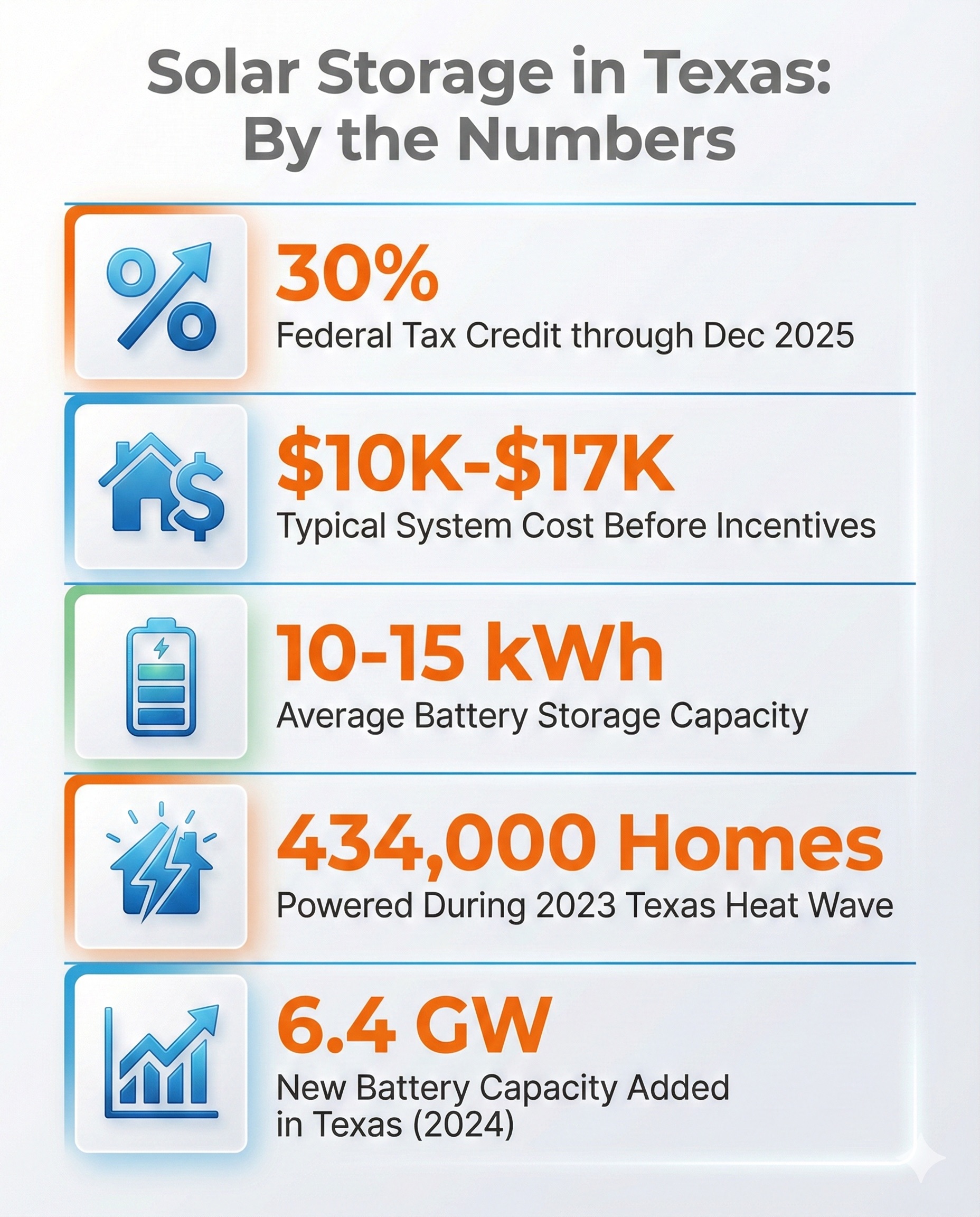
Solar storage combines photovoltaic (PV) panels with battery systems to capture and store excess solar energy for later use. This pairing allows Texas homeowners to use solar power during peak evening hours, provide backup during outages, and maximize energy independence. Modern lithium iron phosphate (LFP) batteries offer 10-15 kWh capacity, 90%+ round-trip efficiency, and 10+ year lifespans. With Texas adding 6.4 GW of new battery capacity in 2024—the most of any state—now is an ideal time to explore solar storage solutions for your home.
For a comprehensive overview of battery options and technologies, see our complete solar battery storage guide.
What Is Solar Storage and How Does It Work?
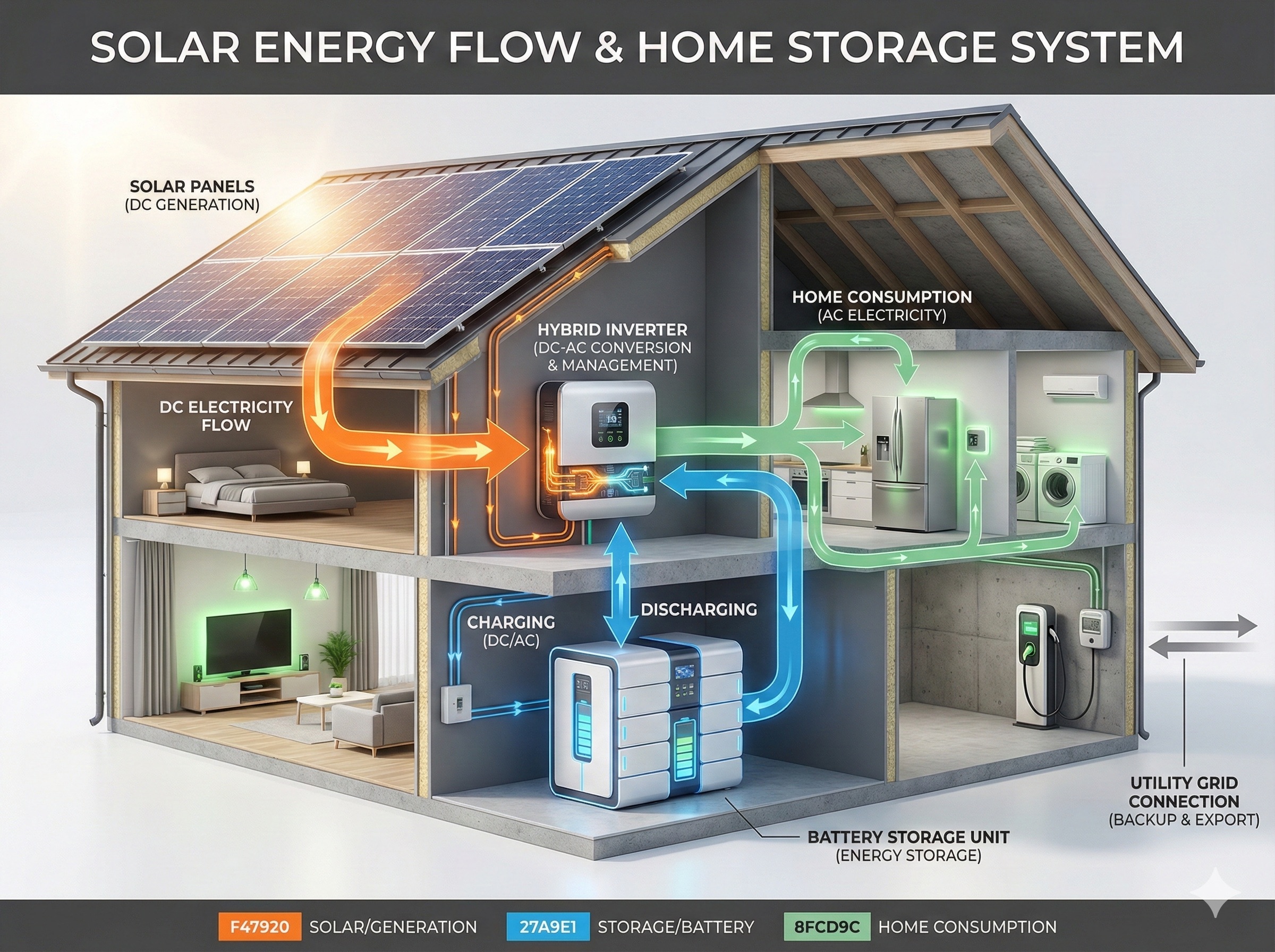
Solar storage systems pair rooftop PV panels with battery units to capture, store, and deploy solar energy on demand. During daylight hours, your solar panels generate direct current (DC) electricity. Any excess power that your home doesn't immediately consume charges your battery system instead of flowing back to the grid.
The heart of a solar storage system is the inverter. In AC-coupled systems, separate inverters handle the solar panels and battery independently. DC-coupled systems use a single hybrid inverter to manage both components more efficiently. According to the Department of Energy, hybrid inverters simplify installation and typically achieve round-trip efficiency above 90%, meaning you retain most of the energy you store.
When evening arrives or an outage occurs, your battery releases stored solar energy to power your home. This on-demand access transforms intermittent solar generation into reliable, 24-hour renewable energy.
Key Components of a Solar Storage System
A complete solar storage installation includes several essential components working in harmony:
Solar Panels: Generate DC electricity from sunlight. Most residential systems in Texas use 6-12 kW arrays depending on home size and energy consumption.
Battery System: Stores excess solar energy for later use. Popular options include the Tesla Powerwall, Enphase IQ Battery, and Generac PWRcell. Most residential batteries provide 10-15 kWh of usable capacity—enough to power essential loads for several hours during an outage.
Inverter: Converts DC electricity to AC power for home use. Hybrid inverters manage both solar production and battery storage in a single unit.
Critical Load Panel: Prioritizes which circuits receive power during outages. This ensures your refrigerator, medical equipment, and communications stay operational when you need them most.
Modern lithium iron phosphate (LFP) batteries dominate the Texas market due to their safety, longevity, and performance in high temperatures. LFP chemistry offers 90-100% depth of discharge and thousands of charge cycles over a 10+ year lifespan. Learn more about sizing your solar battery for your specific needs.
Benefits of Solar Storage for Texas Homeowners
Texas homeowners face unique energy challenges that make solar storage particularly valuable. ERCOT, the state's grid operator, projects electricity demand will nearly double by 2030, increasing strain on infrastructure during extreme weather events.
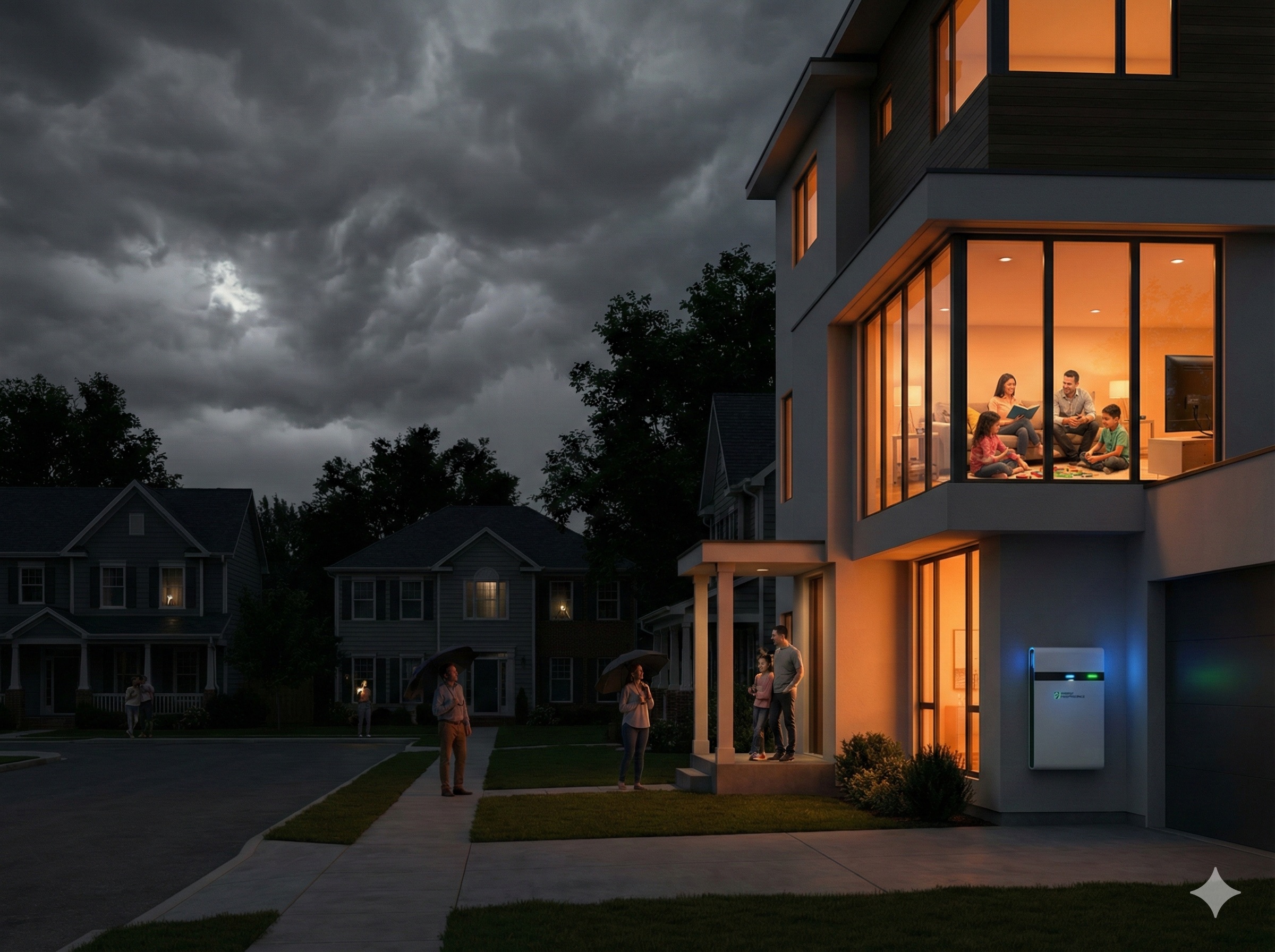
Outage Protection: During a September 2023 heat wave, battery storage systems helped avoid grid failure by powering approximately 434,000 homes when traditional generation couldn't keep up. With solar storage, you're prepared for both summer heat waves and winter storms. See how solar panels perform during power outages.
Energy Independence: Reduce your reliance on the ERCOT grid by storing your own solar energy. Use battery power during expensive peak hours or when rates spike due to demand.
Bill Savings: Maximize your solar investment through peak shaving and time-of-use optimization. Pair your system with a competitive solar buyback program to earn full credits for excess generation.
Tax Incentives: The federal Investment Tax Credit provided a 30% credit on solar storage systems placed in service by December 31, 2025. It is not available for newer systems. Texas still offers property tax exemptions for solar and battery improvements.
Costs and ROI of Solar Storage in Texas
Understanding the investment helps you plan effectively. According to Lone Star Solar Services, home battery systems in Texas typically cost $10,000-$17,000 installed before incentives.
For example, a Tesla Powerwall installation runs approximately $15,400-$16,779 before incentives. For systems installed by the end of 2025, the 30% federal tax credit brought the net cost to approximately $10,780-$11,745.
Several factors affect your solar storage ROI:
- Electricity Usage: The typical Texas home consumes 25-30 kWh daily. Higher consumption means greater potential savings.
- Buyback Programs: Solar buyback rates vary significantly between retail electric providers. Programs offering competitive credits maximize your return.
- Outage Frequency: If you experience frequent power interruptions, the value of backup power increases substantially.
Most Texas homeowners see payback periods of 10-15 years for battery storage alone, with shorter timelines when paired with solar panels in high-use households. Request your free energy quote to get a personalized cost analysis.
Is Solar Storage Right for Your Home?
Solar storage makes the most sense for homeowners who meet several criteria:
- You already have solar panels or plan to install them
- Your area experiences frequent power outages
- You want protection from volatile electricity prices
- Energy independence is a priority for your household
Consider your home's size, energy consumption patterns, and budget when evaluating options. Even modest battery systems can power essential circuits during emergencies, while larger installations provide whole-home backup capability.
For detailed guidance on home battery backup options, explore our resources or speak with an energy consultant.
Take the Next Step
Solar storage transforms your PV system from a daytime power source into a complete energy solution. With battery costs declining and Texas grid challenges intensifying, homeowners have good reasons to look at storage now.
Ready to explore solar storage for your home? Get your free energy quote or call our Texas energy consultants at (817) 402-2664 to discuss your options. You can also compare solar buyback plans to maximize your solar investment returns.
Sources
- U.S. Department of Energy - Solar Integration: Solar Energy and Storage Basics
- Lone Star Solar Services - Home Battery Storage Texas Guide
- Tesla - Powerwall Home Battery Storage
- SEIA - Energy Storage Initiative
Update, October 2026: According to the IRS, the 30% federal Residential Clean Energy Credit is not available for systems placed in service after December 31, 2025. Mentions of the credit below apply only to systems installed by then. Texas utility rebates and the Texas property tax exemption may still lower your cost.
To size a battery for solar, calculate your daily energy consumption in kilowatt-hours (kWh), multiply by your desired days of backup autonomy, then divide by the battery's depth of discharge and efficiency. For most Texas homes using 25-30 kWh daily, a 10-15 kWh battery covers essential loads during outages. Larger whole-home backup typically requires 20-30 kWh or more of storage capacity.
Understanding Solar Battery Sizing Basics
Getting your solar battery size right matters more than most homeowners realize. An undersized battery leaves you without power when you need it most. An oversized battery wastes money on capacity you'll never use. Understanding how to size battery for solar systems correctly protects both your investment and your family during outages.
Battery capacity measures how much energy a battery can store, expressed in kilowatt-hours (kWh). However, the number on the label doesn't tell the whole story. Every battery has a depth of discharge (DoD) limit—the percentage of total capacity you can actually use without damaging the battery. This is why battery backup for home systems require careful planning.
For grid-tied solar systems, battery sizing focuses on backup duration during outages. Off-grid systems require larger batteries to cover multiple days without sunshine. According to the U.S. Energy Information Administration, understanding your actual energy needs is the foundation of proper battery sizing.
The key difference between total capacity and usable capacity determines how many solar batteries you need for your specific situation.
How Much Energy Does Your Home Use?
Before calculating your battery size, you need to know your actual energy consumption. This number drives every sizing decision you'll make.
The simplest method uses your utility bill. Find your monthly kWh usage and divide by 30 to get your daily average. According to the U.S. Energy Information Administration, the average American home uses approximately 10,500-11,000 kWh annually, or roughly 880-920 kWh per month. That translates to about 29-31 kWh per day.
Texas homes typically use 25-35 kWh daily, though this varies significantly based on home size, efficiency, and whether you have electric heating or cooling. During summer months, air conditioning can push daily usage above 40 kWh. ERCOT data shows Texas residential consumption peaks during July and August.
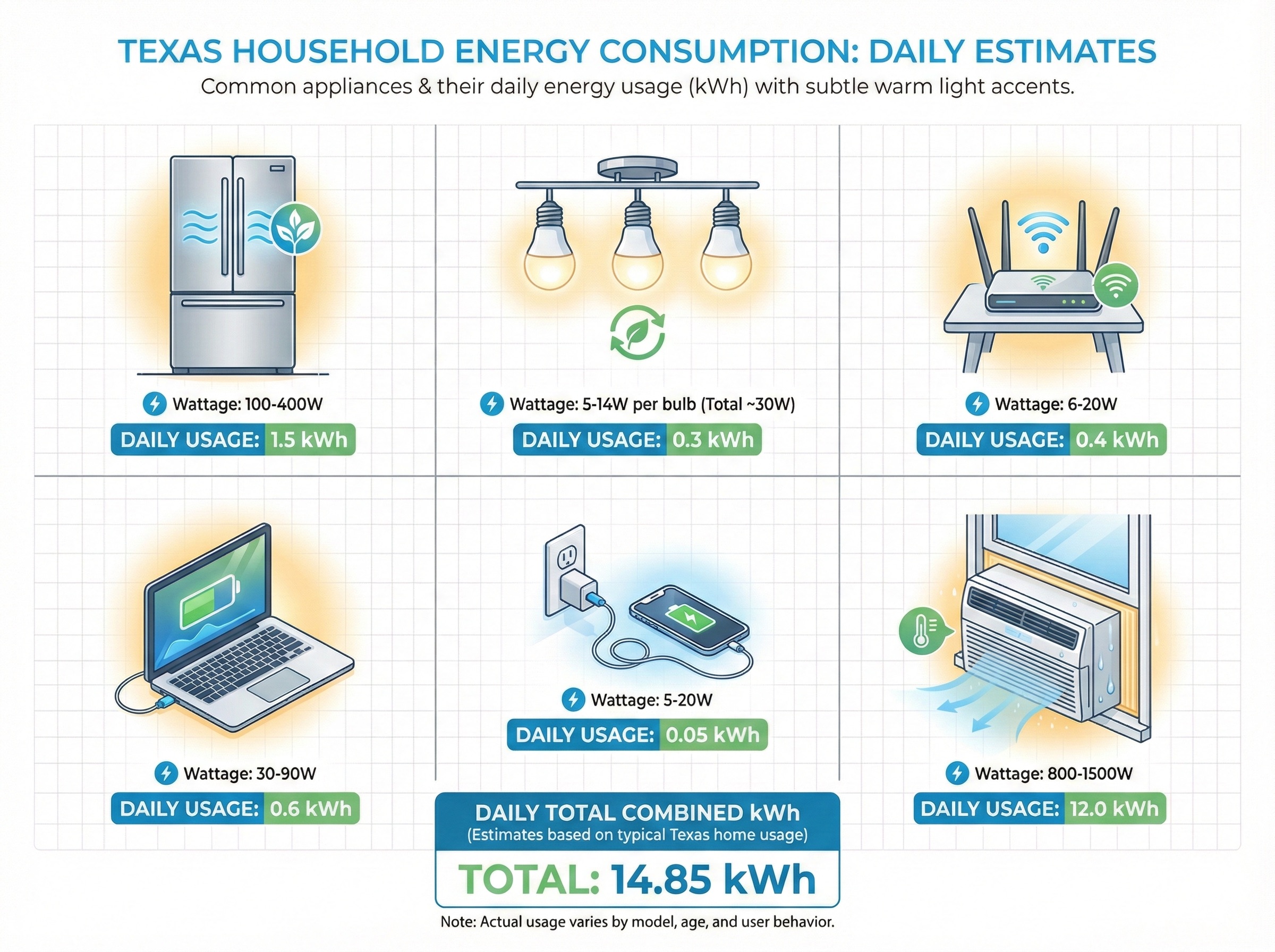
However, most homeowners don't need to power their entire home during an outage. A critical loads panel isolates essential circuits—refrigerator, lights, phone charging, WiFi router, and medical equipment. These essential loads typically consume only 8-12 kWh per day, dramatically reducing the battery capacity you need.
Common Appliance Energy Usage:
| Appliance | Watts | Hours/Day | Daily kWh |
|---|---|---|---|
| Refrigerator | 150-400 | 24 | 1.2-2.4 |
| LED Lights (10 bulbs) | 100 | 6 | 0.6 |
| WiFi Router | 10 | 24 | 0.24 |
| Phone Charger | 5 | 3 | 0.015 |
| Laptop | 50 | 4 | 0.2 |
| Window AC Unit | 1,200 | 8 | 9.6 |
| Central AC (3 ton) | 3,500 | 8 | 28 |
Understanding how much battery storage do i need starts with knowing these numbers.
The Solar Battery Sizing Formula
The core formula for calculating battery size is straightforward once you understand each component. This calculation tells you exactly how many solar batteries you need for your situation.
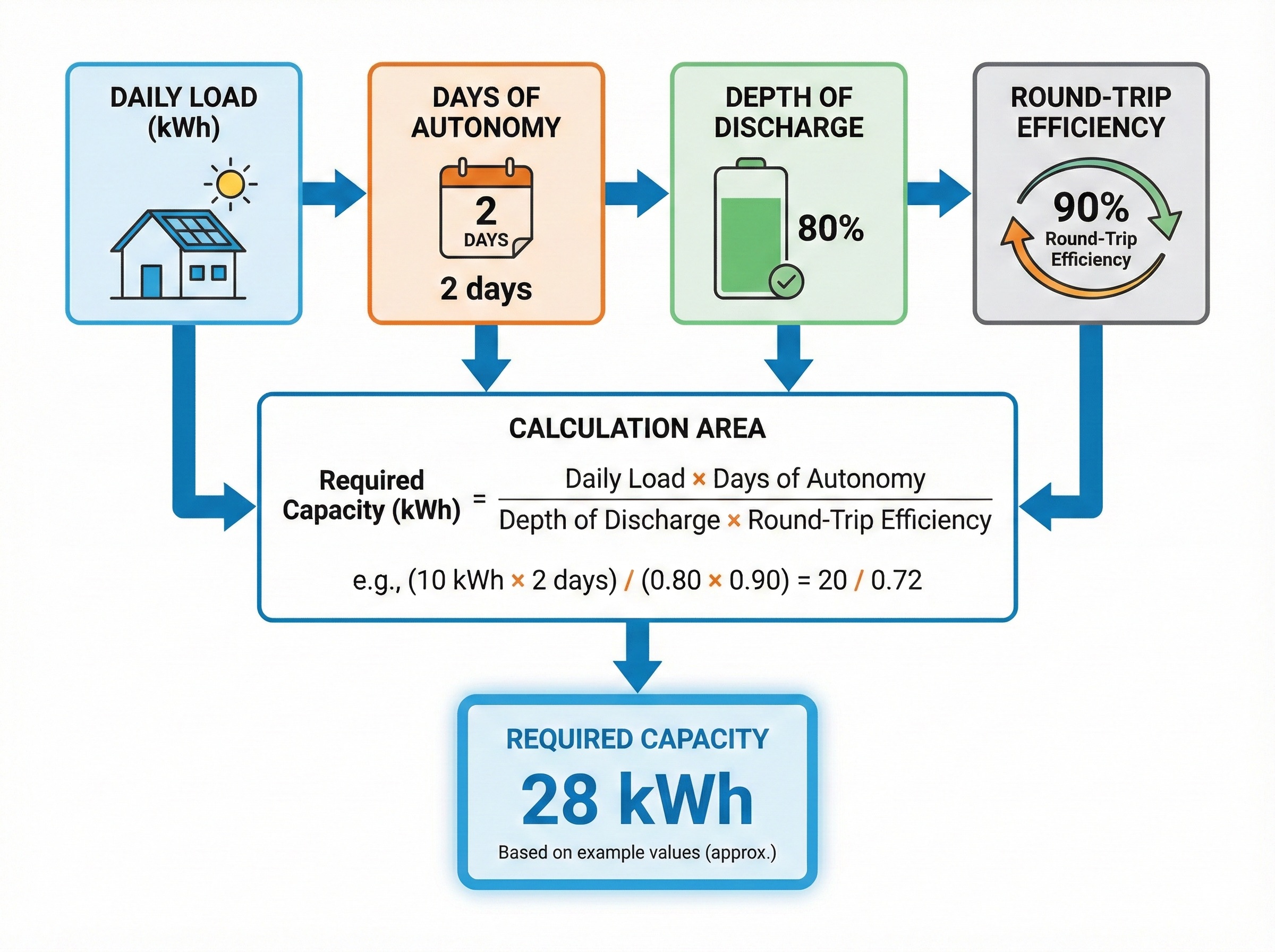
The Master Formula:
Let's break down each element:
Daily Load: Your daily energy consumption in kWh. Use your critical loads total for backup systems, or full-home usage for off-grid applications.
Days of Autonomy: How many days you want the battery to last without solar recharging. Grid-tied backup systems typically use 1-2 days. Off-grid systems often require 3-5 days to account for cloudy weather.
Depth of Discharge (DoD): The percentage of battery capacity you can safely use. Lithium iron phosphate (LFP) batteries allow 80-90% DoD. Traditional lead-acid batteries only permit 50% DoD to maintain longevity. This is why lithium batteries effectively provide more usable storage per labeled kWh.
Round-Trip Efficiency: Energy is lost during charging and discharging. Lithium batteries achieve 90-95% round-trip efficiency. Lead-acid batteries manage only 80-85%. According to BloombergNEF, these efficiency differences significantly impact long-term performance and sizing requirements.
This formula accounts for real-world losses that many battery calculators ignore. Skipping these factors leads to undersized systems that disappoint during actual outages.
Step-by-Step Battery Sizing Example
Let's work through a complete example for a typical Texas home. This practical calculation shows how to size battery for solar in real-world conditions.
Scenario: A Houston-area home wants backup power for essential loads during grid outages.
Step 1: Calculate Daily Load
- Critical loads identified: refrigerator, LED lights, WiFi, phone charging, laptop
- Total daily consumption for essentials: 10 kWh
Step 2: Choose Days of Autonomy
- Grid-tied system in urban area
- Target: 2 days of backup (typical for Texas grid-tied systems)
Step 3: Select Battery Chemistry
- Lithium iron phosphate (LFP) chosen for safety and longevity
- DoD: 80% (0.80)
- Round-Trip Efficiency: 90% (0.90)
Step 4: Apply the Formula
Required Capacity = 20 / 0.72
Required Capacity = 27.8 kWh
Result: This home needs approximately 28 kWh of nominal battery capacity. A system using two Tesla Powerwall 3 units (13.5 kWh each = 27 kWh total) would meet this requirement.
Common Sizing Scenarios:
| Backup Goal | Daily Load | Days | Battery Size Needed |
|---|---|---|---|
| Essential loads only | 8-10 kWh | 1 | 10-14 kWh |
| Essential loads | 8-10 kWh | 2 | 20-28 kWh |
| Most home circuits | 15-20 kWh | 1 | 21-28 kWh |
| Whole-home backup | 25-30 kWh | 1 | 35-42 kWh |
According to the American Clean Power Association, residential storage installations reached 608 MW of new capacity in Q2 2025, representing a 132% increase compared to Q2 2024. This growth reflects increasing homeowner interest in properly sized backup systems.
Lithium vs Lead-Acid: How Chemistry Affects Sizing
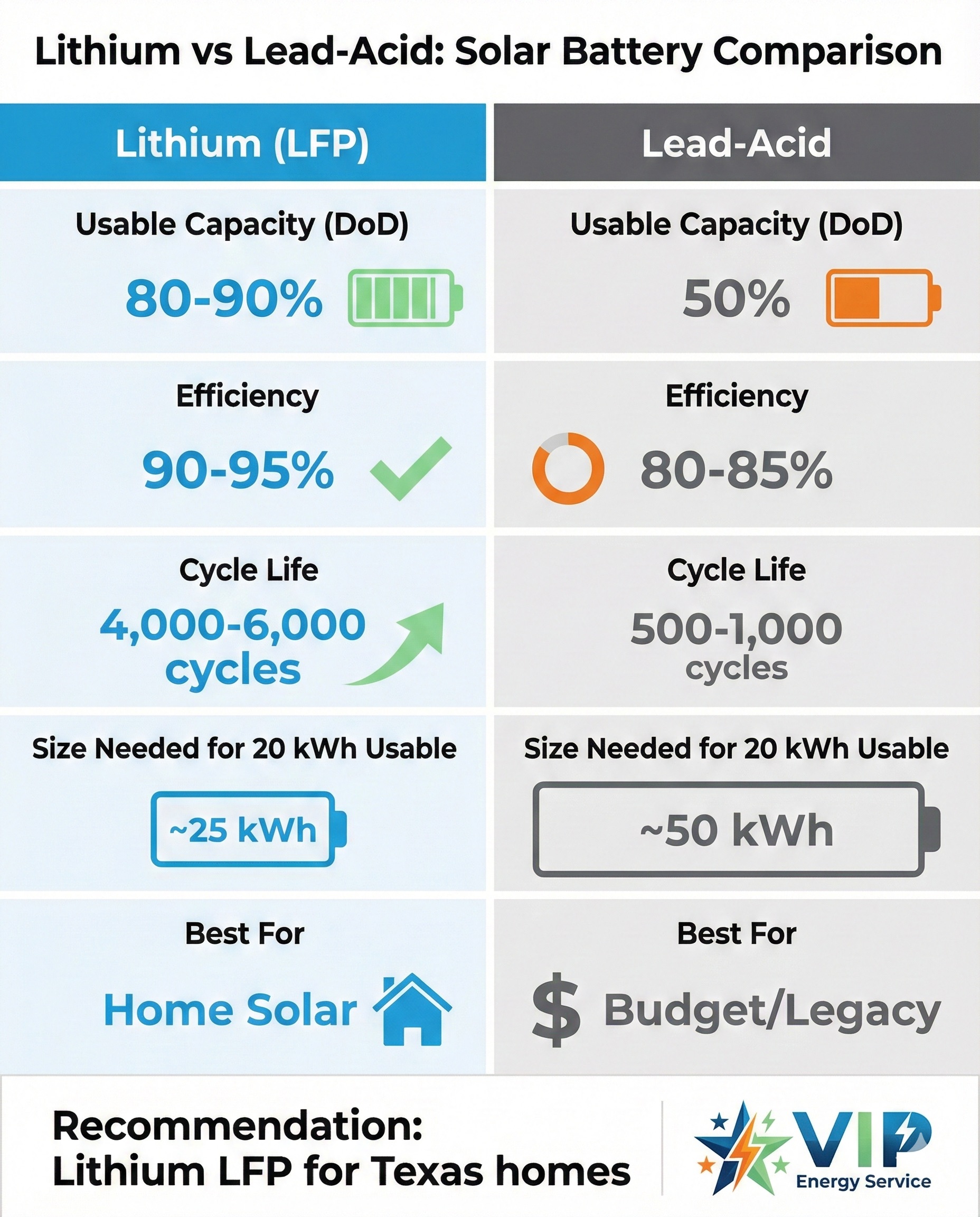
Battery chemistry dramatically impacts how many solar batteries you need. The same energy requirement produces very different battery bank sizes depending on your chosen technology.
Lithium Iron Phosphate (LFP) has become the preferred choice for residential solar storage. These batteries offer 80-90% depth of discharge, meaning you can use most of the labeled capacity. Their 90-95% round-trip efficiency loses minimal energy during charge cycles. According to ACE Battery market research, lithium-ion technology continues to dominate residential storage because of high energy density, faster charging, and longer cycle life.
Lithium NMC (Nickel Manganese Cobalt) batteries offer slightly higher energy density but require more sophisticated thermal management. Products like the Enphase IQ Battery and LG Energy Solution systems use this chemistry.
Lead-acid batteries remain available but require significantly larger installations. Their 50% depth of discharge means you need twice the nominal capacity to achieve the same usable energy. Lower 80-85% efficiency creates additional losses. While upfront costs are lower, the total cost per usable kWh typically exceeds lithium options over the system lifetime.
Chemistry Comparison:
| Factor | Lithium LFP | Lithium NMC | Lead-Acid |
|---|---|---|---|
| Usable DoD | 80-90% | 80-85% | 50% |
| Round-Trip Efficiency | 90-95% | 85-90% | 80-85% |
| Cycle Life | 4,000-6,000 | 2,000-3,000 | 500-1,000 |
| Thermal Stability | Excellent | Good | Good |
| Upfront Cost/kWh | Higher | Higher | Lower |
| Cost per Usable kWh | Lower | Moderate | Higher |
Major manufacturers like BYD and Sonnen have standardized on LFP chemistry for residential applications. This trend aligns with the MarketsandMarkets projection that the global residential energy storage market will grow from $26.9 billion in 2024 to $45.8 billion by 2030.
Solar Battery Sizing for Texas Homes
Texas homeowners face unique considerations when sizing solar batteries. The ERCOT grid operates independently from the rest of the country, and reliability concerns have driven record demand for home battery storage.
After Winter Storm Uri in 2021, Texans increasingly view battery backup as essential rather than optional. Wood Mackenzie research analyst Allison Feeney noted that "residential storage is expected to outperform rooftop solar in growth thanks to resilient policy support and high attachment rates." Texas leads the nation in new solar-plus-storage installations.
Summer Considerations: Texas summers push air conditioning systems hard. If you want to run AC during outages, plan for an additional 25-35 kWh daily beyond essential loads. Most homeowners choose smaller backup systems and rely on fans and strategic cooling rather than sizing for full AC operation.
Winter Considerations: While Texas winters are generally mild, cold snaps can stress electric heating systems. Heat pumps consume 3-5 kWh per hour when running. Gas heating with electric blower motors requires much less battery capacity.
Texas Incentive Programs: The 30% federal tax credit on battery storage is not available for systems placed in service after December 31, 2025. VP of Energy Storage Noah Roberts at the American Clean Power Association emphasized that "large-scale deployment of batteries is rapidly strengthening the U.S. grid and lowering energy costs for homes and businesses."
Consider your solar electricity plans when sizing batteries. Time-of-use rate structures can make battery storage economically attractive even without outages.
Matching Your Battery to Your Solar Panel System
Your solar array must generate enough power to recharge your battery within a reasonable timeframe. Mismatched systems create problems—either the battery never fully charges or the solar panels waste potential generation.
Solar-to-Battery Sizing Rule:
Texas averages 4.5-5.5 peak sun hours daily depending on location. For a 28 kWh battery:
This calculation ensures your panels can fully recharge the battery on a typical sunny day while still powering daytime loads.
Inverter Considerations: Your hybrid solar inverter must handle both solar input and battery charging/discharging. Check that the inverter's continuous power rating exceeds your peak load expectations. The inverter often limits how much power you can draw simultaneously from the battery.
System Voltage: Most residential systems operate at 48V for efficiency. Higher voltages reduce wiring losses and improve charge controller performance. Systems using lower voltages (12V or 24V) work for small applications but require more complex wiring for whole-home backup.
If your existing solar system produces more than you use, you might be able to sell solar energy back to the grid. Battery storage gives you flexibility to choose when to export excess power versus storing it for later use.
Common Solar Battery Sizing Mistakes to Avoid
Even experienced solar installers sometimes make sizing errors. Avoiding these common mistakes ensures your battery system performs as expected.
Mistake 1: Ignoring Depth of Discharge
Many homeowners compare batteries by total capacity alone. A 10 kWh lead-acid battery with 50% DoD delivers only 5 kWh of usable energy—the same as a 5.5 kWh lithium battery with 90% DoD. Always calculate usable capacity.
Mistake 2: Forgetting Round-Trip Efficiency
Every charge-discharge cycle loses some energy. A system sized without accounting for efficiency losses will underperform by 5-15%. The formula in this guide includes this factor.
Mistake 3: Sizing for Average Instead of Peak Usage
Your energy usage varies throughout the year. Sizing for your annual average leaves you short during peak summer months. Use your highest-consumption season for backup sizing.
Mistake 4: Ignoring Battery Degradation
Batteries lose capacity over time. A new 10 kWh battery might only hold 8 kWh after 5-7 years. Building in 10-15% extra capacity accounts for this degradation.
Mistake 5: Overlooking Texas Heat
High temperatures reduce battery efficiency and accelerate degradation. Batteries installed in unconditioned spaces (garages, outdoor enclosures) may need additional capacity to compensate. LFP batteries handle heat better than other lithium chemistries—one reason they're preferred for Texas installations.
Frequently Asked Questions
How many solar batteries do I need for my house?
The number depends on your daily energy consumption and backup goals. Most Texas homes need 10-15 kWh for essential backup (1 battery) or 20-30 kWh for extended backup (2 batteries). Calculate your specific needs using the formula above.
What size battery for a 5kW solar system?
A 5kW solar system pairs well with 10-15 kWh of battery storage. This ratio allows full battery charging on sunny days while leaving generation capacity for daytime loads. Larger batteries may not fully charge during shorter winter days.
How long will a 10 kWh battery last during an outage?
Duration depends entirely on your load. Running essential loads (refrigerator, lights, WiFi) at 400-500 watts gives you 20-25 hours. Adding a window AC unit at 1,200 watts reduces runtime to approximately 6-8 hours. Whole-home loads drain a 10 kWh battery in just 2-3 hours.
Can I add more batteries later?
Most modern systems are modular and expandable. The Tesla Powerwall, Enphase IQ Battery, and Sonnen systems all support adding additional units. Verify expandability before purchasing if you anticipate future needs. Starting smaller and adding capacity later often makes financial sense.
Getting Your Solar Battery Size Right
Proper battery sizing protects your investment and ensures reliable backup when you need it most. The formula is straightforward: calculate your daily load, multiply by days of autonomy, and divide by usable capacity factors.
For most Texas homeowners, a 10-15 kWh battery system handles essential loads through typical outages. Whole-home backup or multi-day autonomy requires 25-40 kWh or more. Either way, accurate sizing prevents both underpowered disappointment and overspending on excess capacity.
When calculations get complex or you're unsure about load estimates, professional guidance pays for itself in system performance. VIP Energy Service helps Texas homeowners determine exactly how much battery storage they need based on their specific home, usage patterns, and backup priorities.
Ready to size your solar battery system correctly? Contact VIP Energy Service for a personalized assessment of your home's energy needs and battery storage options.
Sources
- U.S. Energy Information Administration - Residential Energy Consumption Survey
- American Clean Power Association - U.S. Energy Storage Monitor Q2 2025
- BloombergNEF - Global Energy Storage Growth Outlook 2025
- MarketsandMarkets - Residential Energy Storage Market Trends 2025
- EnergySage - How Many Solar Batteries Do You Need?
Update, October 2026: According to the IRS, the 30% federal Residential Clean Energy Credit is not available for systems placed in service after December 31, 2025. Mentions of the credit below apply only to systems installed by then. Texas utility rebates and the Texas property tax exemption may still lower your cost.
When a solar panels power outage situation occurs, most Texas homeowners discover a frustrating truth: their grid-tied solar system shuts down completely. Even though the sun is shining and your panels are capable of producing electricity, standard solar installations cannot power your home during a blackout. The reason comes down to a critical safety feature called anti-islanding protection. However, pairing your solar system with solar battery storage creates a solution that keeps your essential circuits running when ERCOT goes dark.
Why Grid-Tied Solar Panels Shut Down During Outages
If you have solar panels and the power goes out, your inverter immediately stops sending electricity to your home. This automatic shutdown happens within milliseconds—faster than you would notice. The technology behind this response is called anti-islanding protection, and every grid-tied solar system in Texas is required to have it.
Anti-islanding protection exists to protect utility workers. According to Lone Star Solar Services, when the electrical grid goes down, repair crews work on power lines assuming those lines carry no current. If your solar panels continued feeding electricity back into the grid during an outage, workers could face lethal voltages they did not expect.
During Winter Storm Uri in 2021, over 4.5 million Texas homes and businesses lost power—some for days. ERCOT forecasts a 50% chance of rolling outages during extreme winter weather similar to December 2022 conditions. When the power grid fails, your grid-tied solar system cannot help because it has no way to safely disconnect from ERCOT while continuing to power your home.
How Anti-Islanding Protection Works
Your solar inverter constantly monitors grid voltage and frequency. When these readings fall outside a narrow acceptable range—as they do during any blackout or brownout—the inverter disconnects automatically. This applies to standard string inverters and microinverters alike.
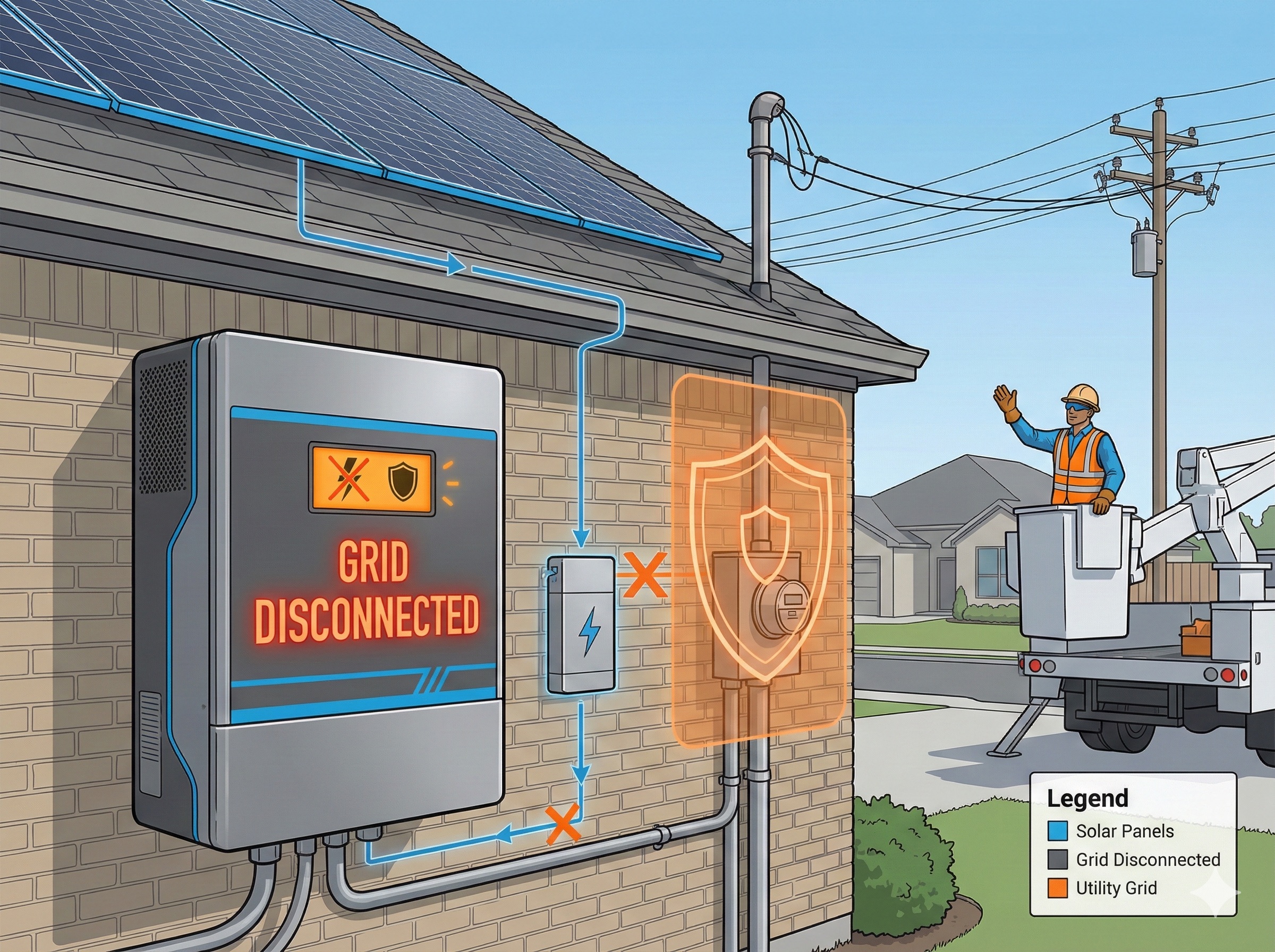
The solar panels power cut happens instantly because your equipment is designed to "listen" for the grid's presence. Without detecting stable grid power, the inverter will not operate, even with abundant sunshine on your panels.
The Solution: Solar Battery Storage Systems
Adding a home battery storage system transforms your solar installation from grid-dependent to backup-capable. According to energy experts interviewed by ABC13 Houston, "The first step to making a home or business more resilient to power outages is to look into some of the separate elements of a microgrid, such as solar panels, a generator, or battery energy storage systems."
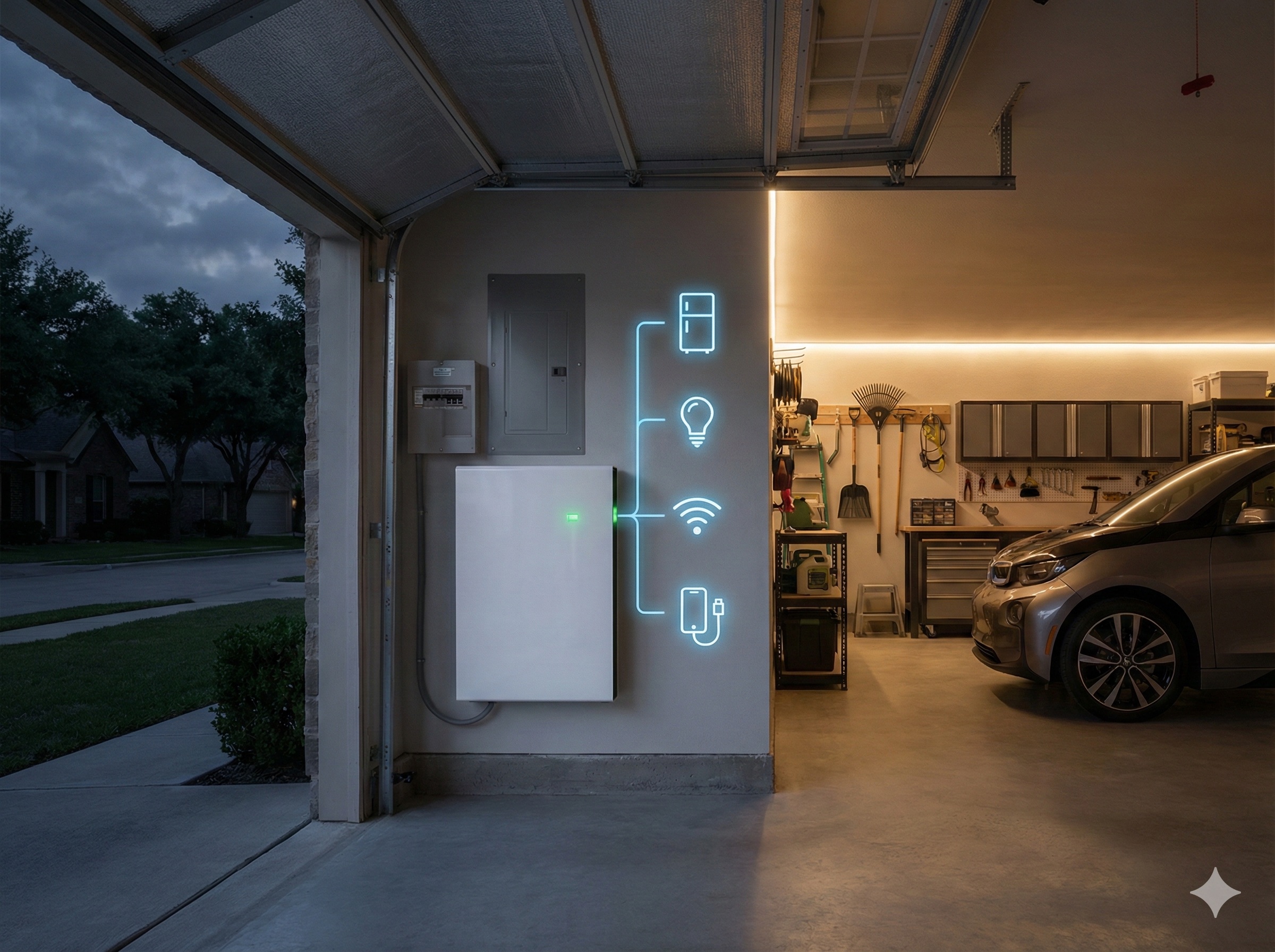
A battery backup system includes:
- Home battery storage (10-15 kWh capacity typical)
- Hybrid inverter that can manage solar, battery, and grid connections
- Critical loads panel that prioritizes essential circuits
When the power goes out, your hybrid inverter isolates your home from ERCOT and switches to battery power within seconds. Your solar panels continue generating electricity during daylight hours, charging the battery while simultaneously powering your home. At night, stored energy keeps your essential systems running.
During the September 2023 Texas heat wave, battery storage resources helped avoid grid failure by providing power equivalent to about 434,000 homes when traditional generation could not keep up.
What a Battery Backup System Powers
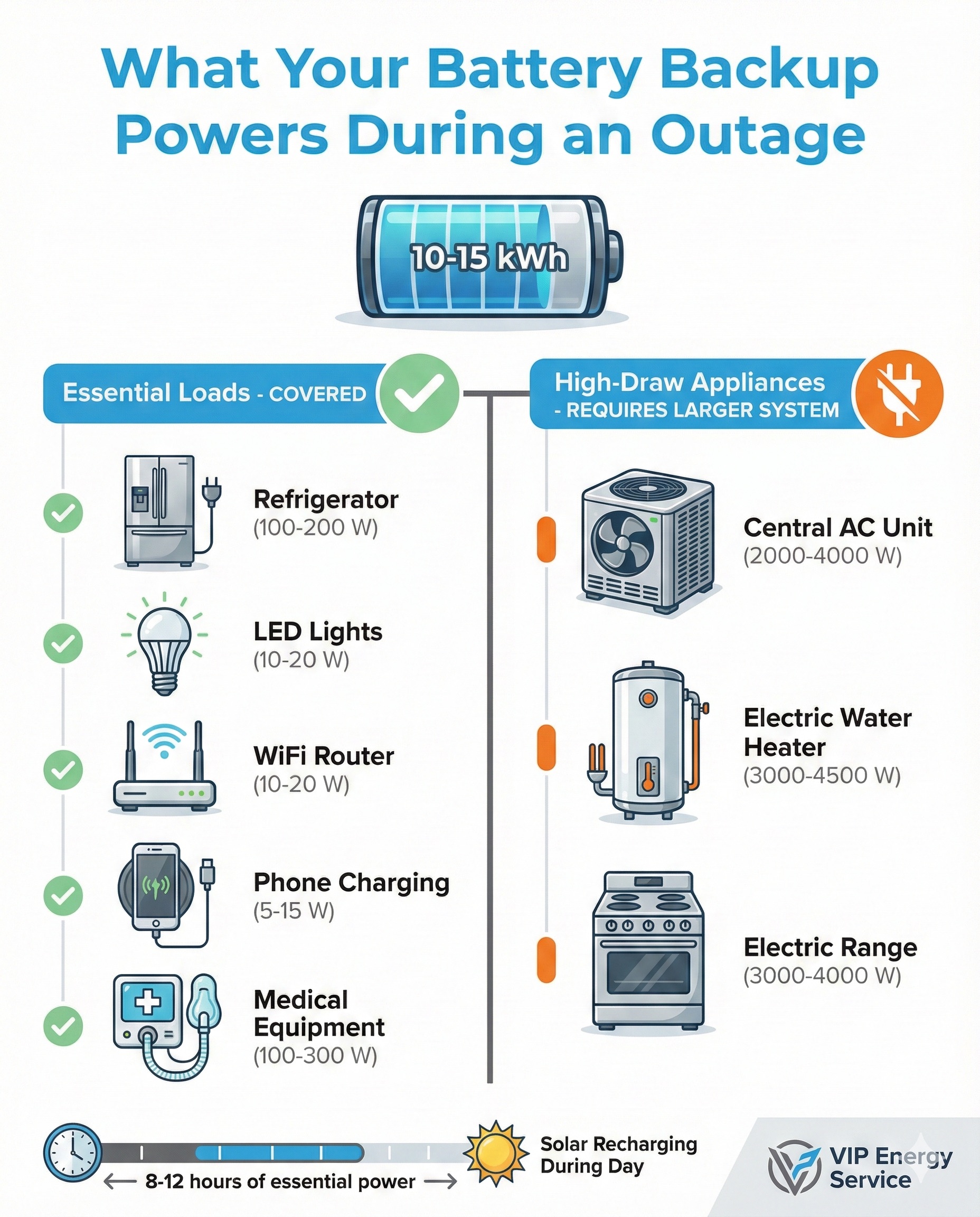
Most residential battery systems in Texas provide 10-15 kWh of storage. Texas homes average 25-30 kWh of daily consumption, so batteries typically cover essential loads:
Usually covered: Refrigerator, LED lights, WiFi router, phone charging, medical equipment, garage door
Requires larger system: Central AC, electric water heater, electric range
Texas-Specific Considerations for Solar Backup
Texas faces unique challenges because ERCOT operates largely isolated from other U.S. grids. When extreme weather strikes—whether Winter Storm Uri or Hurricane Beryl—outside assistance cannot flow in easily.
The Texas Legislature recognized this vulnerability by approving $1.8 billion for the Texas Backup Power Package Program. According to UH Energy Innovation, this represents "a significant shift toward distributed energy resilience in the state's broader electricity reliability strategy."
For homeowners, the economics of battery storage continue improving. The 30% federal Investment Tax Credit applies to both solar and battery installations. Additionally, working with Ambit Energy provides access to a competitive solar buyback rate—one of only two such programs available in Texas. This rate helps offset battery costs by maximizing the value of your solar generation during normal grid operation.
Getting Started with Solar Battery Backup
If your home already has grid-tied solar, retrofitting a battery system is possible. You will need:
- Assessment of daily energy needs (typical Texas home: 25-30 kWh)
- Evaluation of existing inverter compatibility or upgrade to hybrid inverter
- Sizing calculation for battery capacity based on backup priorities
- Installation of transfer switch or critical loads panel
VIP Energy Service offers personalized energy consulting to evaluate your options. Unlike online-only providers, our local Texas energy consultants work face-to-face with homeowners to match solar buyback plans and backup solutions to specific needs.
The federal tax credit combined with competitive electricity rates and plans make 2025 an excellent time to add battery backup. Many homeowners also qualify for no-deposit electricity service, removing upfront barriers.
Ready to keep your home powered during the next Texas blackout? Get your free energy quote from VIP Energy Service and discover how solar battery storage protects your family when ERCOT cannot.
Sources
- Lone Star Solar Services - Home Battery Storage Texas Guide
- ABC13 Houston - Texas Microgrids Emerge as Backup Solution
- UH Energy Innovation - Microgrid Resilience in Texas
- Texas Tribune - Texas Solar for All Program Coverage
- EcoFlow - Texas Solar Boom 2025
Quick Answer: If you have solar panels and the power goes out, your solar system will stop generating electricity—even on a sunny day. This happens because of a safety feature called anti-islanding protection. The good news? Adding battery storage for your solar panel system keeps your home powered during grid outages.
You've invested in solar panels. The sun is shining. Then the power goes out, and your lights go dark just like everyone else's. It's one of the most common frustrations Texas homeowners experience with grid-tied solar systems.
The reason comes down to safety—specifically, protecting utility workers who repair power lines during outages. But understanding why your solar panels stop working during a power outage also reveals the solution: battery storage.
Why Solar Panels Stop Working During Power Outages
Most residential solar systems in Texas are grid-tied. This means your solar panels connect directly to the electrical grid through an inverter. When your panels produce more electricity than you need, excess power flows to the grid. When you need more than your panels produce, you pull from the grid.
Here's the critical part: your inverter must detect grid power to operate. During a solar panels power cut, the inverter immediately shuts down. This isn't a malfunction—it's a deliberate safety mechanism.
Anti-Islanding Protection Explained
When power lines go down, utility workers need to repair them safely. If your solar panels continued sending electricity into the grid during an outage, they could electrocute workers or cause fires.
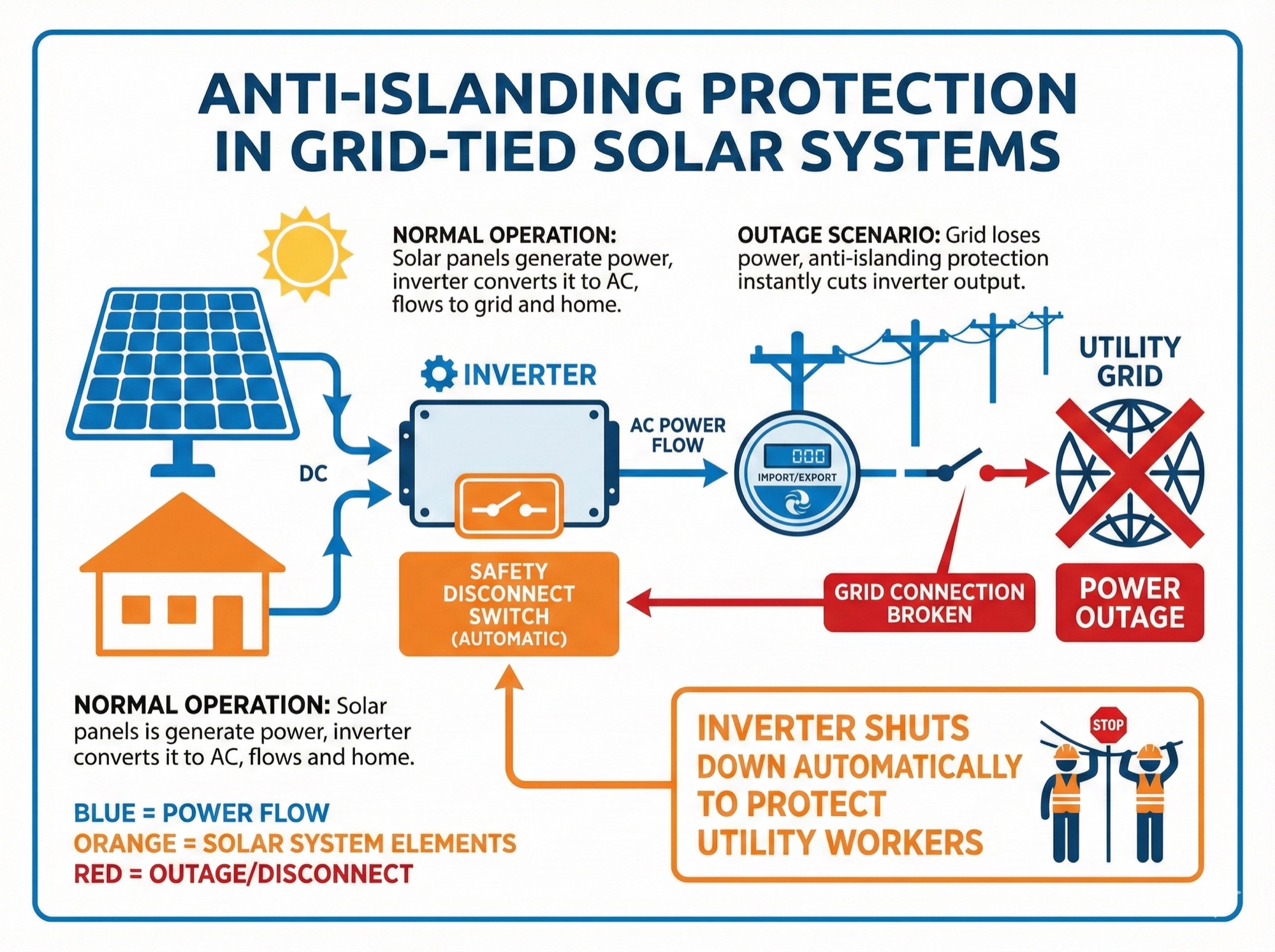
The safety feature that prevents this is called anti-islanding protection. Every grid-tied solar inverter must include it by law, per IEEE Standard 1547. The moment your inverter detects the grid is down, it stops converting solar energy to usable electricity.
This means your solar panels work during normal conditions but become useless exactly when you might need backup power most—during storms, grid failures, or the Texas grid instability events that have become increasingly common.
The Battery Storage Solution
If you have solar panels and the power goes out, battery storage changes everything. A solar battery system stores excess energy your panels produce during the day. During an outage, the battery disconnects from the grid and powers your home independently.
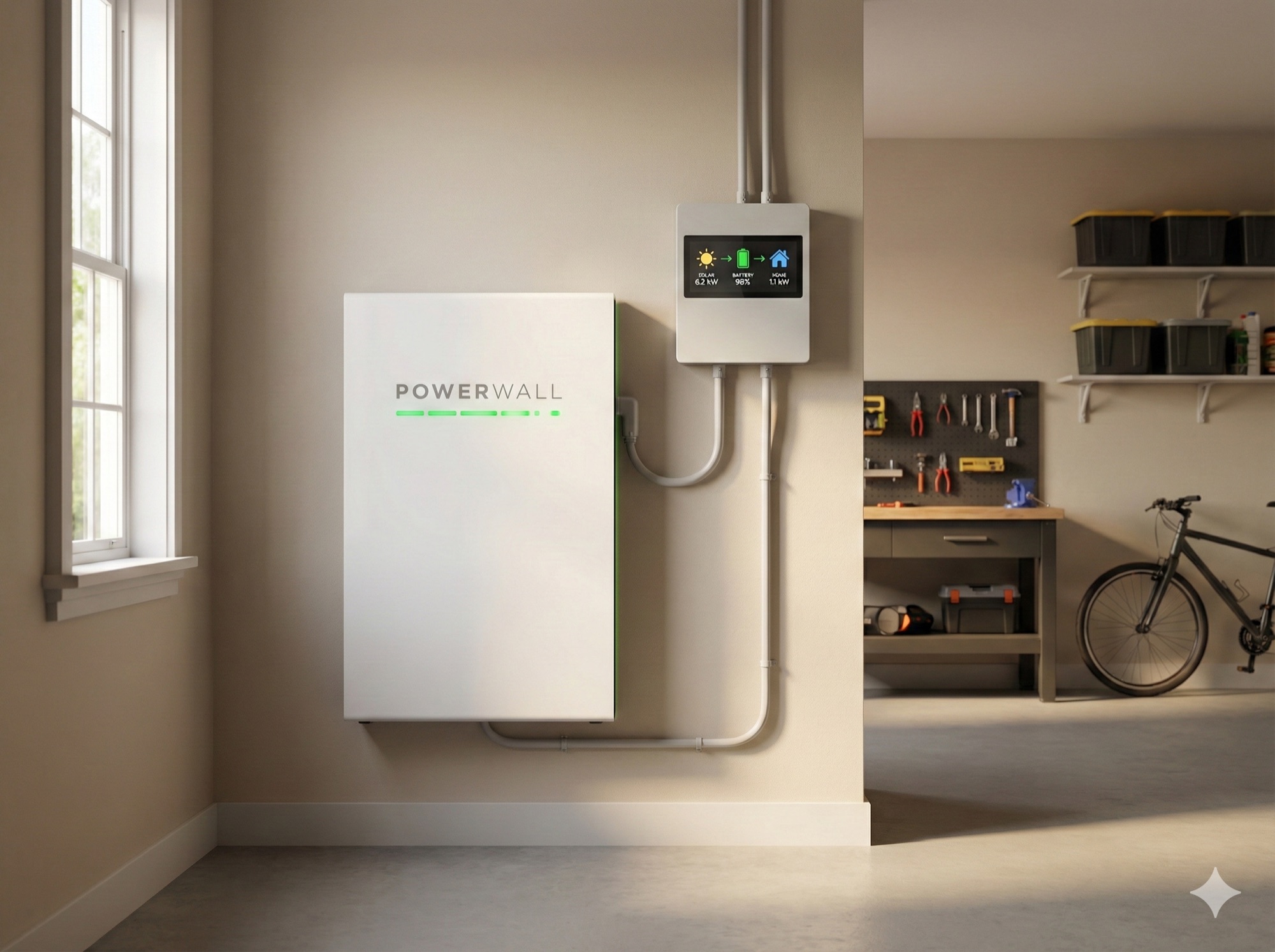
This setup is called "islanding" when done safely—your home becomes an island, powered by stored solar energy without any connection to utility power lines.
How Battery Backup Works
Here's the basic flow:
- Normal operation: Solar panels charge the battery while powering your home. Excess goes to the grid (earning solar buyback credits).
- Outage detection: The battery system detects the power outage within milliseconds.
- Automatic switchover: The system disconnects from the grid and switches to battery power seamlessly—often so fast you won't notice.
- Continued solar charging: During daylight, your panels continue charging the battery while it powers your home.
- Night operation: The battery provides stored power until morning, when solar charging resumes.
How Much Battery Storage Do You Need?
The right battery capacity depends on two factors: which appliances you want to power and how long outages typically last in your area.
Essential Loads Coverage

Most Texas homeowners choose to power essential loads during outages:
| Appliance | Daily Usage |
|---|---|
| Refrigerator | ~1.5 kWh per day |
| LED Lights | ~0.5 kWh per day |
| WiFi Router | ~0.2 kWh per day |
| Phone/Device Charging | ~0.3 kWh per day |
| Medical Equipment | Varies by device |
A typical 10-15 kWh battery system can power these essentials for 24-48 hours—longer if the sun is shining and your panels keep charging.
For whole-home backup during extended outages, you may need 20-40 kWh of storage depending on your energy needs and home size.
Cost and ROI Considerations
Battery storage adds $10,000-$20,000 to a solar installation, depending on capacity. However, the federal solar tax credit applies to batteries installed with solar, reducing costs by 30%.
Beyond backup power, batteries offer additional savings:
- Time-of-use optimization: Store cheap daytime solar and use it during expensive evening peak rates
- Demand charge reduction: Smooth out energy usage to avoid utility demand charges
- Increased solar self-consumption: Use more of your own solar energy instead of selling it back at wholesale rates
For Texas homeowners tired of grid reliability issues, the peace of mind alone often justifies the investment.
Getting Started with Solar Battery Storage
If your current solar panels power cut frustration has you considering battery backup, here's your next step: get a personalized assessment of your energy needs and backup requirements.
At VIP Energy Service, we help Texas homeowners find the right combination of solar and battery solutions for their homes. Our energy consultants can analyze your usage patterns, outage history, and budget to recommend the optimal system.
Ready to keep your lights on during the next outage? Request your free energy quote and discover how solar battery storage can provide true energy independence for your Texas home.
Sources
- ERCOT - Texas Grid Generation Information (2025)
- U.S. Department of Energy - Homeowner's Guide to the Federal Tax Credit for Solar Photovoltaics
- IEEE Standard 1547-2018 - Anti-Islanding Requirements for Distributed Energy Resources
Commercial battery storage systems help Texas businesses reduce energy costs by 20-40% on demand charges while providing critical backup power during grid emergencies. With installation costs dropping 93% since 2010 and Texas offering property tax exemptions plus federal tax credits, commercial and industrial battery storage has never been more accessible for businesses seeking energy independence and resilience.
In this guide, we cover everything Texas business owners need to know about commercial battery storage—from costs and benefits to incentives and whether it makes sense for your facility. If you're exploring ways to pair battery storage with solar battery storage, you're in the right place.
What Is Commercial Battery Storage?
Commercial battery storage refers to Battery Energy Storage Systems (BESS) designed for business and industrial applications. Unlike residential systems, commercial battery storage systems typically range from 100 kWh to over 1 MWh in capacity.
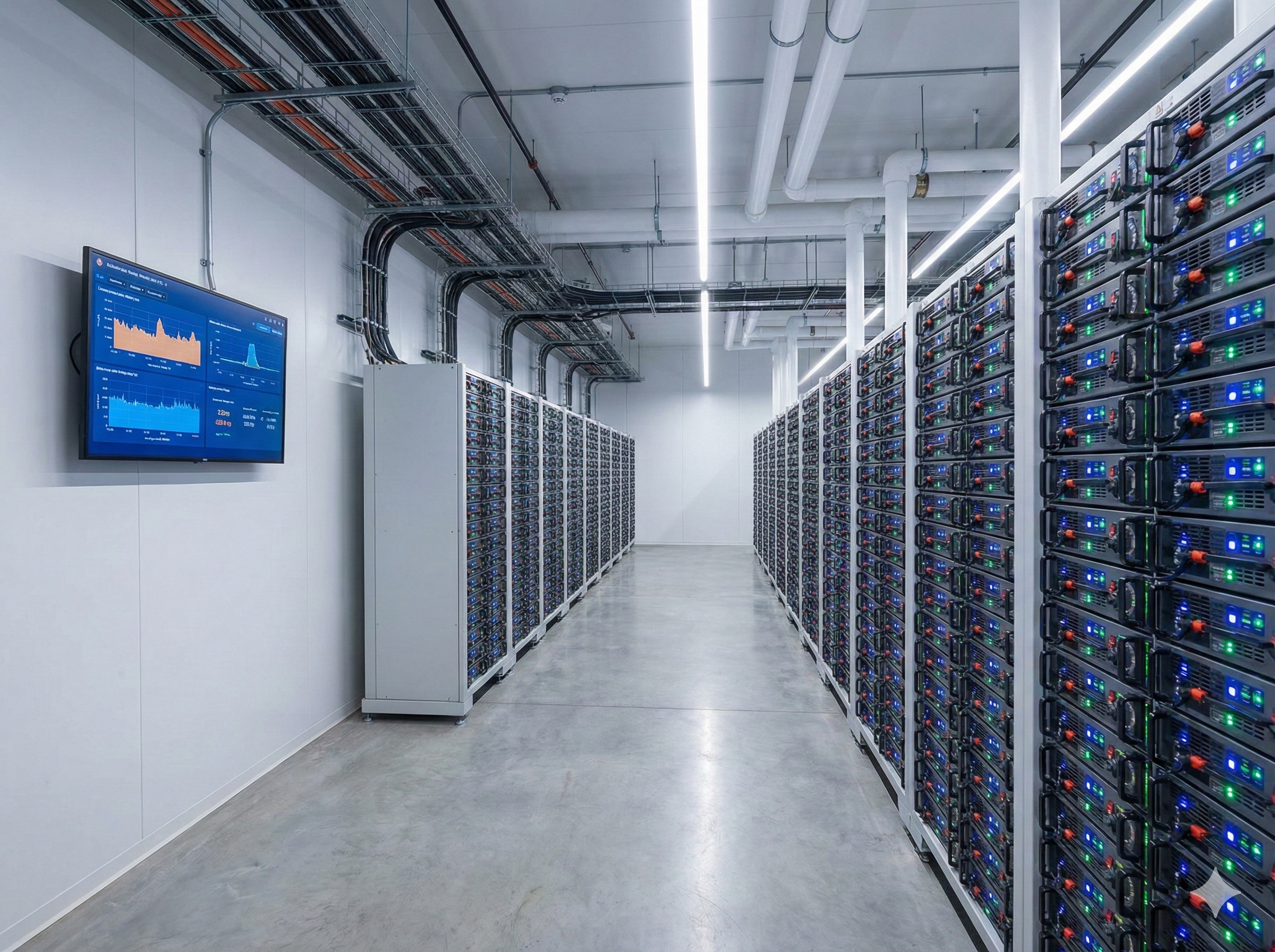
These industrial battery storage solutions serve two primary functions: behind-the-meter applications (reducing your facility's grid demand) and front-of-meter applications (selling services back to the grid). According to the National Renewable Energy Laboratory's 2024 Annual Technology Baseline, lithium-ion batteries—particularly lithium iron phosphate (LFP) chemistry—dominate today's commercial and industrial energy storage market due to their safety profile and longevity.
Why Texas Businesses Are Investing in Commercial Battery Storage
The Texas Battery Boom
Texas leads the nation in battery storage deployment. According to Yes Energy's 2025 ERCOT analysis, Texas now has nearly 10 GW of commercial battery storage capacity—more than the other 48 states combined. The U.S. Energy Information Administration reports that 50% of all planned U.S. battery storage capacity will be built in Texas.
Business Drivers
Why the surge? Texas businesses face unique energy challenges:
- Peak demand charges: The 4CP (Four Coincident Peak) system penalizes businesses during high-demand periods
- Grid resilience: After Winter Storm Heather in January 2024, the Texas Comptroller reported that commercial battery storage units delivered $750 million in market savings
- Rising electricity costs: Industrial energy storage offers price protection through energy arbitrage
- ERCOT market structure: Texas's deregulated grid rewards battery flexibility with ancillary services payments
Key Benefits of Commercial Battery Storage Systems
Demand Charge Reduction
Peak demand management is the primary benefit for most Texas businesses. By discharging during 4CP periods, commercial battery storage systems can reduce transmission charges by 20-40%. For facilities with high demand charges, the savings alone often justify the investment.
Backup Power and Resilience
Commercial battery storage systems provide critical backup power for data centers, manufacturing facilities, healthcare operations, and retail businesses. When ERCOT issues grid emergencies, industrial battery storage keeps your operations online while competitors face costly downtime.
Solar Integration
Pairing commercial battery storage systems with solar PV maximizes your renewable energy investment. Industrial energy storage lets you store excess generation during peak production hours, then discharge during evening rate spikes. This time-shifting strategy amplifies your solar buyback in Texas returns and helps you turn excess power into savings.
Revenue Opportunities
Beyond cost savings, industrial battery storage creates revenue streams through:
- Demand response program participation
- Ancillary services payments from ERCOT
- Energy arbitrage (charge during low wholesale prices, discharge during peaks)
Commercial Battery Storage Costs in 2025
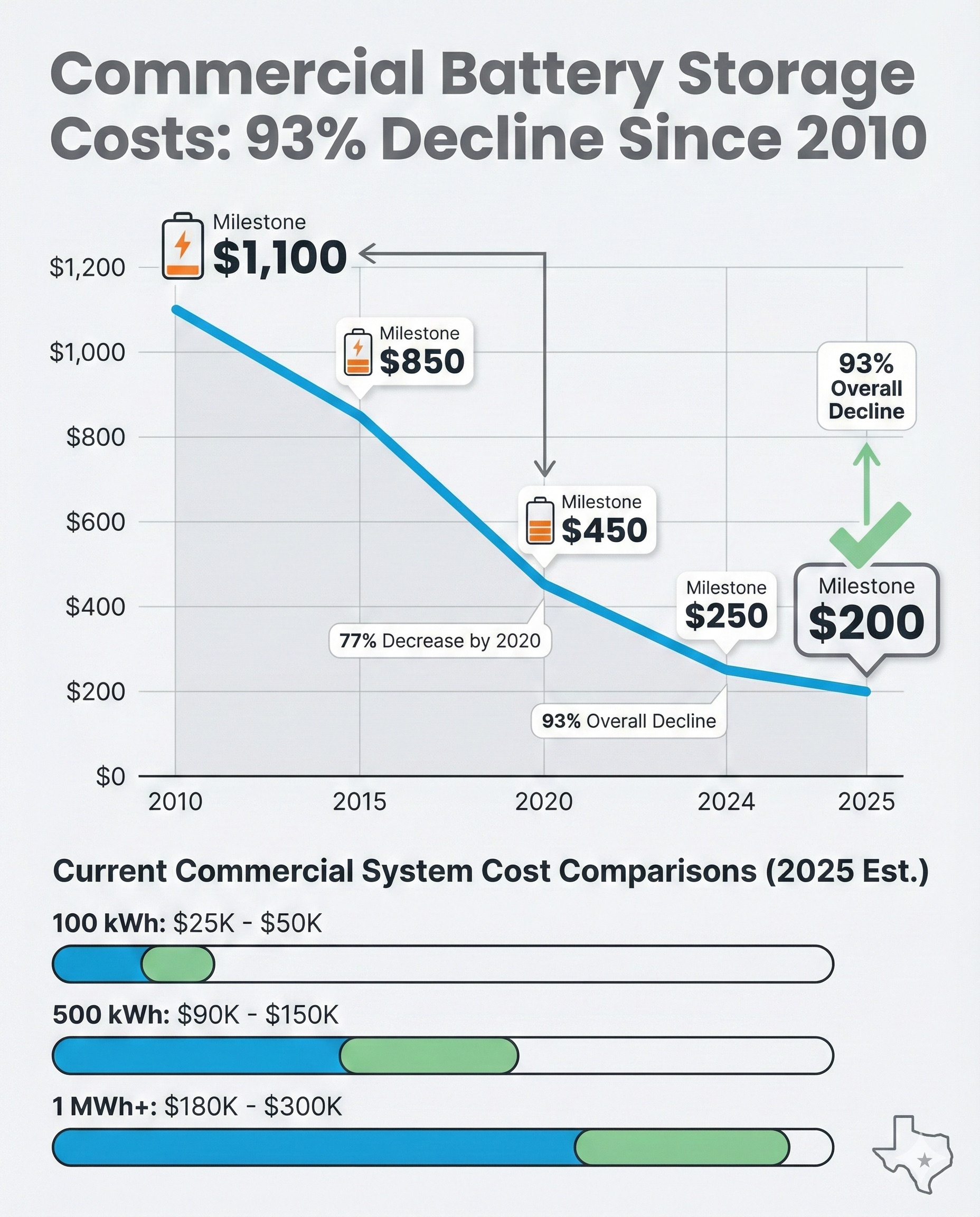
Commercial battery storage costs have plummeted. According to IRENA's 2025 battery storage report, two-hour systems saw a 38% cost reduction in 2024 alone.
Current installed costs for commercial battery storage systems:
| System Size | Cost Range | Best For |
|---|---|---|
| 100 kWh | $25,000-$50,000 | Small businesses, retail |
| 500 kWh | $90,000-$150,000 | Medium facilities, offices |
| 1 MWh+ | $180,000-$300,000 | Large industrial operations |
Per-kWh costs range from $280-$580 for standard commercial battery storage systems to $180-$300 for large containerized industrial energy storage installations. That's a 93% decline from 2010 prices, making industrial battery storage accessible for businesses of all sizes.
Texas Incentives for Commercial Battery Storage
Texas offers significant financial incentives for commercial battery storage investment:
- Federal Investment Tax Credit (ITC): Now available for standalone battery storage under the Inflation Reduction Act
- 40% Bonus Depreciation (2025): Immediate deduction on system value
- MACRS Depreciation: 5-year accelerated depreciation schedule
- Property Tax Exemption: 100% exemption on added appraised value for solar+storage systems
- Local Abatements: Up to 10-year property tax abatements available in many Texas jurisdictions
Ready to calculate your savings? Our energy consultants can help you navigate available incentives and determine your potential ROI. Get your free energy quote to start the conversation.
Is Commercial Battery Storage Right for Your Business?
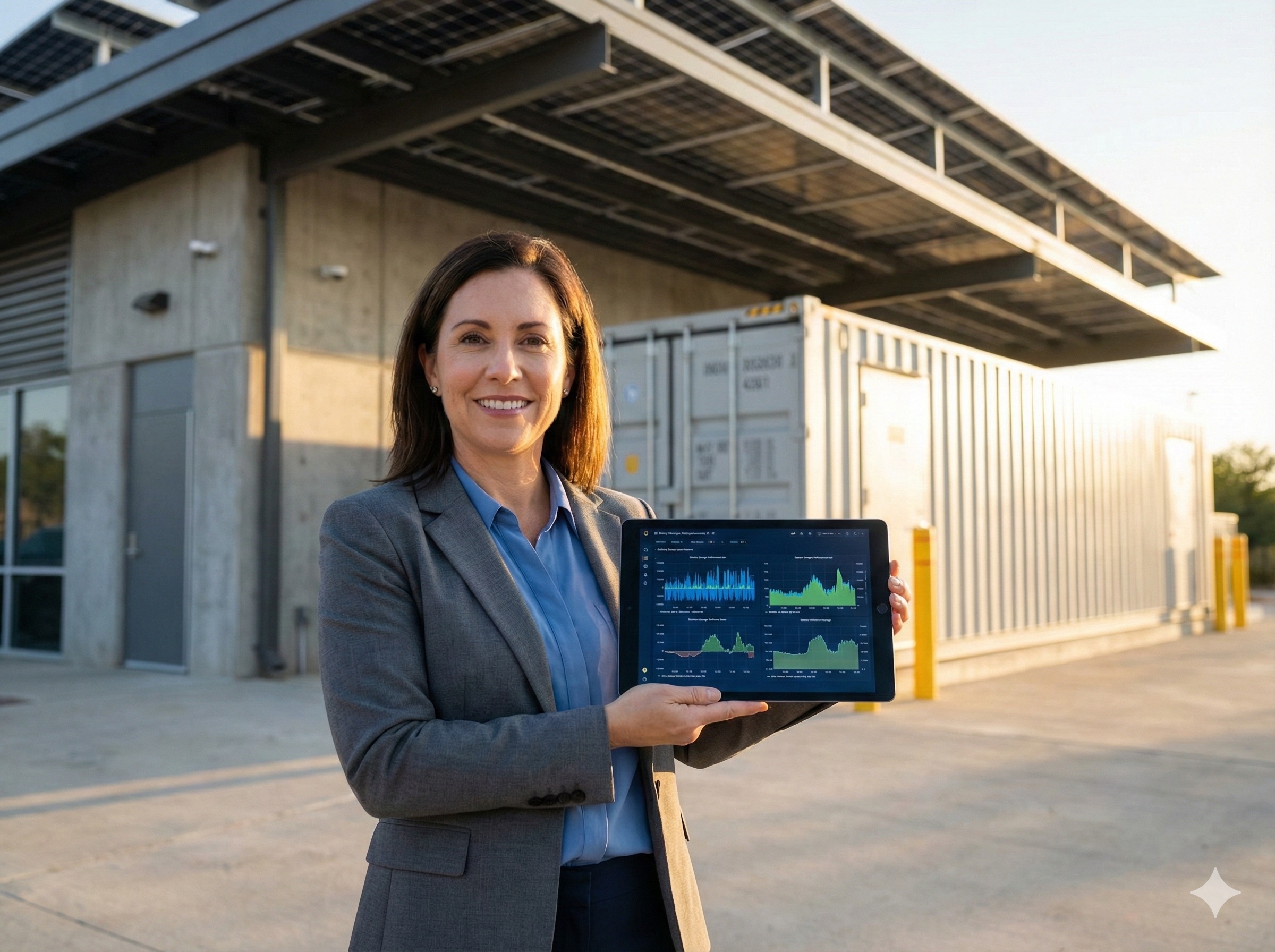
Commercial battery storage makes the most sense for Texas businesses that:
- Face high demand charges on monthly utility bills
- Need reliable backup power for critical operations
- Have existing or planned commercial solar installations
- Want to participate in ERCOT demand response programs
- Seek long-term energy cost stability
If your facility experiences significant peak demand or operates in an area with unreliable grid service, industrial energy storage delivers both immediate savings and long-term resilience. Many Texas businesses combine commercial battery storage systems with our competitive solar buyback program for maximum returns.
Ready to explore your options? Our team provides free solar buyback analysis and can assess whether commercial battery storage systems fit your energy strategy.
Take the Next Step
Commercial battery storage represents a proven investment for Texas businesses seeking to reduce energy costs, enhance resilience, and capitalize on state and federal incentives. With Texas leading the nation in BESS deployment and costs at historic lows, now is the ideal time to evaluate your options.
Take the first step today. Get your free energy quote and discover how commercial battery storage can transform your business's energy future.
Sources
- National Renewable Energy Laboratory - Commercial Battery Storage 2024 Annual Technology Baseline
- Texas Comptroller - Battery Storage Infrastructure Report 2024
- U.S. Energy Information Administration - Battery Storage Projections 2024
- IRENA - Battery Energy Storage Systems Report August 2025
- Yes Energy - ERCOT's Battery Storage Boom 2025
Update, October 2026: According to the IRS, the 30% federal Residential Clean Energy Credit is not available for systems placed in service after December 31, 2025. Mentions of the credit below apply only to systems installed by then. Texas utility rebates and the Texas property tax exemption may still lower your cost.

When February 2021's Winter Storm Uri left 4.5 million Texans without power for an average of 42 hours, solar battery storage transformed from a luxury into a necessity. For Texas homeowners tired of relying on an unpredictable grid, home battery storage offers the protection and energy independence that the ERCOT system simply cannot guarantee.
Solar battery storage systems capture excess electricity from your solar panels and store it for later use—whether that's powering your home during an evening peak, surviving a multi-day outage, or maximizing your solar buyback credits. With over 50,000 Texas homes now equipped with solar batteries and the state leading the nation with 3.5+ gigawatts of installed battery capacity, the question isn't whether you should invest in solar energy battery storage—it's which system is right for your home.
This comprehensive guide walks you through everything you need to know: how solar battery storage works, which battery types perform best in Texas heat, what systems cost, and how to maximize your return on investment with solar buyback programs.
What Is Solar Battery Storage and How Does It Work?
Solar battery storage is a technology that allows homeowners to capture, store, and use electricity generated by solar panels whenever they need it—not just when the sun is shining. Think of it like a savings account for electricity: instead of sending excess solar power back to the grid immediately, you deposit it into your battery for withdrawal during peak evening hours, power outages, or whenever electricity prices spike.
The process works through a straightforward charge-store-discharge cycle:
- Generation: Your solar panels produce direct current (DC) electricity during daylight hours
- Conversion: An inverter converts DC power to alternating current (AC) for home use
- Storage: Excess electricity not used immediately flows into your battery system, stored as chemical energy
- Discharge: When you need power—at night, during outages, or peak pricing periods—the battery converts stored energy back to electricity
Every solar battery system includes several key components working together: battery modules containing interconnected cells, a Battery Management System (BMS) monitoring health and safety, an inverter/charger handling power conversion, and a weatherproof enclosure housing everything.
You'll encounter two main system configurations. DC-coupled systems send solar power directly to the battery before conversion, offering slightly higher efficiency—ideal for new installations. AC-coupled systems convert solar power to AC first, then back to DC for battery storage—easier to retrofit onto existing solar panel systems.
Why Solar Battery Backup Is Essential for Texas Homes

No state in America has learned the importance of backup power more painfully than Texas. Winter Storm Uri didn't just cause inconvenience—it resulted in an estimated 246 to 702 deaths, $195 billion in economic damage, and exposed critical vulnerabilities in the ERCOT power grid that remain concerning today.
Consider these sobering statistics from the crisis:
- 4.5 million Texans lost power, many for days
- 69% of all Texas residents experienced power disruptions
- Average outage duration: 42 hours, with 31 consecutive hours without electricity
- 49% of Texans also lost water service
- Wholesale electricity prices spiked to $9,000 per megawatt-hour—compared to the typical $25
The Texas grid remains uniquely vulnerable because ERCOT operates independently from the national power grid, limiting the ability to import electricity during emergencies. While Texas has added 35% more generating capacity since the storm—with over 90% coming from solar, wind, and battery storage—the fundamental isolation of the Texas grid persists.
Summer presents its own challenges. Record-breaking heat waves in 2023 and 2024 pushed the grid to its limits, with ERCOT issuing conservation appeals as demand approached maximum capacity. For homeowners dependent on air conditioning during 100°F+ days, losing power isn't just uncomfortable—it's dangerous.
This explains why Texas now leads the nation in battery storage adoption. With over 3.5 gigawatts of installed capacity and 50,000+ homes equipped with solar battery backup, Texans are taking energy resilience into their own hands. A properly sized home battery storage system means your refrigerator keeps running, your medical equipment stays powered, and your family stays safe—regardless of what happens on the grid.
Types of Solar Batteries for Home: Which Is Right for You?
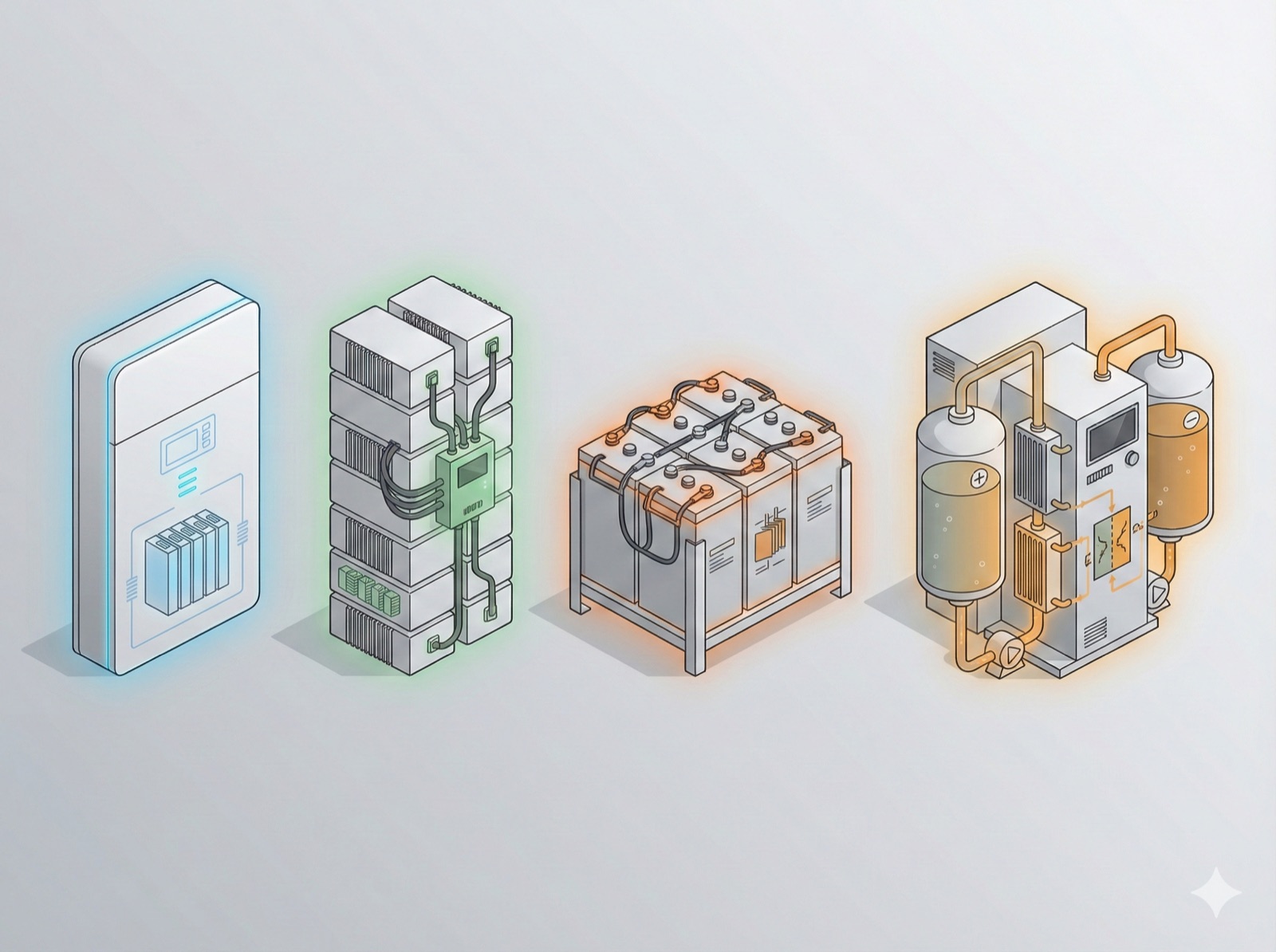
Not all solar batteries are created equal. Understanding the differences helps you choose the right technology for your specific needs, budget, and—critically for Texans—climate conditions.
Lithium-Ion Batteries (NMC Chemistry)
Efficiency: 90-95% | Lifespan: 10-15 years | Best For: Most residential applications
Lithium-ion batteries using nickel-manganese-cobalt (NMC) chemistry dominate the market, powering over 90% of new residential installations. They offer excellent round-trip efficiency, meaning minimal energy loss during charge and discharge cycles. The Tesla Powerwall uses this chemistry, as does the LG Chem RESU series.
Lithium Iron Phosphate (LFP) Batteries
Efficiency: 90-95% | Lifespan: 15+ years | Best For: Hot climates like Texas
LFP batteries represent the newer generation of lithium technology with several advantages for Texas homeowners. They operate at cooler temperatures, offer superior thermal stability during extreme heat, and provide longer cycle life. Manufacturers like Enphase, Generac, and Sonnen increasingly favor LFP chemistry. For homes in Houston, Dallas, San Antonio, and other Texas cities experiencing 100°F+ summer days, LFP is often the smartest choice.
Lead-Acid Batteries
Efficiency: 70-80% | Lifespan: 3-7 years | Best For: Budget-conscious or off-grid applications
The oldest rechargeable battery technology, lead-acid offers lower upfront costs ($3,000-$7,000) but comes with significant tradeoffs: shorter lifespan, lower efficiency, heavier weight, and a maximum 50% depth of discharge—meaning you can only use half the stated capacity without damaging the battery.
Flow Batteries
Efficiency: 70-80% | Lifespan: 20+ years | Best For: Commercial or large-scale applications
Flow batteries store energy in liquid electrolytes and can discharge 100% of their capacity without degradation. However, their larger footprint, higher complexity, and $20,000-$40,000 price point make them impractical for most residential installations.
Bottom line for Texas homeowners: Lithium Iron Phosphate (LFP) batteries offer the best combination of efficiency, longevity, and heat tolerance. If you're installing a new system, prioritize brands using LFP chemistry.
Understanding Solar Battery Specifications: What Homeowners Need to Know
Shopping for solar batteries means encountering technical specifications that can seem overwhelming. Here's what actually matters for your home:
kWh Capacity
This measures total energy storage—how many kilowatt-hours the battery can hold. Residential systems typically range from 5 to 20 kWh per unit. A Tesla Powerwall stores 13.5 kWh, while Enphase IQ batteries stack from 10.5 to 17.5 kWh depending on configuration.
What it means practically: The average Texas home consumes 35-40 kWh daily. A single 13.5 kWh battery could power essential loads (refrigerator, lights, phone chargers, internet) for 12-24+ hours during an outage.
Depth of Discharge (DoD)
DoD indicates what percentage of the battery you can actually use. Modern lithium-ion batteries offer 80-100% DoD, meaning a 13.5 kWh battery provides 10.8-13.5 kWh of usable energy. Lead-acid batteries typically allow only 50% DoD—cutting usable capacity in half.
Round-Trip Efficiency
This measures how much energy you get back compared to what you put in. Lithium-ion systems achieve 85-95% round-trip efficiency, meaning for every 10 kWh stored, you retrieve 8.5-9.5 kWh. Higher efficiency equals less wasted energy and better economics.
Cycle Life
Batteries degrade over time through repeated charging and discharging. Cycle life indicates how many complete charge/discharge cycles the battery can handle before capacity drops below a specified threshold (typically 70-80% of original). Quality lithium-ion batteries offer 3,000-7,000 cycles—translating to 10-15 years of daily use.
Power Rating (kW)
While capacity measures total storage, power rating indicates how much electricity the battery can deliver at once. A 5 kW system can power appliances totaling 5,000 watts simultaneously. For whole-home backup including air conditioning, you'll want 7.6-10 kW or higher.
Best Solar Battery Storage Systems for 2025
The solar battery market has matured significantly, with several manufacturers offering reliable, well-supported products. Here are the leading options for Texas homeowners:
| Brand | Model | Capacity | Chemistry | Standout Feature |
|---|---|---|---|---|
| Tesla | Powerwall 2 | 13.5 kWh | Li-ion (NMC) | Best app integration, seamless automation |
| Enphase | IQ 5P | 10.5-17.5 kWh | LFP | Modular design, add capacity over time |
| LG Chem | RESU Prime | 11.4-17.1 kWh | Li-ion (NMC) | Compact footprint, proven reliability |
| Generac | PWRcell | 9-18 kWh | LFP | True whole-home backup capability |
| Sonnen | EcoLinx | 10-20 kWh | LFP | Longest lifespan, German engineering |
Tesla Powerwall remains the most recognized name, offering excellent app-based monitoring and Storm Watch features that automatically charge before severe weather. However, availability and installation timelines can be challenging.
Enphase IQ batteries excel for homeowners who want flexibility. Start with one battery module and add more as your budget and needs grow. Their LFP chemistry handles Texas heat well.
Generac PWRcell deserves consideration for whole-home backup. With higher continuous power output, it can keep your air conditioning running during outages—crucial for Texas summers.
With over 500,000 U.S. homes now using battery storage and installations growing 60%+ annually, these proven systems offer the reliability Texas homeowners need.
How Much Does Solar Battery Storage Cost in Texas?
Let's address the question everyone asks first: solar battery storage represents a significant investment. Here's what Texas homeowners should expect:
Current Cost Ranges (2024-2025)
| System Size | Typical Cost (Installed) | Notes |
|---|---|---|
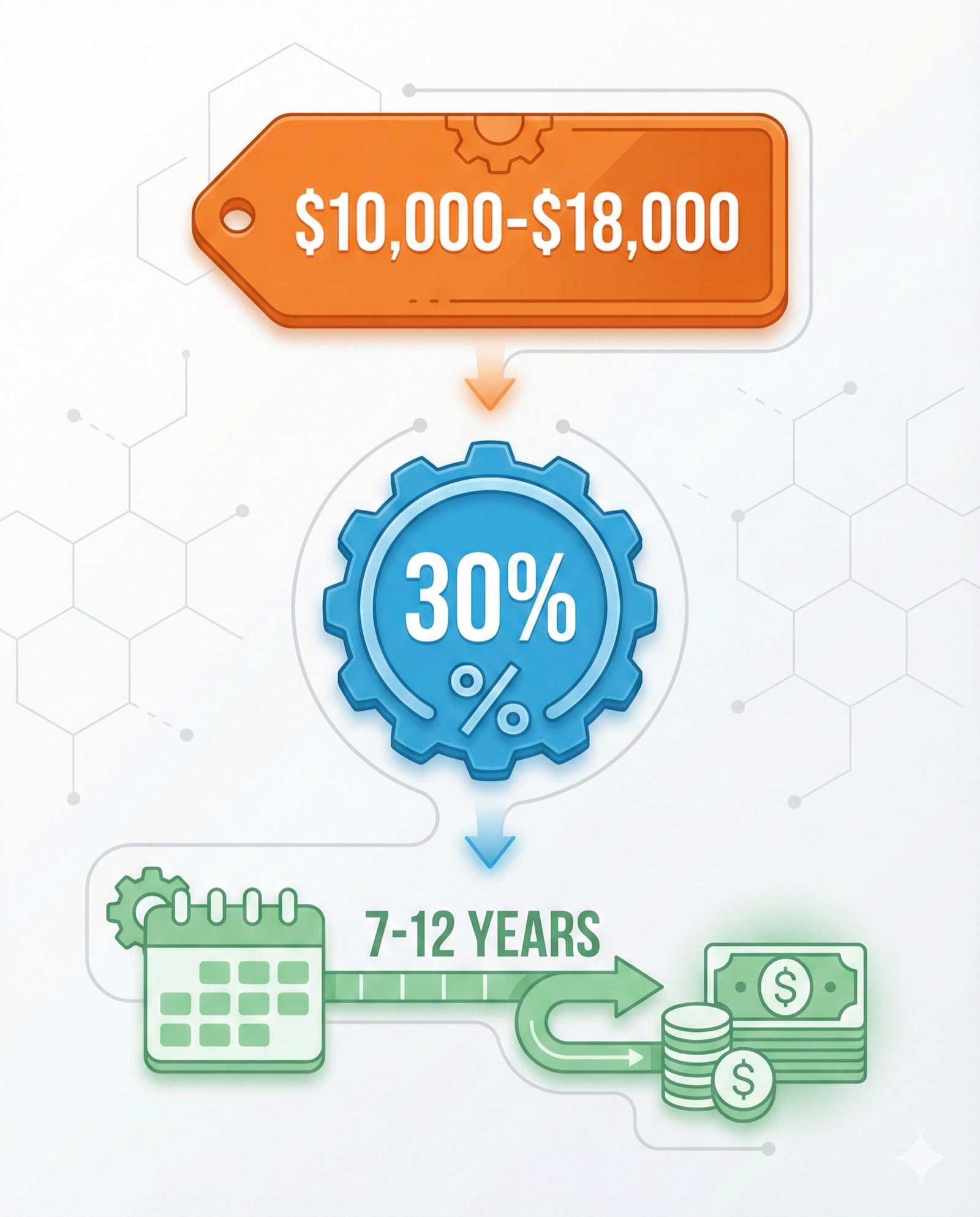
| Single battery (10-15 kWh) | $10,000-$18,000 | Covers essential loads |
| Full-home system (25-40 kWh) | $20,000-$35,000 | Multiple batteries |
| Cost per kWh | $800-$1,200 | Varies by brand and installation |
The Federal Tax Credit Advantage
The 30% federal Investment Tax Credit (ITC) dramatically improves battery economics. A $15,000 battery installation becomes $10,500 after the tax credit—savings of $4,500. This incentive extends through 2032 under the Inflation Reduction Act, giving homeowners time to plan their investment.
Texas-Specific Considerations
While Texas lacks state-level battery incentives, the grid reliability argument is compelling. Consider that during Winter Storm Uri, wholesale electricity prices hit $9,000 per megawatt-hour—360 times higher than normal rates. Homeowners on variable-rate plans faced electricity bills of $10,000 or more for a single week. A battery system that cost $15,000 could have prevented that entire nightmare.
Return on Investment
Most Texas homeowners see payback periods of 7-12 years when combining:
- Federal tax credit (30%)
- Avoided outage costs
- Time-of-use rate optimization
- Solar buyback credit maximization
For a system lasting 15+ years, that means 5-8 years of essentially free electricity after payback—plus the priceless benefit of energy security.
How Solar Battery Storage Maximizes Your Solar Buyback Credits
Here's where solar battery storage becomes particularly valuable for Texas homeowners with solar panels: strategic optimization of solar buyback credits.
Most Texas utilities offer solar buyback programs that credit you for excess electricity your panels send to the grid. But not all buyback rates are equal—and timing matters.
Without a battery: Your solar panels produce maximum power midday when the sun is strongest. But that's also when grid demand (and thus buyback value) is often lowest. You're forced to export electricity at whatever rate the utility offers in that moment.
With a battery: You store that midday excess instead of exporting immediately. Then you either use it during expensive evening peak hours or export when rates are highest. Some programs like Octopus Energy even pay homeowners $40/month to allow grid support during peak stress periods.
The competitive Buyback Advantage
Most Texas utilities offer wholesale buyback rates far below what you pay for electricity. However, only two Texas providers offer true competitive solar buyback—meaning you receive the same rate for exported electricity that you pay for imported electricity. This dramatically improves solar economics.
Ambit Energy VIP Energy Service is one of these providers, offering personalized energy consulting to help homeowners maximize the value of their solar investment. Combined with battery storage, a competitive solar buyback program lets you:
- Store excess solar during peak production
- Use stored energy during evening peaks
- Export strategically when rates are highest
- Avoid ever buying expensive grid electricity
For Texas homeowners serious about maximizing their solar ROI, the combination of battery storage plus a competitive solar buyback program represents the optimal configuration.
How to Determine the Right Battery Size for Your Texas Home
Sizing a solar battery system correctly requires balancing three factors: your energy consumption, your backup priorities, and your budget.
Step 1: Calculate Your Daily Usage
The average Texas home consumes 35-40 kWh daily—higher than the national average due to air conditioning demands. Review your electricity bills to find your actual consumption, noting seasonal variations between summer and winter.
Step 2: Define Your Backup Priorities
Essential loads only (refrigerator, lights, phone chargers, internet):
- Requirement: 1 battery (10-15 kWh)
- Duration: 12-24+ hours, indefinite with solar recharging
Partial home (essentials plus one AC unit, some outlets):
- Requirement: 2 batteries (20-30 kWh)
- Duration: 8-16 hours typical
Whole-home backup (everything including full HVAC):
- Requirement: 3+ batteries (40+ kWh)
- Duration: Varies significantly with AC usage
Step 3: Factor in Solar Production
If your solar panels produce 30 kWh on a typical sunny day, a single battery can cycle through multiple charge/discharge cycles—extending your backup duration significantly. During extended cloudy periods or winter months, battery-only duration becomes the limiting factor.
Professional Recommendation: Given the complexity of load calculations, inverter sizing, and electrical panel requirements, we recommend working with a qualified energy consultant. VIP Energy Service offers personalized assessments to ensure your system meets your specific needs. Request a free consultation to get started.
Frequently Asked Questions About Solar Battery Storage
How long can a solar battery power my home during an outage?
With a typical 13.5 kWh battery powering only essential loads, expect 12-24+ hours of backup. If your solar panels can recharge the battery during daylight hours, you can maintain power indefinitely in good weather. Whole-home backup with air conditioning significantly reduces duration—potentially to just 4-8 hours without solar recharging.
Do solar batteries automatically switch on during power outages?
Yes, modern systems with backup interfaces enable automatic transfer switching, typically in under 100 milliseconds—so fast that most electronics won't even register the interruption. This seamless transition keeps medical equipment, security systems, and other critical loads running continuously.
Can I go completely off-grid with solar batteries in Texas?
Technically yes, though it requires substantial investment—typically 40+ kWh of battery storage, a large solar array, and careful load management. Most Texas homeowners find grid-connected systems with backup capability more practical and cost-effective.
What maintenance do solar batteries require?
Minimal maintenance is one of the biggest advantages of modern solar batteries. The Battery Management System handles monitoring automatically. We recommend an annual professional inspection to verify connections, update firmware, and ensure optimal performance.
Do solar batteries qualify for the federal tax credit?
Yes. When installed with solar panels or charged by an existing solar system, batteries qualify for the 30% federal Investment Tax Credit (ITC) through 2032. A $15,000 battery installation could yield $4,500 in tax savings.
How do solar batteries handle Texas summer heat?
Modern batteries are rated for temperatures from 15°F to 110°F. For optimal performance and longevity in Texas heat, we recommend indoor installation in a garage. Lithium Iron Phosphate (LFP) chemistry offers superior thermal stability compared to other lithium-ion types.
Are solar batteries worth the investment for Texas homeowners?
For most Texas homeowners, yes. The combination of grid reliability concerns (Storm Uri proved the risk), the 30% federal tax credit, and potential solar buyback optimization creates a compelling value proposition. Typical payback periods of 7-12 years mean systems lasting 15+ years deliver substantial long-term savings.
What happens to my solar credits if I add a battery?
Batteries give you more control over when you export electricity. Instead of sending excess power to the grid immediately at whatever rate is offered, you can store it and export during peak pricing periods—or use it yourself and avoid buying expensive evening electricity entirely.
Take Control of Your Energy Future with Solar Battery Storage
Winter Storm Uri taught Texas an expensive lesson about grid reliability. With 4.5 million residents left without power, hundreds of deaths, and $195 billion in damages, the vulnerability of the ERCOT grid became impossible to ignore. For homeowners who lived through multi-day outages in freezing temperatures—or sweltering summer conservation alerts—solar battery storage offers something the grid cannot: certainty.
Beyond emergency backup, home battery storage transforms your relationship with electricity. You become less dependent on utility pricing decisions, better positioned to maximize solar panel investments, and protected from the wholesale price spikes that devastated so many Texans during the winter storm.
The technology is proven. The incentives are available—30% federal tax credit through 2032. And the need has never been clearer.
Ready to explore solar battery storage for your Texas home? VIP Energy Service specializes in helping homeowners navigate the solar and battery landscape with personalized, one-on-one consulting—not high-pressure sales tactics. Our energy consultants can assess your needs, explain your options, and help you take advantage of our industry-leading competitive solar buyback program.
Take the first step toward energy independence today. Your future self—especially during the next grid emergency—will thank you.
Sources: U.S. Energy Information Administration, Solar Energy Industries Association, Texas Comptroller's Office, ERCOT, EnergySage, FERC


