Update, October 2026: According to the IRS, the 30% federal Residential Clean Energy Credit is not available for systems placed in service after December 31, 2025. Mentions of the credit below apply only to systems installed by then. Texas utility rebates and the Texas property tax exemption may still lower your cost.
When a solar panels power outage situation occurs, most Texas homeowners discover a frustrating truth: their grid-tied solar system shuts down completely. Even though the sun is shining and your panels are capable of producing electricity, standard solar installations cannot power your home during a blackout. The reason comes down to a critical safety feature called anti-islanding protection. However, pairing your solar system with solar battery storage creates a solution that keeps your essential circuits running when ERCOT goes dark.
Why Grid-Tied Solar Panels Shut Down During Outages
If you have solar panels and the power goes out, your inverter immediately stops sending electricity to your home. This automatic shutdown happens within milliseconds—faster than you would notice. The technology behind this response is called anti-islanding protection, and every grid-tied solar system in Texas is required to have it.
Anti-islanding protection exists to protect utility workers. According to Lone Star Solar Services, when the electrical grid goes down, repair crews work on power lines assuming those lines carry no current. If your solar panels continued feeding electricity back into the grid during an outage, workers could face lethal voltages they did not expect.
During Winter Storm Uri in 2021, over 4.5 million Texas homes and businesses lost power—some for days. ERCOT forecasts a 50% chance of rolling outages during extreme winter weather similar to December 2022 conditions. When the power grid fails, your grid-tied solar system cannot help because it has no way to safely disconnect from ERCOT while continuing to power your home.
How Anti-Islanding Protection Works
Your solar inverter constantly monitors grid voltage and frequency. When these readings fall outside a narrow acceptable range—as they do during any blackout or brownout—the inverter disconnects automatically. This applies to standard string inverters and microinverters alike.
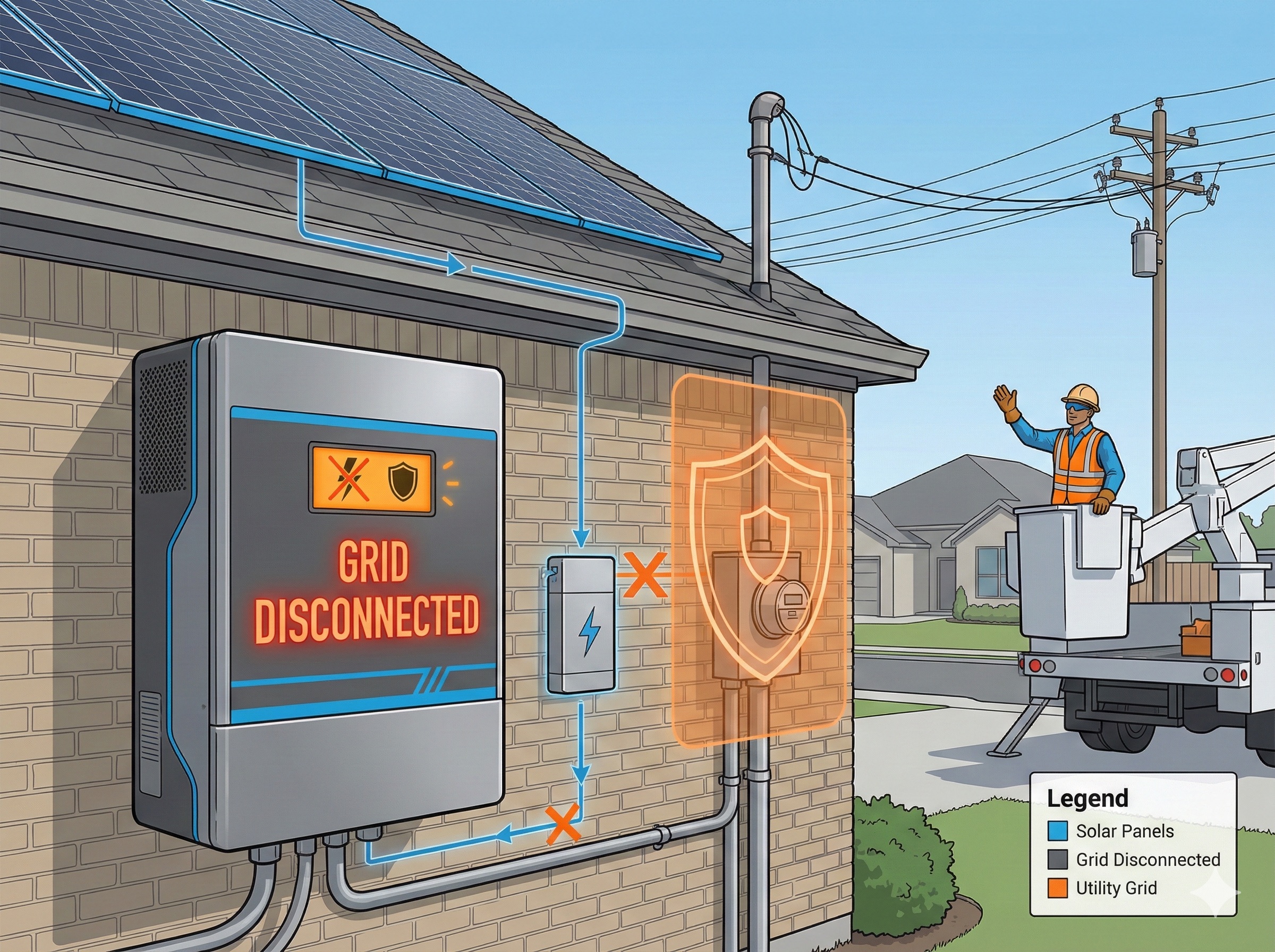
The solar panels power cut happens instantly because your equipment is designed to "listen" for the grid's presence. Without detecting stable grid power, the inverter will not operate, even with abundant sunshine on your panels.
The Solution: Solar Battery Storage Systems
Adding a home battery storage system transforms your solar installation from grid-dependent to backup-capable. According to energy experts interviewed by ABC13 Houston, "The first step to making a home or business more resilient to power outages is to look into some of the separate elements of a microgrid, such as solar panels, a generator, or battery energy storage systems."
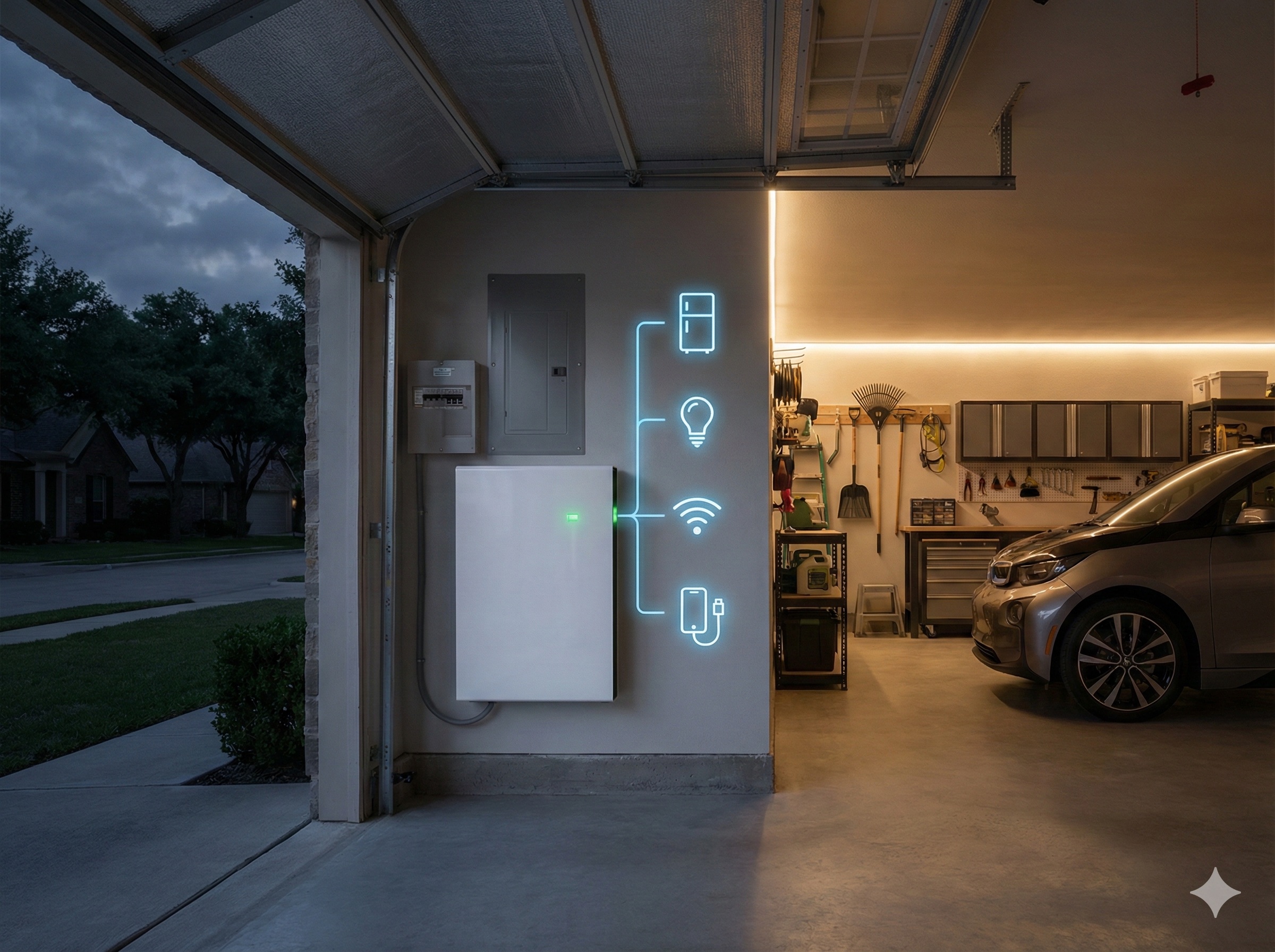
A battery backup system includes:
- Home battery storage (10-15 kWh capacity typical)
- Hybrid inverter that can manage solar, battery, and grid connections
- Critical loads panel that prioritizes essential circuits
When the power goes out, your hybrid inverter isolates your home from ERCOT and switches to battery power within seconds. Your solar panels continue generating electricity during daylight hours, charging the battery while simultaneously powering your home. At night, stored energy keeps your essential systems running.
During the September 2023 Texas heat wave, battery storage resources helped avoid grid failure by providing power equivalent to about 434,000 homes when traditional generation could not keep up.
What a Battery Backup System Powers
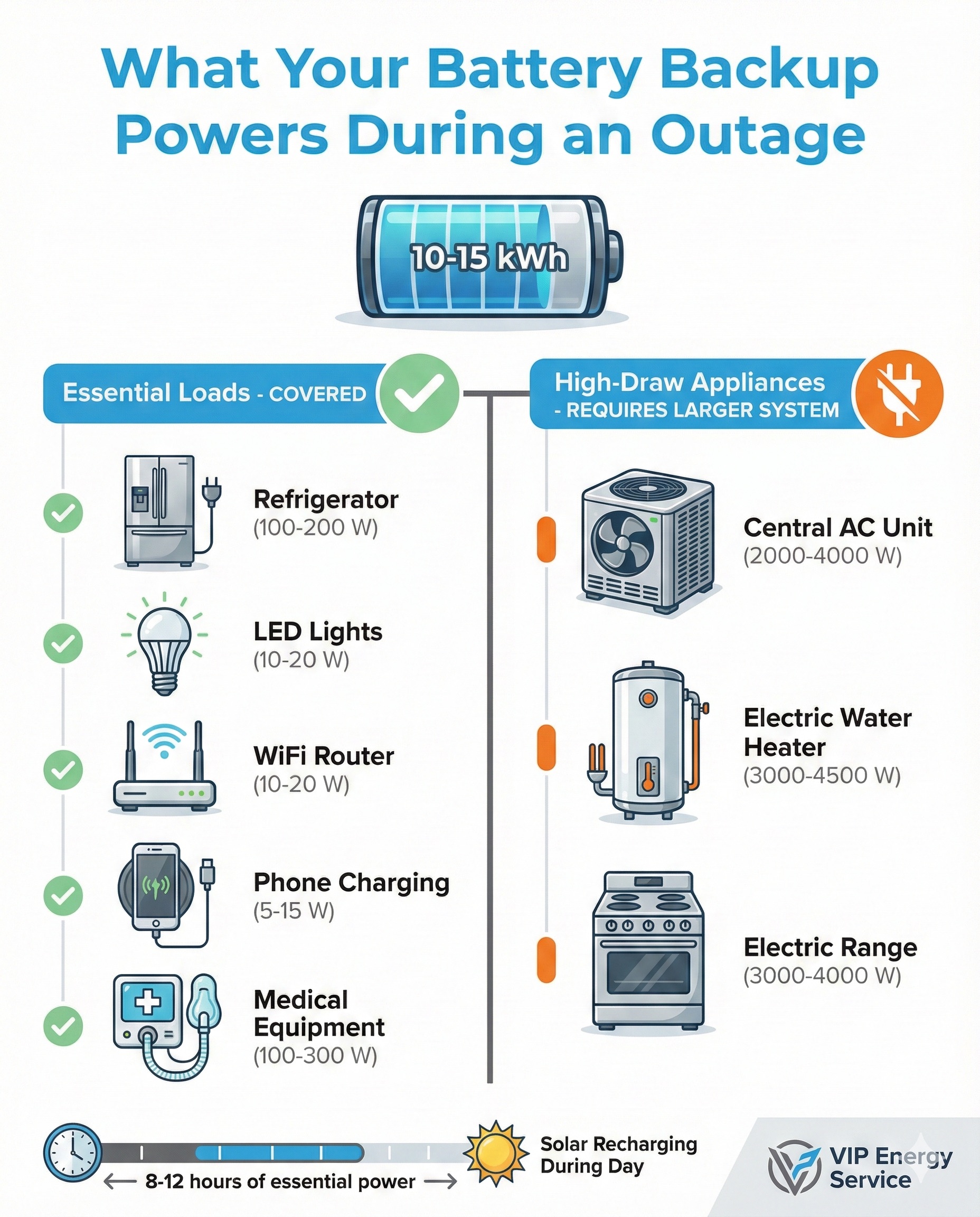
Most residential battery systems in Texas provide 10-15 kWh of storage. Texas homes average 25-30 kWh of daily consumption, so batteries typically cover essential loads:
Usually covered: Refrigerator, LED lights, WiFi router, phone charging, medical equipment, garage door
Requires larger system: Central AC, electric water heater, electric range
Texas-Specific Considerations for Solar Backup
Texas faces unique challenges because ERCOT operates largely isolated from other U.S. grids. When extreme weather strikes—whether Winter Storm Uri or Hurricane Beryl—outside assistance cannot flow in easily.
The Texas Legislature recognized this vulnerability by approving $1.8 billion for the Texas Backup Power Package Program. According to UH Energy Innovation, this represents "a significant shift toward distributed energy resilience in the state's broader electricity reliability strategy."
For homeowners, the economics of battery storage continue improving. The 30% federal Investment Tax Credit applies to both solar and battery installations. Additionally, working with Ambit Energy provides access to a competitive solar buyback rate—one of only two such programs available in Texas. This rate helps offset battery costs by maximizing the value of your solar generation during normal grid operation.
Getting Started with Solar Battery Backup
If your home already has grid-tied solar, retrofitting a battery system is possible. You will need:
- Assessment of daily energy needs (typical Texas home: 25-30 kWh)
- Evaluation of existing inverter compatibility or upgrade to hybrid inverter
- Sizing calculation for battery capacity based on backup priorities
- Installation of transfer switch or critical loads panel
VIP Energy Service offers personalized energy consulting to evaluate your options. Unlike online-only providers, our local Texas energy consultants work face-to-face with homeowners to match solar buyback plans and backup solutions to specific needs.
The federal tax credit combined with competitive electricity rates and plans make 2025 an excellent time to add battery backup. Many homeowners also qualify for no-deposit electricity service, removing upfront barriers.
Ready to keep your home powered during the next Texas blackout? Get your free energy quote from VIP Energy Service and discover how solar battery storage protects your family when ERCOT cannot.
Sources
- Lone Star Solar Services - Home Battery Storage Texas Guide
- ABC13 Houston - Texas Microgrids Emerge as Backup Solution
- UH Energy Innovation - Microgrid Resilience in Texas
- Texas Tribune - Texas Solar for All Program Coverage
- EcoFlow - Texas Solar Boom 2025
Quick Answer: If you have solar panels and the power goes out, your solar system will stop generating electricity—even on a sunny day. This happens because of a safety feature called anti-islanding protection. The good news? Adding battery storage for your solar panel system keeps your home powered during grid outages.
You've invested in solar panels. The sun is shining. Then the power goes out, and your lights go dark just like everyone else's. It's one of the most common frustrations Texas homeowners experience with grid-tied solar systems.
The reason comes down to safety—specifically, protecting utility workers who repair power lines during outages. But understanding why your solar panels stop working during a power outage also reveals the solution: battery storage.
Why Solar Panels Stop Working During Power Outages
Most residential solar systems in Texas are grid-tied. This means your solar panels connect directly to the electrical grid through an inverter. When your panels produce more electricity than you need, excess power flows to the grid. When you need more than your panels produce, you pull from the grid.
Here's the critical part: your inverter must detect grid power to operate. During a solar panels power cut, the inverter immediately shuts down. This isn't a malfunction—it's a deliberate safety mechanism.
Anti-Islanding Protection Explained
When power lines go down, utility workers need to repair them safely. If your solar panels continued sending electricity into the grid during an outage, they could electrocute workers or cause fires.
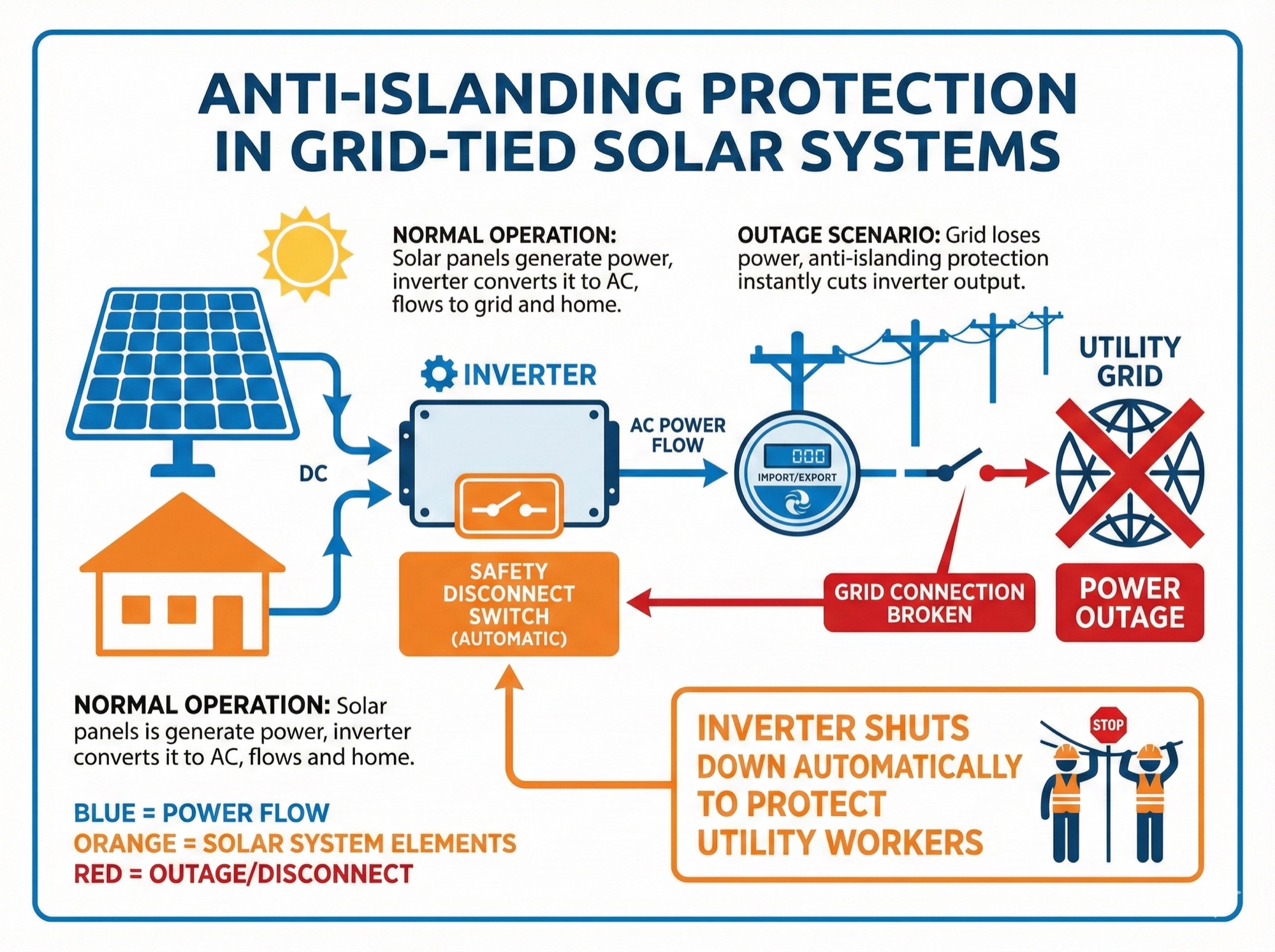
The safety feature that prevents this is called anti-islanding protection. Every grid-tied solar inverter must include it by law, per IEEE Standard 1547. The moment your inverter detects the grid is down, it stops converting solar energy to usable electricity.
This means your solar panels work during normal conditions but become useless exactly when you might need backup power most—during storms, grid failures, or the Texas grid instability events that have become increasingly common.
The Battery Storage Solution
If you have solar panels and the power goes out, battery storage changes everything. A solar battery system stores excess energy your panels produce during the day. During an outage, the battery disconnects from the grid and powers your home independently.
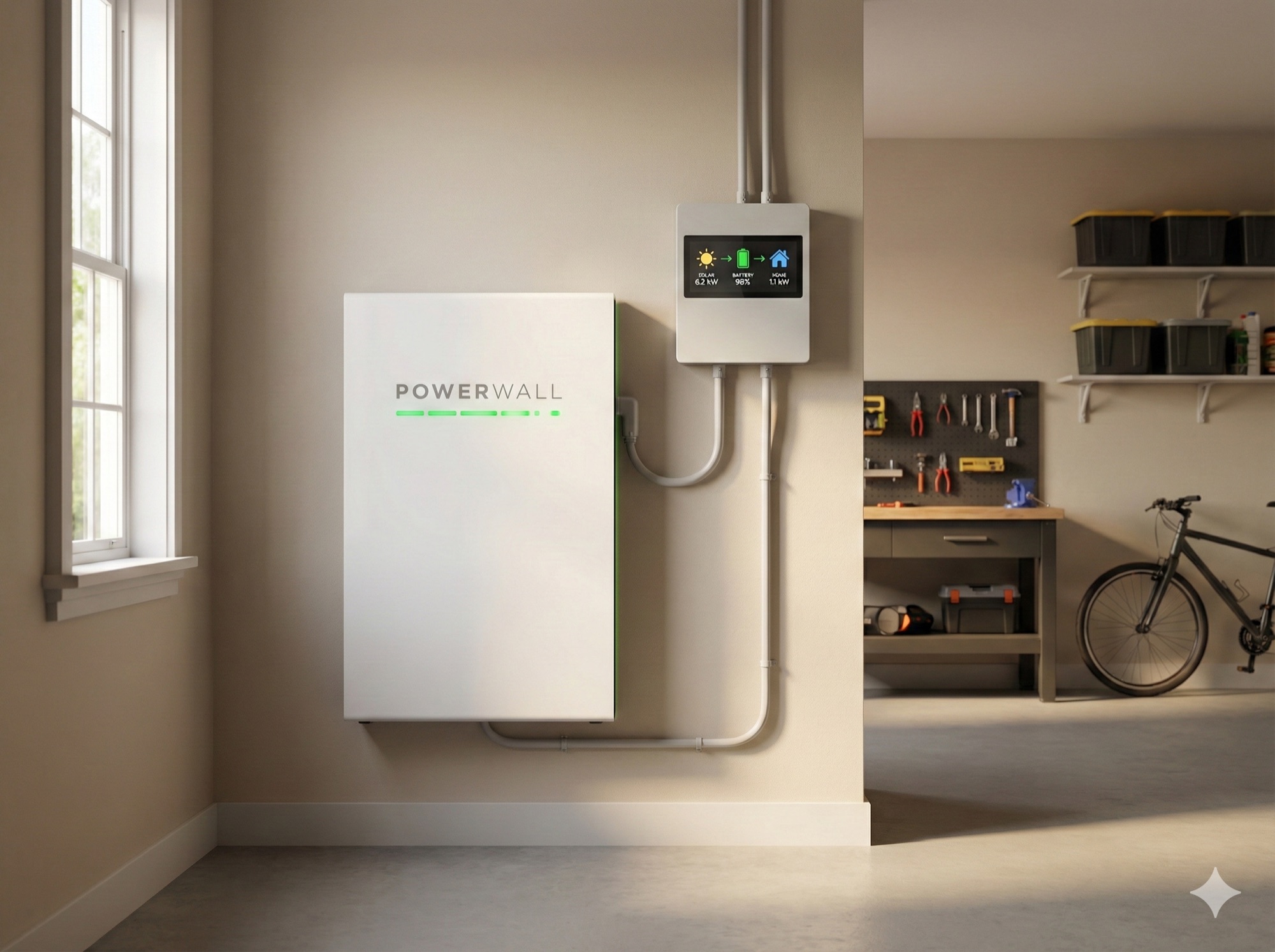
This setup is called "islanding" when done safely—your home becomes an island, powered by stored solar energy without any connection to utility power lines.
How Battery Backup Works
Here's the basic flow:
- Normal operation: Solar panels charge the battery while powering your home. Excess goes to the grid (earning solar buyback credits).
- Outage detection: The battery system detects the power outage within milliseconds.
- Automatic switchover: The system disconnects from the grid and switches to battery power seamlessly—often so fast you won't notice.
- Continued solar charging: During daylight, your panels continue charging the battery while it powers your home.
- Night operation: The battery provides stored power until morning, when solar charging resumes.
How Much Battery Storage Do You Need?
The right battery capacity depends on two factors: which appliances you want to power and how long outages typically last in your area.
Essential Loads Coverage

Most Texas homeowners choose to power essential loads during outages:
| Appliance | Daily Usage |
|---|---|
| Refrigerator | ~1.5 kWh per day |
| LED Lights | ~0.5 kWh per day |
| WiFi Router | ~0.2 kWh per day |
| Phone/Device Charging | ~0.3 kWh per day |
| Medical Equipment | Varies by device |
A typical 10-15 kWh battery system can power these essentials for 24-48 hours—longer if the sun is shining and your panels keep charging.
For whole-home backup during extended outages, you may need 20-40 kWh of storage depending on your energy needs and home size.
Cost and ROI Considerations
Battery storage adds $10,000-$20,000 to a solar installation, depending on capacity. However, the federal solar tax credit applies to batteries installed with solar, reducing costs by 30%.
Beyond backup power, batteries offer additional savings:
- Time-of-use optimization: Store cheap daytime solar and use it during expensive evening peak rates
- Demand charge reduction: Smooth out energy usage to avoid utility demand charges
- Increased solar self-consumption: Use more of your own solar energy instead of selling it back at wholesale rates
For Texas homeowners tired of grid reliability issues, the peace of mind alone often justifies the investment.
Getting Started with Solar Battery Storage
If your current solar panels power cut frustration has you considering battery backup, here's your next step: get a personalized assessment of your energy needs and backup requirements.
At VIP Energy Service, we help Texas homeowners find the right combination of solar and battery solutions for their homes. Our energy consultants can analyze your usage patterns, outage history, and budget to recommend the optimal system.
Ready to keep your lights on during the next outage? Request your free energy quote and discover how solar battery storage can provide true energy independence for your Texas home.
Sources
- ERCOT - Texas Grid Generation Information (2025)
- U.S. Department of Energy - Homeowner's Guide to the Federal Tax Credit for Solar Photovoltaics
- IEEE Standard 1547-2018 - Anti-Islanding Requirements for Distributed Energy Resources
Commercial battery storage systems help Texas businesses reduce energy costs by 20-40% on demand charges while providing critical backup power during grid emergencies. With installation costs dropping 93% since 2010 and Texas offering property tax exemptions plus federal tax credits, commercial and industrial battery storage has never been more accessible for businesses seeking energy independence and resilience.
In this guide, we cover everything Texas business owners need to know about commercial battery storage—from costs and benefits to incentives and whether it makes sense for your facility. If you're exploring ways to pair battery storage with solar battery storage, you're in the right place.
What Is Commercial Battery Storage?
Commercial battery storage refers to Battery Energy Storage Systems (BESS) designed for business and industrial applications. Unlike residential systems, commercial battery storage systems typically range from 100 kWh to over 1 MWh in capacity.
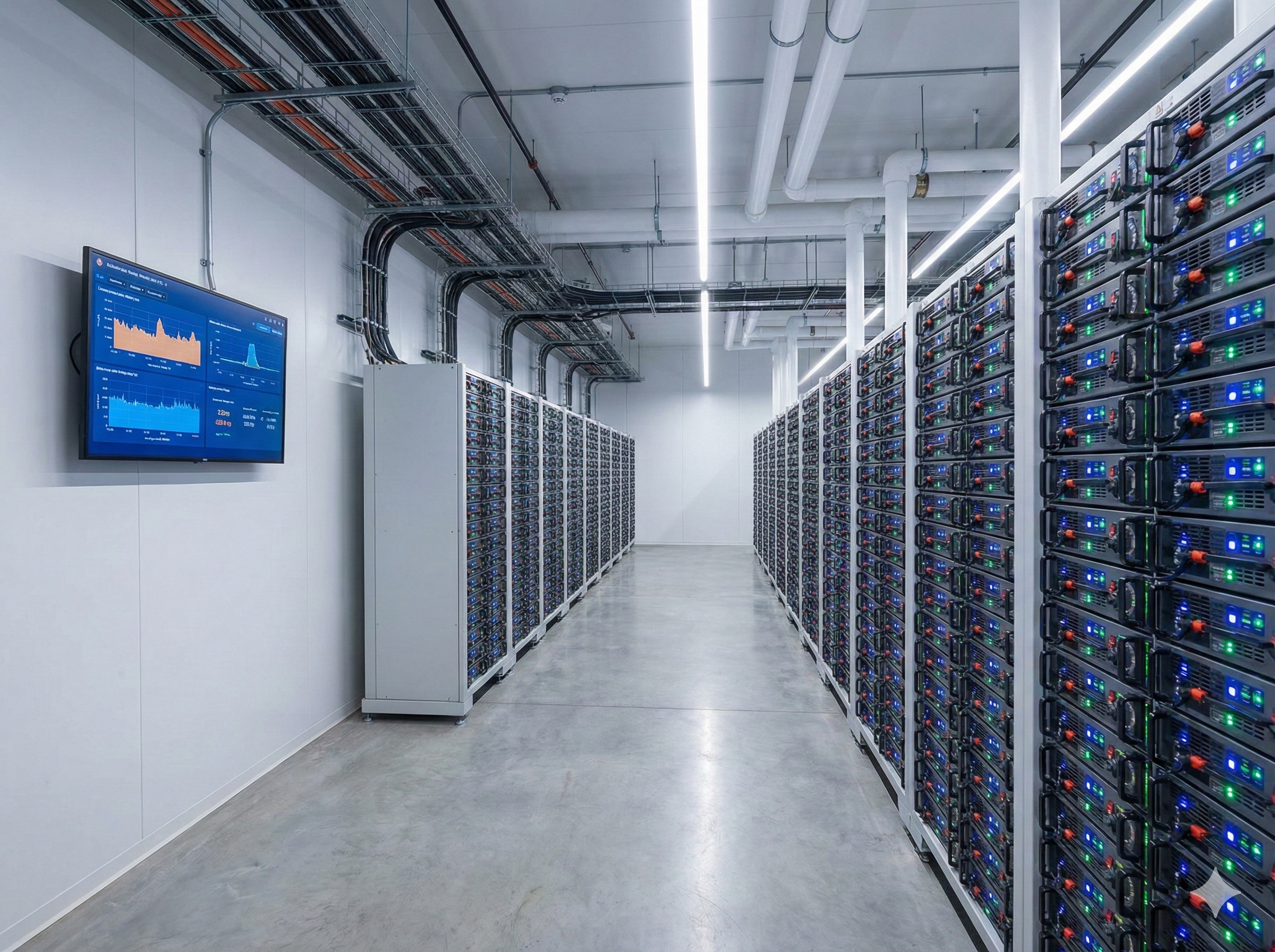
These industrial battery storage solutions serve two primary functions: behind-the-meter applications (reducing your facility's grid demand) and front-of-meter applications (selling services back to the grid). According to the National Renewable Energy Laboratory's 2024 Annual Technology Baseline, lithium-ion batteries—particularly lithium iron phosphate (LFP) chemistry—dominate today's commercial and industrial energy storage market due to their safety profile and longevity.
Why Texas Businesses Are Investing in Commercial Battery Storage
The Texas Battery Boom
Texas leads the nation in battery storage deployment. According to Yes Energy's 2025 ERCOT analysis, Texas now has nearly 10 GW of commercial battery storage capacity—more than the other 48 states combined. The U.S. Energy Information Administration reports that 50% of all planned U.S. battery storage capacity will be built in Texas.
Business Drivers
Why the surge? Texas businesses face unique energy challenges:
- Peak demand charges: The 4CP (Four Coincident Peak) system penalizes businesses during high-demand periods
- Grid resilience: After Winter Storm Heather in January 2024, the Texas Comptroller reported that commercial battery storage units delivered $750 million in market savings
- Rising electricity costs: Industrial energy storage offers price protection through energy arbitrage
- ERCOT market structure: Texas's deregulated grid rewards battery flexibility with ancillary services payments
Key Benefits of Commercial Battery Storage Systems
Demand Charge Reduction
Peak demand management is the primary benefit for most Texas businesses. By discharging during 4CP periods, commercial battery storage systems can reduce transmission charges by 20-40%. For facilities with high demand charges, the savings alone often justify the investment.
Backup Power and Resilience
Commercial battery storage systems provide critical backup power for data centers, manufacturing facilities, healthcare operations, and retail businesses. When ERCOT issues grid emergencies, industrial battery storage keeps your operations online while competitors face costly downtime.
Solar Integration
Pairing commercial battery storage systems with solar PV maximizes your renewable energy investment. Industrial energy storage lets you store excess generation during peak production hours, then discharge during evening rate spikes. This time-shifting strategy amplifies your solar buyback in Texas returns and helps you turn excess power into savings.
Revenue Opportunities
Beyond cost savings, industrial battery storage creates revenue streams through:
- Demand response program participation
- Ancillary services payments from ERCOT
- Energy arbitrage (charge during low wholesale prices, discharge during peaks)
Commercial Battery Storage Costs in 2025
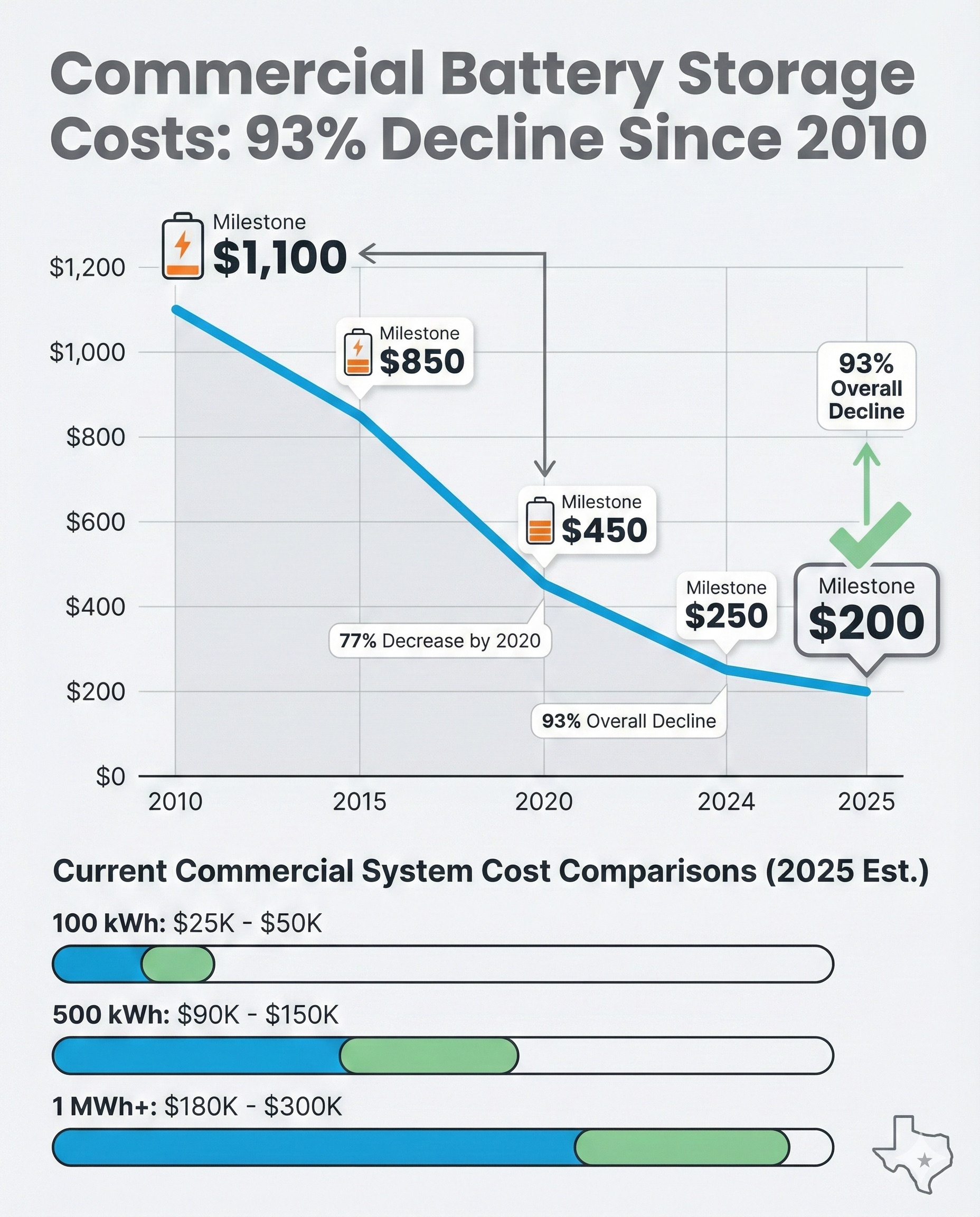
Commercial battery storage costs have plummeted. According to IRENA's 2025 battery storage report, two-hour systems saw a 38% cost reduction in 2024 alone.
Current installed costs for commercial battery storage systems:
| System Size | Cost Range | Best For |
|---|---|---|
| 100 kWh | $25,000-$50,000 | Small businesses, retail |
| 500 kWh | $90,000-$150,000 | Medium facilities, offices |
| 1 MWh+ | $180,000-$300,000 | Large industrial operations |
Per-kWh costs range from $280-$580 for standard commercial battery storage systems to $180-$300 for large containerized industrial energy storage installations. That's a 93% decline from 2010 prices, making industrial battery storage accessible for businesses of all sizes.
Texas Incentives for Commercial Battery Storage
Texas offers significant financial incentives for commercial battery storage investment:
- Federal Investment Tax Credit (ITC): Now available for standalone battery storage under the Inflation Reduction Act
- 40% Bonus Depreciation (2025): Immediate deduction on system value
- MACRS Depreciation: 5-year accelerated depreciation schedule
- Property Tax Exemption: 100% exemption on added appraised value for solar+storage systems
- Local Abatements: Up to 10-year property tax abatements available in many Texas jurisdictions
Ready to calculate your savings? Our energy consultants can help you navigate available incentives and determine your potential ROI. Get your free energy quote to start the conversation.
Is Commercial Battery Storage Right for Your Business?
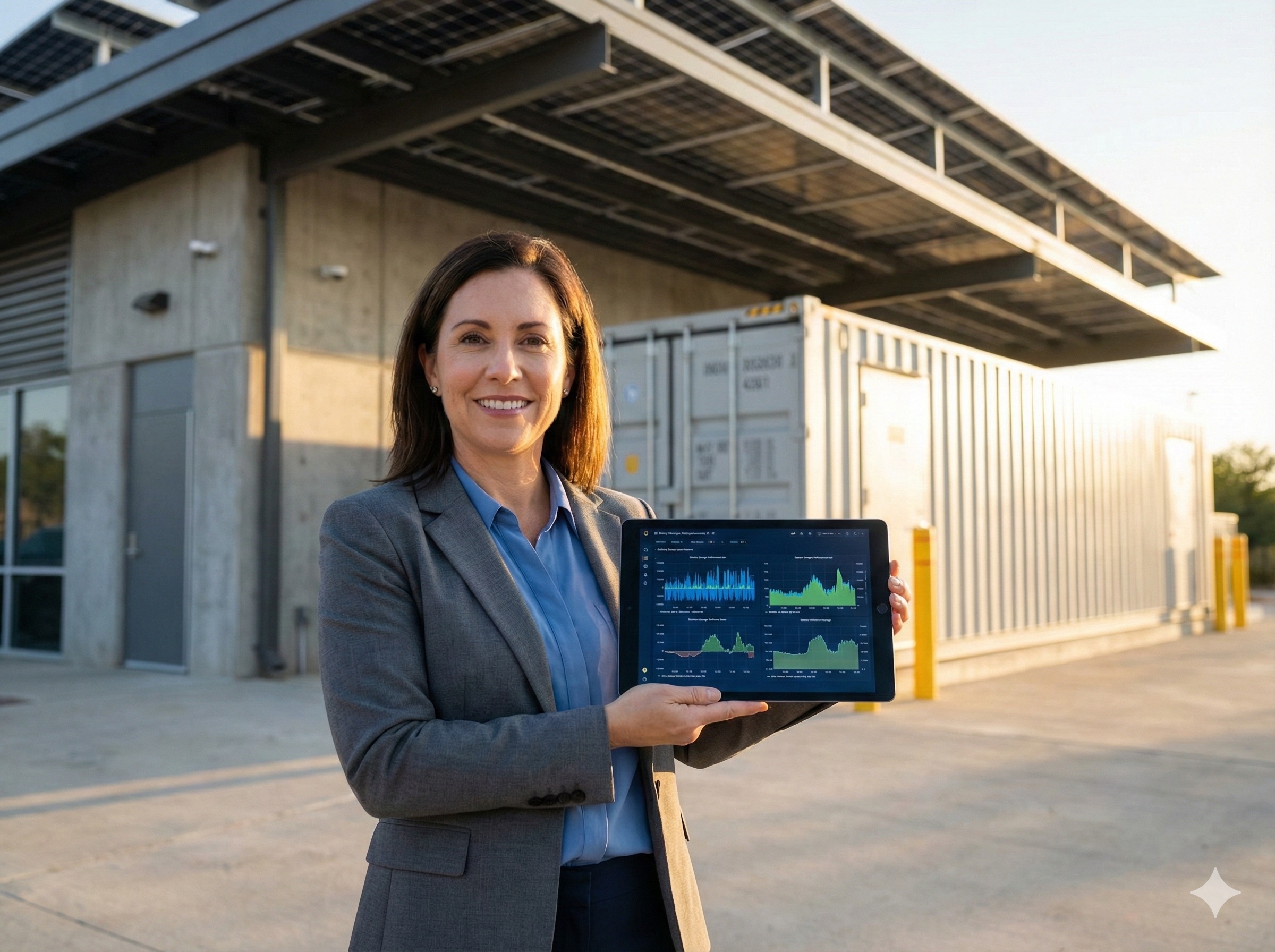
Commercial battery storage makes the most sense for Texas businesses that:
- Face high demand charges on monthly utility bills
- Need reliable backup power for critical operations
- Have existing or planned commercial solar installations
- Want to participate in ERCOT demand response programs
- Seek long-term energy cost stability
If your facility experiences significant peak demand or operates in an area with unreliable grid service, industrial energy storage delivers both immediate savings and long-term resilience. Many Texas businesses combine commercial battery storage systems with our competitive solar buyback program for maximum returns.
Ready to explore your options? Our team provides free solar buyback analysis and can assess whether commercial battery storage systems fit your energy strategy.
Take the Next Step
Commercial battery storage represents a proven investment for Texas businesses seeking to reduce energy costs, enhance resilience, and capitalize on state and federal incentives. With Texas leading the nation in BESS deployment and costs at historic lows, now is the ideal time to evaluate your options.
Take the first step today. Get your free energy quote and discover how commercial battery storage can transform your business's energy future.
Sources
- National Renewable Energy Laboratory - Commercial Battery Storage 2024 Annual Technology Baseline
- Texas Comptroller - Battery Storage Infrastructure Report 2024
- U.S. Energy Information Administration - Battery Storage Projections 2024
- IRENA - Battery Energy Storage Systems Report August 2025
- Yes Energy - ERCOT's Battery Storage Boom 2025
Update, October 2026: According to the IRS, the 30% federal Residential Clean Energy Credit is not available for systems placed in service after December 31, 2025. Mentions of the credit below apply only to systems installed by then. Texas utility rebates and the Texas property tax exemption may still lower your cost.
When Winter Storm Uri hit Texas in February 2021, millions of homeowners learned a hard lesson about grid reliability. The power went out for days. Pipes froze. Food spoiled. For some, it became a matter of survival. Since then, demand for home battery backup systems has surged across the Lone Star State—and for good reason.
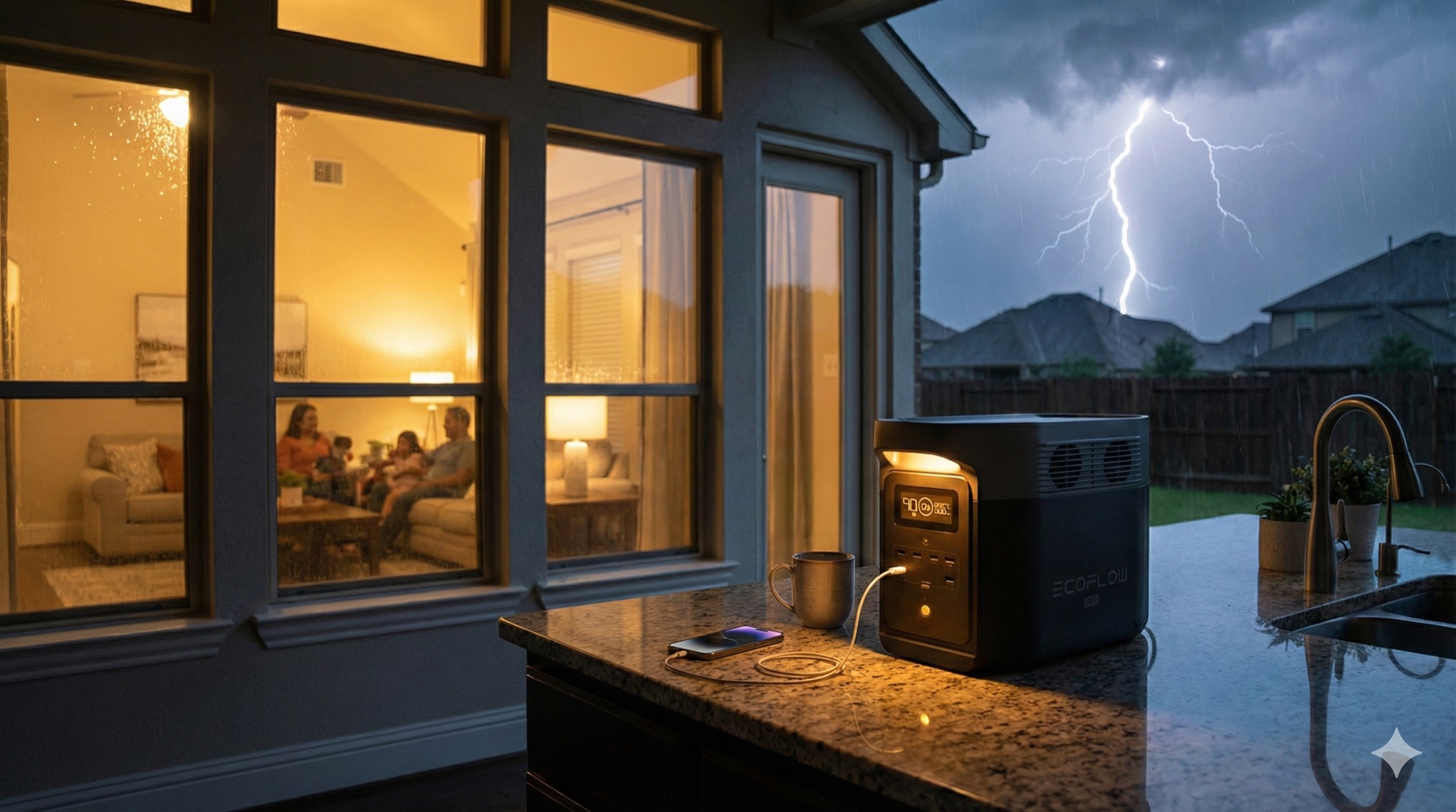
A battery backup for home provides reliable power when the grid fails. Whether you choose a portable power station for essential devices or a whole-house battery system for complete independence, these solutions offer peace of mind that Texas homeowners increasingly value. In this comprehensive guide, we cover everything you need to know about choosing the right power station for your home, from technical specifications to costs and solar integration options.
What Is a Home Battery Backup System?
A home battery backup system stores electrical energy for use when your primary power source becomes unavailable. Think of it as a large rechargeable battery—similar to your smartphone's battery, but scaled up dramatically to power appliances, medical devices, and essential home systems.
These systems consist of three main components: battery cells that store energy (typically lithium-ion or LiFePO4 chemistry), an inverter that converts stored DC power to usable AC electricity, and a battery management system (BMS) that monitors charging, temperature, and overall health.
Portable Power Stations vs. Whole-House Systems
The market offers two primary categories of battery backup solutions, each serving different needs and budgets.
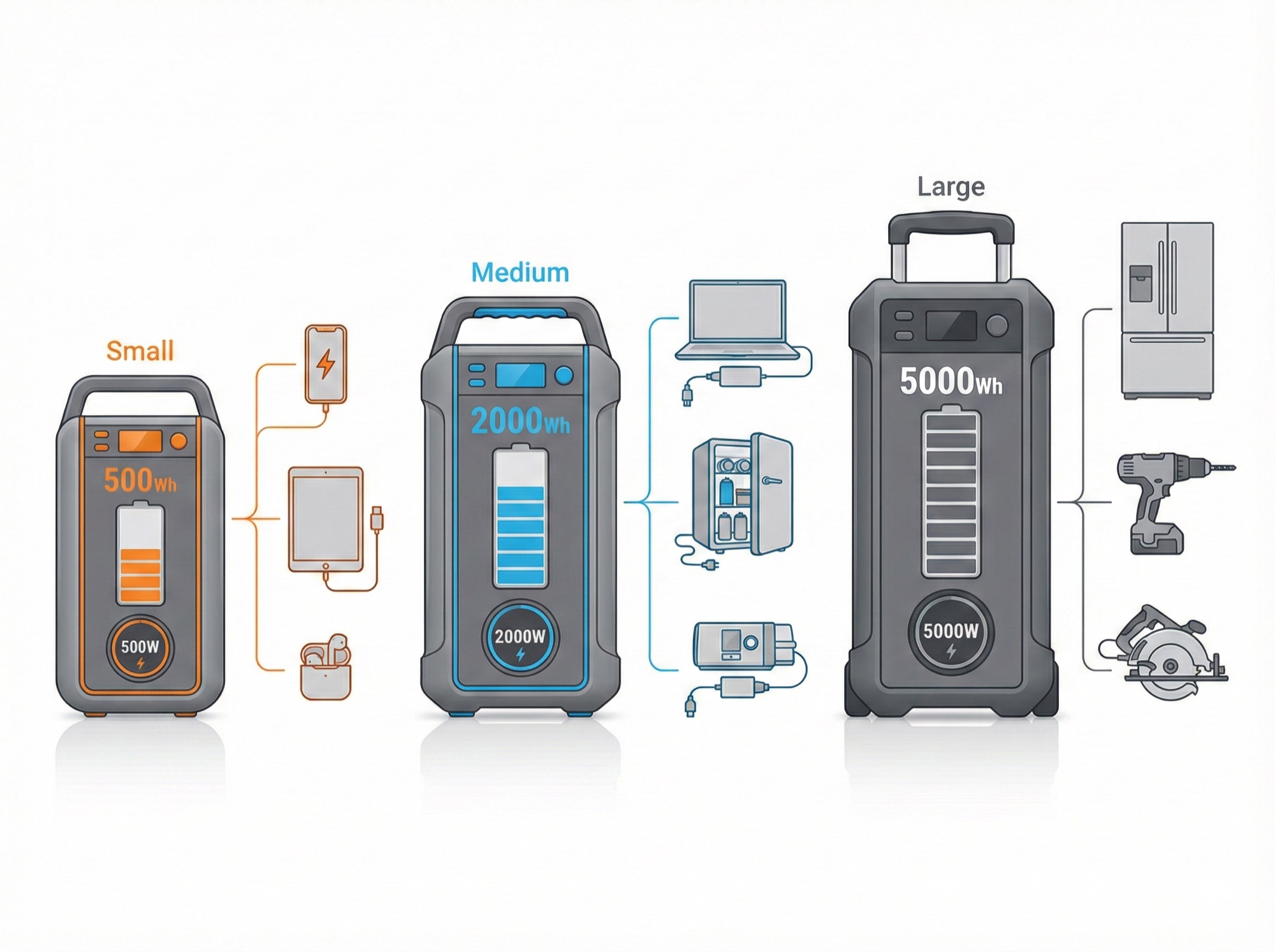
Portable power stations range from compact 500 watt-hour (Wh) units to expandable systems exceeding 5,000 Wh. These plug-and-play devices require no installation—simply charge them, and they're ready when you need backup power. They excel at powering laptops, phones, small appliances, medical devices like CPAP machines, and emergency lighting. Prices range from $200 for entry-level models to $3,500 for premium high-capacity units.
Whole-house battery backup systems provide 10,000 to 20,000+ Wh of capacity and integrate directly with your home's electrical panel. These require professional installation but can power major appliances including refrigerators, HVAC systems, and water heaters. Installation costs typically run $8,000 to $25,000 depending on capacity and complexity.
For most Texas homeowners facing occasional outages lasting several hours to a day or two, a quality portable power station in the 1,000-3,000 Wh range offers the best balance of capability, convenience, and value.
Why Texas Homeowners Need Battery Backup
Texas operates on its own electrical grid—the Electric Reliability Council of Texas, or ERCOT—which manages power for approximately 90% of the state's electrical load. This independence brings both advantages and challenges that make battery backup particularly relevant for Texas residents.
Since 2021, electricity demand on the ERCOT grid has grown 23%, making it the fastest-growing grid in the United States. The U.S. Energy Information Administration projects an additional 21% demand surge between 2024 and 2026, driven largely by data center construction and industrial expansion. This rapid growth strains infrastructure and increases outage risks during peak demand periods.
Texas Grid Reliability: What's Changed Since 2021
The good news: significant improvements have occurred since Winter Storm Uri. Summer 2025 marked the first season since that devastating storm without any conservation alerts from ERCOT. Solar generation broke 17 records, while battery storage systems set four discharge records in September alone.
Renewable energy now plays a critical role in Texas grid stability. Wind and solar together supplied 36% of ERCOT's total electricity demand in the first nine months of 2025. Battery storage systems proved essential during peak evening hours, providing an average of 4 gigawatts of power at 8 p.m. as solar output declined but demand remained high.
Despite these improvements, Texas homeowners still face outage risks from:
- Summer heatwaves pushing air conditioning demand to record levels
- Winter ice storms damaging power lines and overwhelming generation capacity
- Severe thunderstorms causing localized outages across the state
- Hurricane season threatening coastal and inland communities
A home battery backup system transforms these risks from crises into minor inconveniences. When the grid goes down, your power station keeps essential devices running—refrigerators preserving food, medical equipment operating, phones charging for emergency communication, and fans or space heaters maintaining livable temperatures.
Key Specifications to Compare When Buying a Power Station
Not all battery backup systems deliver equal performance. Understanding key specifications helps you match a power station to your actual needs rather than overpaying for capacity you won't use or underpaying for a system that falls short during emergencies.
Battery Capacity (Watt-Hours)
Capacity determines how much total energy a power station can store and deliver. A 1,000 Wh system can theoretically power a 100-watt device for 10 hours, or a 500-watt device for 2 hours. In practice, inverter efficiency reduces actual output by 10-15%.
To estimate your needs, add up the wattage of devices you'd want to power during an outage and multiply by the hours you expect to need them. A typical scenario:
- Refrigerator: 150W × 24 hours = 3,600 Wh
- Phone charging: 20W × 4 hours = 80 Wh
- LED lights: 40W × 8 hours = 320 Wh
- Wi-Fi router: 10W × 24 hours = 240 Wh
- Total: approximately 4,240 Wh for 24 hours
Output Power (Watts)
While capacity determines how long your system runs, output power determines what it can run simultaneously. A 1,000W power station cannot start a 1,500W air conditioner, regardless of how much energy it has stored.
| Capacity Tier | Typical Output | Best For |
|---|---|---|
| 500-1,000 Wh | 300-600W | Phones, laptops, small devices |
| 1,000-2,000 Wh | 1,000-1,500W | Above + mini-fridge, fans |
| 2,000-5,000 Wh | 2,000-3,000W | Above + full refrigerator, power tools |
Lithium-Ion vs. LiFePO4 Batteries
Most power stations use lithium-ion batteries, which offer excellent energy density at competitive prices. These typically provide 3,000-5,000 charge cycles before capacity degrades significantly—roughly 8-14 years of regular use.
LiFePO4 (lithium iron phosphate) batteries cost 20-40% more but deliver 5,000-10,000 cycles and enhanced safety characteristics. They perform better in extreme temperatures and carry virtually zero risk of thermal runaway. For Texas homeowners planning long-term use and maximum reliability, LiFePO4 represents a worthwhile investment despite the higher upfront cost.
Top Use Cases for Home Battery Backup
Understanding common use cases helps you evaluate which power station features matter most for your situation.

Emergency Outage Protection
The primary reason Texas homeowners invest in battery backup is protecting essential loads during grid failures. Modern power stations can keep refrigerators running to preserve food worth hundreds of dollars, maintain communications through charged phones and active internet connections, operate medical devices requiring continuous power, and provide lighting for safety and comfort.
For outages lasting 12-24 hours—common during severe weather events—a 2,000-3,000 Wh portable power station handles essential loads comfortably. Longer outages benefit from solar charging capability, which can extend runtime indefinitely during daylight hours.
Solar Energy Storage
Battery backup systems pair powerfully with rooftop solar installations. During peak sunlight hours when solar panels generate more electricity than your home consumes, excess energy charges your battery instead of flowing back to the grid at potentially unfavorable rates.
This stored solar energy powers your home during evening hours when demand peaks and solar generation drops to zero. The result: reduced grid dependence, lower electricity bills, and the ability to participate in favorable solar buyback programs that credit your account for excess generation.
Medical Device Support
For household members requiring CPAP machines, oxygen concentrators, or other medical equipment, power outages pose serious health risks. A dedicated battery backup ensures these devices continue operating regardless of grid conditions.
When selecting a power station for medical use, prioritize:
- Sufficient capacity for 24+ hours of continuous operation
- Pure sine wave output (required by sensitive medical electronics)
- Automatic switchover capability when grid power fails
- Reliable notification systems for low battery warnings
Outdoor and Mobile Applications
Beyond emergency home use, portable power stations excel at outdoor adventures and mobile applications. Camping trips, RV travel, tailgating events, and backyard gatherings all benefit from clean, quiet, emission-free portable power.
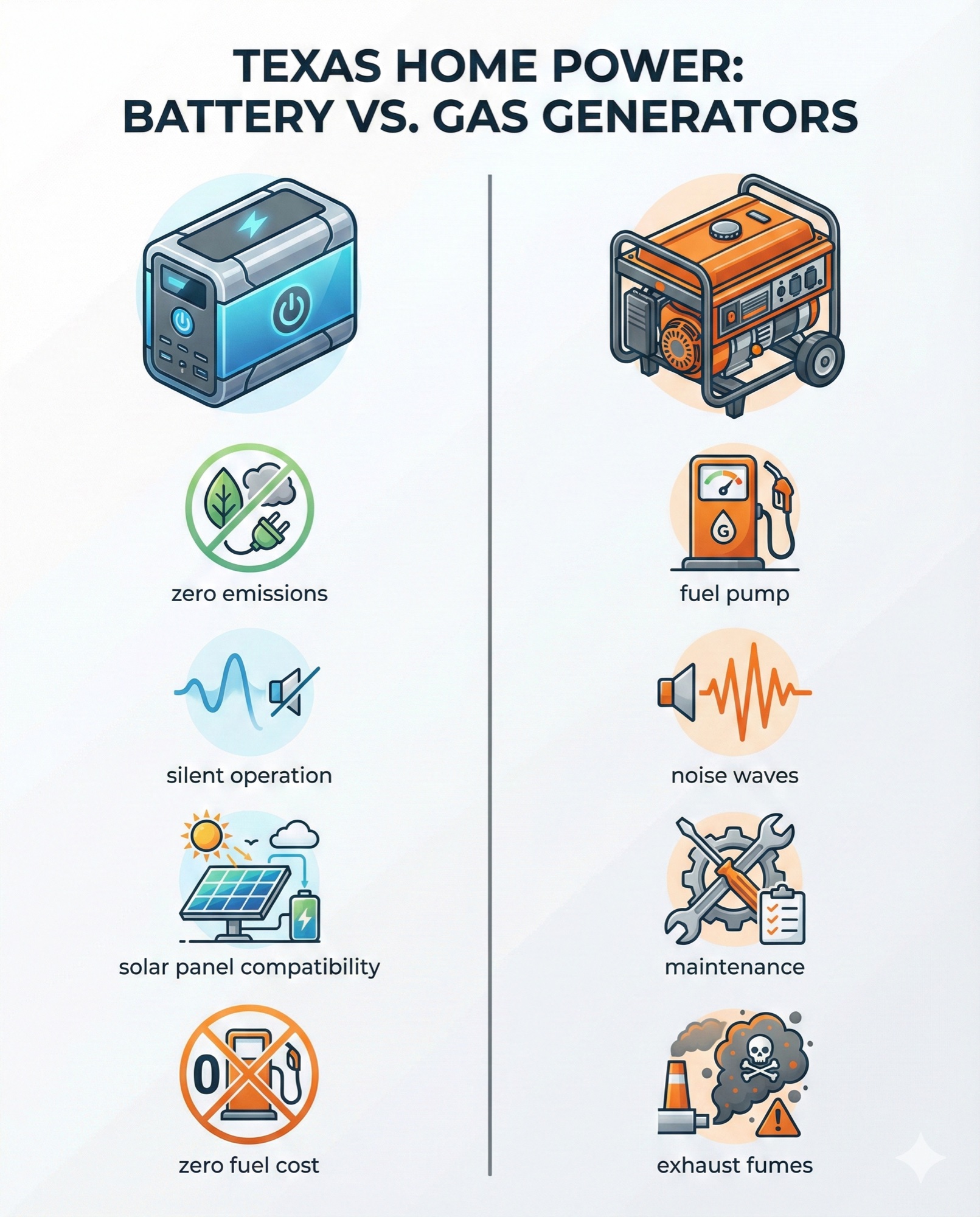
Unlike gas generators, battery-powered systems produce no exhaust fumes, operate silently, and require no fuel storage or ongoing maintenance. Charge them at home before departure, supplement with solar panels during extended trips, and enjoy convenient power wherever your adventures lead.
Costs and ROI for Texas Homeowners
Understanding the true cost of battery backup requires looking beyond sticker prices to consider long-term value, incentives, and comparisons to alternatives.
Price Ranges by Capacity
Current market pricing for quality portable power stations:
| Capacity | Price Range | Cost per Wh | After 30% Tax Credit |
|---|---|---|---|
| 500-1,000 Wh | $300-$800 | $0.30-$0.80 | $210-$560 |
| 1,000-2,000 Wh | $600-$1,500 | $0.30-$0.75 | $420-$1,050 |
| 2,000-5,000 Wh | $1,500-$3,500 | $0.30-$0.70 | $1,050-$2,450 |
Whole-house systems requiring professional installation typically cost $8,000-$25,000 depending on capacity and installation complexity.
Federal Tax Incentives
The Inflation Reduction Act provides a 30% federal tax credit for residential energy storage systems. This applies to both standalone battery installations and batteries paired with solar panels. A $2,000 portable power station effectively costs $1,400 after claiming the credit; a $15,000 whole-house system costs $10,500.
Battery Systems vs. Gas Generators
Traditional gas generators cost less upfront ($1,000-$3,000 for portable units, $5,000-$15,000 for whole-house standby systems) but carry ongoing operational costs that battery systems avoid:
Gas Generator Ongoing Costs:
- Fuel consumption: $20-$50 per day during operation
- Maintenance: $100-$300 annually for oil changes and tune-ups
- Fuel storage and stabilization
- Potential noise complaint issues (70-100 decibels)
Battery System Advantages:
- Zero fuel costs
- Minimal maintenance
- Silent operation
- Zero emissions (safe indoor use)
- Solar charging capability for indefinite runtime
For Texas homeowners experiencing 2-3 multi-hour outages annually, battery systems typically achieve better lifetime economics while delivering superior convenience and environmental benefits.
Solar Integration and Texas Buyback Programs
Texas leads the nation in renewable energy deployment, and the state's deregulated electricity market creates unique opportunities for homeowners combining battery storage with solar generation.
How Battery + Solar Works Together
Solar panels generate electricity during daylight hours, often producing more than a home consumes during midday. Without battery storage, this excess energy flows to the grid—potentially at unfavorable wholesale rates. With battery storage, you capture that surplus and use it during evening peak hours when electricity rates typically climb.
This self-consumption strategy provides consistent savings regardless of net metering policy changes, while battery reserves ensure power availability during outages when the grid fails.
How competitive Solar Buyback Maximizes Your Investment
Not all Texas electricity providers offer the same compensation for excess solar generation. Many credit surplus at wholesale rates significantly below what you pay for consumption. This disparity reduces the value of your solar investment and extends payback periods.
At VIP Energy Service, we offer true competitive solar buyback—meaning you receive credit at the same rate you pay for electricity consumed. Combined with battery storage, this approach lets you:
- Store excess solar for personal evening use (avoiding peak rates)
- Export remaining surplus at fair retail-equivalent rates
- Maximize return on your solar investment
- Maintain backup power during grid outages
Only two retail electricity providers in Texas offer genuine competitive solar buyback rates. Learn more about our solar buyback program and how it compares to standard wholesale-rate compensation.
Top Brands and Products to Consider
The portable power station market has matured significantly, with several established manufacturers offering reliable products at various price points.
EcoFlow specializes in modular systems allowing capacity expansion by connecting additional battery units. Their Delta series features X-Boost technology for powering high-draw devices and industry-leading charging speeds.
Jackery focuses on outdoor enthusiasts, offering comprehensive solar panel bundles optimized for camping and RV applications. Their Explorer series ranges from compact 240 Wh units to substantial 3,000 Wh systems.
Bluetti emphasizes LiFePO4 chemistry in their premium models, delivering enhanced safety and longevity. Their AC series provides excellent value for whole-home backup applications.
Goal Zero pioneered the portable power market with outdoor-focused designs and extensive accessory ecosystems. Their Yeti series remains popular among adventure enthusiasts.
Anker leverages consumer electronics expertise to deliver reliable mid-range options with strong warranty support and customer service.
When evaluating specific products, prioritize capacity matching your needs, output power sufficient for your largest loads, battery chemistry aligned with your longevity expectations, and charging versatility including solar panel compatibility.
Frequently Asked Questions
How long will a battery backup power my home?
Runtime depends on your battery capacity and connected load. A 2,000 Wh power station running a 200W combined load (refrigerator, lights, phone charging) provides approximately 8-10 hours of backup. Larger 5,000+ Wh systems or whole-house installations extend this to 24+ hours for essential loads.
Can I use a power station while it's charging?
Yes, most quality power stations support pass-through charging, allowing simultaneous charging and discharging. This enables continuous operation when connected to solar panels during extended outages.
What size battery backup do I need for my Texas home?
For essential loads during typical outages (12-24 hours), 2,000-3,000 Wh of portable capacity serves most households well. Homes with higher demands or those seeking whole-house backup should consider 10,000+ Wh installed systems.
Are battery backup systems safe to use indoors?
Absolutely. Unlike gas generators, battery power stations produce zero emissions, require no ventilation, and operate silently. They're safe for bedrooms, living areas, and any indoor space.
How do I charge a battery backup with solar panels?
Connect compatible solar panels to your power station's DC input. A 200-400W solar array typically recharges a 2,000 Wh battery in 6-10 hours under good conditions. Most manufacturers offer matched solar panel bundles ensuring compatibility.
What's the difference between portable and whole-house systems?
Portable power stations are self-contained, require no installation, and range from 500-5,000 Wh capacity. Whole-house systems integrate with your electrical panel, require professional installation, and provide 10,000-20,000+ Wh capacity with automatic switchover during outages.
Do battery systems work with Texas solar buyback programs?
Yes. Battery storage enhances solar economics by letting you consume stored energy during peak hours and export remaining surplus. With competitive solar buyback rates, you maximize credit value for every kilowatt-hour exported.
How long do home battery systems last?
Quality lithium-ion batteries provide 3,000-5,000 cycles (8-14 years of typical use). LiFePO4 batteries extend this to 5,000-10,000 cycles (14-27 years). All batteries gradually lose capacity over time, retaining approximately 80% of original capacity at end-of-life ratings.
Take Control of Your Home's Power
Texas homeowners face unique energy challenges—from ERCOT grid constraints to severe weather events that can leave families without power for hours or days. A quality battery backup for home transforms these vulnerabilities into manageable situations, keeping essential devices running and providing peace of mind when the grid fails.
Whether you choose a portable power station for emergency backup or invest in a whole-house system with solar integration, the technology has never been more reliable, affordable, or accessible. Combined with VIP Energy Service's competitive solar buyback rate, battery storage delivers both emergency protection and long-term energy savings.
Ready to explore your options? Get your free energy quote and discover how battery backup and solar integration can work for your Texas home. Our energy consultants help you evaluate your needs, compare solutions, and maximize available incentives—all with the personalized service that sets VIP Energy Service apart.
This content is provided for informational purposes. Specific product recommendations should be evaluated based on individual circumstances. Federal tax credits are subject to eligibility requirements; consult a tax professional for personalized advice.
Update, October 2026: According to the IRS, the 30% federal Residential Clean Energy Credit is not available for systems placed in service after December 31, 2025. Mentions of the credit below apply only to systems installed by then. Texas utility rebates and the Texas property tax exemption may still lower your cost.
Unlock the full value of your solar investment by understanding how to carry forward your unused federal solar tax credits.
Installing solar panels on your Texas home is an excellent way to reduce your electricity bills and take advantage of the abundant sunshine in the Lone Star State. One of the most significant financial incentives for going solar is the federal Residential Clean Energy Credit, which allows you to claim 30% of your solar installation costs as a credit against your federal income taxes.
However, many homeowners discover that their tax liability in the year of installation isn't large enough to use the entire credit. The good news? You don't lose those unused credits. Through the solar tax credit carryover provision, you can roll over any remaining credit amount to future tax years, maximizing your solar investment's financial returns.
This guide will explain everything Texas homeowners need to know about the solar tax credit carryover process, how many years you can carry forward your credit, and strategies to ensure you capture every dollar of solar incentives you're entitled to receive.
What Is the Solar Tax Credit?
The federal solar tax credit, officially called the Residential Clean Energy Credit, is a dollar-for-dollar reduction in your federal income tax liability based on qualified solar expenses. Currently, this credit equals 30% of the total cost of your solar energy system, including equipment, installation, and related expenses.
For example, if your solar system costs $20,000, your potential tax credit would be $6,000 ($20,000 × 30%). This credit directly reduces what you owe in federal taxes—if you owed $7,000 in federal income tax, applying this credit would reduce your tax bill to just $1,000.
Key Features of the Residential Clean Energy Credit
- Credit percentage: 30% for systems installed from 2022 through 2032
- Credit reduction: Decreases to 26% in 2033 and 22% in 2034
- Expiration: Scheduled to end after December 31, 2034
- Eligibility: Available for both primary and secondary residences
- Non-refundable: Reduces tax liability but doesn't generate a refund
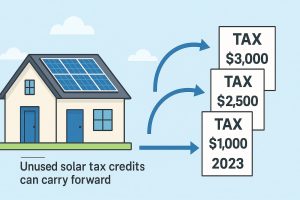
- Carryover provision: Unused credits can roll over to future tax years
Understanding Solar Tax Credit Carryover
The solar tax credit is non-refundable, meaning it can only reduce your tax liability to zero—it won't result in a tax refund beyond what you've paid in. This is where the carryover provision becomes crucial.
How Solar Tax Credit Carryover Works
If your solar tax credit exceeds your tax liability in the installation year, you can carry forward the unused portion to future tax years. This rollover capability ensures you can capture the full credit value over time, even if you can't use it all in a single year.
Let's look at an example:
- Solar system cost: $25,000
- Solar tax credit (30%): $7,500
- Year 1 federal tax liability: $4,000
In this scenario, you would apply $4,000 of your credit to eliminate your tax liability in Year 1, leaving $3,500 in unused credits. Instead of losing this amount, you can carry it forward to Year 2 and beyond until you've used the full $7,500 credit.
How Many Years Can You Carry Forward Solar Tax Credits?
One of the most common questions about solar tax credit carryover is how long the credits remain available. According to current IRS guidelines, you can carry forward your unused solar tax credits for as long as the credit remains in effect.
Since the Residential Clean Energy Credit is currently authorized through December 31, 2034, you can continue to apply carried-over credits to your federal taxes until this date. However, the credit will step down from 30% to 26% in 2033 and then to 22% in 2034 before expiring completely.
Important Timeline for Solar Tax Credit Carryover
- 2022-2032: 30% credit available
- 2033: Credit reduces to 26%
- 2034: Credit reduces to 22%
- After December 31, 2034: Credit expires
This timeline is critical for Texas homeowners planning their solar investments. To maximize the available credits, it's advisable to install your system during the 30% credit period and ensure you have sufficient tax liability over the coming years to utilize any carried-over credits before the program expires.
How to Claim Solar Tax Credit Carryover
Claiming your solar tax credit and carrying over unused amounts requires careful documentation and proper tax filing. Here's a step-by-step process:
Step 1: Initial Credit Claim
In the year you install your solar system, you must file IRS Form 5695 (Residential Energy Credits) with your tax return to establish your credit. This initial filing is crucial even if you can't use the full credit amount that year.
Step 2: Calculate Your Tax Liability
Determine your tax liability for the year to understand how much of the credit you can use immediately. Remember, you can only apply the credit up to the amount of taxes you owe.
Step 3: Apply the Credit and Note the Carryover
On Form 5695, you'll indicate the total credit amount and how much you're using for the current tax year. The difference represents your carryover amount.
Step 4: Carry Forward in Subsequent Years
In future tax years, you'll again file Form 5695, indicating the carryover amount from previous years. Continue this process until you've used the full credit or until the credit expires.
Strategies to Maximize Your Solar Tax Credit
For Texas homeowners looking to optimize their solar tax benefits, consider these strategies:
1. Plan Your Installation Timing
If possible, time your solar installation to align with years when you expect higher tax liability. This could help you use more of the credit upfront.
2. Adjust Tax Withholdings
If you have significant carried-over credits, you might consider reducing your tax withholdings for the following year. This allows you to benefit from the credit throughout the year rather than waiting for a tax refund.
3. Consider Roth Conversions
For those with retirement accounts, strategically converting traditional IRA funds to a Roth IRA can create taxable income that can be offset by solar tax credits.
4. Accelerate Income
If you have flexibility in when you receive income (self-employed individuals, for example), you might accelerate income into years when you have unused solar credits.
5. Consult with a Tax Professional
Every homeowner's tax situation is unique. Working with a qualified tax professional familiar with renewable energy incentives can help you develop a personalized strategy to maximize your solar tax credits.
Solar Tax Credit Carryover FAQs
Is the Solar Tax Credit Refundable?
No, the Residential Clean Energy Credit is non-refundable. This means it can only reduce your tax liability to zero; any excess credit amount must be carried forward to future tax years rather than being refunded.
Can I Claim the Solar Tax Credit if I Don't Owe Taxes?
You must have tax liability to benefit from the solar tax credit. If you don't owe any federal income taxes in the installation year, you'll need to carry the entire credit forward to a future year when you do have tax liability.
What Happens if I Can't Use All My Credit Before It Expires?
If you haven't used all your carried-over credits by December 31, 2034 (when the credit is scheduled to expire), you may lose the remaining amount. This makes it important to plan your tax strategy to utilize the credits before this date.
Can I Claim the Solar Tax Credit More Than Once?
You can claim the solar tax credit for each new solar installation. If you install solar on your primary residence and later add panels to a second property or expand your existing system, you can claim the credit for each project.
Do State Solar Incentives Affect the Federal Credit?
State incentives such as rebates may reduce the cost basis for your federal credit calculation. However, most state tax credits don't affect your federal credit calculation. Texas currently doesn't offer a state solar tax credit, but some utilities and local governments may offer rebate programs.
Real-World Example: Texas Homeowner's Solar Tax Credit Carryover
Let's look at how a hypothetical Texas homeowner might utilize the solar tax credit carryover:
John's Solar Journey:
- Installed a $30,000 solar system in Dallas in 2024
- Qualified for a $9,000 federal tax credit (30% of $30,000)
- Had a federal tax liability of $5,000 in 2024
- Applied $5,000 of the credit to his 2024 taxes
- Carried forward $4,000 to use in 2025
By understanding and properly planning for the solar tax credit carryover, John was able to eliminate his federal tax liability in 2024 and reduce his 2025 taxes as well, maximizing the financial benefits of his solar investment.
Conclusion
The solar tax credit carryover provision ensures that Texas homeowners can capture the full value of their federal solar incentives, even if their tax liability in a single year isn't sufficient to use the entire credit. By understanding how this carryover works and developing a strategic approach to your taxes, you can maximize your solar investment's financial returns.
As you consider solar energy for your Texas home, remember that the current 30% credit rate is available through 2032, with reductions in subsequent years before expiring after 2034. This timeline makes now an ideal time to invest in solar, knowing you have several years to utilize any carried-over credits.
While maximizing your tax credits is crucial, it's just one aspect of optimizing your solar investment. For a complete strategy on getting the most value from your solar panels, check out our comprehensive guide on selling solar energy back to the grid.
Take Action Today
Ready to explore how solar energy can benefit your Texas home? Contact Ambit Energy today to learn more about our solar buyback plans and how we can help you navigate the financial incentives available for renewable energy.
Request a Solar Buyback Analysis or call us at (817) 402-2664 to speak with our energy experts.


